
Thessaloniki travel guide
Thessaloniki is a perfect choice for a weekend getaway. It is also a mandatory stop on the way to northern Greece, Halkidiki, Meteora, or Athens. Located along the Thermaic Bay, it is the country’s second-largest city and port.
Although I visited Thessaloniki a few times, I always found something new and different. And every time, I enjoy looking at the Byzantine churches, relaxing in trendy cafes along the waterfront, and tasting delicious Greek food in traditional taverns in the Ladadika quarter.
This travel guide will help you discover the major highlights of the town, churches, museums, how to get there, dining recommendations, shopping areas, and the nearest beaches, if you want to combine your trip with seaside relaxation.
✨ Disclosure:
This post contains affiliate links.
If you click and make a purchase, I may earn a small commission at no extra cost to you. Thanks.
📌 How to get to Thessaloniki
Thessaloniki can be reached in several ways.
🚗🚌 By road
Most visitors arrive in the city by car following the Egnatia Odos motorway (part of the European route E90). The National Road Patra-Athens-Thessaloniki-Evzoni connects the city to Athens (about 500 km away) and the Greek border Evzoni (82 km away).
KTEL buses connect Thessaloniki with various cities across Greece. For example, the trip from Athens takes around 6–7 hours.
✈️ By plane
The Makedonia International Airport (SKG) is located 15 km from the city centre. The airport is connected with direct flights to Athens and many European cities, especially during the summer. From the airport, you can take the bus line 01X by day, or line 01N at night, a taxi, or arrange a private transfer to the centre.
🚅 By train
Thessaloniki is connected by train to Athens (a journey takes around 4-5 hours) and other parts of Greece, including Larissa, Volos, and Alexandroupoli. Check the schedule here.
⛴️ By sea
The Thessaloniki port is one of the most important ports in Southeastern Europe, at the northwest corner of the Aegean Sea. It is situated in the centre of the city. Mostly, the port serves commercial purposes, but there are ferry connections for passengers to the North Aegean islands, the Cyclades, and the Sporades islands.
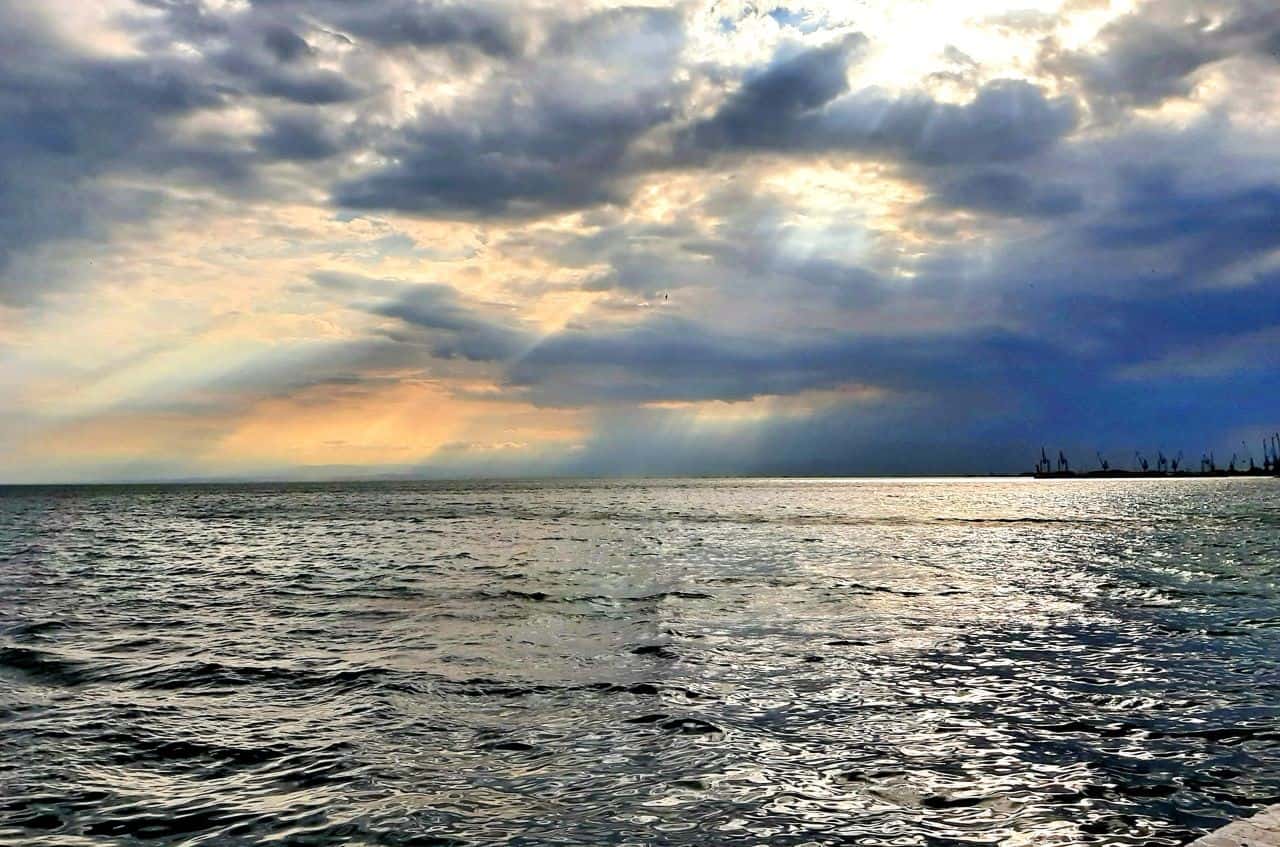
Thessaloniki Bay
📍 A few words about the history of Thessaloniki
The area around the town has been inhabited since prehistoric times.
The town of Thessaloniki was founded by King Cassander of Macedon in 315 BC, on the site of the ancient Greek town of Therme. He named the town after his wife, Thessalonike, the daughter of King Philip II and the half-sister of Alexander the Great.
For a short time, it became an important naval base and a centre for trade and culture. The town had its own mint and issued currency with the sign of Thessaloniki in 187 BC.
During the Roman period, Thessaloniki became the capital of the second Roman administrative district of Macedonia. Several magnificent monuments were constructed, whose ruins can be seen even today. Then, it was the second-largest city of the Byzantine Empire, after Constantinople.
Throughout history, Thessaloniki was attacked by numerous enemies: Avars, Slavs, Bulgarians, Saracen pirates, Normans, Crusaders, and Venetians. In 1430, it was conquered by the Ottomans and stayed under its rule until 1912, when it became part of the Kingdom of Greece.
Today, it is a modern town of over one million people. It preserves traces of previous civilisations, which are incorporated into the urban life.
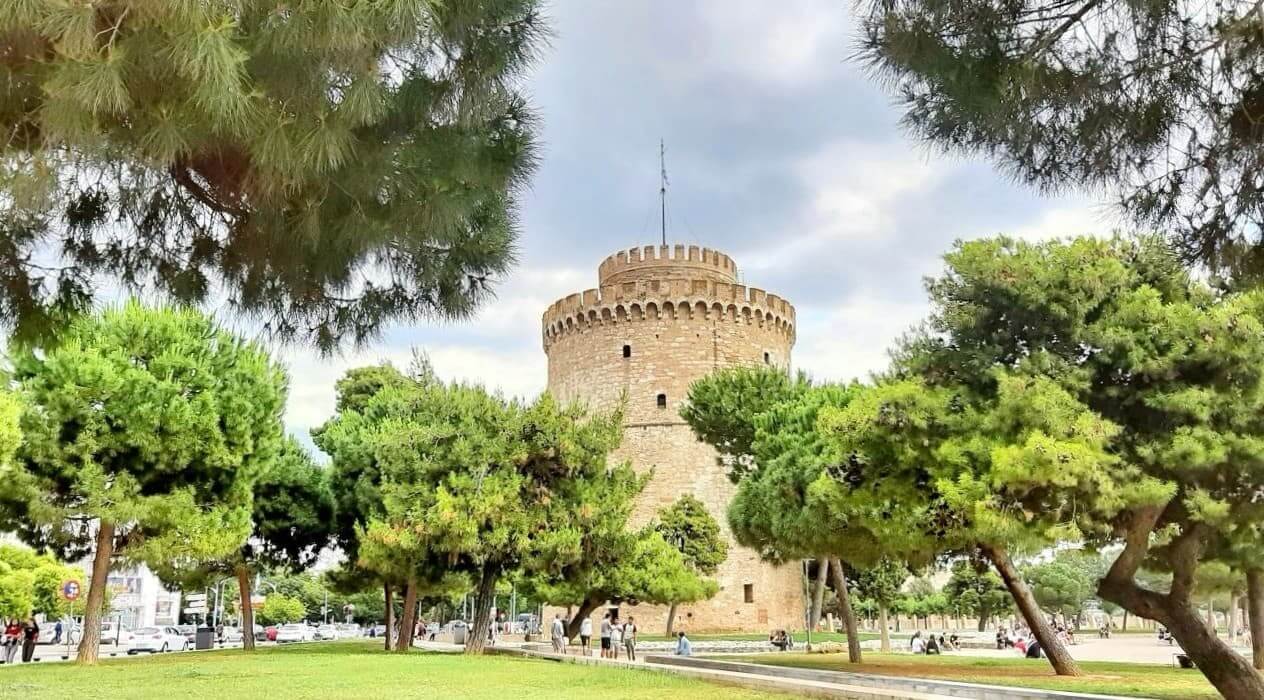
Thessaloniki, the White Tower
📍 What to see and do in Thessaloniki
The town has a rich history due to its strategic position in Greece and Europe. You can see ruins and monuments of various periods while walking through the whole town. The best way to explore the town is on foot, but you can take a bus, taxi or metro to reach the sites.
📍Roman ruins
In the early 4th century BC, Thessaloniki became the capital of the Roman province of Macedonia.
A glorious imperial complex was built during the reign of the Roman emperor, Caesar Galerius Maximianus. Some of its parts can still be seen today, but most were buried under modern buildings. The complex consisted of the Royal Palace, the Hippodrome, the Rotonda, and the Arch of Galerius.
The Royal Palace and the Hippodrome
Today, the ruins of the Royal Palace are situated at the Navarionou Square. The complex of Galerius’ residence consists of several impressive buildings. The palace and rooms were located at the centre, surrounded by a courtyard, elaborate baths, corridors with mosaic floors and marble pavings. The Octagon building served as the throne hall. Its small Arch of Galerius can be seen today at the Archaeological Museum of Thessaloniki.
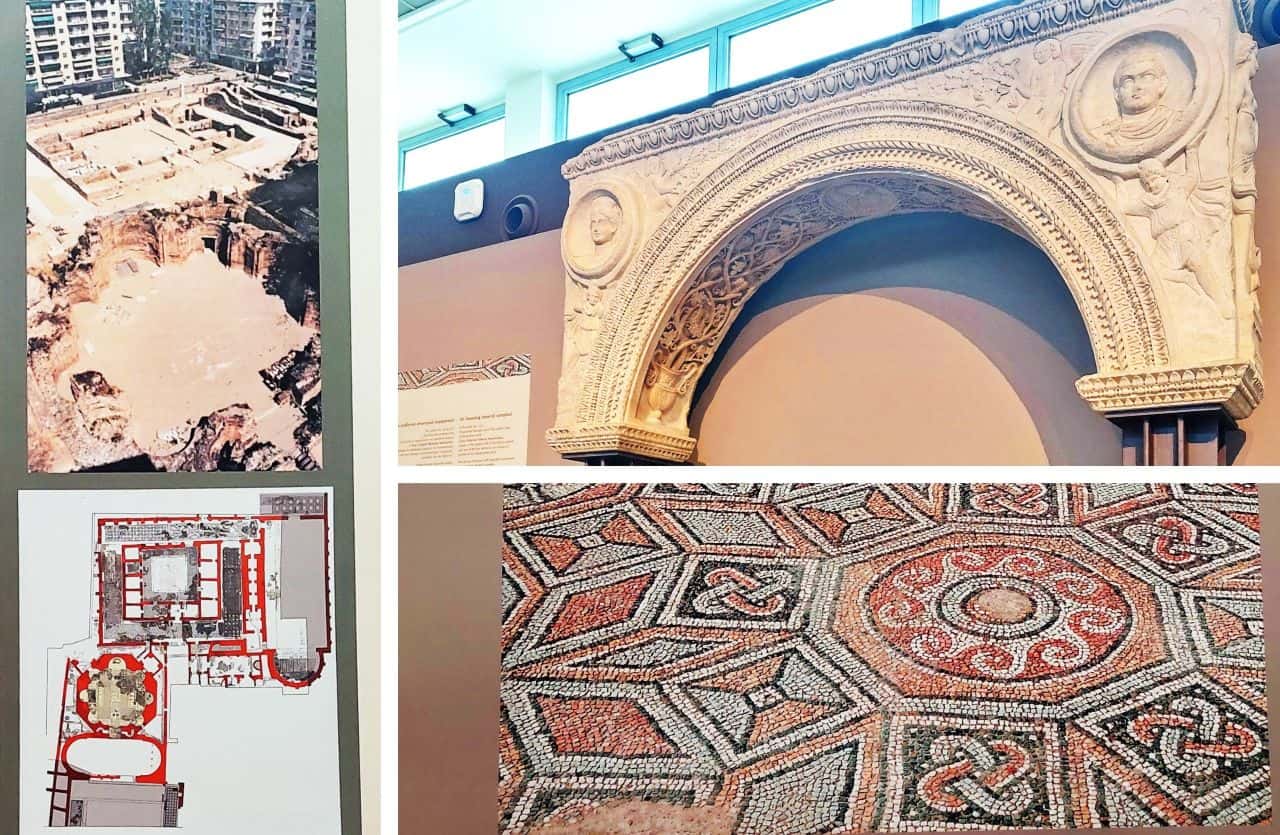
Royal Palace, mosaic and the small Arch of Galerius, Archaeological Museum
The Basilica was used for the official audiences, while the Apsidal Hall served for banquets and other ceremonies.
The Hippodrome, approximately 450 meters long and 95 meters wide, was a place for fun and performances. Only small fragments of the hippodrome can be seen today under the residential building of Ippodromiou Square.
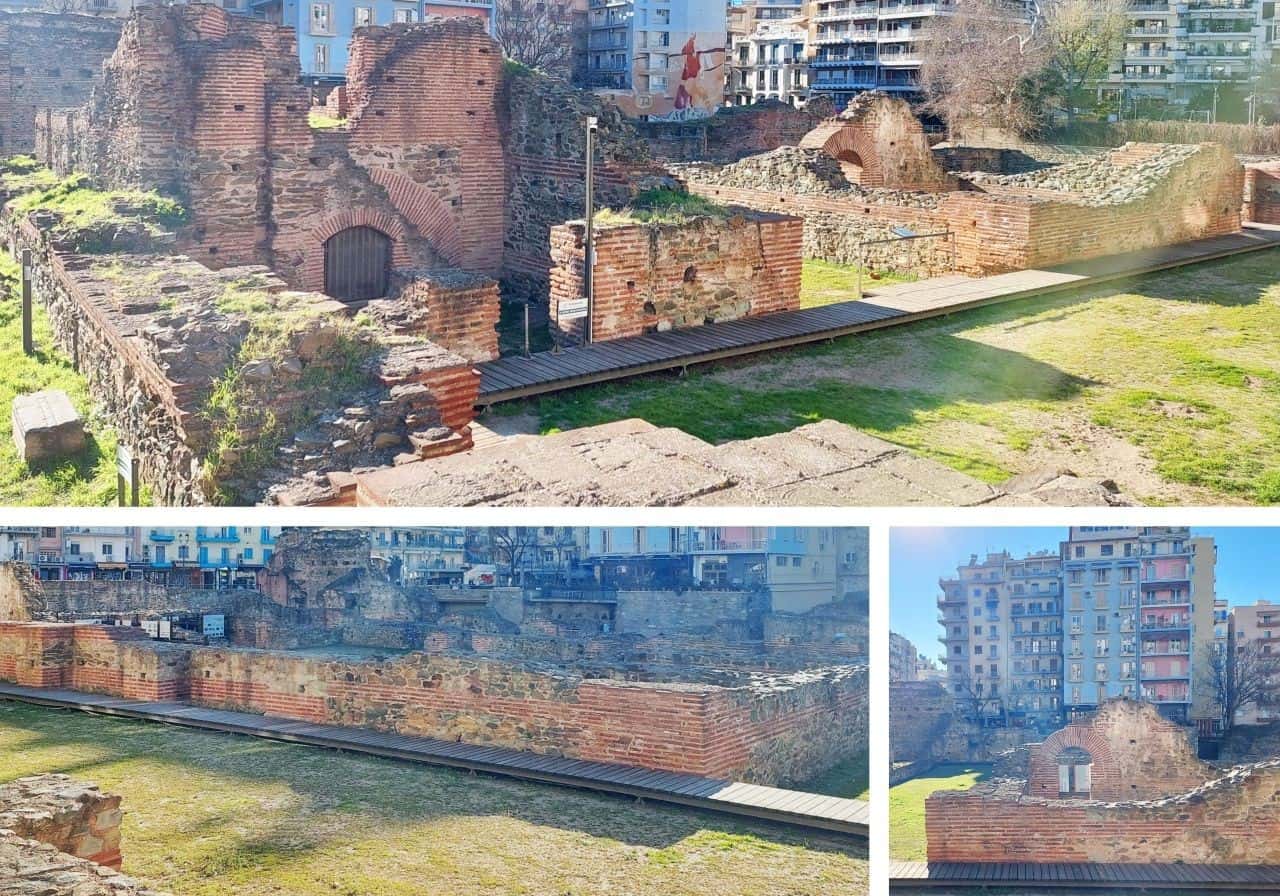
Ruins of the Royal Palace of Galerius
⛪ Rotonda (Rotunda)
The Rotonda is one of the most important archaeological sites in the city, built about 306 AD as Galerius’ mausoleum. It later became a church, then a mosque during the Ottomans, and then again an Orthodox church dedicated to Saint George. Its beautiful mosaics are among the oldest Christian works of art.
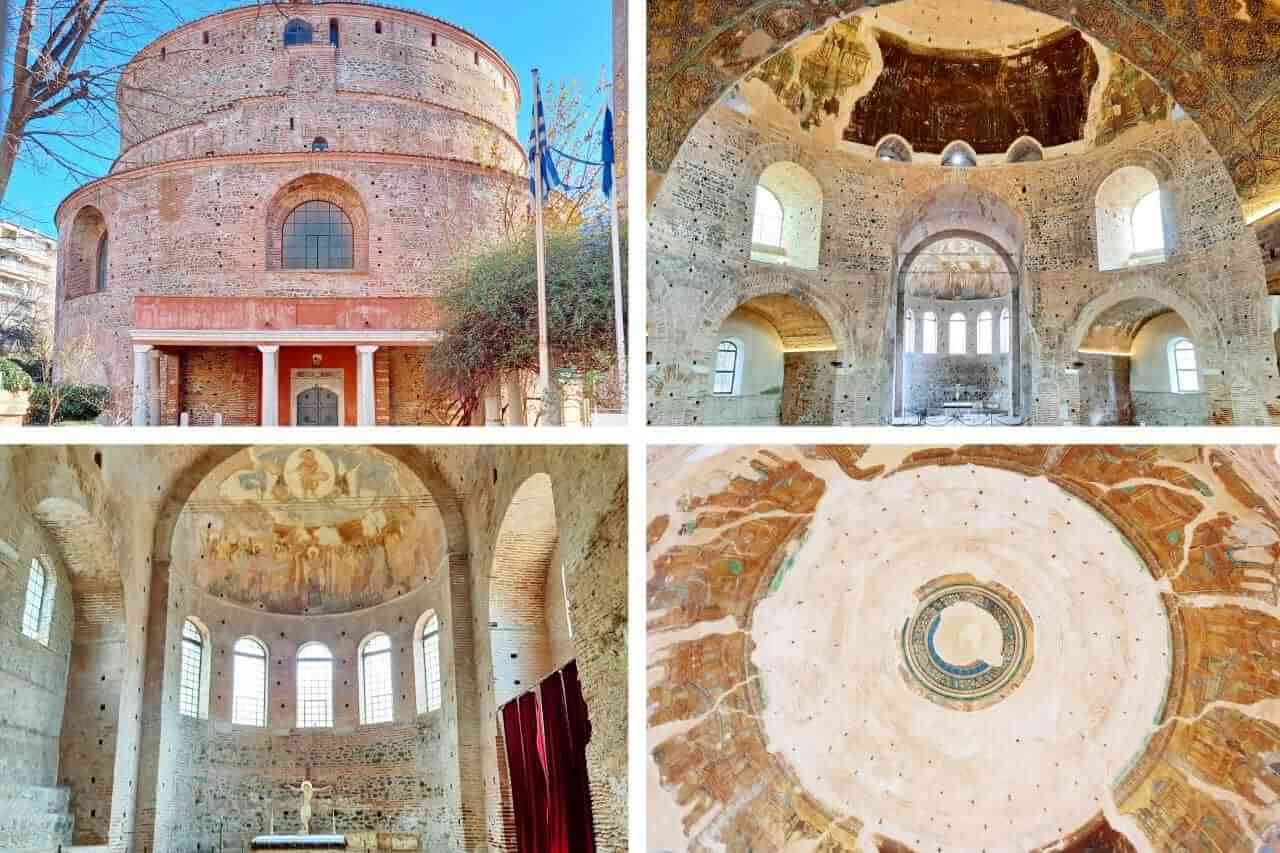
Thessaloniki Rotonda
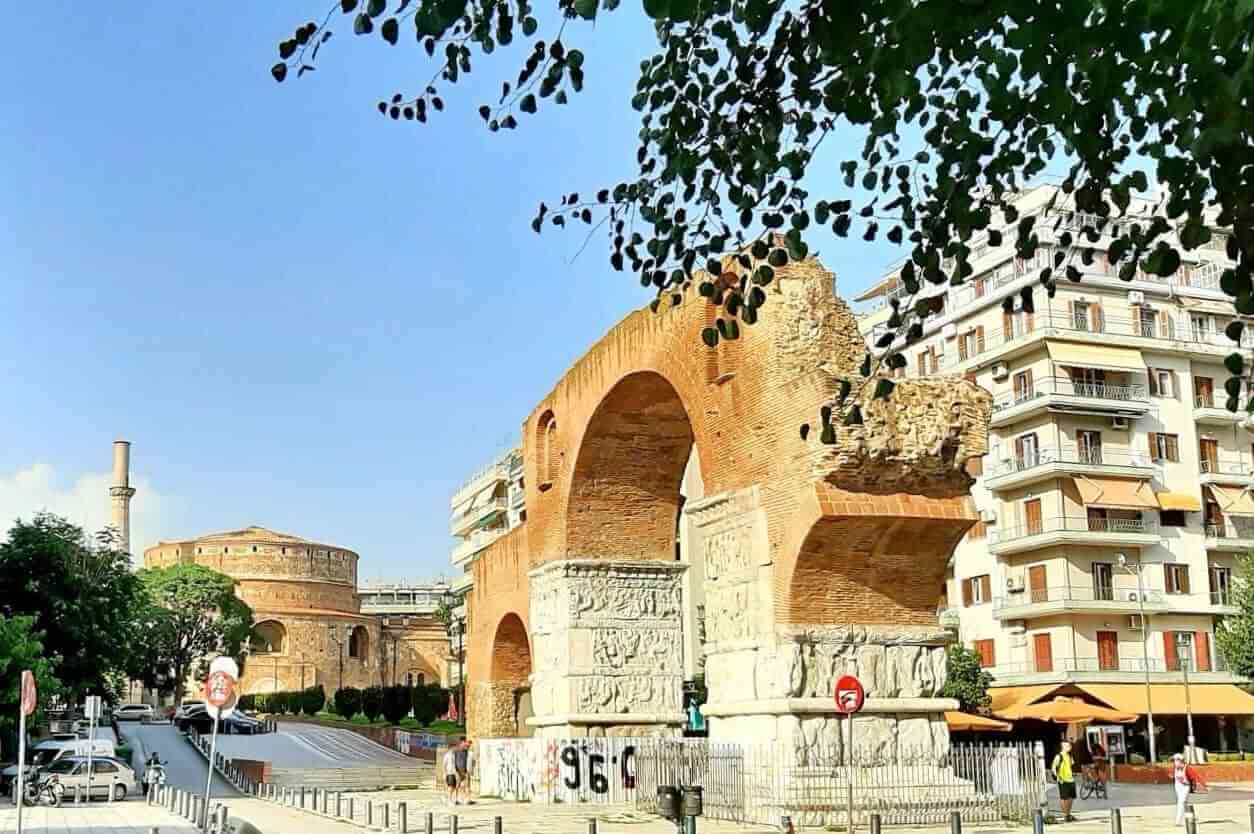
The Rotonda and Arch of Galerius
Arch of Galerius (Kamara)
Once, the Rotonda and the marvellous Arch of Galerius were connected with a grand, collonaded processional way. This route was part of the main Egnatia road, which today intersects Egnatia and Dimitriou Gounari streets.
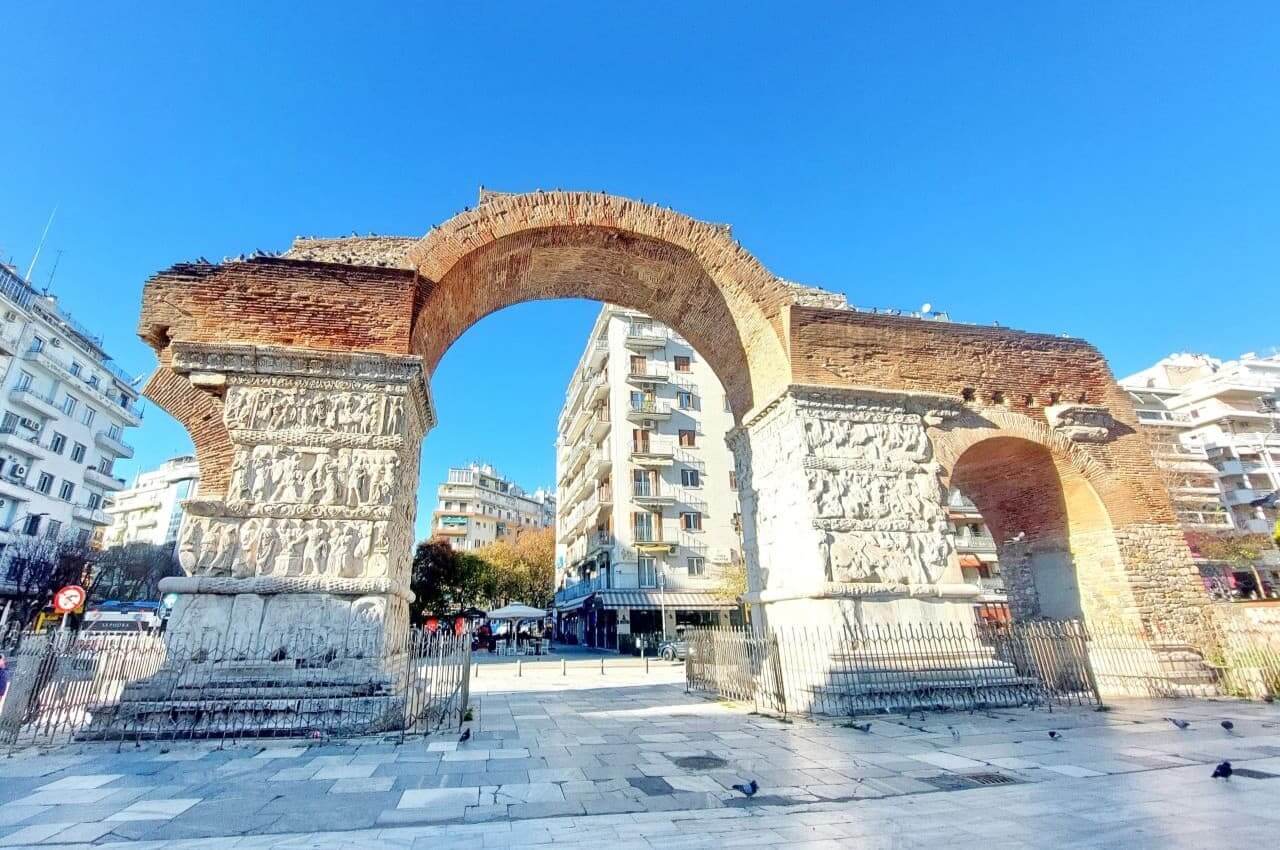
Arch of Galerius
The triumphal arch consists of a masonry core. It was probably built between 298 and 305 AD to commemorate the victory of Galerius over the Persians, as indicated on marble sculptural panels. Today, we can see about two-thirds of the arch, and it still looks magnificent.
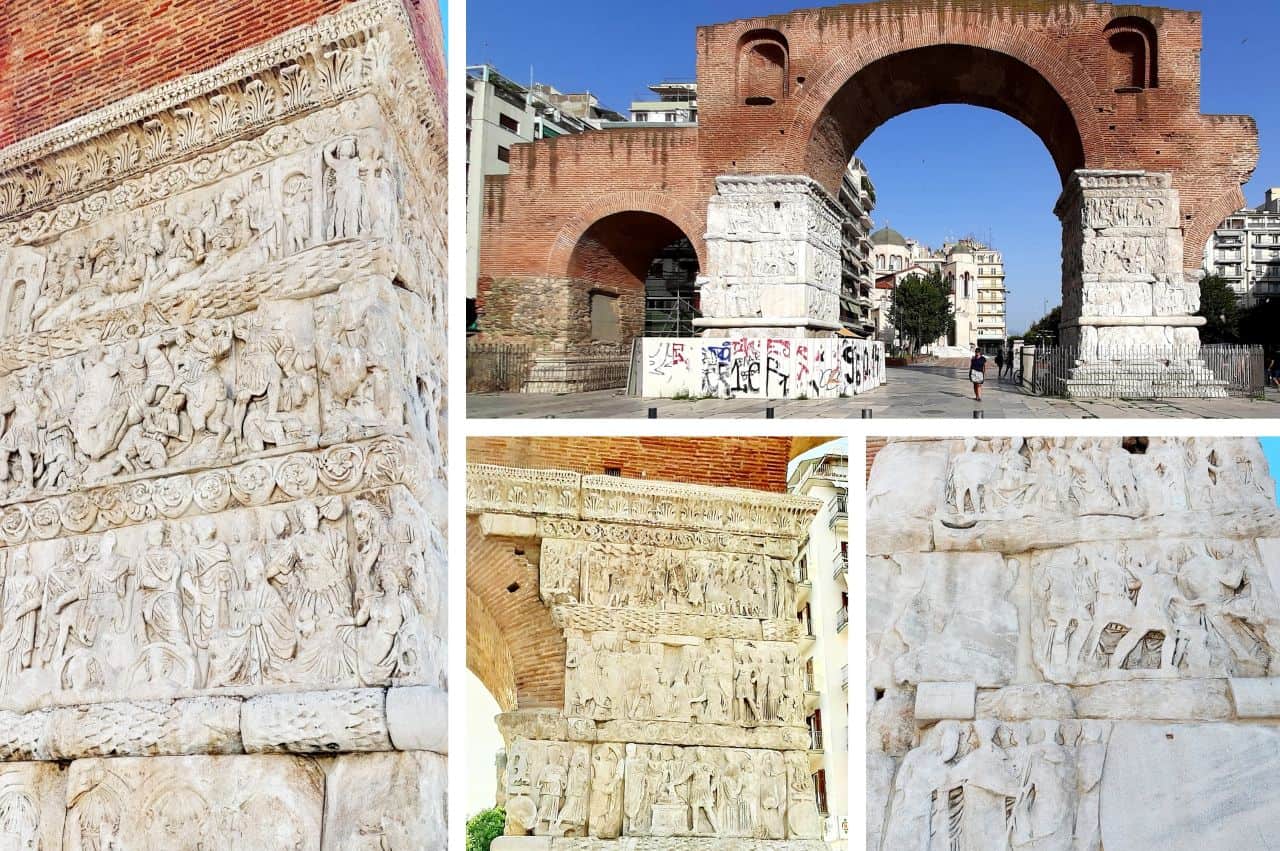
Arch of Galerius with marble panels
Roman Forum (Ancient Agora)
The Roman Forum is located at the upper side of Aristotelous Square. It was built at the end of the 2nd century AD, on the site of a pre-existing Hellenistic Agora. The forum served as the administrative, economic and social centre of Thessaloniki until the 6th century AD.
The forum complex consisted of two monumental squares (one is still buried under Aristotelous Square), Roman baths, a small odeon used for gladiator games, two-storey stoas, and mosaic floors. The various items found in the Roman Forum can be seen in the small underground Museum of the Roman Forum.
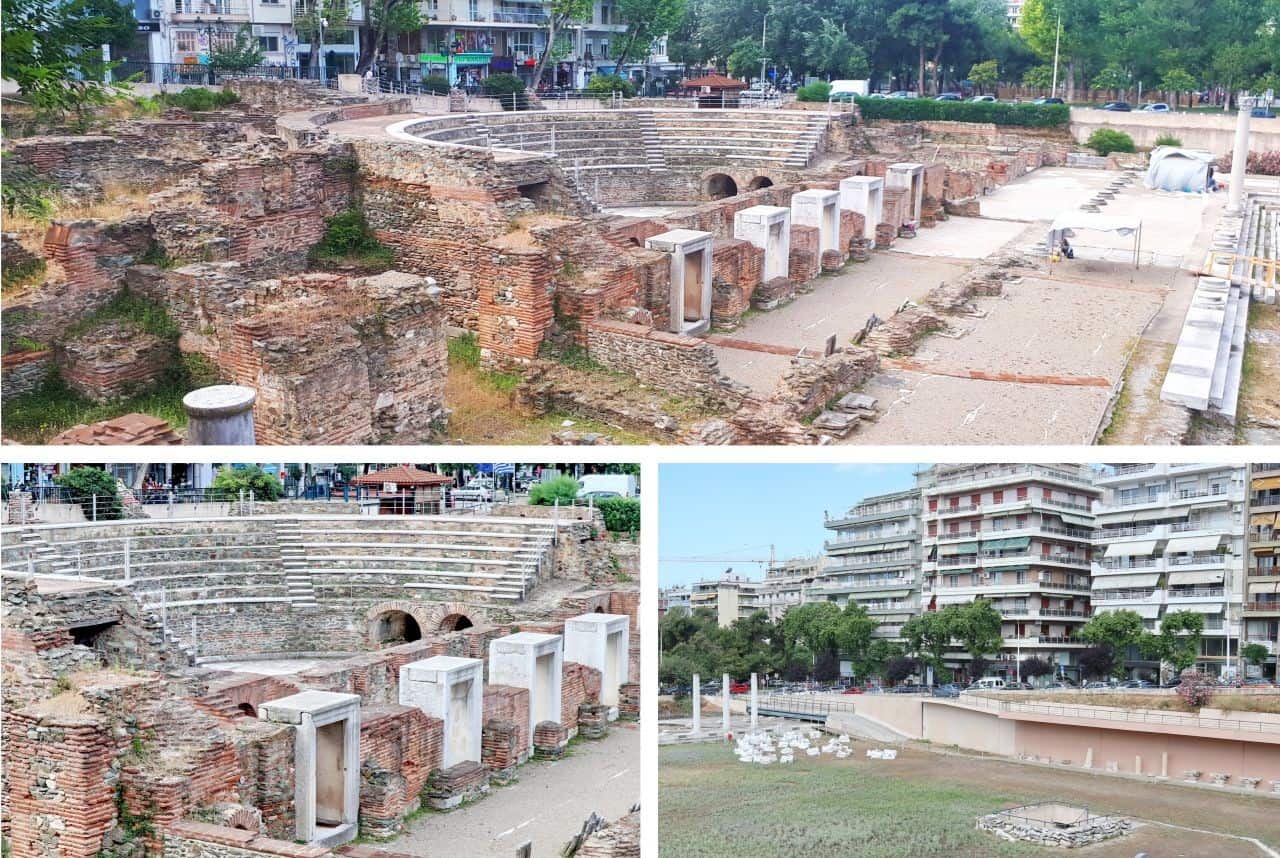
Ruins of the Roman Forum
Roman and Byzantine ruins at the Thessaloniki Metro stations
By the way, the construction of the Thessaloniki Metro started in 2006, but it was officially opened at the end of 2024. The discovery of important archaeological findings was the reason for the delay for years. Actually, over 130,000 archaeological artefacts from various periods were found during its construction.
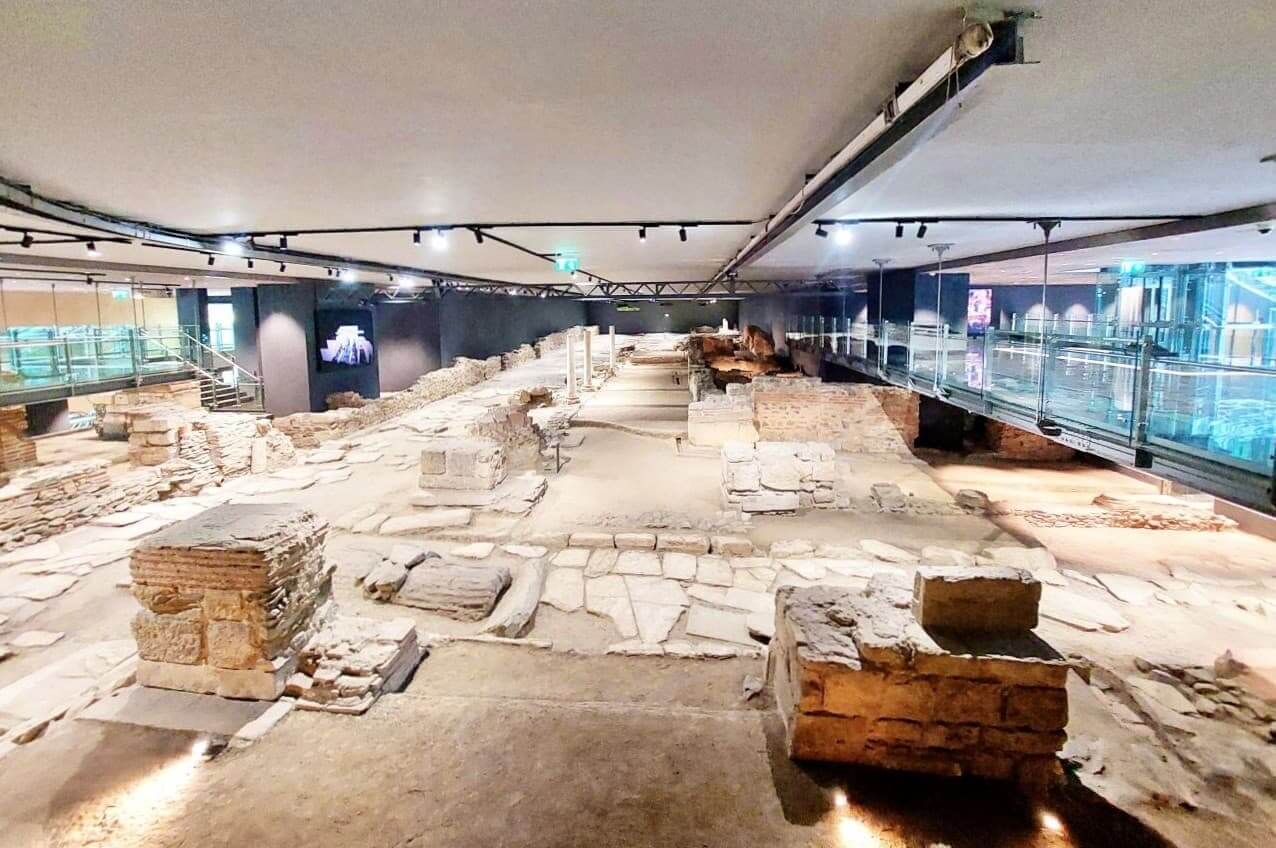
Thessaloniki Metro station Venizelou: the archaeological site of the Roman and later Byzantine Decumanus Maximus, the first level
The major discovery was a marble-clad, column-lined Decumanus Maximus, the main east–west avenue, together with shops, houses, and a public square. It was found running along the route of the Via Egnatia (today Egnatia Street) at 5.4 metres below ground level.
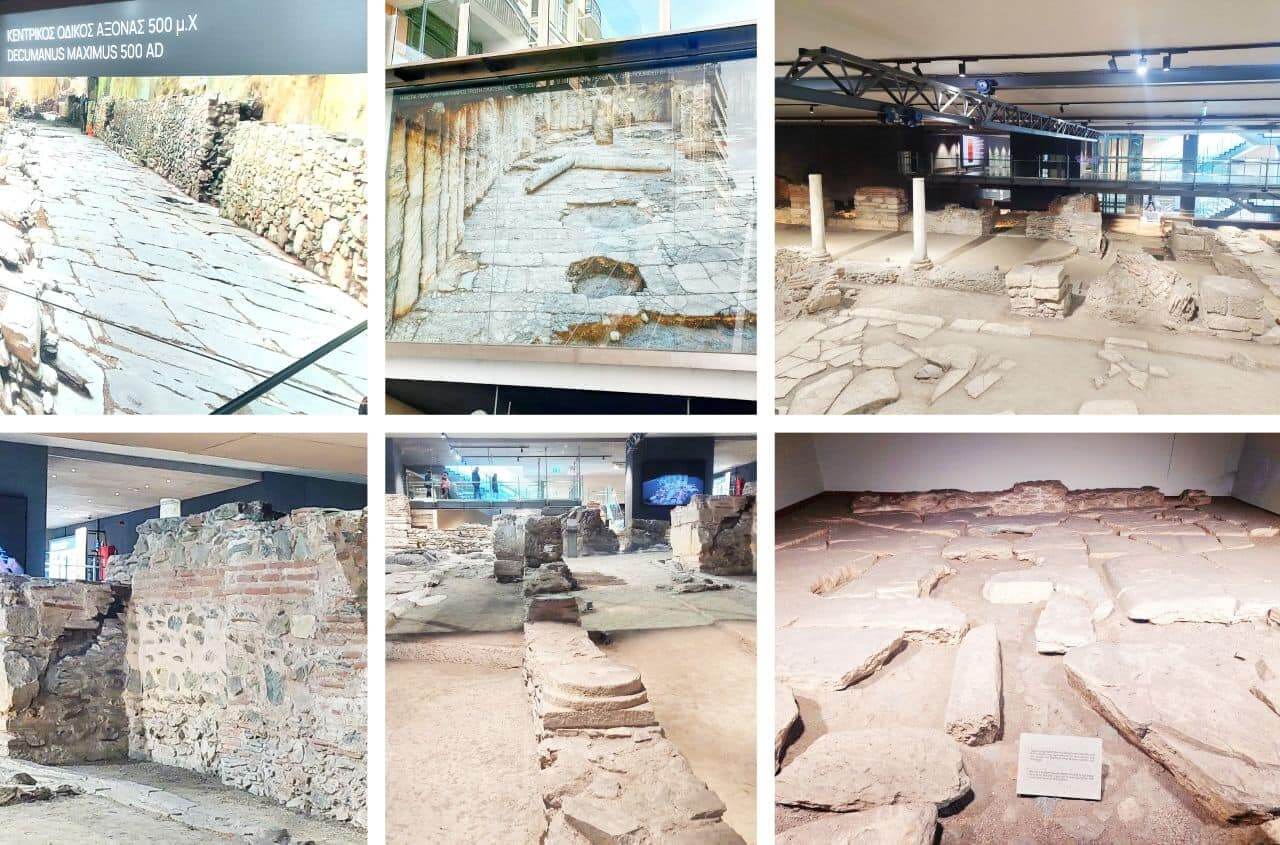
Open museum at the Venizelou Metro station
We must acknowledge that the constructors did an outstanding job of building an underground museum to preserve this archaeological site. There is also a small museum within the next metro station, Agia Sofias, similar to the Syntagma metro station in Athens.
⛪ The monuments from the Byzantine period
During the Byzantine era, Thessaloniki was the second city of the Byzantine Empire, after Constantinople. It was a major trade and military centre on the Roman road, Via Egnatia, and also an important centre for Christianity in the Balkans.
Due to its unique architecture, 15 churches and monuments in Thessaloniki were inscribed on the UNESCO World Heritage List in 1988, known as the Paleochristian and Byzantine monuments of Thessaloniki. On the list, besides the churches, there are the City Walls, Rotonda, and the Byzantine Bath.
✨ You can read more about the 15 Byzantine Churches and Monuments of Thessaloniki here.
But now, let’s mention the most important of them.
🏰 City walls and Castle of Thessaloniki
The first walls were built in the 3rd century BC by Cassander, king of Macedonia, who founded the town. Throughout the centuries, they were rebuilt by various rulers. Today’s wall ruins date back to the early Byzantine and Ottoman periods.
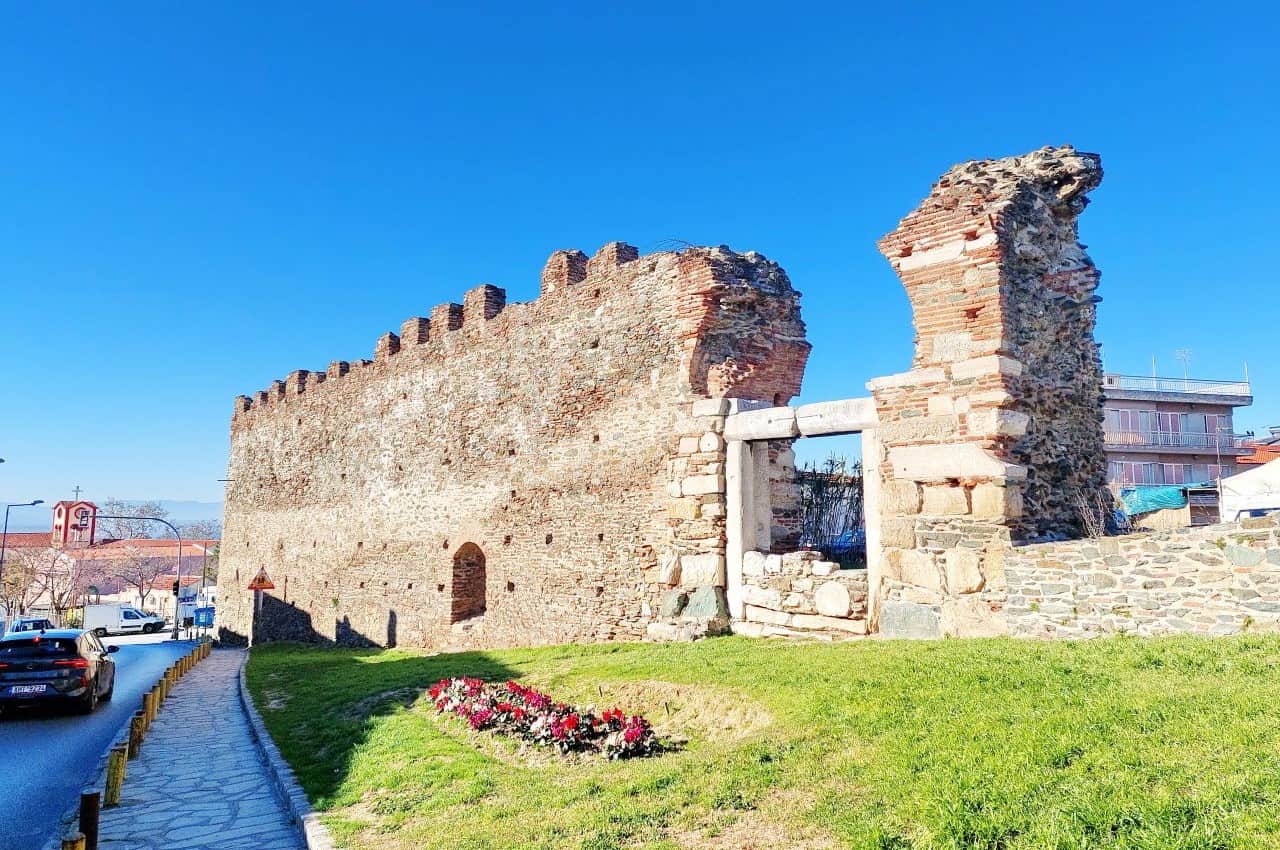
East Wall of Acropolis
At the top of the hill, you can find the Castle of Thessaloniki. It is also known as the Heptapyrgion or Yedi Kule, as the Ottomans called it. By the way, its name means the Seven Towers, even though it has ten towers.
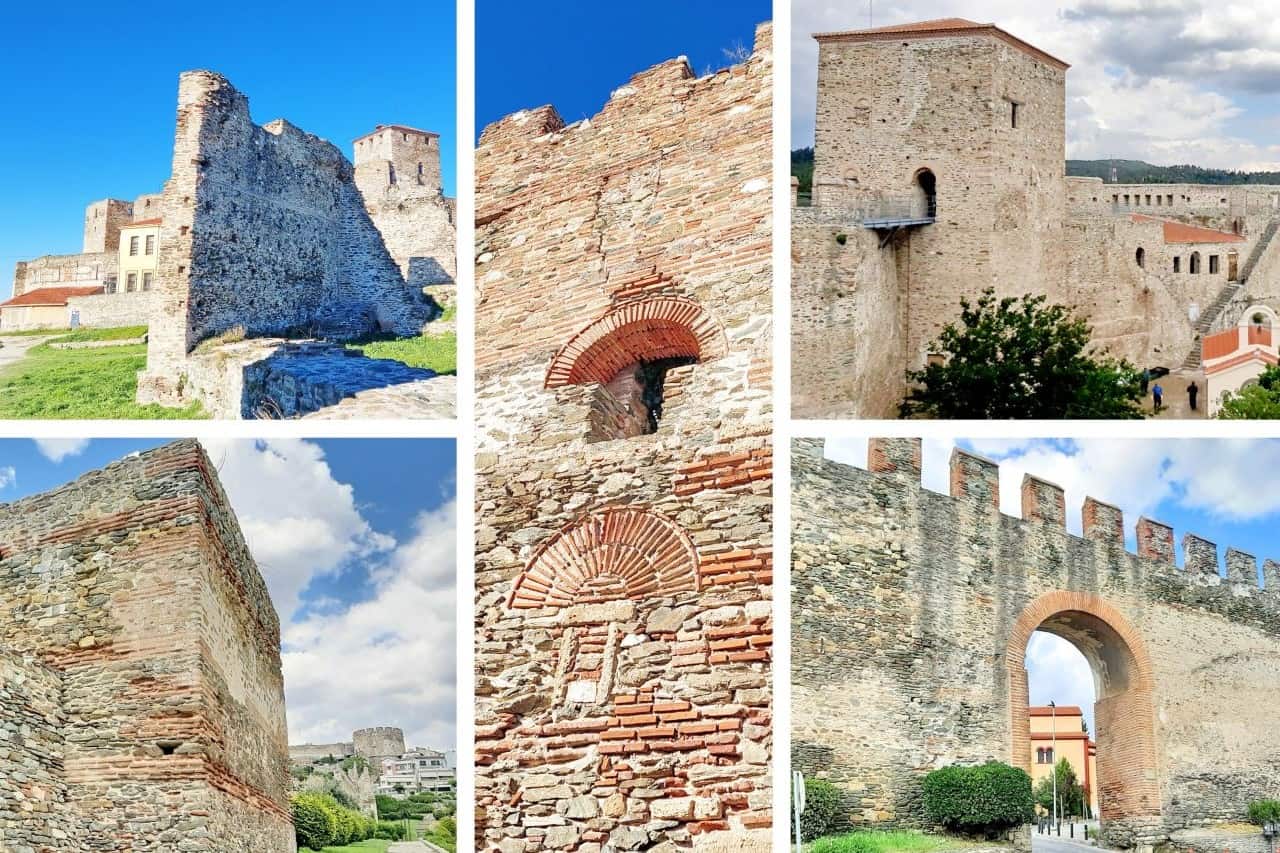
City Walls and Heptapyrgion of Thessaloniki
Today, we can see the ruins of the Byzantine fortress and the buildings from the period when it served as a prison. Part of the fortress is the impressive Trigionou Tower, rebuilt by the Ottomans.
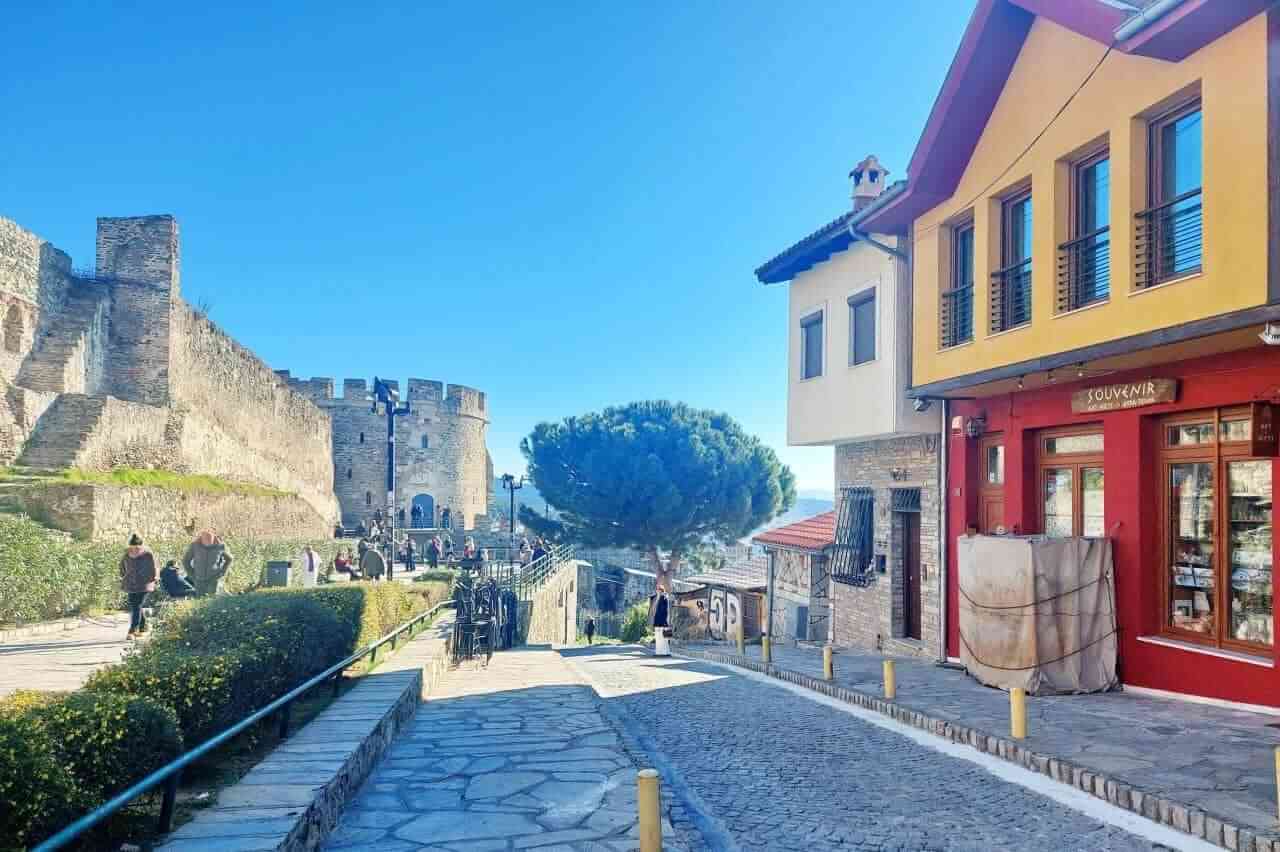
The Trigoniou Tower and Ano Poli houses
Around the fortress, on the top of the hill, there is the Old Town of Thessaloniki, known as Ano Poli, or Upper Town. It is the oldest part of Thessaloniki, which survived a Great Fire in 1917. From the Upper Town, you can enjoy beautiful panoramic views of the town, Mount Olympus and the blue Aegean Sea.
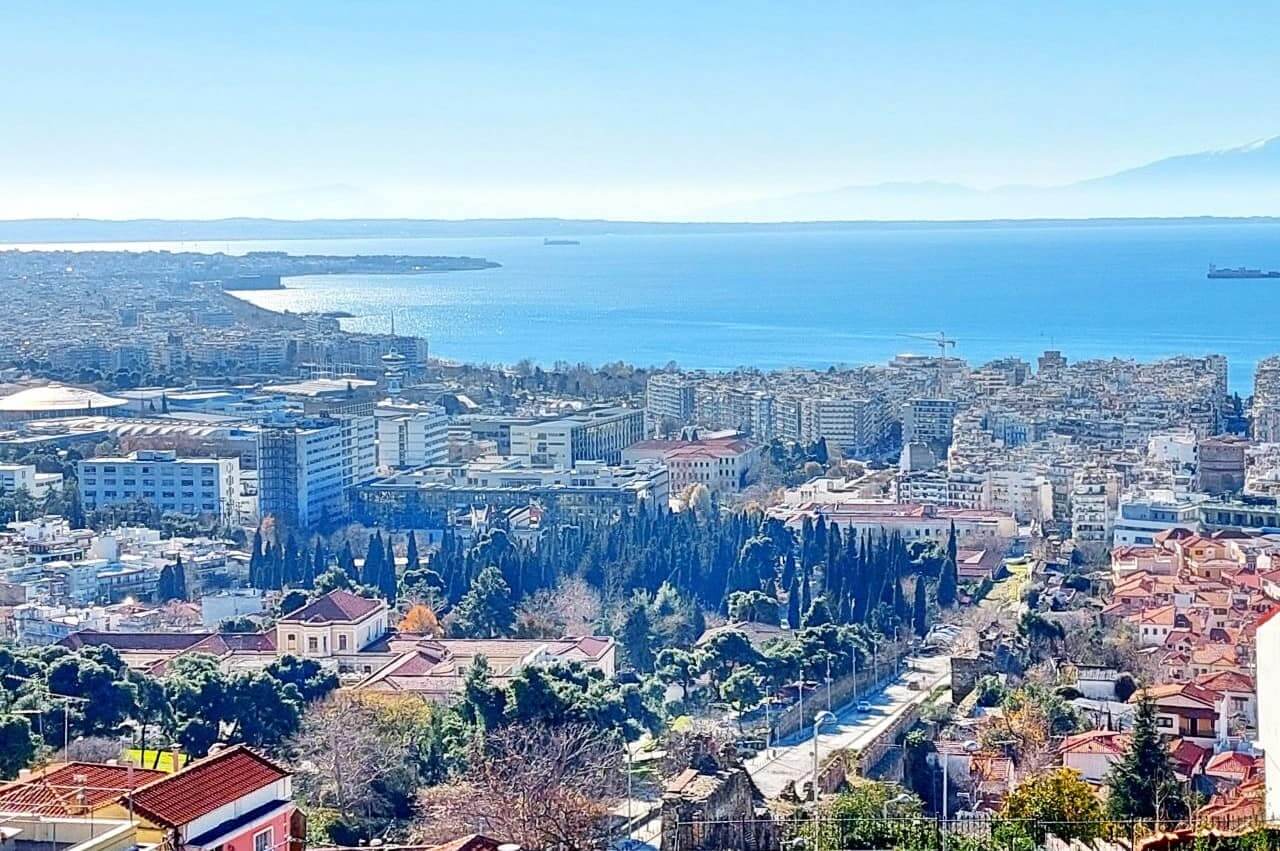
A view of Thessaloniki from Ano Poli
Well, it was interesting walking up the hill from the centre of the town. This picturesque neighbourhood is filled with narrow cobbled streets, colourful houses of traditional architecture, flowered gardens, winding alleys, and souvenir shops. And when you get tired of walking along the city walls and the fortress, take a break in the small cafes and traditional taverns with local dishes.
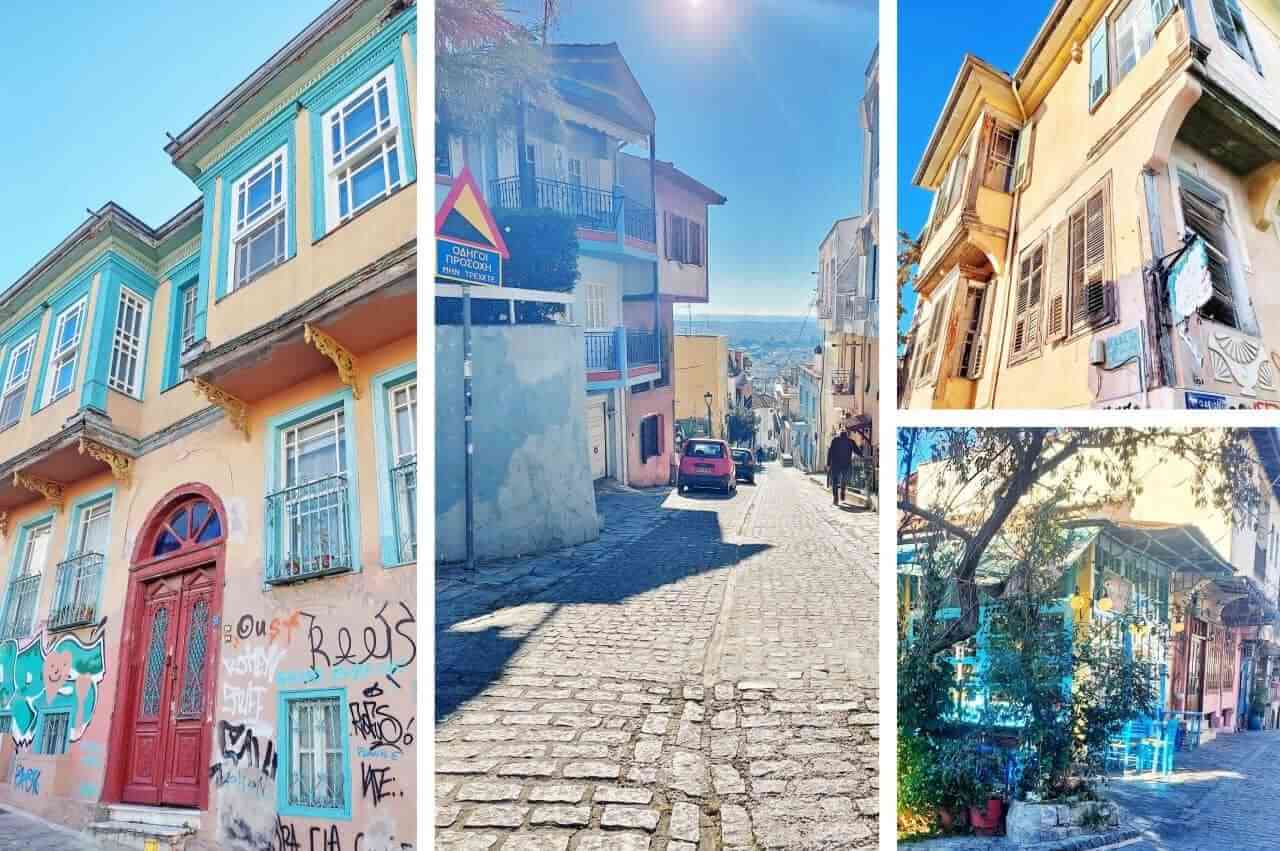
Houses in Ano Poli, Thessaloniki
⛪ Famous Byzantine churches
The most important church in the town is the Church of Agios Demetrios, dedicated to the city’s patron saint, Saint Demetrios.
The first church was built in the 4th century AD, when Emperor Constantine the Great made Christianity the official religion of the Byzantine Empire. It was believed that the grave of Saint Demetrious is miraculous, and thousands of pilgrims visit it every year. The church was converted into a mosque, and then again into the Christian church.
The feast of Saint Demetrius is celebrated on October 26, which is also a public holiday to celebrate the liberation of Thessaloniki from Ottoman rule in 1912.
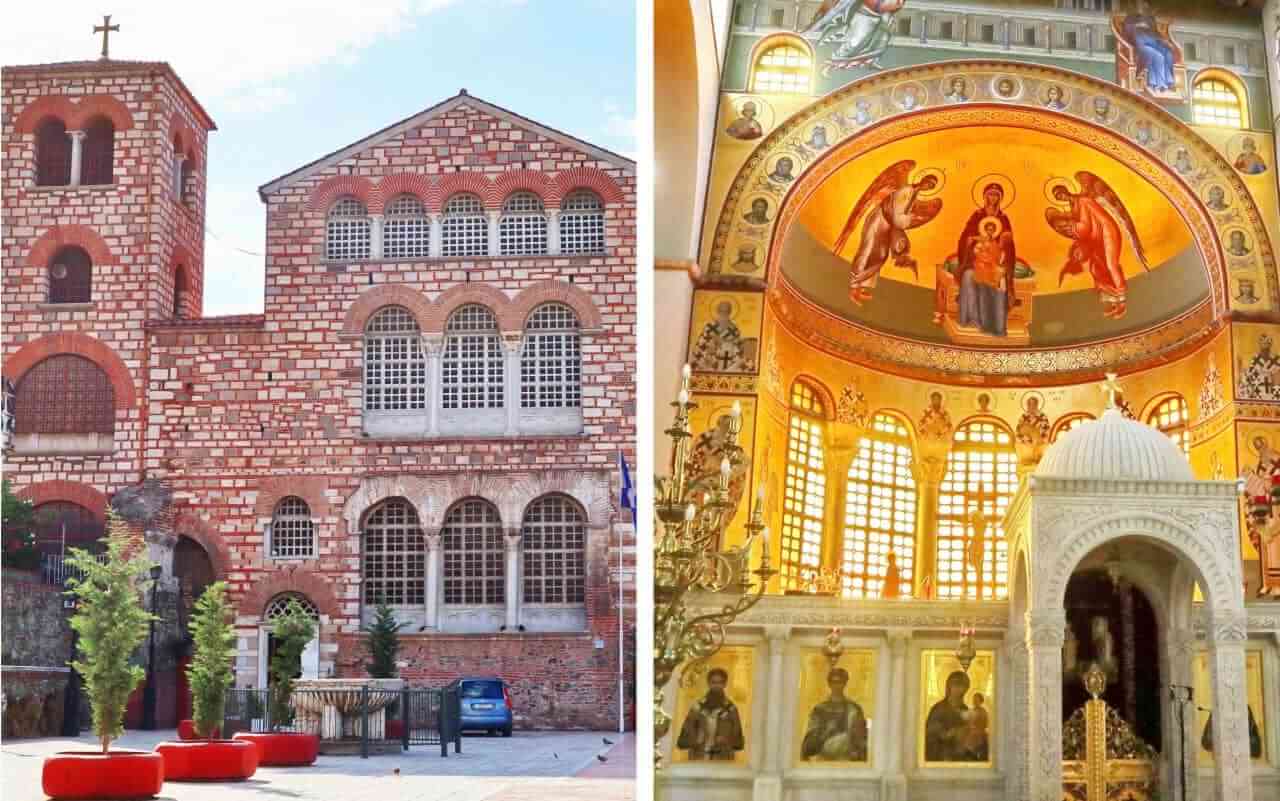
Church of Saint Demetrios
The stunning Church of Agia Sophia was built in the 5th century, inspired by the famous Hagia Sophia in Constantinople. Like other churches, it was converted into a cathedral, then into a mosque, and into an Orthodox church in 1912.
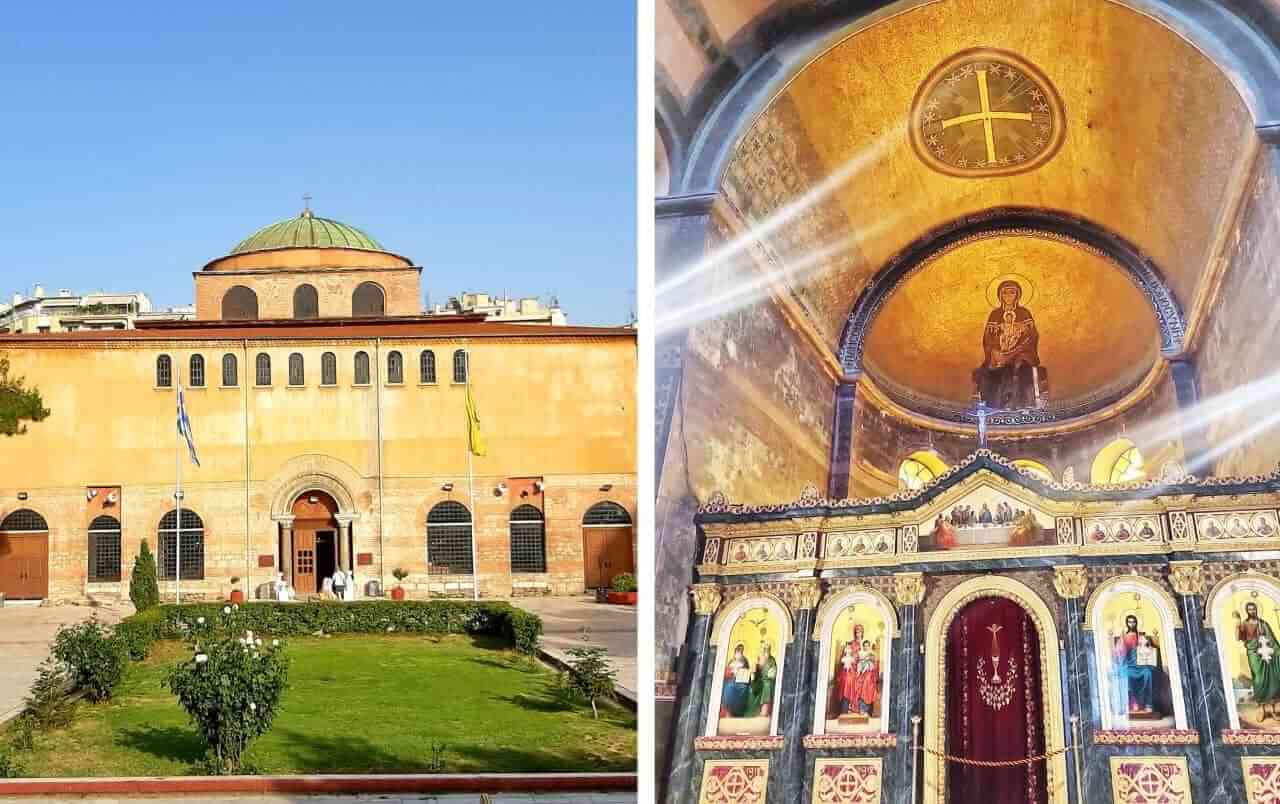
Church of Agia Sophia
⛪ A few modern churches…
Besides the magnificent Byzantine churches, there are several modern and interesting churches, as well.
⛪ The Church of Agios Gregorios (Saint Gregory) Palamas is the Metropolitan church of Thessaloniki. It was built in 1914, in Eclectic-Byzantine style. The church is dedicated to one of the most important saints, Gregory Palamas, who was the city’s Archbishop from 1350 to 1359. His relics are kept inside a special chapel of the church.
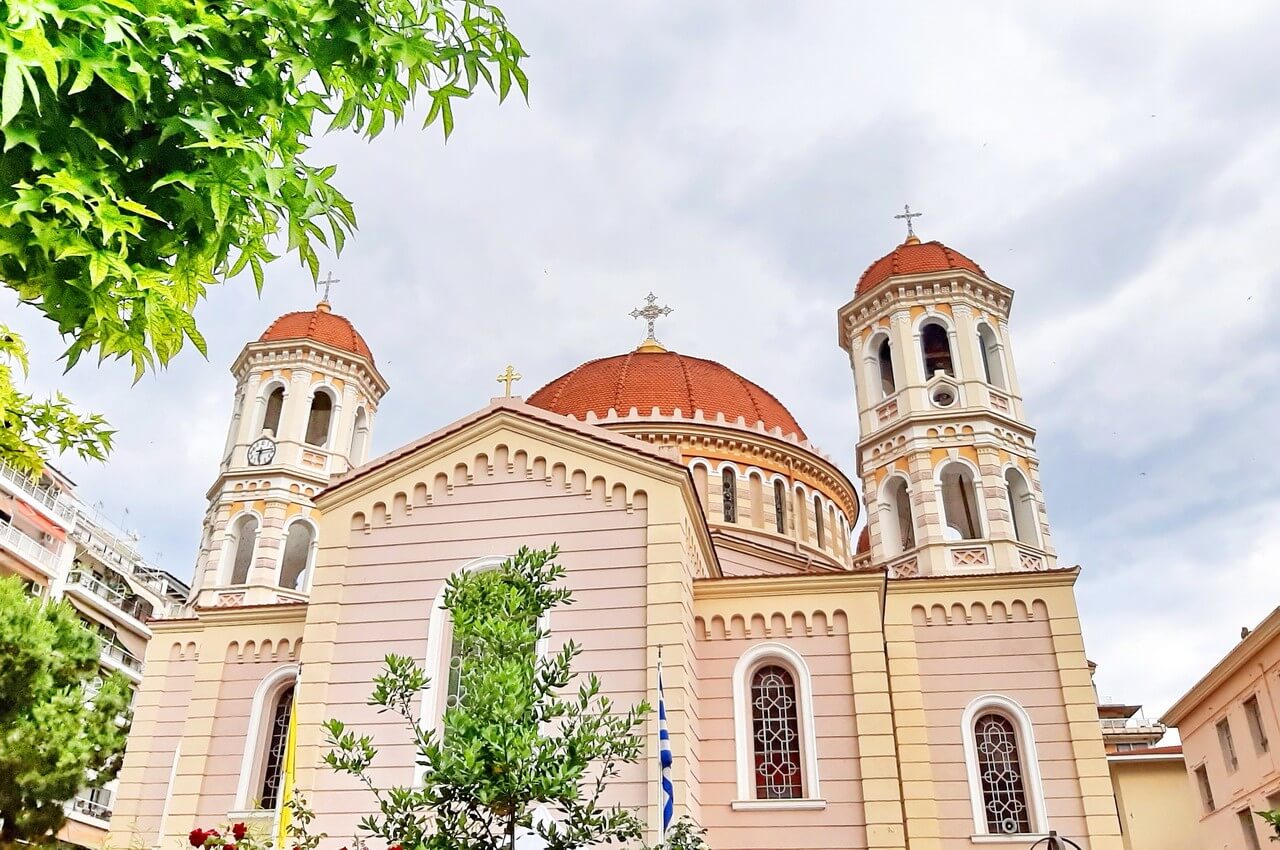
Thessaloniki Metropolitan Church of Saint Gregory Palamas
⛪ The Church of Saint Paul the Apostle is located in the Ano Poli neighbourhood. According to tradition, a spring of water existed at the foothills of Kedrinos Hill, where the Apostle Paul drank water during his visit to Thessaloniki in 50 AD. So, the spring became known as the “Holy spring of Apostle Paul” and attracted numerous pilgrims for centuries. A small church dedicated to him was built in 1922 at this place, after the liberation.
Close to it, on the hill, the large and stunning Church of Saint Paul was built in the 1970s. From the balcony of the temple, you can enjoy a beautiful view of the city.
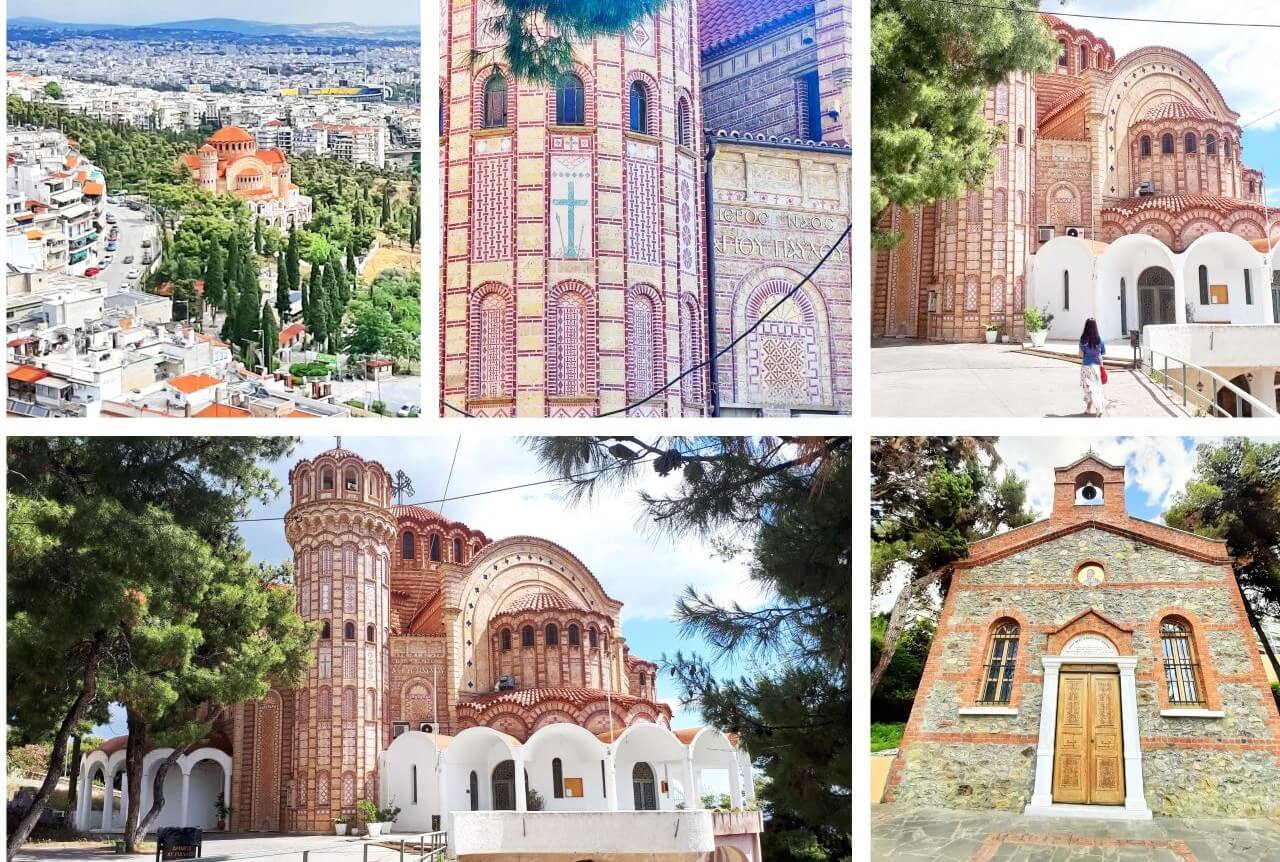
Church of Saint Paul the Apostle
⛪ Church of Panagia Dexia is located close to the Arch of Galerius, in Egnatia Street. It was built in 1956, in Byzantine and modern neoclassical style.
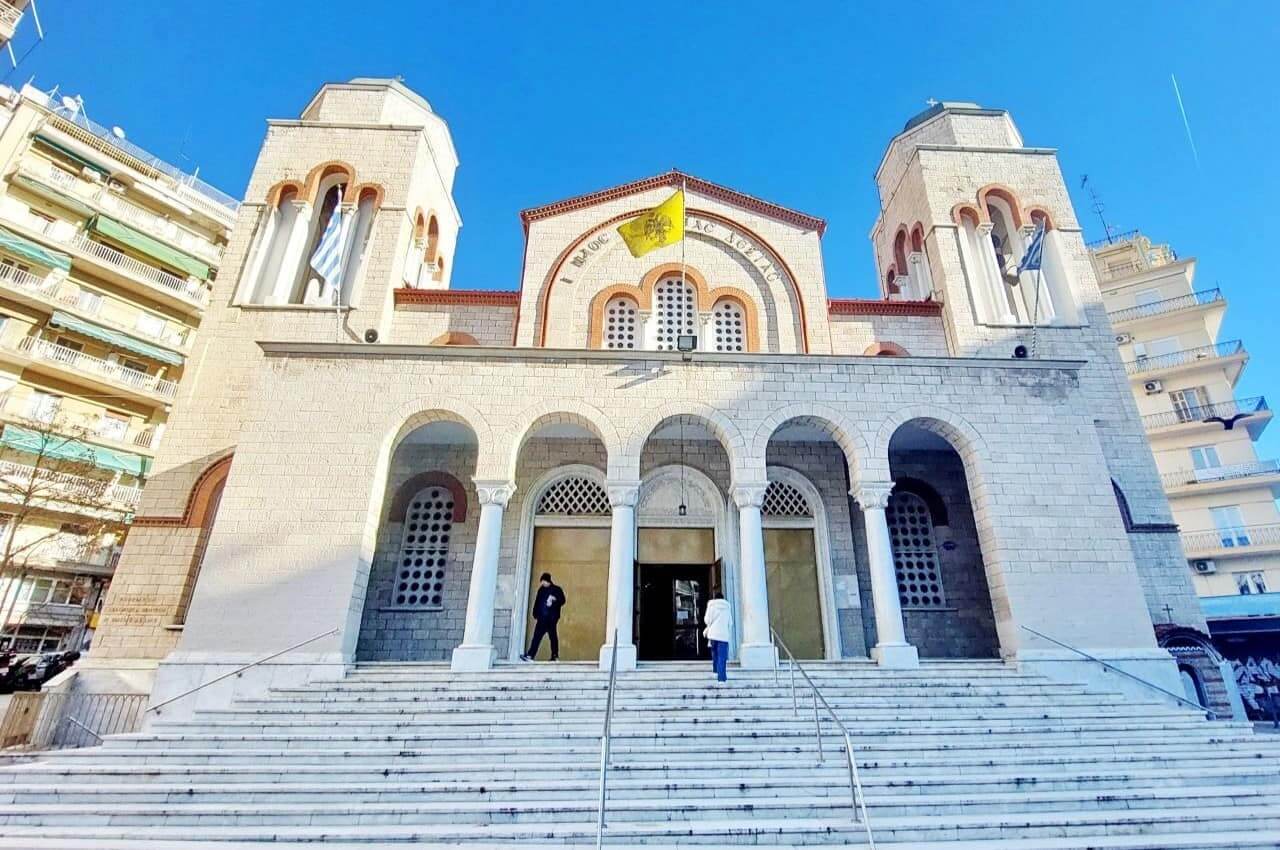
Church of Panagia Dexia
Probably the church got its name because of the icon of the Virgin Mary holding the infant Jesus on the right side, not on the left. So, it is called “Dexia”, or “Dexiokratousa”, which means right-handed/right side.
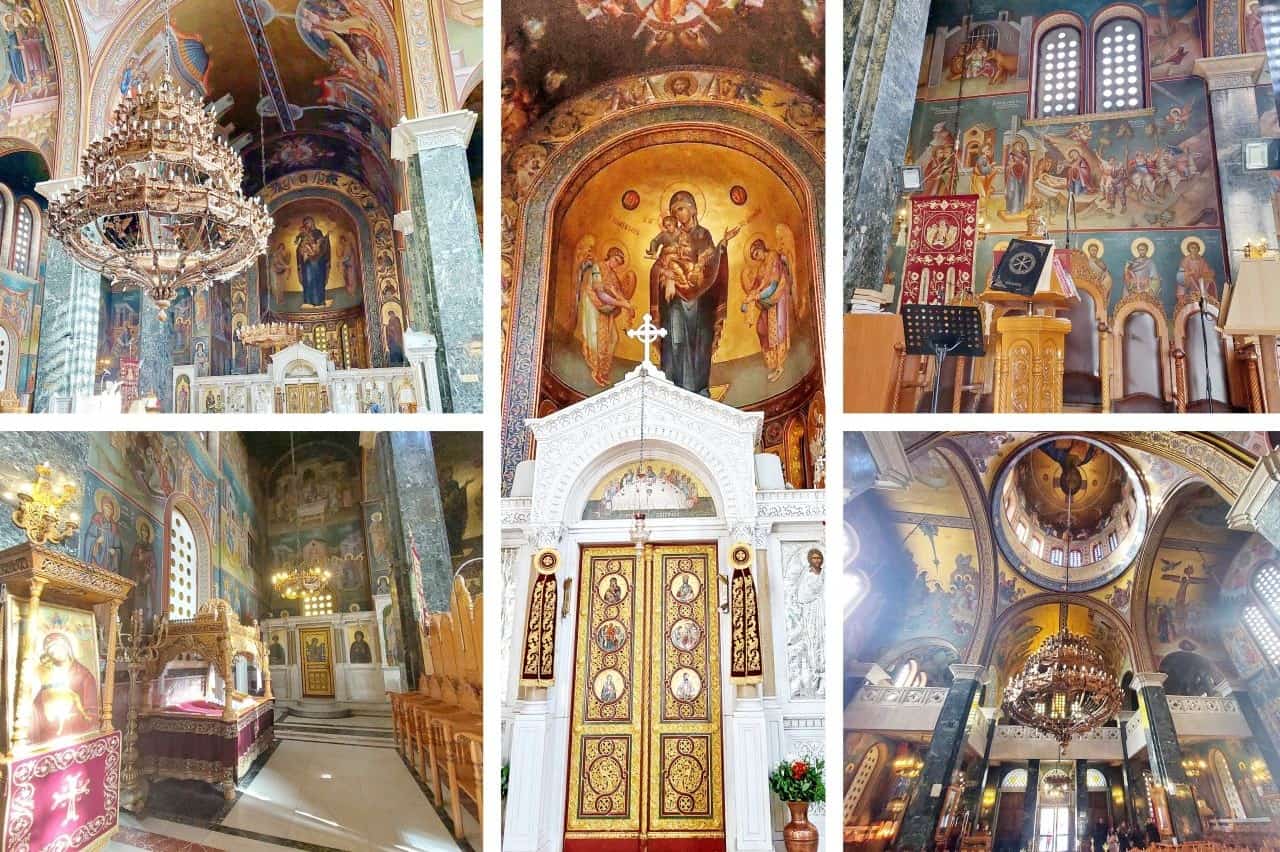
Inside the Church of Panagia Dexia
🕌 Ottoman monuments
The White Tower
The landmark of Thessaloniki is the White Tower, standing on the waterfront promenade, in Nikis Avenue.
It was built in the 15th century by the Ottomans, as part of the city’s fortification, on the site of an old Byzantine tower. The White Tower is 34 meters high, and it has six floors connected by stairs. Once, the tower was surrounded by a low octagonal wall, which was demolished in 1917.
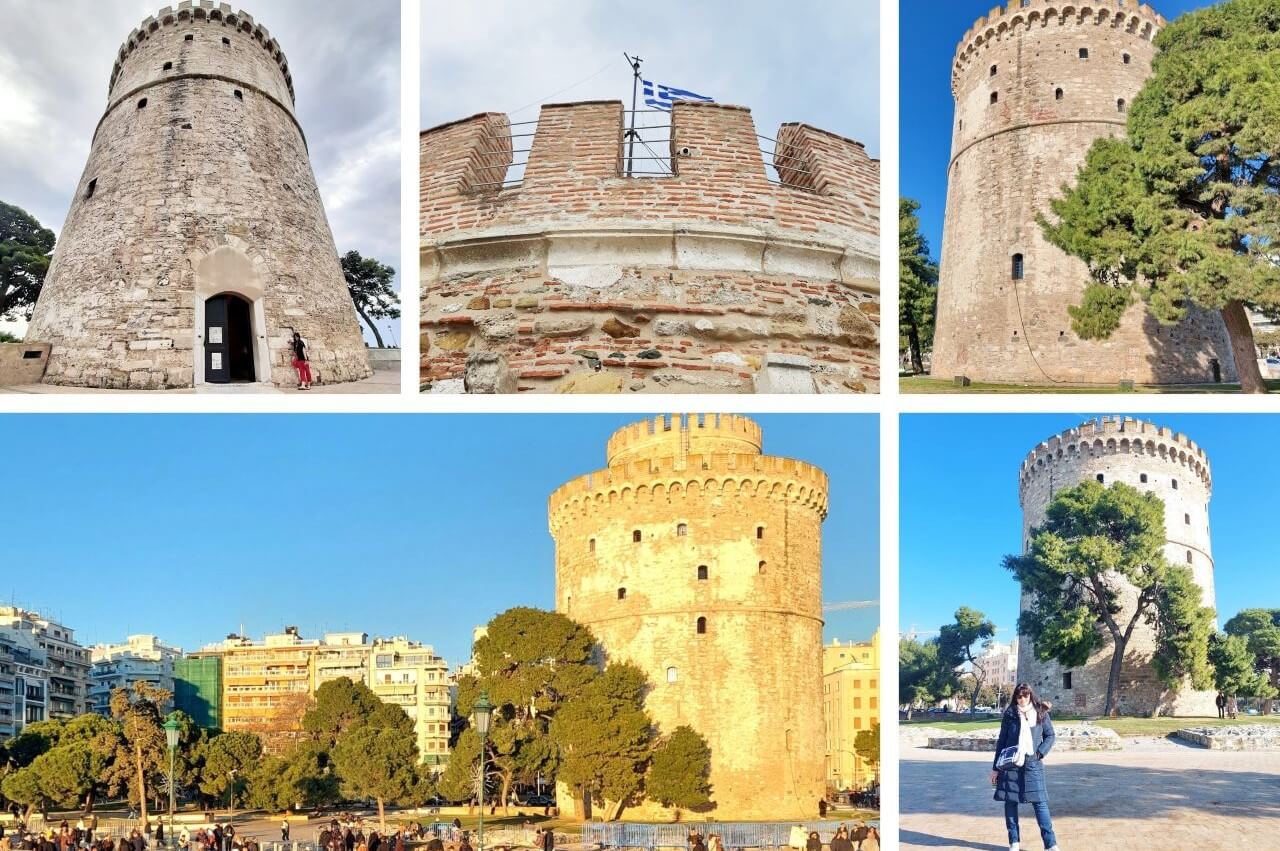
The White Tower
The Ottomans used the tower as a fort, a garrison, and also as a prison. By the way, in the 18th century, it was known as the Kalamaria Fortress. After the massacre in 1826, it was called the Tower of Blood or the Red Tower. The current name dates back to 1890, when it was whitewashed by a convict in exchange for his freedom. Today, the tower has a light brownish-yellow colour, but it has kept its name.
After the liberation in 1912, it became the symbol of the city. In 1985, the Ministry of Culture took over the White Tower, restored it, and transferred it into a museum, organised by the Museum of Byzantine Culture. Visitors could see items from Thessaloniki’s history, from antiquity to modern times. Also, various temporary exhibitions are held at the tower.
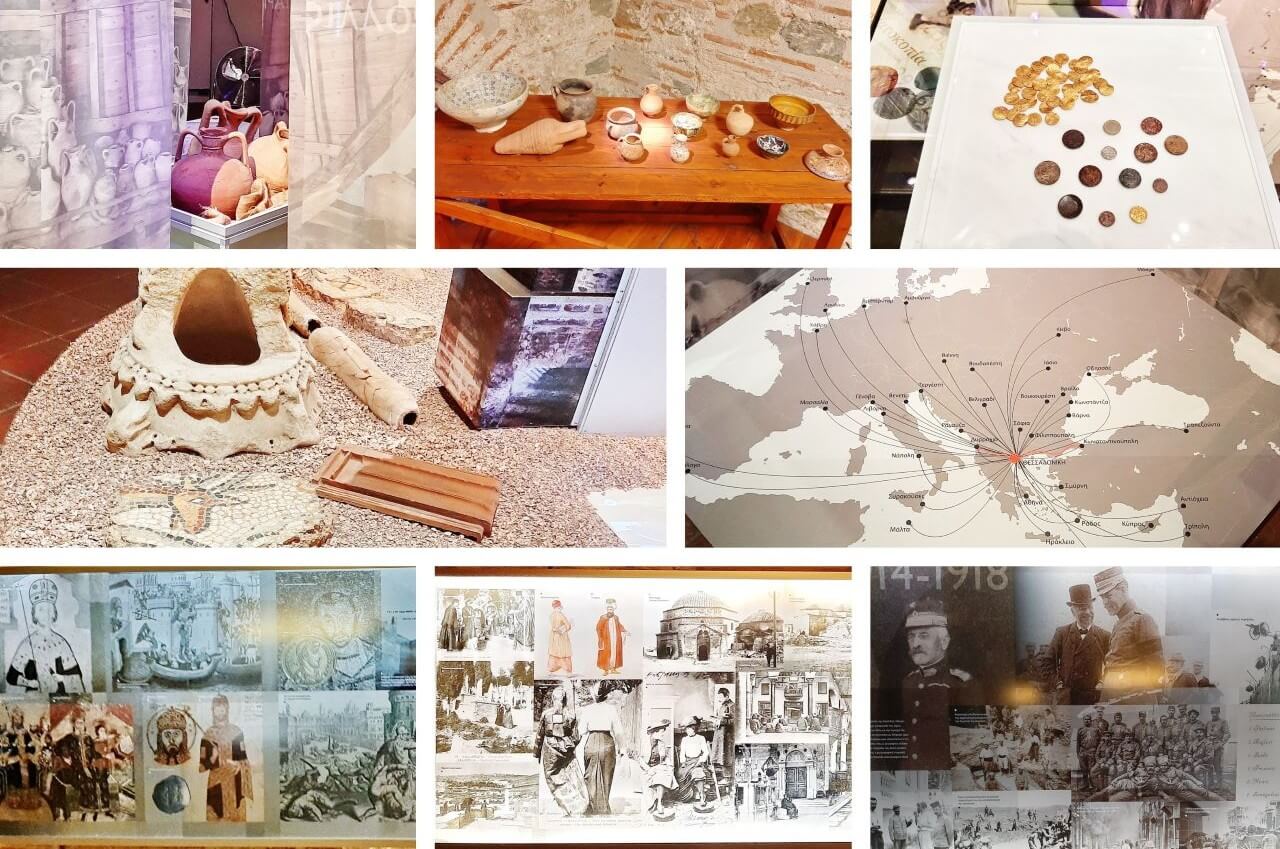
Thessaloniki, inside the White Tower Museum
And don’t miss climbing to the top for panoramic views of the Ano Poli, Thermaic Gulf and Mount Olympus on clear days.
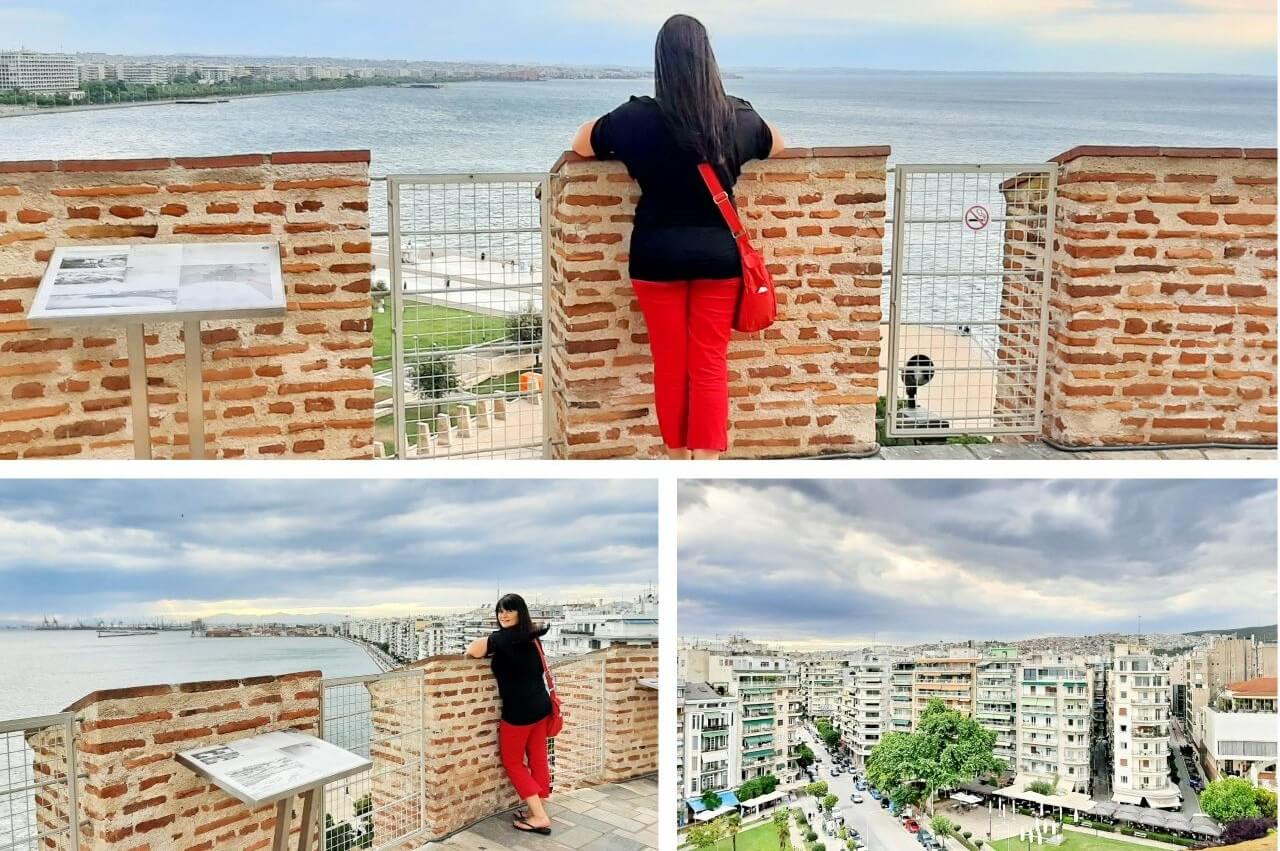
A view from the top of White Tower
During the Christmas and New Year periods, it was fantastically illuminated by an LED show.
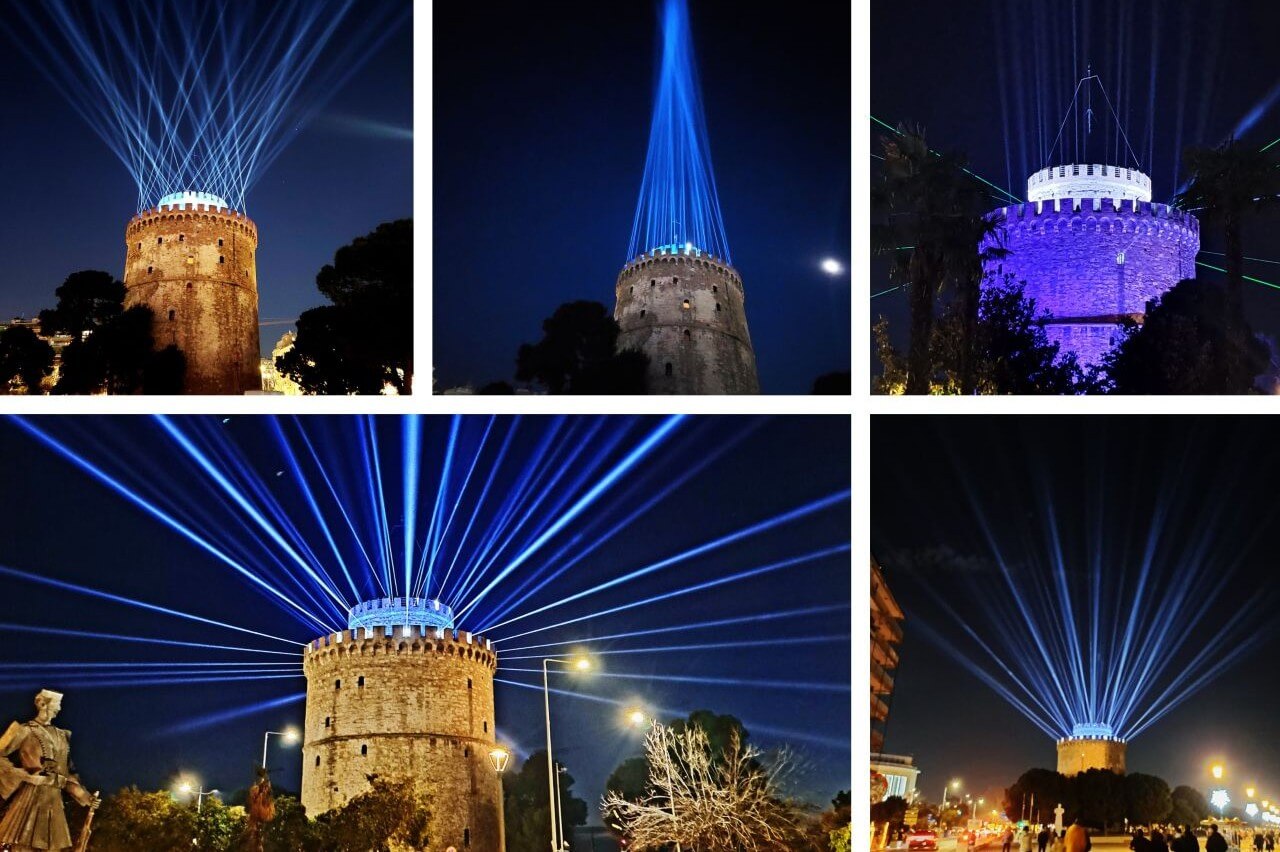
The White Tower by night
The Ottoman mosques and market
The oldest mosque in Thessaloniki is the Hamza Bey Mosque. It is located at the intersection of Egnatia and Venizelou streets, where the Venizelou metro station is today.
The mosque was built in 1460 and named after Hamza Bey, an Ottoman admiral and envoy of Sultan Mehmed II. It was abandoned in the 1820s, and after the liberation in 1912, it lost its religious purpose. For years, it was used as a cinema called the Alcazar, which is how many locals know it. In 2006, the Greek Ministry of Culture started a restoration, which is expected to be finished this year.
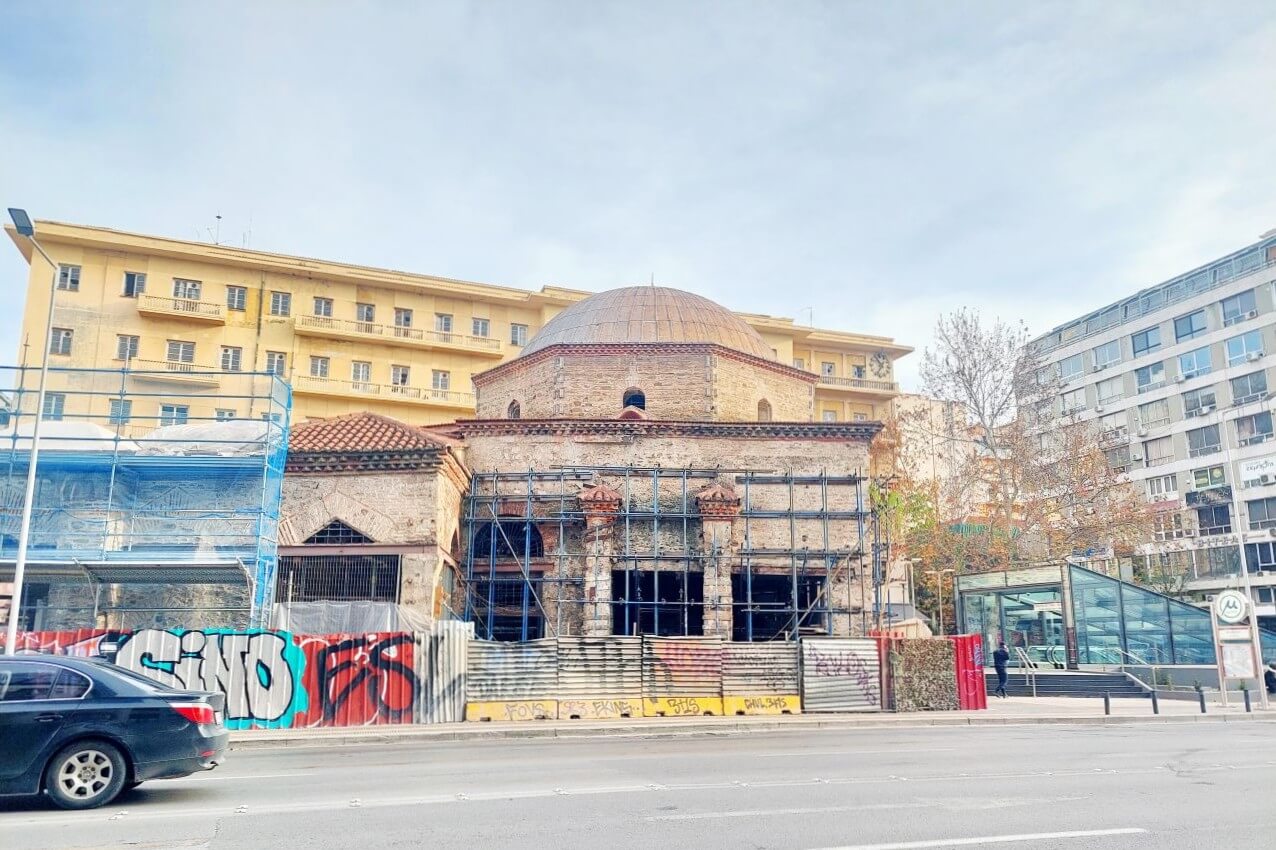
The Hamza Bey Mosque
Close to the Hamza Bey Mosque, at Venizelou and Solomou streets, you can find the Thessaloniki Bezesteni market. It was built in the 15th century by Mehmet II, in a rectangular shape covered with six domes.
By the way, the Turkish word Bezesteni or Bedesten is derived from the Persian word “Bezzazistan”, which means “fabric market.” Before the Great Fire of 1917, there were 113 shops in the bedesten. Even today, it houses various shops.
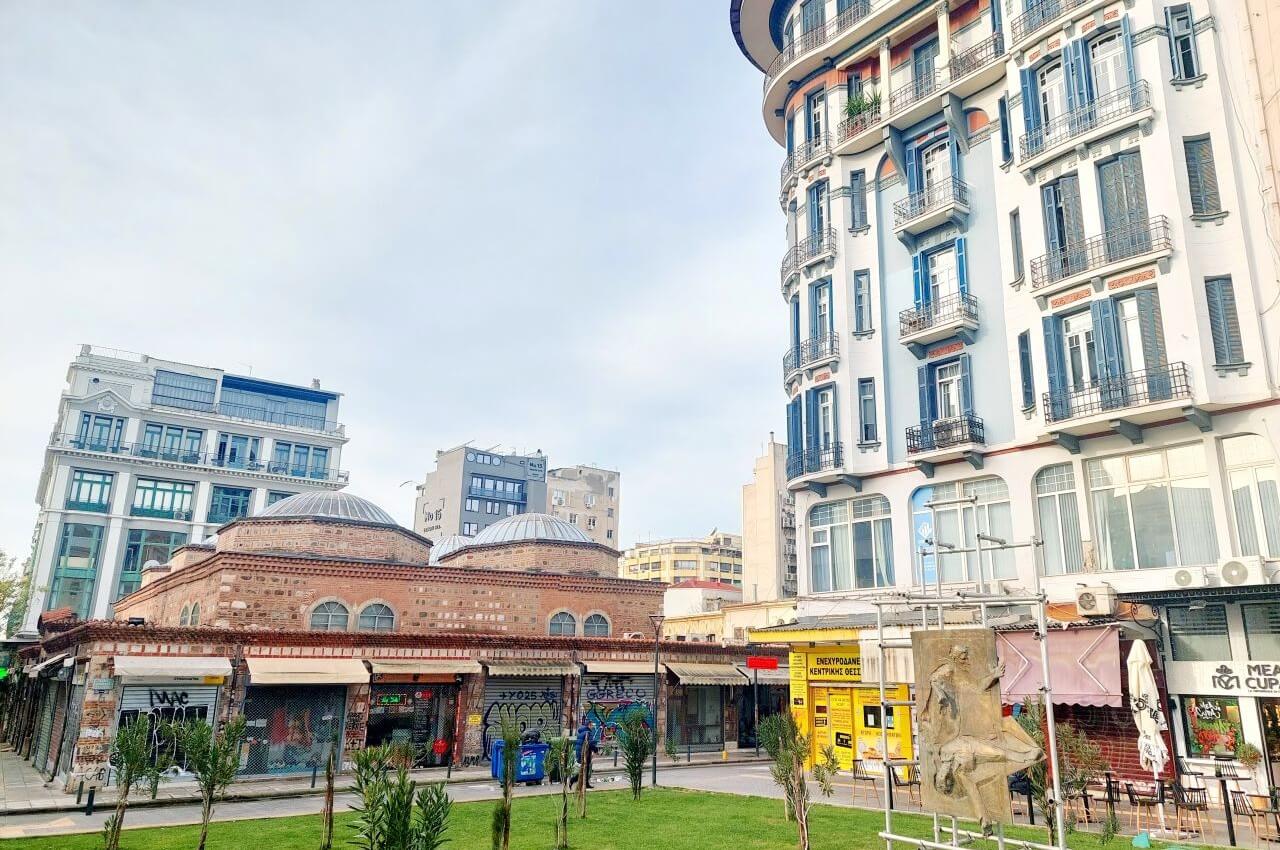
The Bezesteni market
Ishak Pasha Mosque or “Alaca Imaret” is located in Ano Poli. It was one of the most important buildings in Thessaloniki. The mosque was constructed in 1484 by the Grand Vizier, Ishak Pasha. Probably it gets its name from the minaret known as alaca, which means “colourful”, because it was fully covered with diamond-shaped colourful stones.
Today, it is used as an exhibition space for the Municipal Gallery of Thessaloniki.
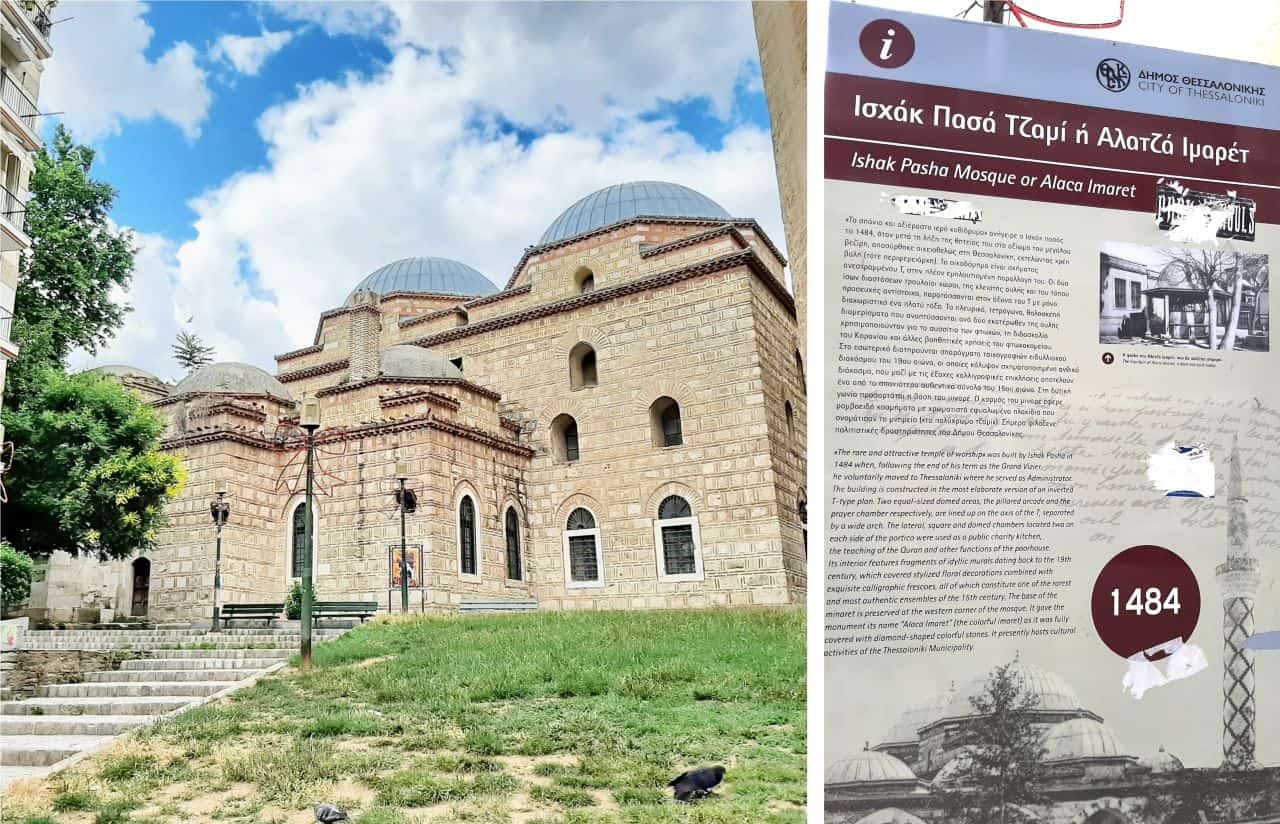
Ishak Pasha Mosque or “Alaca Imaret”
Turkish Baths
The Bey Hammam is the oldest and most impressive Ottoman bath, located at Archaia Agora Square, along Egnatia Street. It was built in 1444 by Sultan Murat II on the ruins of an older Byzantine church.
This Ottoman bath was also known as the “Baths of Paradise”. It had separate rooms for men and women, and it operated until 1968. For years, it was used for cultural events and exhibitions. Now, it is closed to the public because of renovations over the last several years.
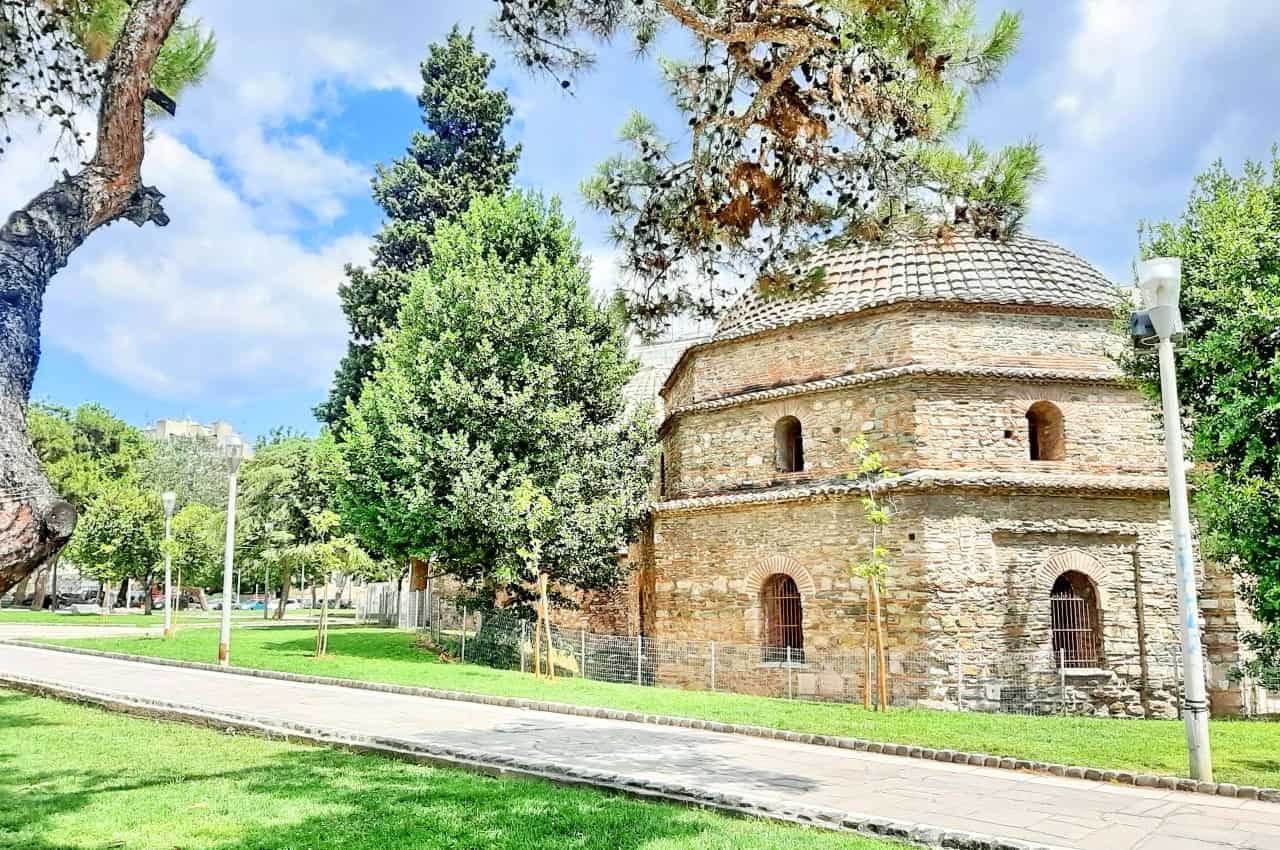
Bey Hamam, Ottoman bath
The Yahudi Hamam is another large Ottoman bath, built in the 16th century. It is located at the intersection of Vasileos Irakleiou and Frangini streets. Its name means “Jewish Baths”, because many Sephardi Jews lived in this neighbourhood. It is also known as the Pazar Hamam because it is just across Agora Modiano, the most popular market in town. The bath had two separate sections for men and women, and it was open until the early 20th century. Today it is closed to the public.
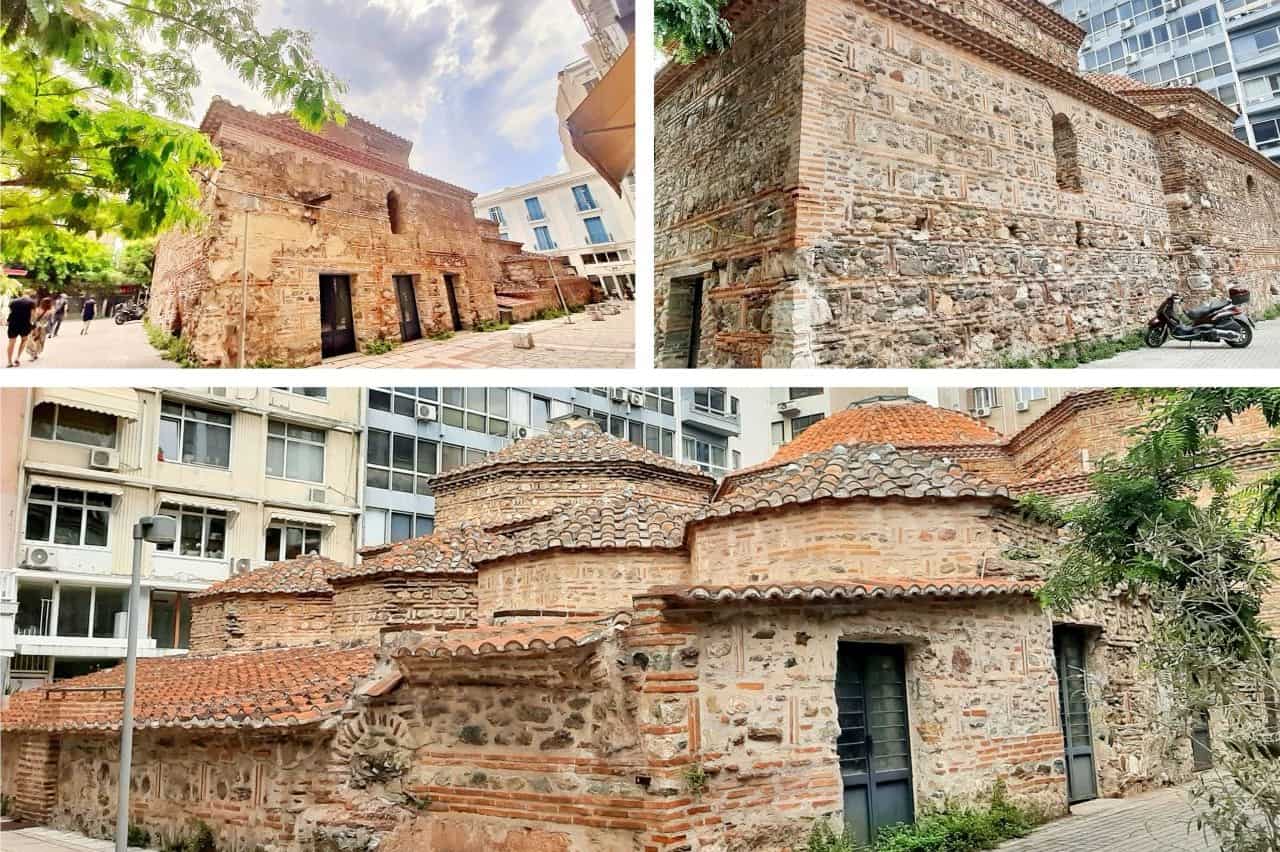
Yahudi Hamam
The Yeni Hamam means “new hamam” in Turkish. And this hamam was built in the 16th century by Khusref Kenkhuda, a property owner in Thessaloniki who probably served as administrator for the Vizier Sokolou Mehmet Pasha. It had separate sections for men and women.
After the liberation in 1912, it became property of the Greek public. For years, it has served as a warehouse, a cinema, a concert hall, and today, it is used as the Aigli Geni Hamam, bar & restaurant.
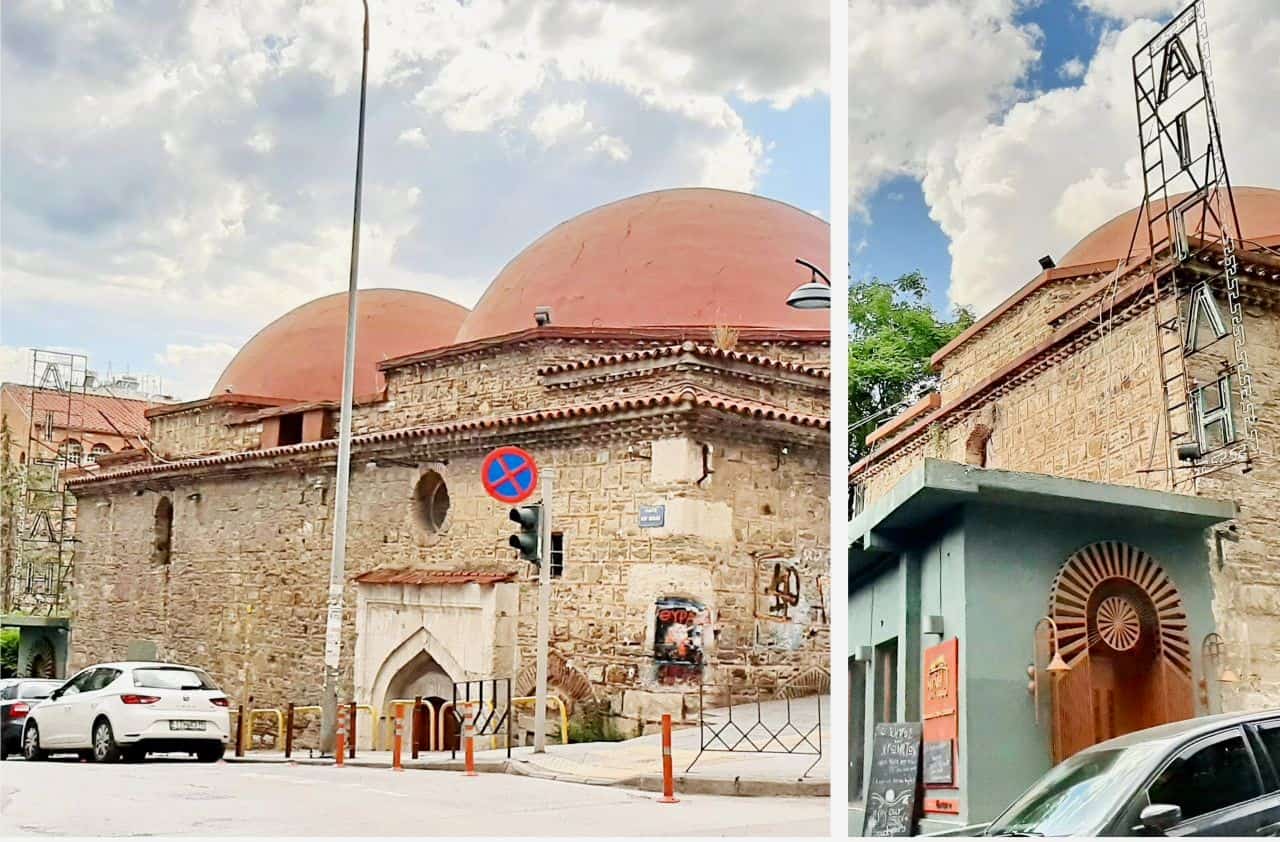
Yeni Hamam
Aristotle (Aristotelous) Square
The Aristotle Square is the main square, and one of the favourite meeting spots in Thessaloniki, both for locals and visitors.
It is located in the heart of town, stretching to the waterfront promenade. This beautiful square was designed by the French architect Ernest Hébrard in 1917 after the Great Fire, which destroyed two-thirds of Thessaloniki. The neoclassical buildings with red colonnades and arches on their facades were built in the 1950s and restored in the 2000s.
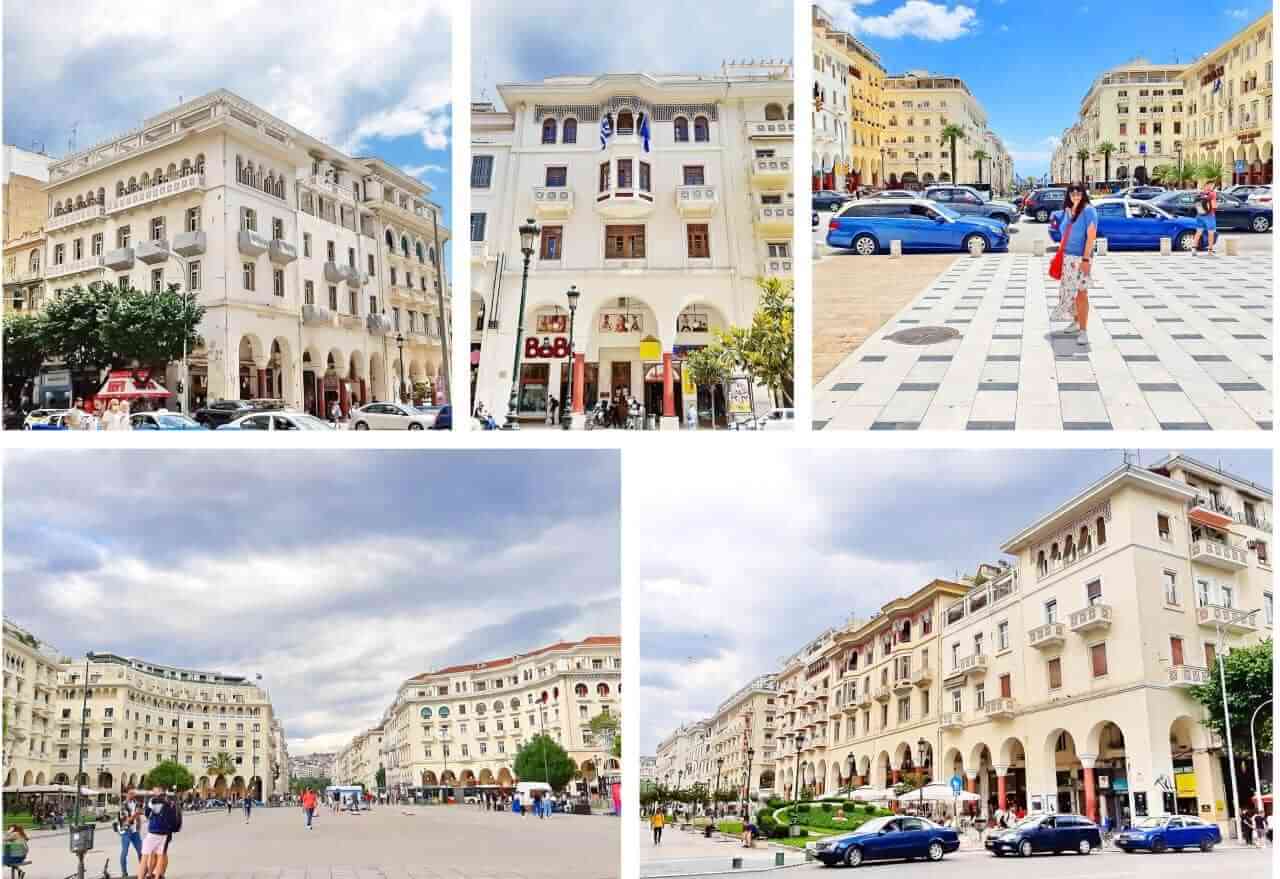
Thessaloniki, Aristotle Square, June 2021
The luxurious 5-star Electra Palace Hotel is located on the west side of the square. From the cafe on the hotel roof, you can enjoy an amazing view of the square and the sea. The Olympion Cinema is on the east side. It is also the seat of the Thessaloniki Film Festival, which is held every November.
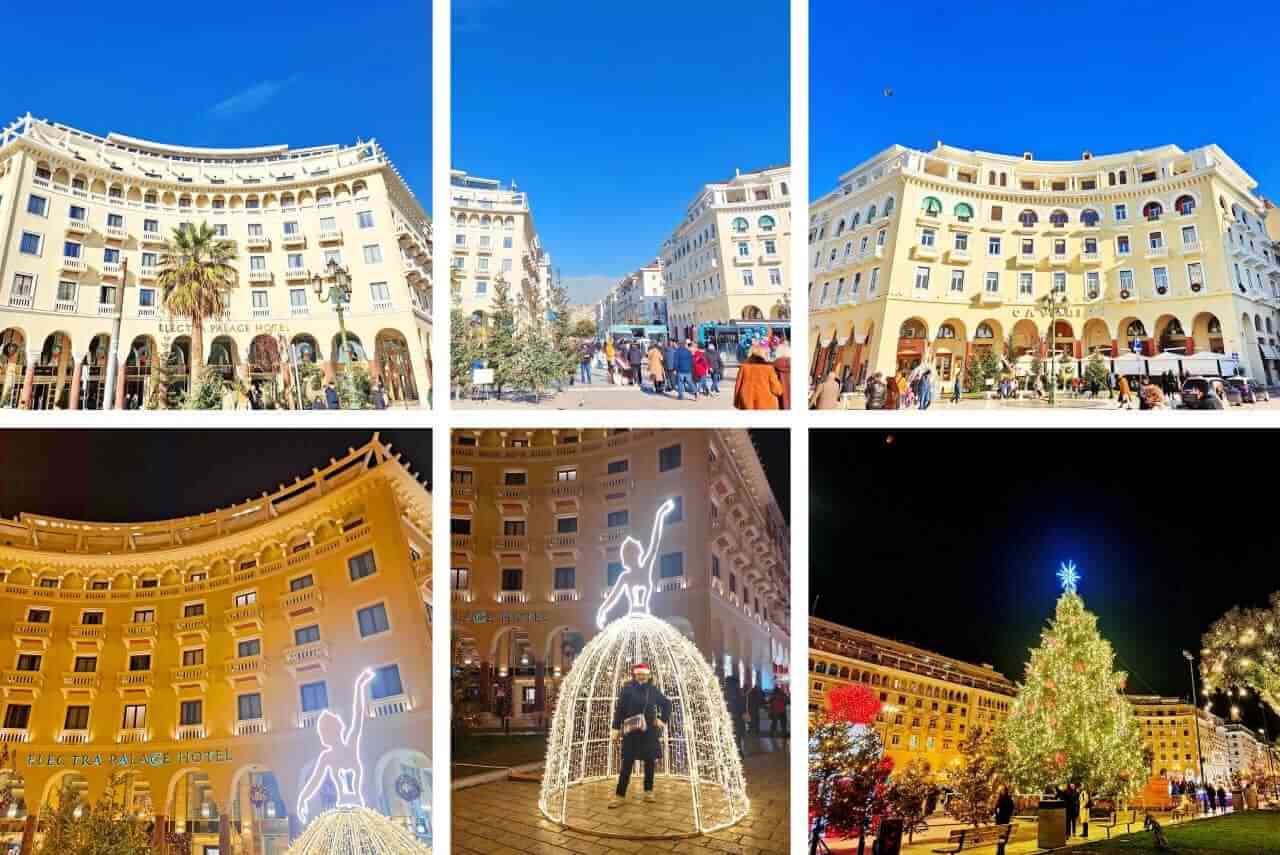
Aristotle Square, Electra Palace Hotel (left), Olympion Cinema (right), on the 31st December 2025
Aristotle Square is a popular tourist place with cafes and restaurants, and also a venue for various cultural, musical, political events, and demonstrations. During the Christmas and New Year’s Eve periods, the square transformed into a fairy place with a big Christmas tree and interesting LED decorations, which attract both kids and adults.
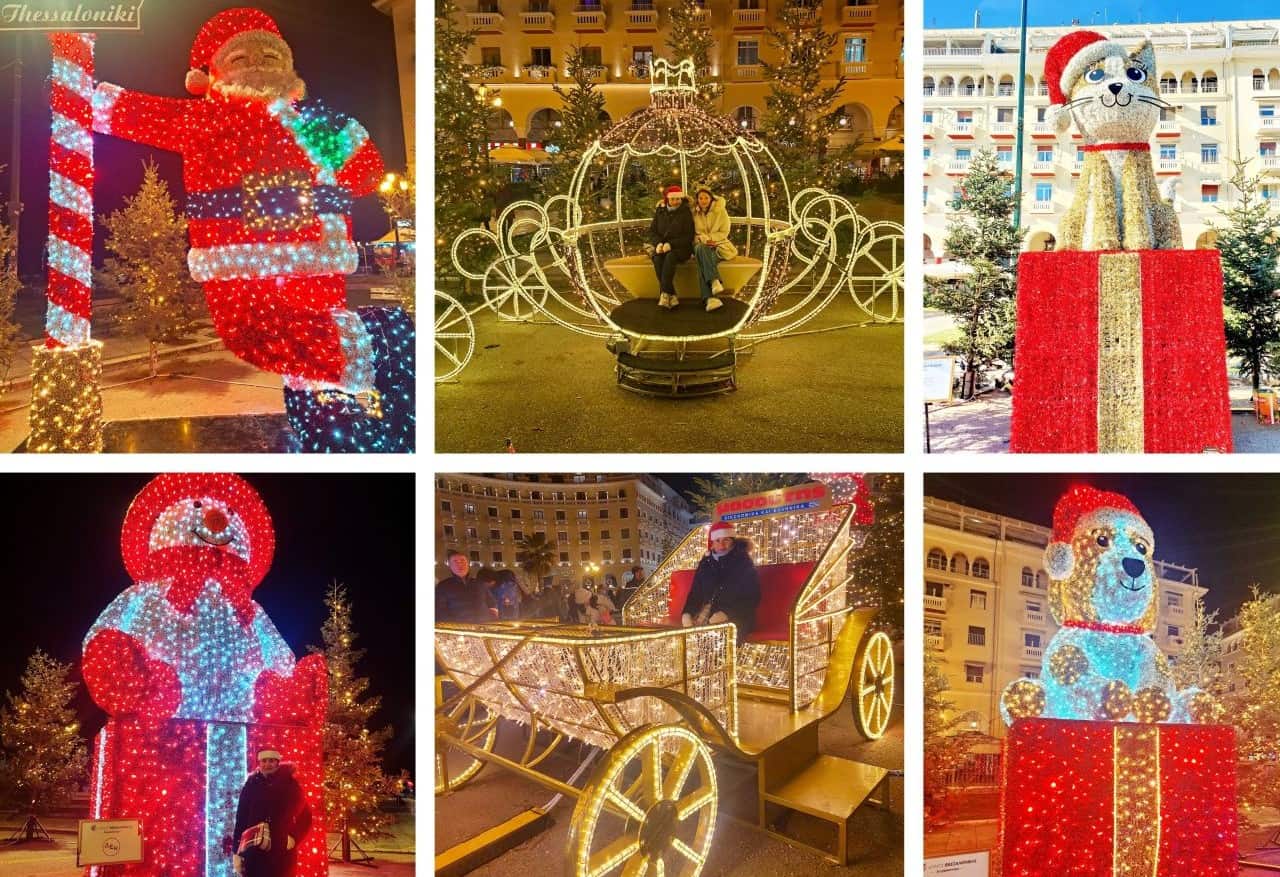
New Year decorations on the Aristotle Square, December 2025
The Thessaloniki Waterfront Promenade (Nea Paralia)
Stretching for five kilometres from the Concert Hall to the port, the Thessaloniki waterfront promenade is the favourite place, both for locals and tourists. It is perfect for a calm walk, cycling, running, and relaxing by the sea, surrounded by the 13 green thematic gardens and cafes along the promenade.
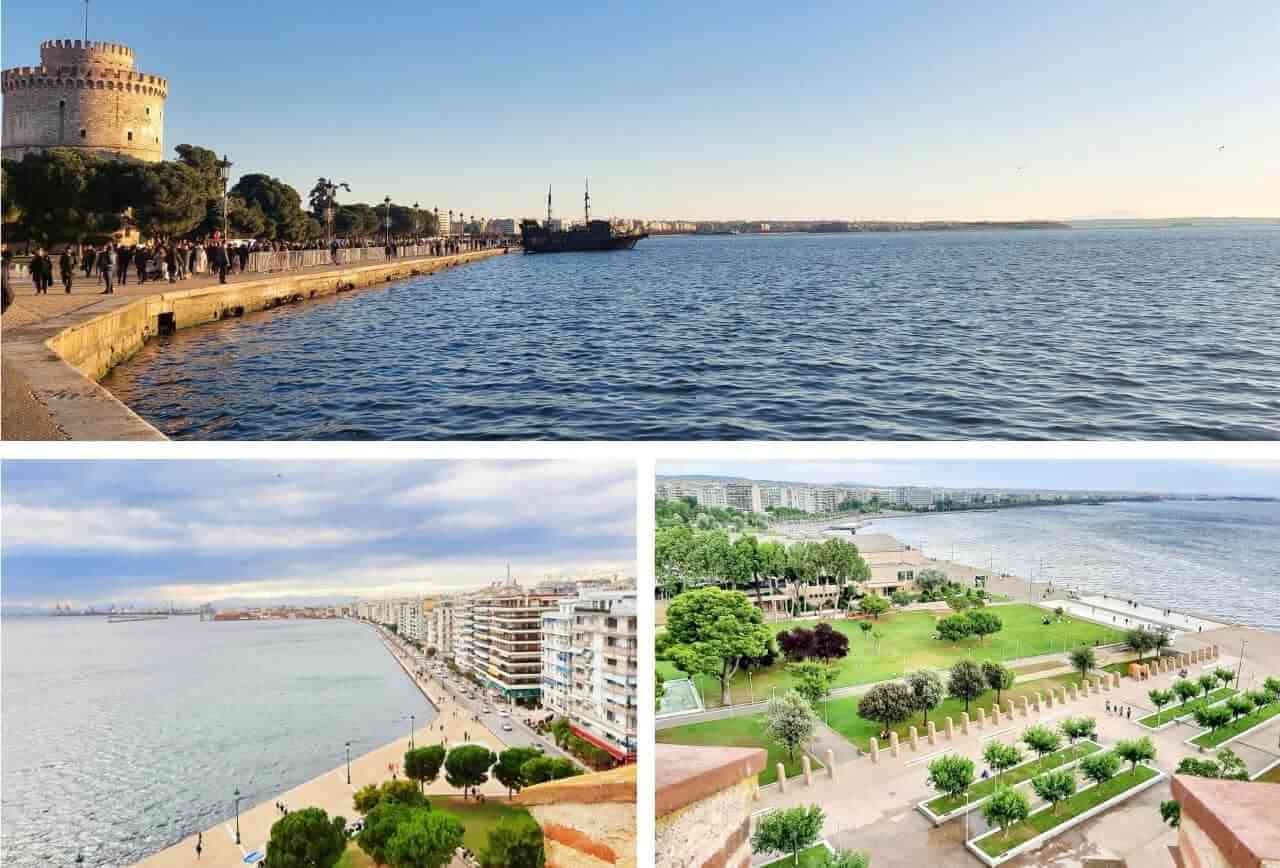
Thessaloniki Waterfront
Alexander the Great Statue
The most impressive statue on the promenade is the Alexander the Great Statue. The bronze statue, which is 6 metres high, represents Alexander the Great riding his faithful companion, Bucephalus.
Near the statue, there is a bronze relief depicting the “Battle of Issus”, while the installation features two arrays of saris and shields, with engraved and printed symbols of Alexander’s troops.
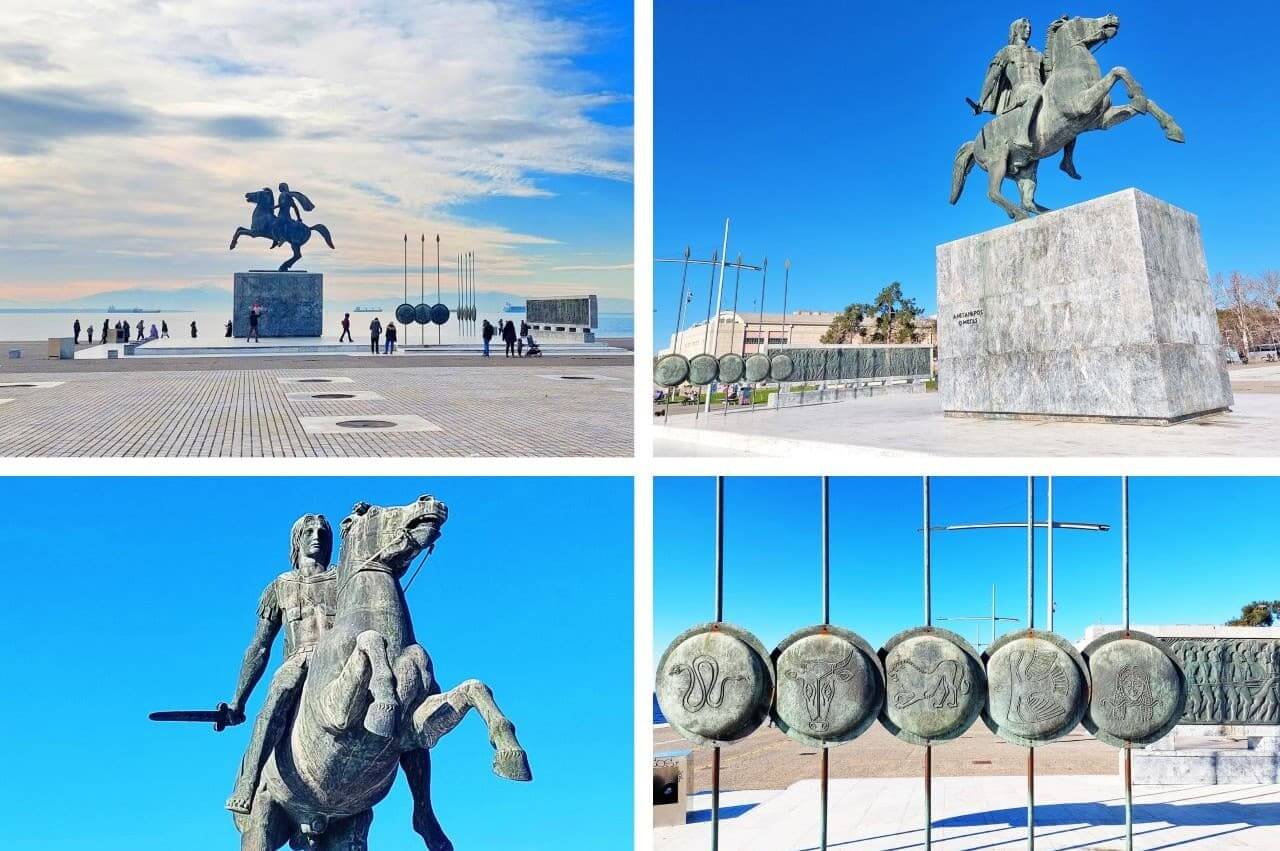
Alexander the Great Statue
☂️ Thessaloniki Umbrellas
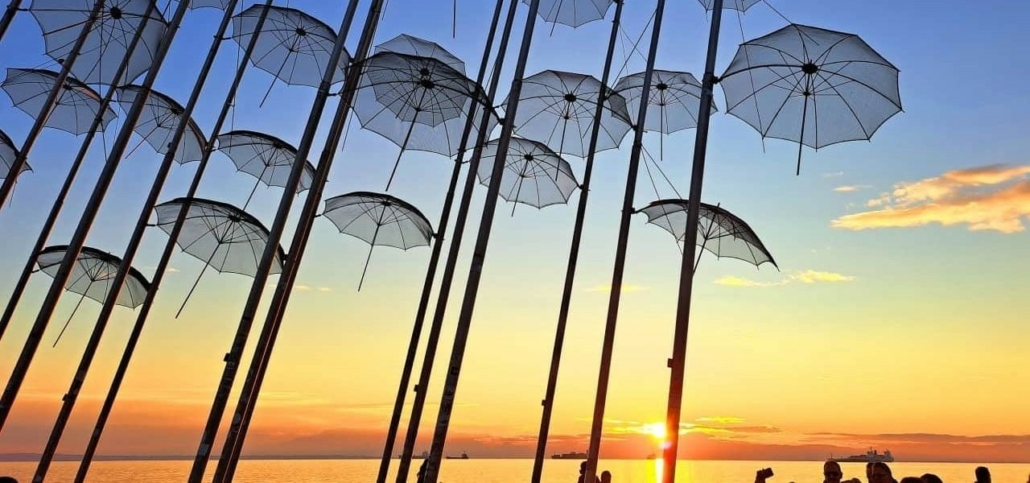
One of the most photographed spots in town is the modern art installation “Umbrellas“, made by the famous Greek artist George Zongolopoulos. The installation consists of 40 umbrellas on vertical columns that span over 13 meters high.
For the first time, it was exhibited in 1903 at the Venice Biennale. Following excellent reviews, umbrellas were displayed in 1997 near the Macedonian Museum of Contemporary Art in Thessaloniki waterfront. They look more amazing at sunset or illuminated at night.
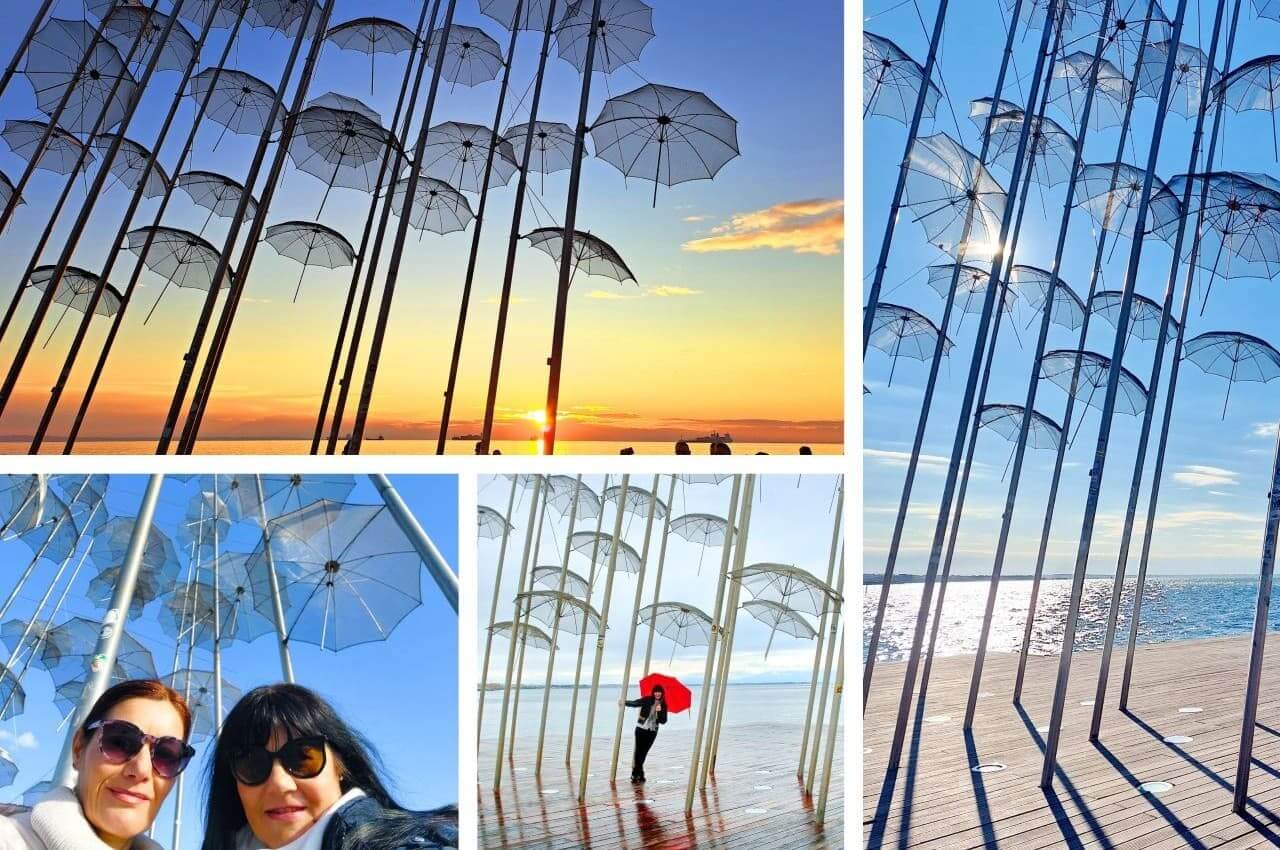
Umbrellas of Thessaloniki
⛵ Boat tours
Take a cruise tour along the Thermaic Bay for the magnificent view of the town from the sea. A few bar boats, such as Black Pearl, Arabella and Klio Cruise Bar, offer a 30-minute ride along the bay. All departures start near the White Tower, every 90 minutes, from 11 AM to late at night.
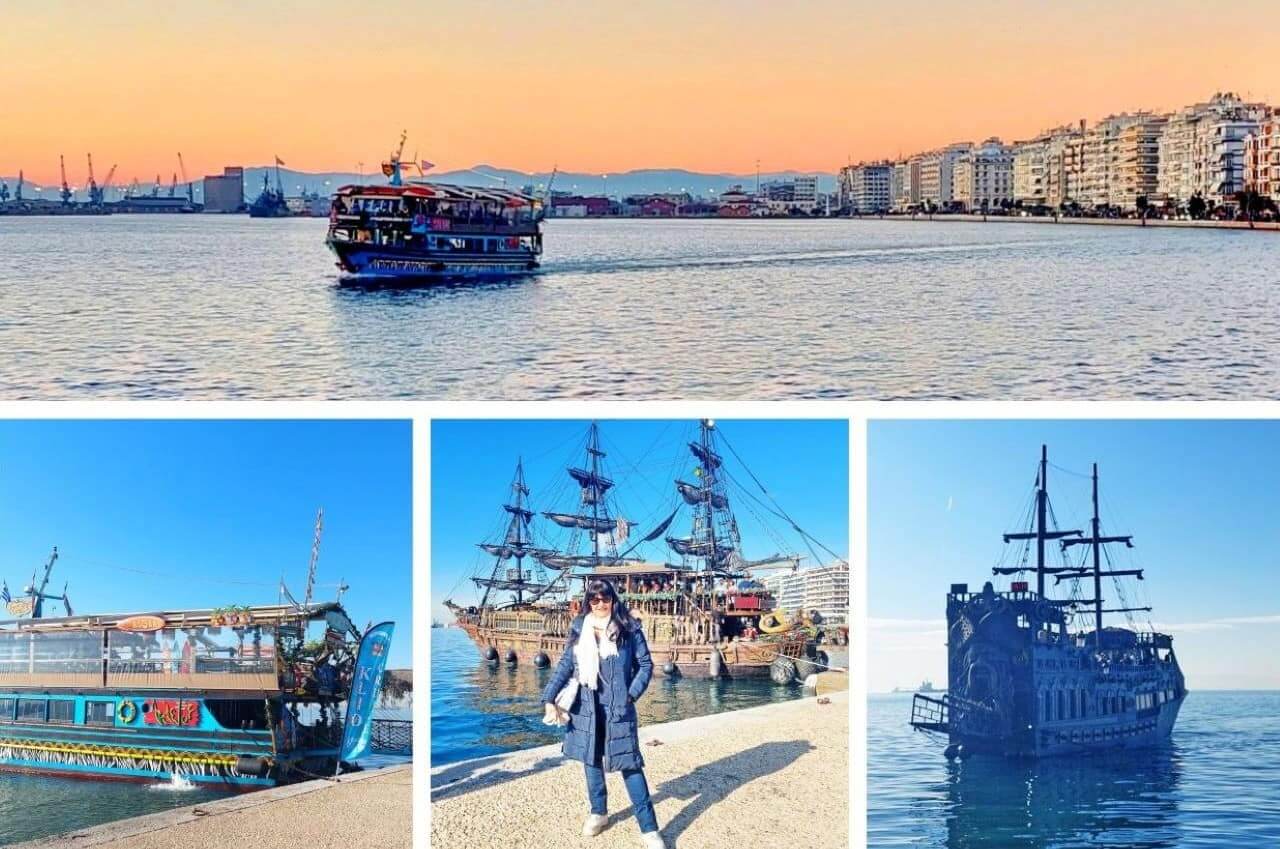
Klio, Arabella, and Black Pearl cruise boats
We took the Black Pearl Cruise Boat, inspired by the famous Pirates of the Caribbean. The boat bar offers refreshing drinks, coffee, beers, wines, signature cocktails (Black Pearl, Jack Sparrow, Barbossa, or Will Turner), music and stunning views of the sea and city, especially at sunset. Also, you can book the pirate boat to celebrate your birthday, host a private event, or have an unforgettable party.
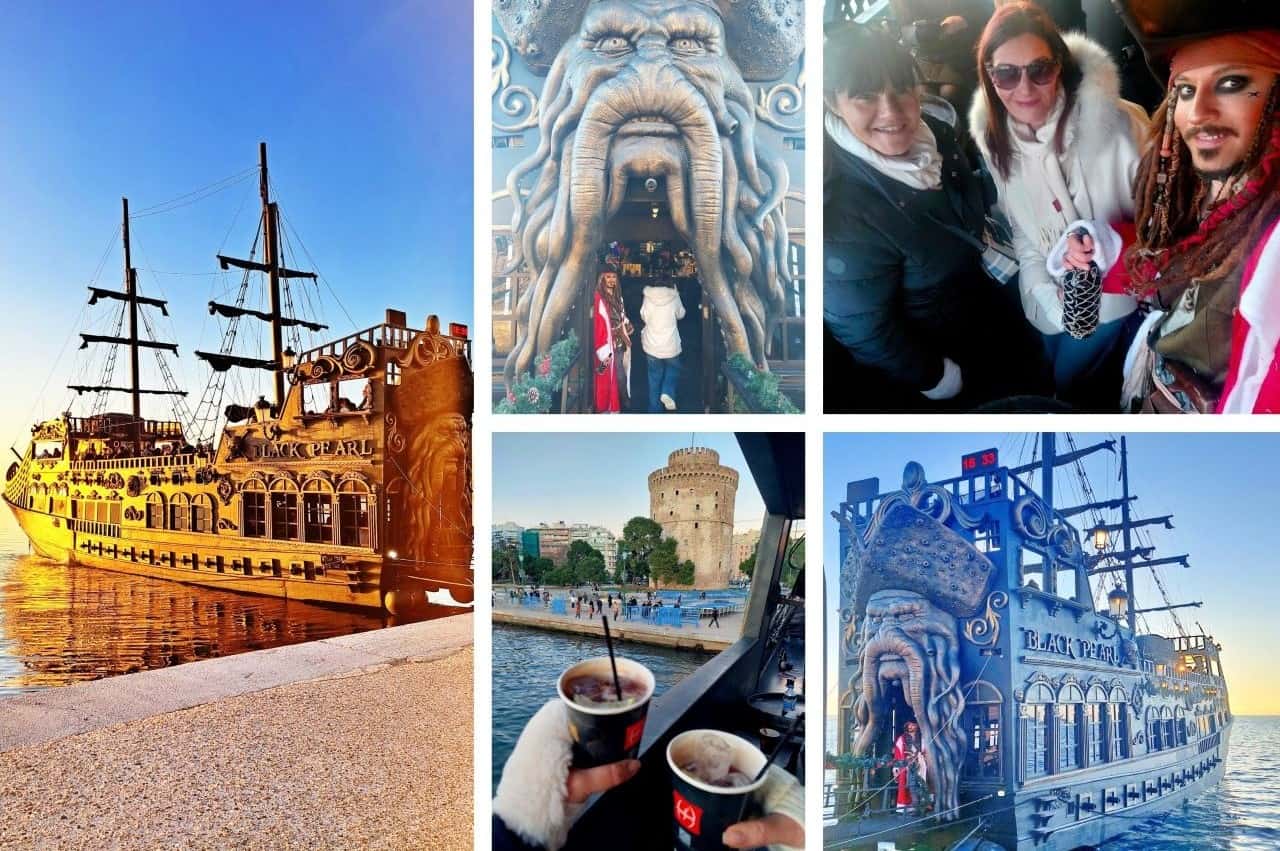
Cruise tour Black Pearl
Ladadika neighbourhood
Ladadika is one of the most picturesque neighbourhoods in the town, with narrow cobbled streets and colourful houses.
By the way, the word “Ladadika” literally means the shops that sell oil and its products. It is located inside the city’s historical centre, and it is close to the port. It was also known as the “Egyptian Market”, and many Jews lived there and had their shops. Before World War I, Ladadika was also known as the Red Light District due to brothels located there.
Although Ladadika wasn’t destroyed by the fire in 1917, it was almost abandoned until the early 1990s, when the Ministry of Culture listed it as a heritage site.
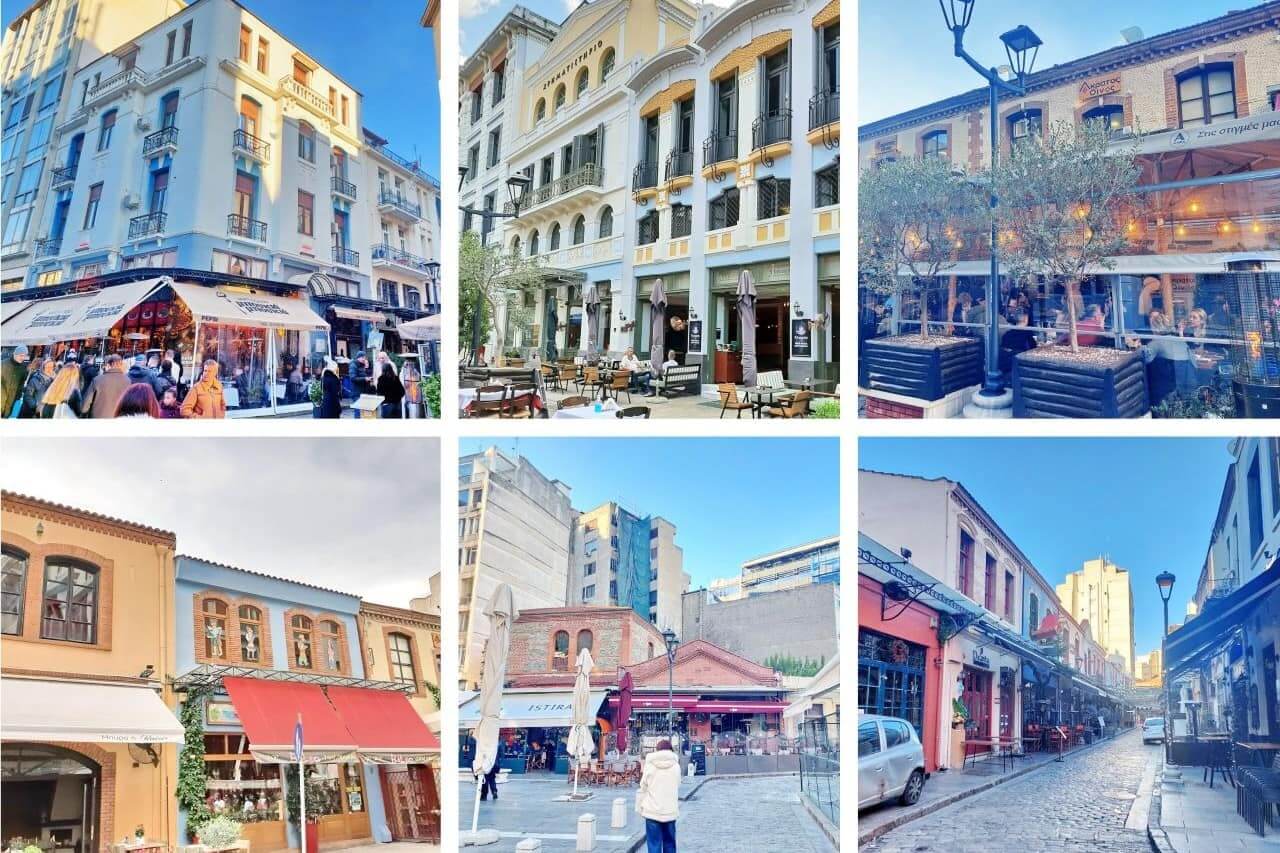
Ladadika restaurants and cafes
Many houses and the main square, Plateia Morichovou, have been renovated and transformed into interesting bars, restaurants, taverns and nightclubs. Today, Ladadika is a place known for its delicious food and good nightlife, which attracts numerous tourists and locals throughout the year.
🏠 A few interesting houses and buildings
I have to admit that I adore strolling around and discovering interesting buildings in every town, and Thessaloniki is full of them…
🏠Old Business District
Close to the Ladadika, there was an old business district along the Agio Mina and Edessis streets. Around today’s Christimirou Square, there are houses built from 1890 to 1925, inspired by the Art Nouveau style. Some of them were destroyed, and the ones that survived are today restored in restaurants, bars or hotels. Some houses are abandoned, but they still look magnificent.
Today, Agio Mina is a pedestrian street, but a part of the tram line can still be seen as a memory of a previous time.
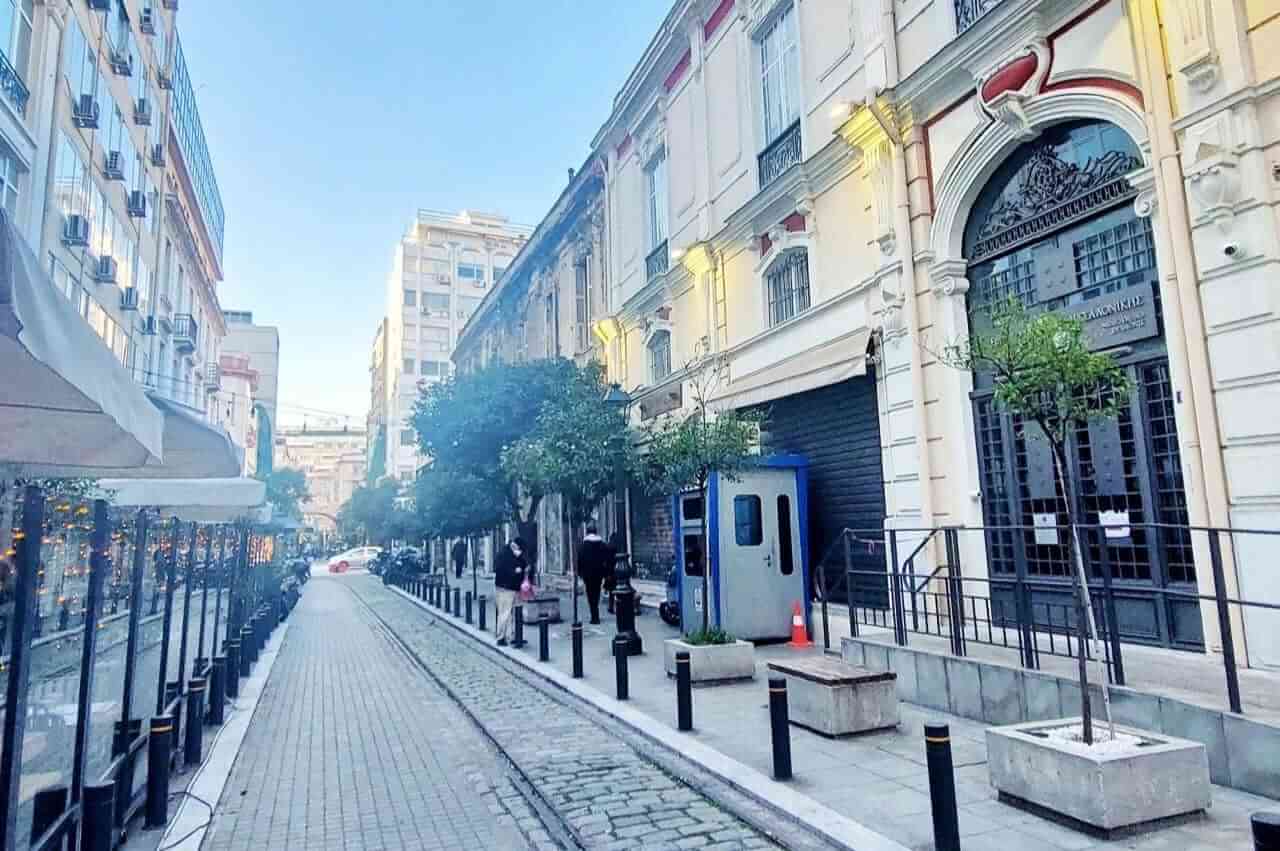
Agio Mina Street and the Jewish Museum
Near this street, you can see the building of Malakopi Arcade. It was built in 1906 for the Allatini family, one of the most powerful Jewish families in the town. The building consisted of shops and offices, and it also housed the Bank of Thessaloniki. It survived a great fire in 1917, while the pediment clock stopped at 11.05 at the time of a big earthquake in 1978. Today, the former arcade houses bars and restaurants.
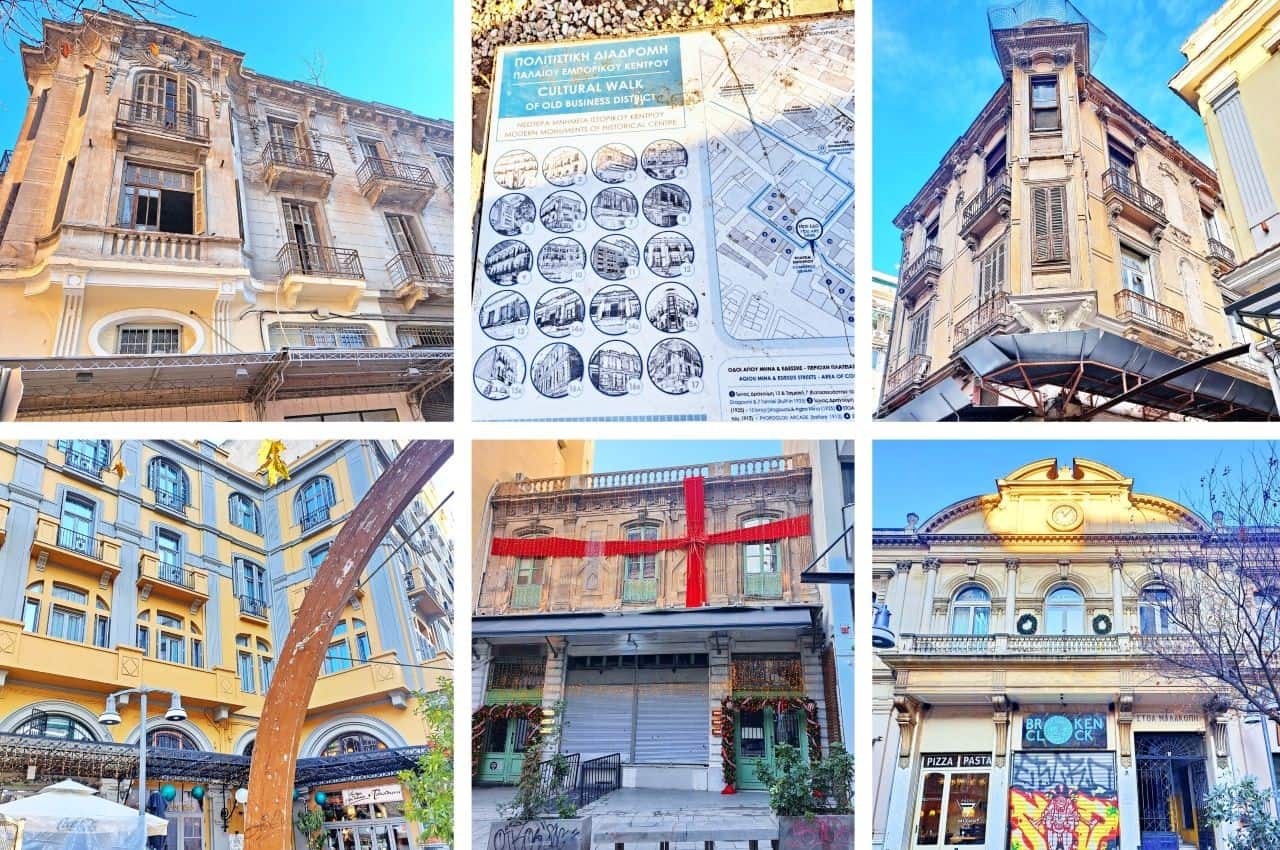
Houses in the Agios Mina and Edessis streets, Malakopi Arcade (right, second row)
🏠 Longos Mansion
This three-storey house is also known as the “Red House” becaouse of its brick construction. It is located at the Agias Sofias Square, across the Church of Agia Sophia, in the centre of the town. The mansion was designed in 1926 by architect Leonardo Gennari for the family of Longos, a wealthy textile industrialist. During Christmas time, it was decorated with a large red ribbon.
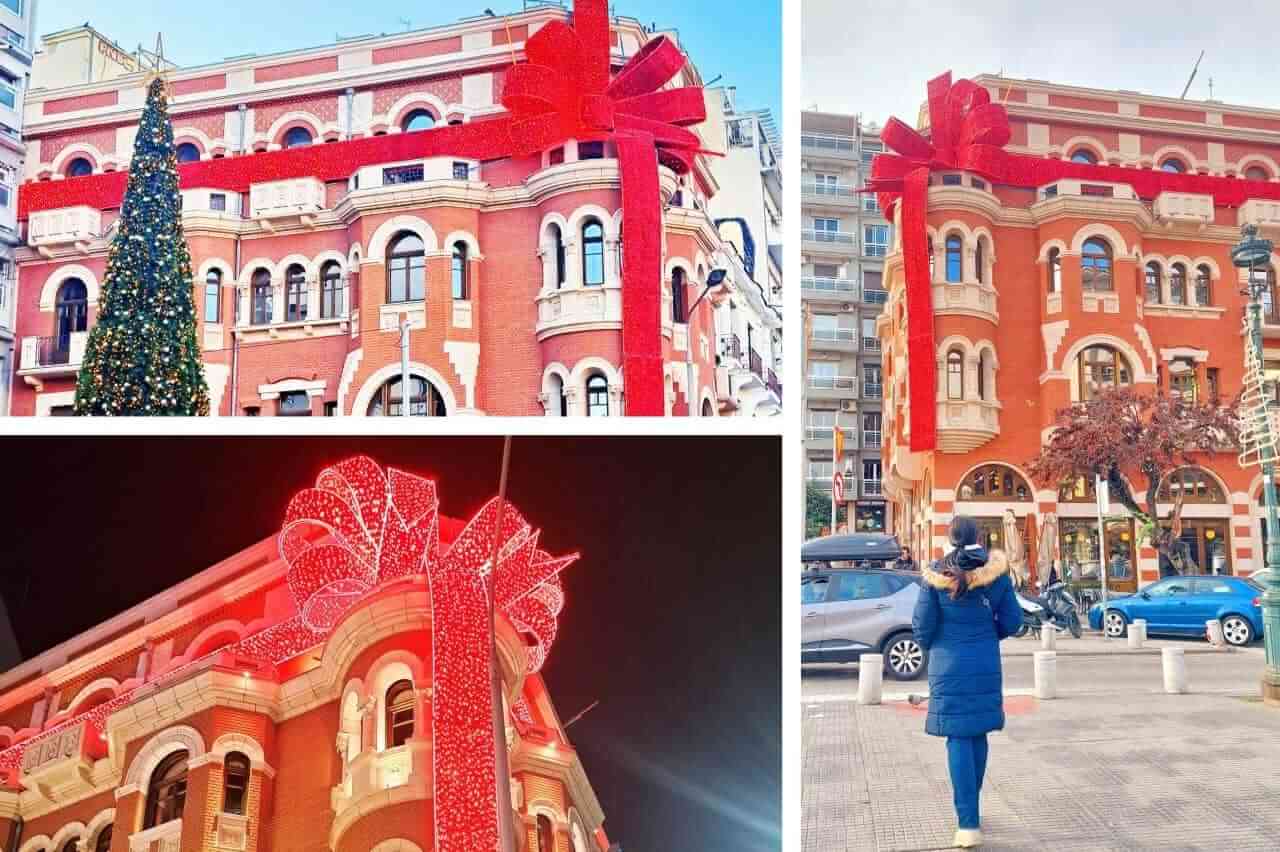
Red House with a red Christmas ribbon
Also, the Agias Sofia pedestrian street was fantastically decorated with blue LED lights.
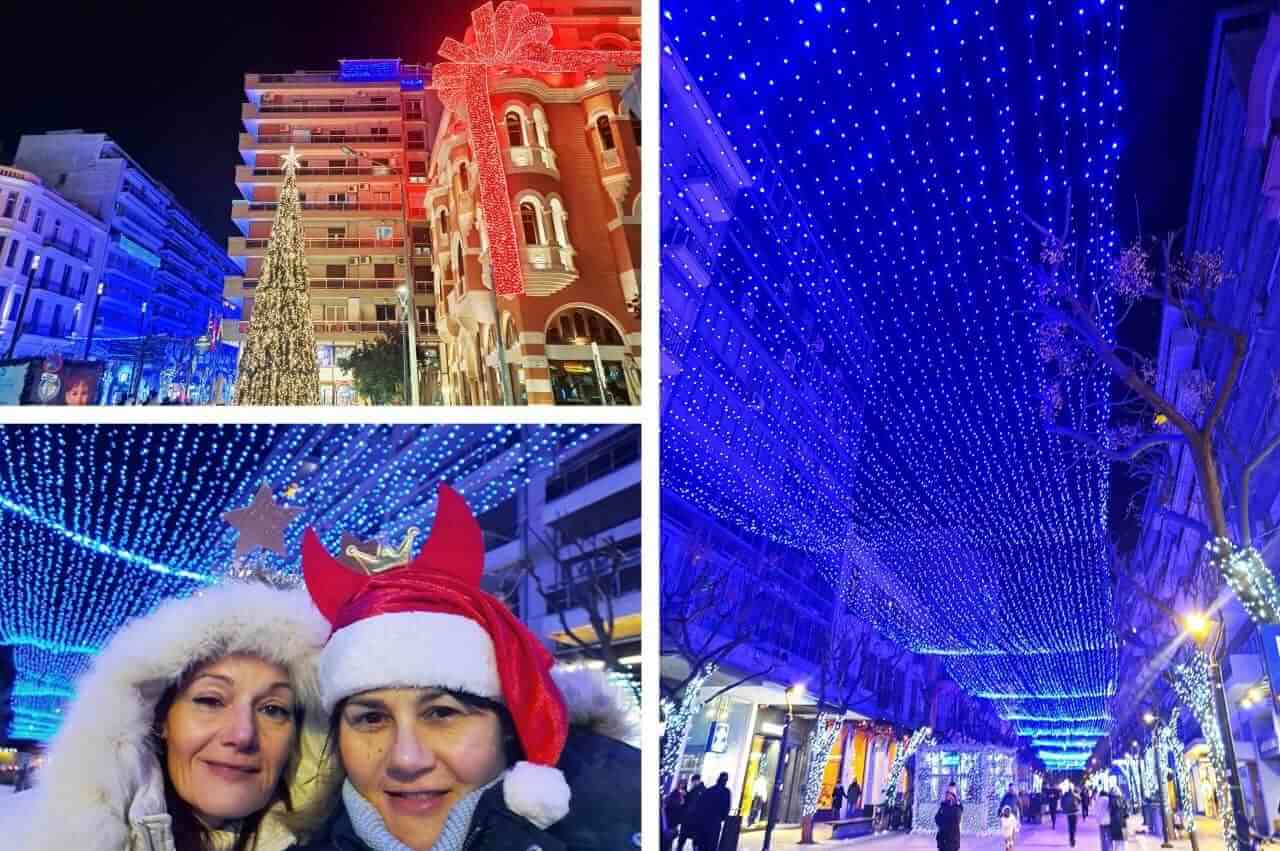
Agia Sophia Street during Christmas time
🪦 Zeitenlik Military Cemetery
The most significant place in Thessaloniki for the Serbian people is the Zeitenlik Allied Military Cemetery. It is the final resting place of about 20,000 soldiers who fought in the Balkan Wars and World War I. Together with Serbian soldiers, the French, Russian, Italian, and British soldiers were buried there.
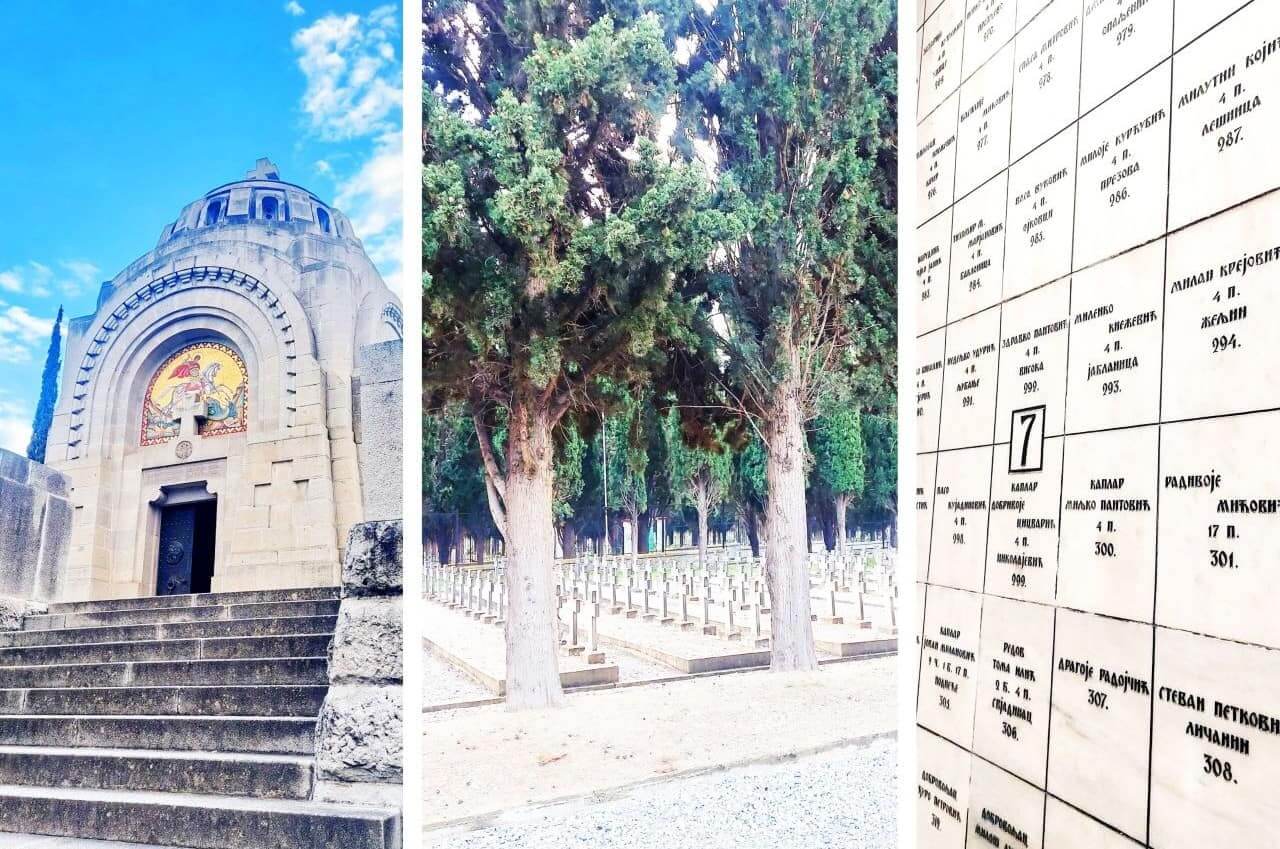
Zeitenlik Military Cemetery
For decades, the Serbian family Mihailović has been the keeper of the Serbian cemetery. But everybody knows about its last keeper, Djordje Mihailović, who passed away in 2023.
📍You can read more about the brave Serbian soldiers and the Zeitenlik Military Cemetery here.
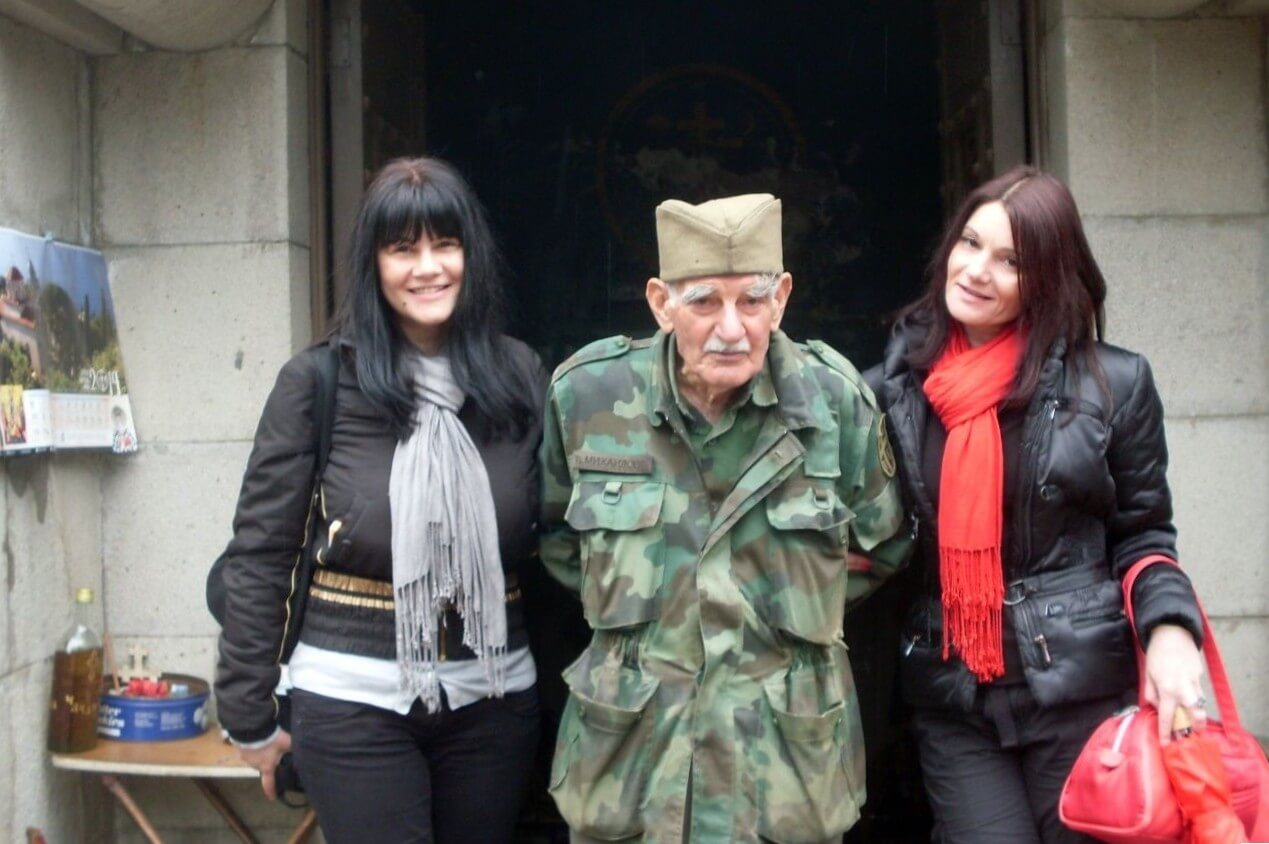
Memory of the keeper of the Serbian cemetery of Zeitenlik, Djordje Mihailovic, April 2014.
🏛️ Museums in Thessaloniki
There are about 20 museums in the town, so take a look at some of them.
♦ The Archaeological Museum of Thessaloniki is the most popular in the town.
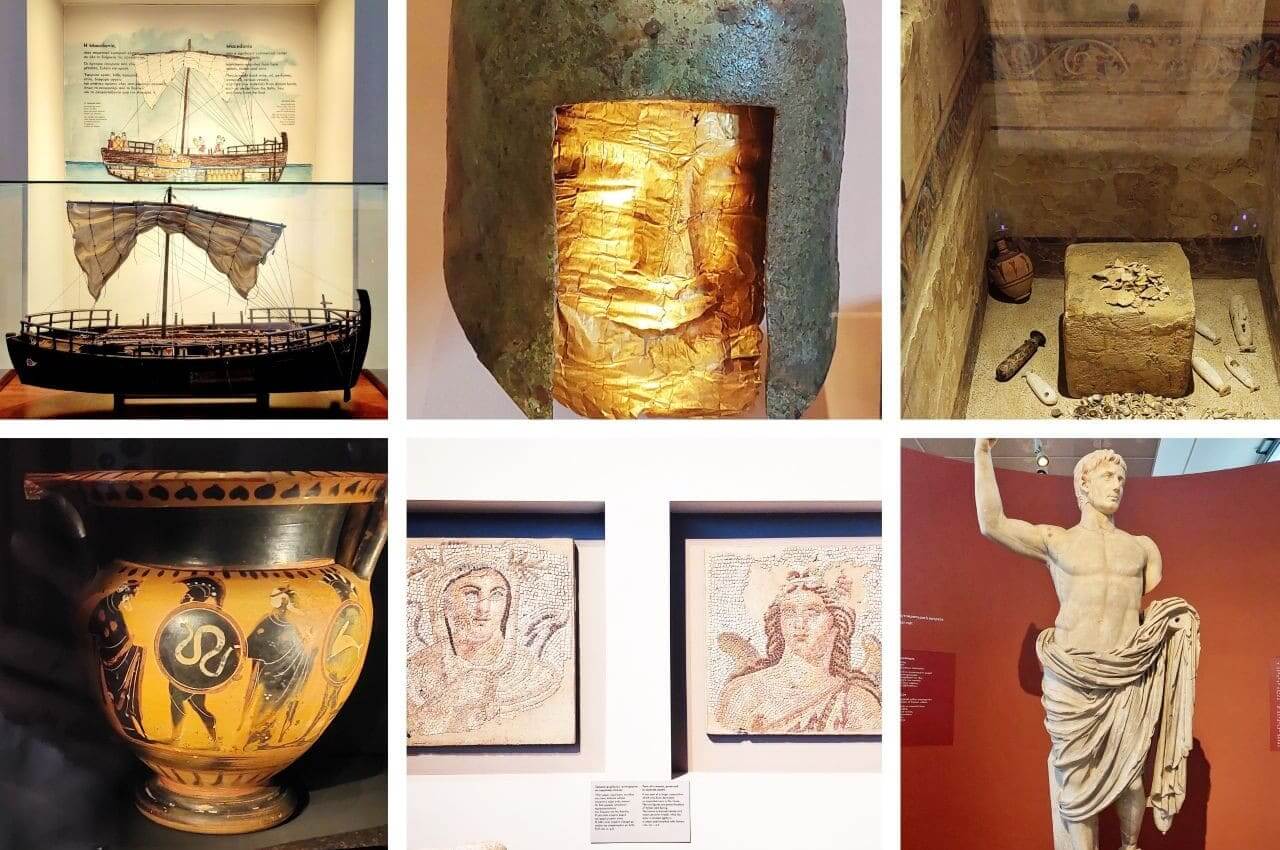
Various items, mosaics and a statue in the Archaeological Museum of Thessaloniki
There, you can see the fantastic artefacts from Macedonia, including statues, gold jewellery, various items, and the Derveni papyrus from the 3rd century BC.
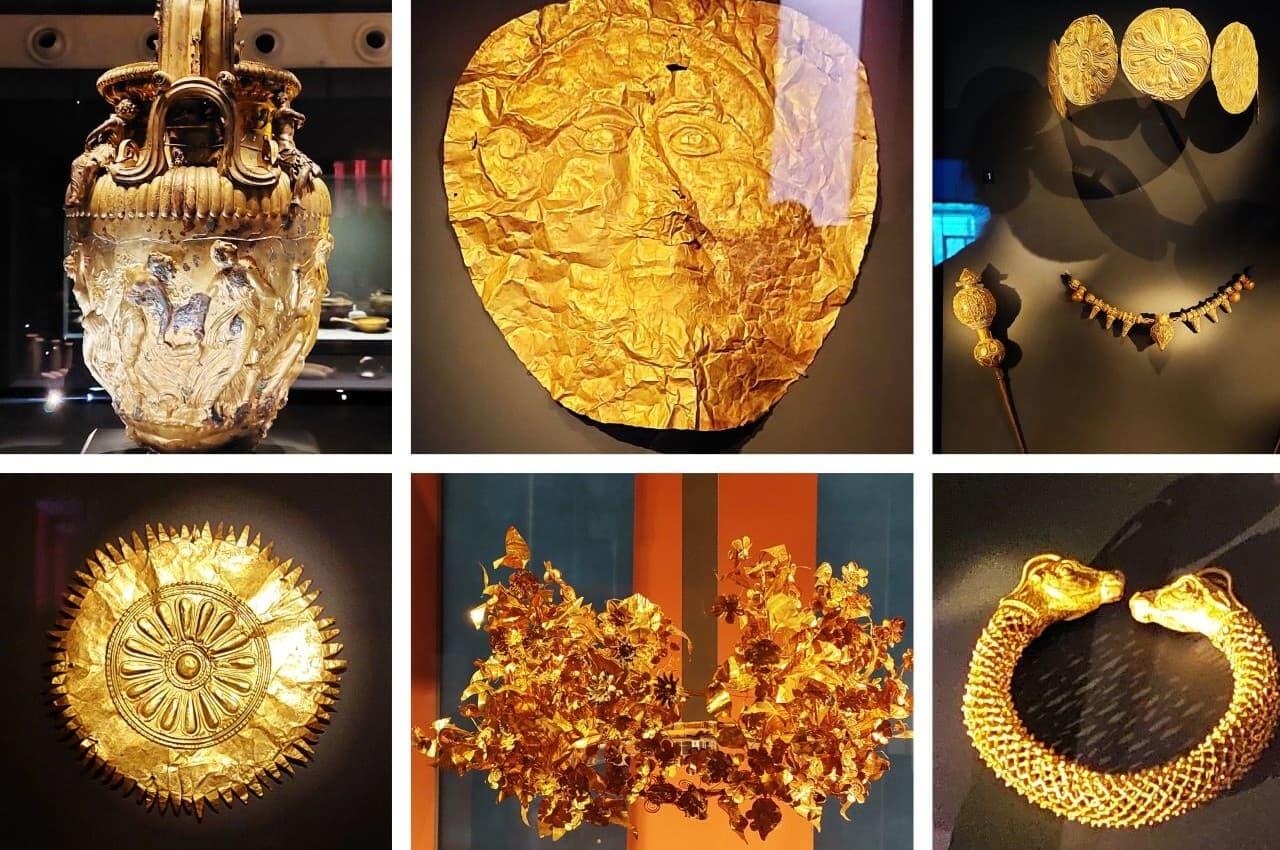
Derveni krater and gold jewellery in the Archaeological Museum
The temporary exhibition “In the Cave”, dedicated to human life from the Palaeolithic era, can be seen from 15th May 2025 to 31st May 2026.
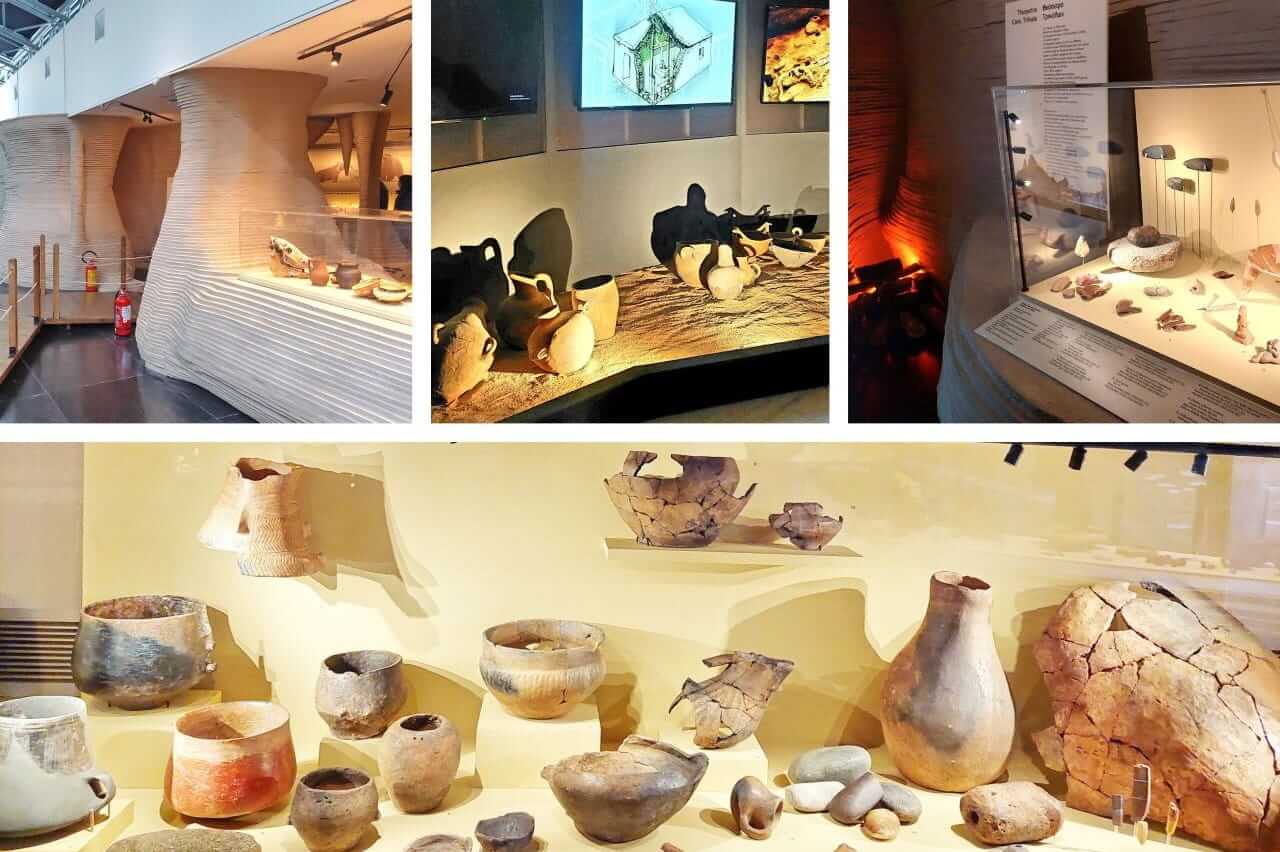
Exhibition “In the Cave”
◊ The Museum of Byzantine Culture is a modern museum of Byzantine heritage, which consists of mosaics, icons, and various objects. Also, the Museum of the White Tower is part of this museum (I already mentioned it in the text).
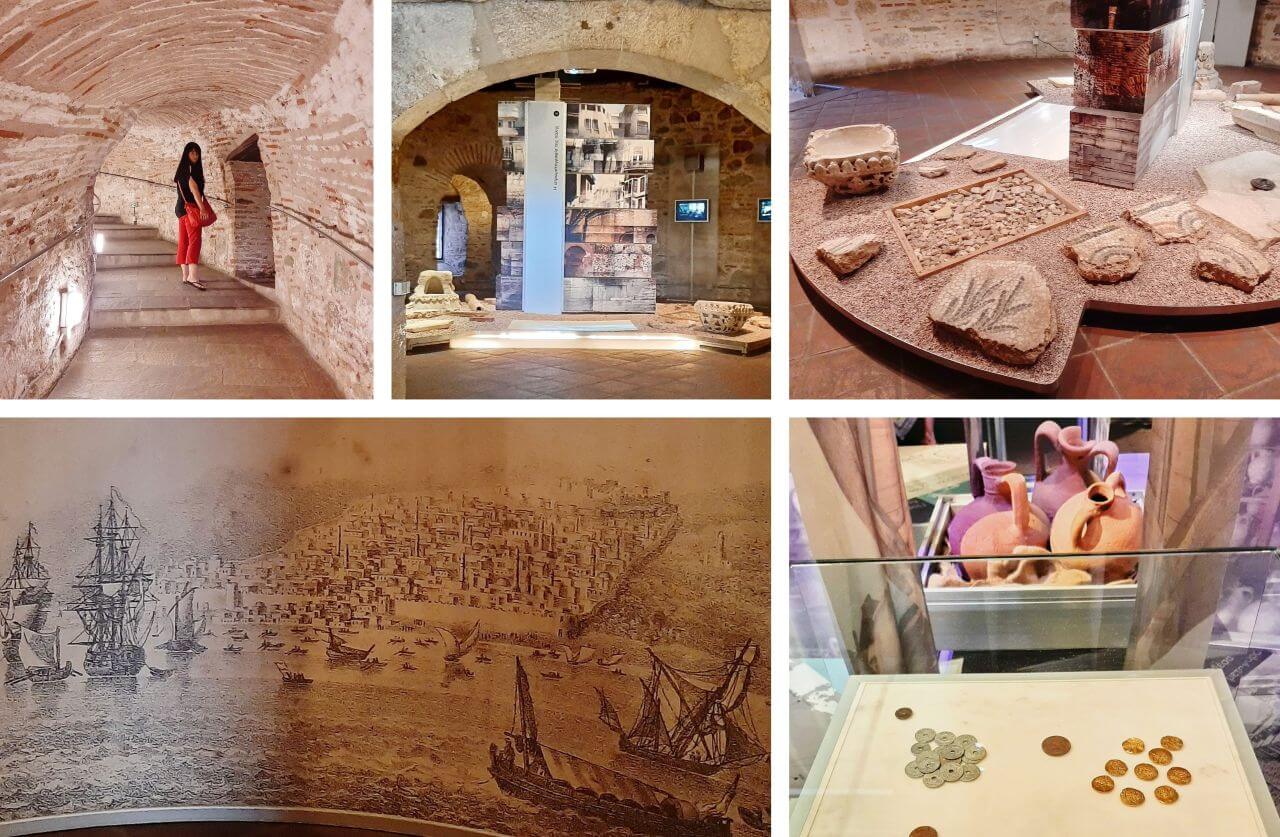
The museum inside the White Tower
♦ The Jewish Museum is dedicated to the memory and history of the Jewish community. It is housed in a renovated commercial arcade dating back to 1904, which once belonged to the Jewish Community of Thessaloniki.
◊ The Museum of the Macedonian Struggle is dedicated to Macedonia’s history from the 19th and early 20th centuries.
♦ The Ataturk Museum is the birth house of Mustafa Kemal Atatürk, the founder of modern Turkey. Today, it is converted into a museum, adjacent to the modern building of the Turkish Consulate.
◊ MOMus MUSEUMS is the Museum of Contemporary Art, located at Warehouse B1 in the Port Area.
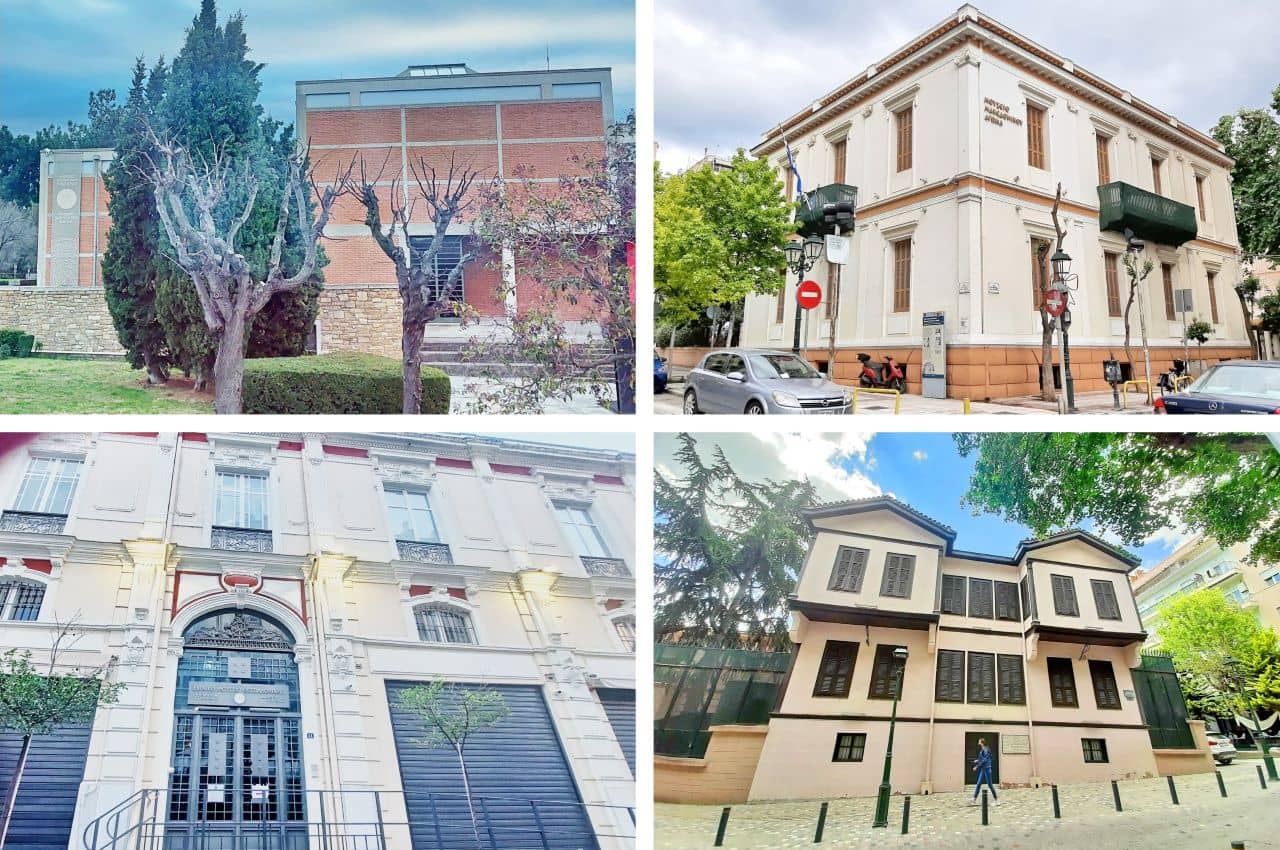
The Museum of Byzantine Culture, The Museum of the Macedonian Struggle, The Jewish Museum, The Atatürk Museum
☕🍽️ Cafes and restaurants
Thessaloniki is well known for its delicious food, thanks to its position and trade on the Mediterranean. It is a mix of Greek, Balkan, and Middle Eastern flavours. In 2021, Thessaloniki was inscribed on the list of UNESCO Cities of Gastronomy.
All around the town, you can find many cafes, taverns, restaurants, and pastries. Try local specialities: Bougatsa pastry, koulouri (sesame bread rings), gyros, souvlaki, Greek salad, mezedes (small plates), and fresh seafood.
Take a look at several restaurants.
Ladadika taverns: Akratos, Haroupi, Akpov, Ladadika, Kantouni, Marathos, Charoupi, Savvikos Greek Grill, Full tou Meze.
Ano Poli is perfect for traditional dishes; the popular restaurants are Tsinari, Kanoula, and Stáfylos Gi.
Many of the waterfront promenade’s cafes and restaurants are ideal for enjoying the view of the sea.
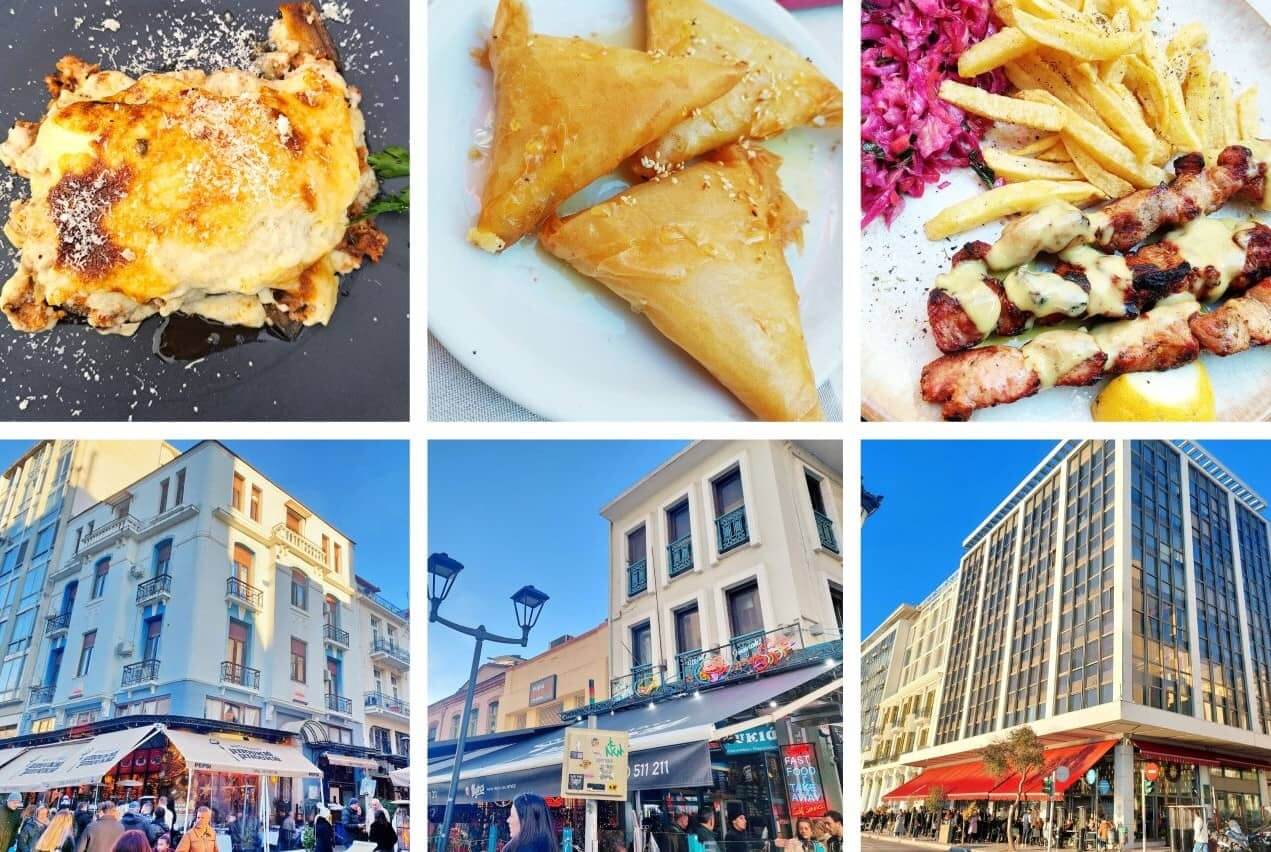
Greek food and restaurants
One of the most popular pastry shops is Blé Taste Gallery, located on Agia Sophia Street. It is an amazing place with delicious chocolate, cakes, handcrafted breads, coffees, festive products, sandwiches and salads.
Blé was fantastically decorated during the Christmas and New Year period 🤩
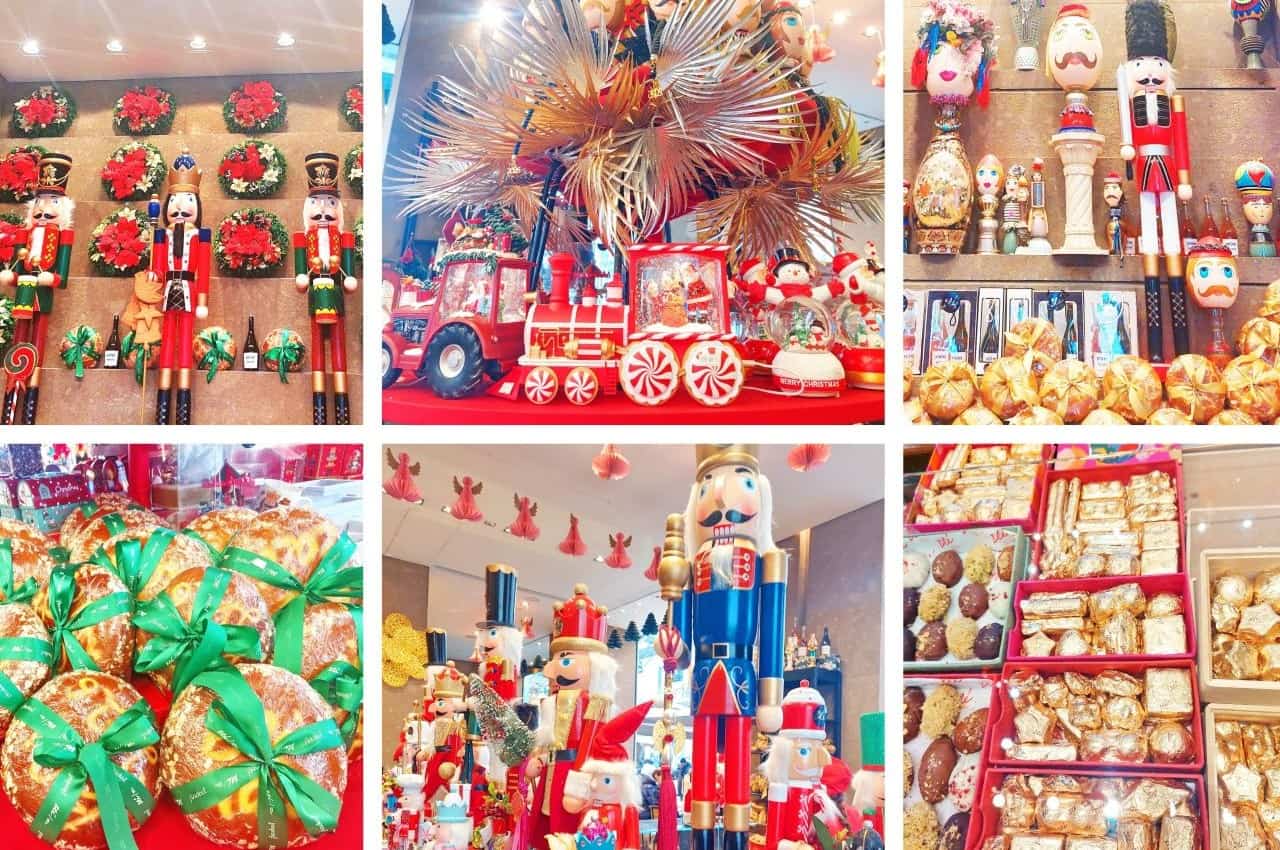
Thessaloniki, Blé Taste Gallery
🏨 Accommodation in Thessaloniki
Numerous accommodation facilities in Thessaloniki suit all budgets.
Luxury hotels:
Electra Palace, Makedonia Palace, No. 15 Ermou Hotel, Mon Asty, The Excelsior – Small Luxury Hotels of the World, The Mediterranean Palace Hotel, The Antigon Urban Chic Hotel, S Hotel Boutique Thessaloniki, Daios Luxury Living, and The Met Hotel Thessaloniki.
Mid-range hotels and apartments:
Noa Hotel, Bahar Boutique Hotel, Zenith Premium Suites, City Hotel Thessaloniki, Pillow urban stay, Caravan Hotel, Gatto Perso Luxury Studios and Apartments, and Mandrino Hotel.
Budget: options:
Zeus is Loose Hostel, Stay Hybrid Youth Hostel, Valaoritou 3 Luxury Rooms.
🛍️ Shopping time
Ah, Thessaloniki is a paradise for shoppers 😀
There are many shops where you can find everything, from luxury boutiques to various clothing, shoes and local markets.
♦ Tsimiski and Egnatia streets are the main shopping streets with international brands and fashion stores.
Mitropoleos Street is known for designer boutiques, while Proxenou Koromila Street is the most exclusive shopping street, with luxurious brands and elegant cafes.
◊ Close to Aristotle Square, there are the Kapani Market and the Modiano Market. At these traditional markets, you can buy fresh local products, cheeses, and spices. Inside, there are also a few tavernas, restaurants and bars.
♦ Shopping malls: Attica Department Store, Mediterranean Cosmos and One Salonica Outlet Mall.
◊ And don’t forget to buy various souvenirs, handicrafts, magnets… You can take local products, like olive oil, olives, honey, wines, cheeses, handmade pasta, or local cakes and chocolates.
📍 What to see close to Thessaloniki
Depending on your time and interests, you can combine a visit to Thessaloniki, a summer vacation and an excursion to a few nearby places.
◊ Beaches near Thessaloniki
Although Thessaloniki is a port city, there are no beaches in the town. The closest beaches are Perea and Agia Triada, located about 30 minutes away, and equipped with all tourist facilities. Epanomi Beach is located about 40 km away, known for its shipwreck and crystal-clear waters.
About an hour’s drive, you can reach the Chalkidiki Peninsula (Sithonia and Kassandra), the favourite area of Balkan tourists. The third “finger” is Mount Athos, known for its monasteries.
♦ Mount Olympus is Greece’s highest mountain, located about 90 km from Thessaloniki. It is famous as the home of the 12 Olympian gods in Greek mythology. You can reach it by car, bus, train or organised tours.
◊ The famous Meteora is an amazing rock formation with the Orthodox monastery complex located on its top. It is about 230 km away from Thessaloniki.
In a word, there are many things you can see and do in Thessaloniki.
So, make a good plan: taste delicious food, visit Byzantine churches and historic monuments, relax, sip coffee and enjoy a sea view. I am sure that Thessaloniki will captivate you with its energy, flavours, and interesting stories.
 www.nataniatravel,com


Leave a Reply
Want to join the discussion?Feel free to contribute!