
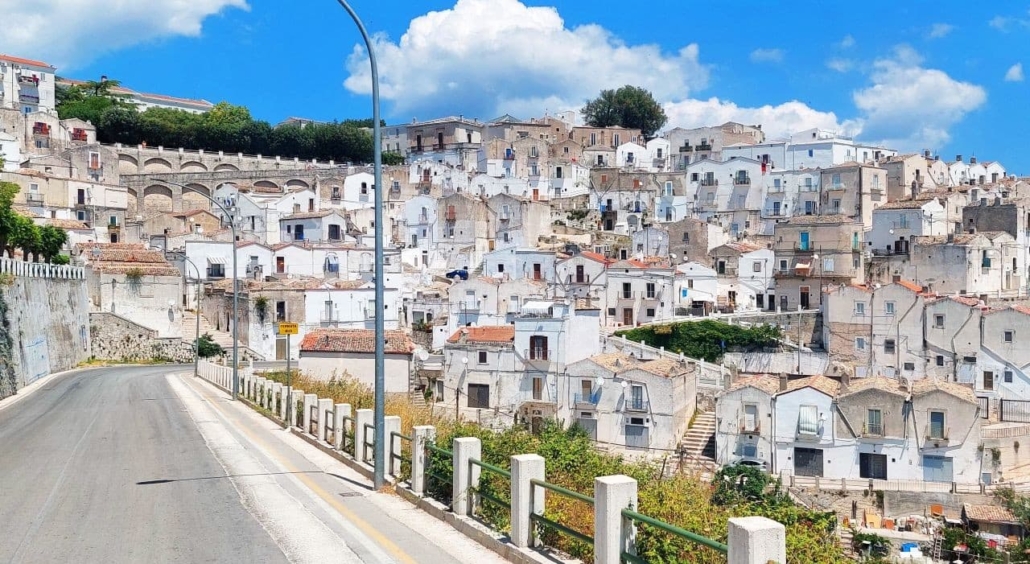
Monte Sant’Angelo and the Sanctuary of San Michele Arcangelo
Monte Sant’Angelo is a beautiful small town situated on the southern slopes of Monte Gargano, in southeastern Italy. For centuries, pilgrims, popes, kings, emperors, and sovereigns have visited this place due to the Sanctuary of San Michele Arcangelo.
Interestingly, this sanctuary lies along the Sacred Line of Saint Michael. It is a mystical alignment that connects seven shrines from Ireland to the Middle East, all dedicated to the Archangel Michael. It sounds interesting, doesn’t it…
So, let me tell you more about this amazing sacred place, veiled in clouds and prayers…
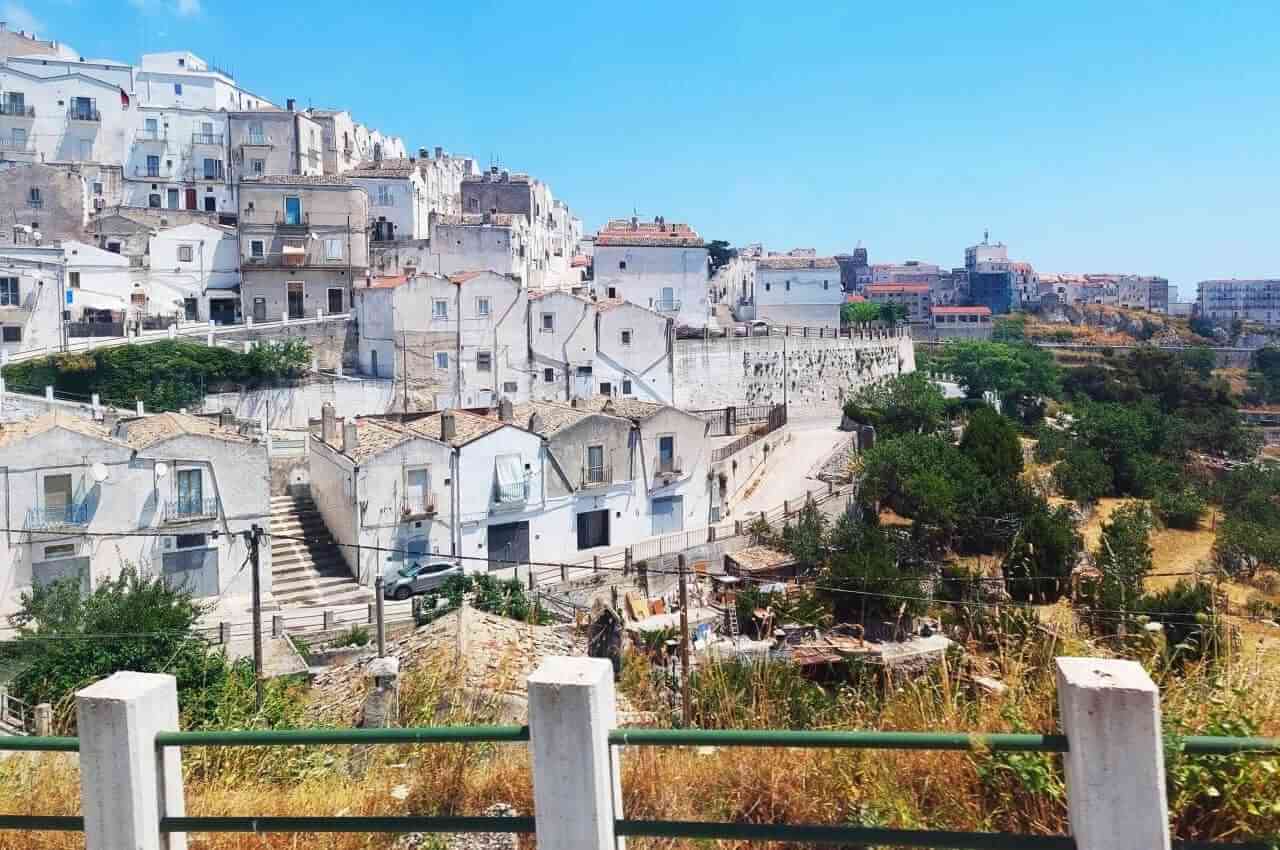
White houses in Monte Sant’Angelo
📌 How to get to Monte Sant’Angelo
Monte Sant’Angelo is located in the province of Foggia, in the region of Puglia, at an elevation of 843 meters. This area belongs to the Gargano Mount and the Gargano National Park. The town is also known as one of “The most beautiful villages in Italy” (Borghi più belli d’Italia).
The road to the town is winding and full of curves, so drive carefully. But the views of olive groves, limestone cliffs, the Adriatic Sea and the Gulf of Manfredonia are breathtaking.
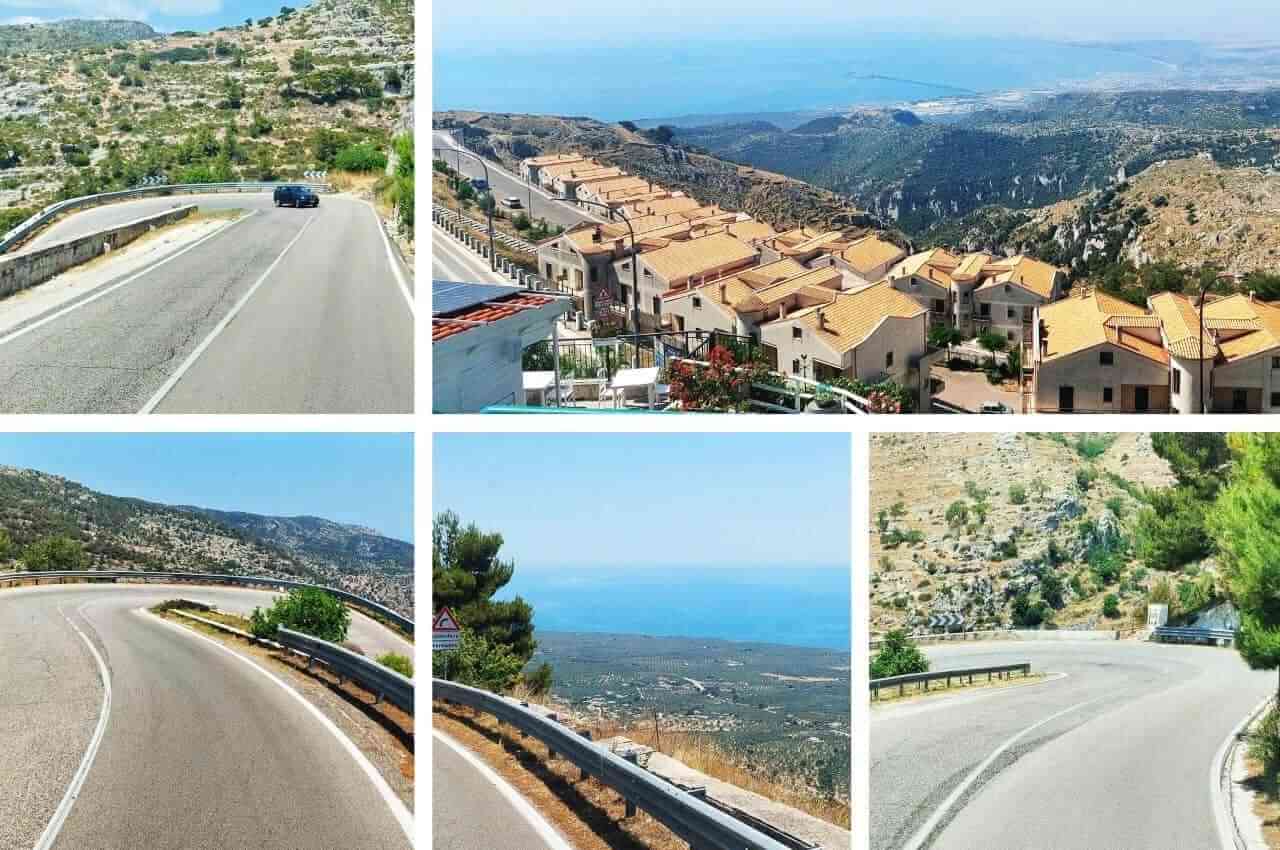
Winding road to Monte Sant’Angelo
🚗 By Car
The most convenient way to reach the town is by car. Follow the A14 Bologna/Taranto motorway, take the San Severo or Foggia exit and follow the signs for Monte Sant’Angelo.
You can also take a bus from several Italian cities. Check the schedule of the Ferrovie del Gargano, which includes both bus and train routes.
Depending on your location, you can take a train to the Foggia station, then continue by bus or taxi to Monte Sant’Angelo.
The nearest airport is Foggia “Gino Lisa” Airport (about 60 km), while Bari Airport is about 130 km away from the town. From there, you can take the bus of Ferrovie del Gargano or rent a car.
What to see in Monte Sant’Angelo
Half a day is usually enough to explore the town. It is the highest inhabited settlement of the Gargano promontory.
Its narrow alleys are filled with white terraced houses, arches, tiny stairways, cafes, restaurants, and small shops selling local products and souvenirs. But let’s start with its most famous landmark, the Sanctuary of San Michele.
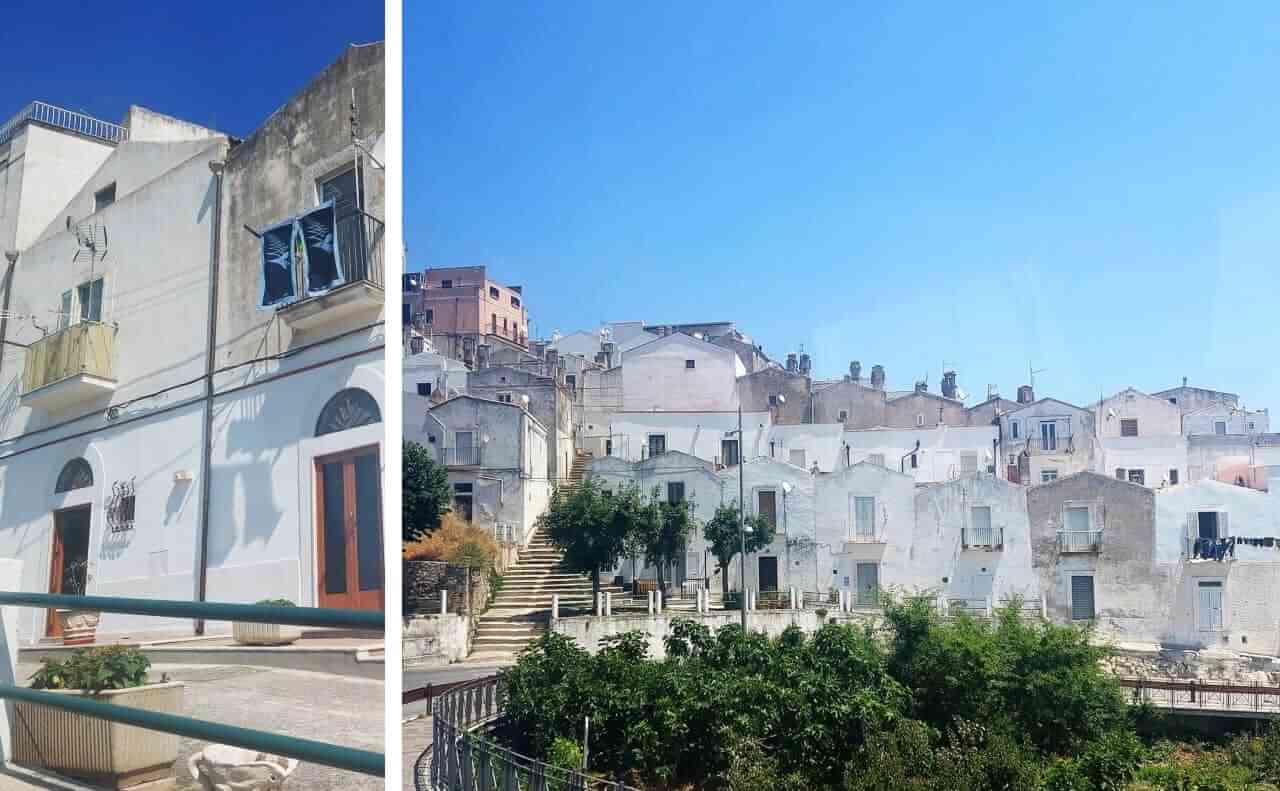
Houses of Monte Sant Angelo
⛪ The Sanctuary of Monte Sant’Angelo and San Michele Arcangelo
The history of Monte Sant’Angelo is inseparable from its sanctuary dedicated to San Michele (Saint Michael the Archangel).
According to legend, this sacred limestone cave was once a site of pagan worship in the Greek and Roman times.
Then, in the late 5th century, San Michele Arcangelo appeared three times, AD: in 490, 492, and 493 AD, shining in a flash of divine light. He instructed the Bishop of Siponto to dedicate the cave to Christian worship, promising protection from invaders.
Each year, the apparition of San Michele is commemorated on the 8th of May.
Who is San Michele Arcangelo (Saint Michael)
By the way, San Michele is one of the seven archangels recognised by Christianity. He is the warrior of God in Christianity, Islam, and Judaism.
San Michele is the protector of the sick, paramedics, the Police Forces, sailors, and firemen. Also, he is the protector of the radiologists, pharmacists, pastry chefs, merchants, and swordsmen.
Today, he is the patron of many cities and towns, the Guardian of the Catholic Church, the Eastern Orthodox, and the protector of the Jewish people.
Generally, San Michele is presented as an angelic warrior, armed with a helmet, sword, and shield. Sometimes, he defeats Satan in the form of a dragon or a serpent. A palm branch in the left hand symbolises the victory of good over evil. Depending on his role, he holds scales weighing souls on Judgement Day, or he has wings, looking like an angel.
Western churches celebrate the Feast of Saint Michael and the Archangels on the 29th of September. Most Eastern Orthodox churches (and those that use the Gregorian calendar) celebrate it on the 8th of November.
Those who follow the Julian calendar (such as in Serbia) celebrate it on the 21st of November. Also, in Serbia, it is one of the most popular family feasts, or “slava”, known as Arandjelovdan. Saint Michael was also the patron saint of the Serbian Nemanjić dynasty. And the capital Belgrade’s Orthodox cathedral, Saborna crkva, is dedicated to Archangel Michael.
Interestingly, the Coptic Churches celebrate him on the 12th of every month.
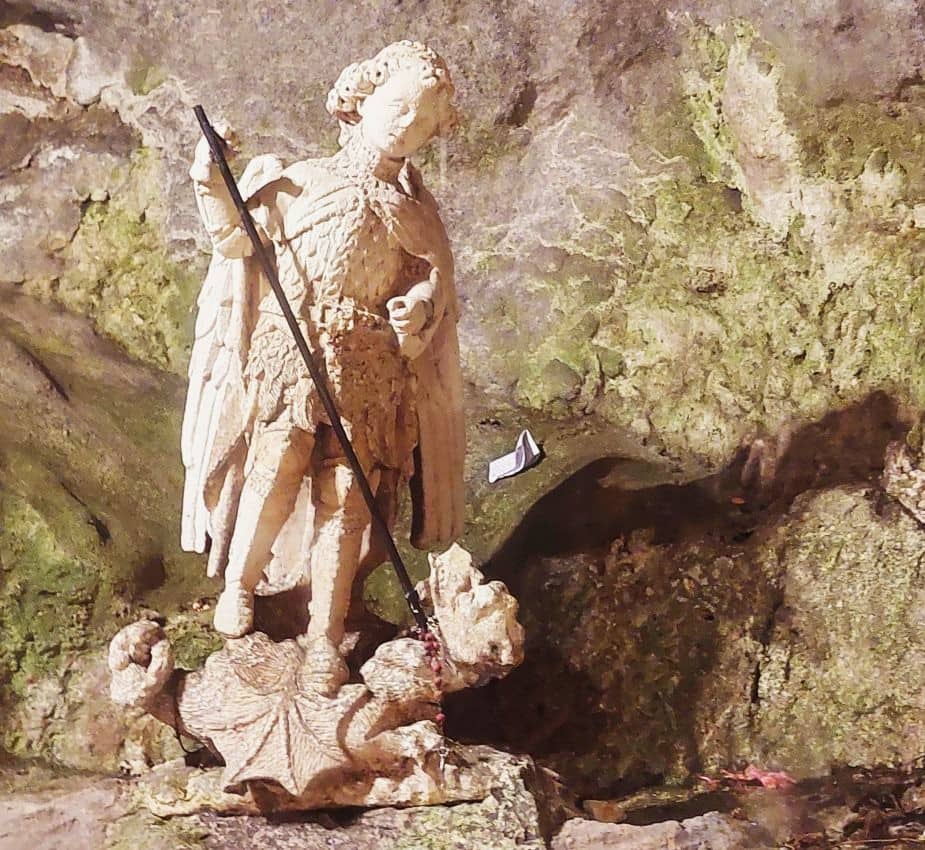
Small statue of San Michele in the Grotta of Saint Michele
A few words about the history of the Sanctuary of San Michele
The first sanctuary was founded in 493 above the cave where Saint Michele appeared for the first time.
Then, in the 7th century, the Gargano area and most parts of the Italian peninsula were conquered by the Lombards, a Germanic tribe. Over time, the cult of San Michele grew, and the sanctuary became a major spiritual centre among the Lombards and the entire Western world. Because of them, the sanctuary is one of the seven groups of historic sites included in the World Heritage Site “Longobards in Italy. Places of the power (568 – 774 AD)“.
After the fall of the Lombard Kingdom in 774 and later the Duchy of Benevento, the sanctuary was damaged due to several Saracen attacks between the late 9th and early 10th centuries. Then, it was under the rule of the Byzantines, the Normans, the Swabians and the Angevins.
In the 17th century, Monte Sant’Angelo became part of the Kingdom of Naples, and later, in 1861, it belonged to the Kingdom of Italy.
The complex of the Sanctuary of Saint Michele was inscribed on the UNESCO World Heritage Site in 2011.
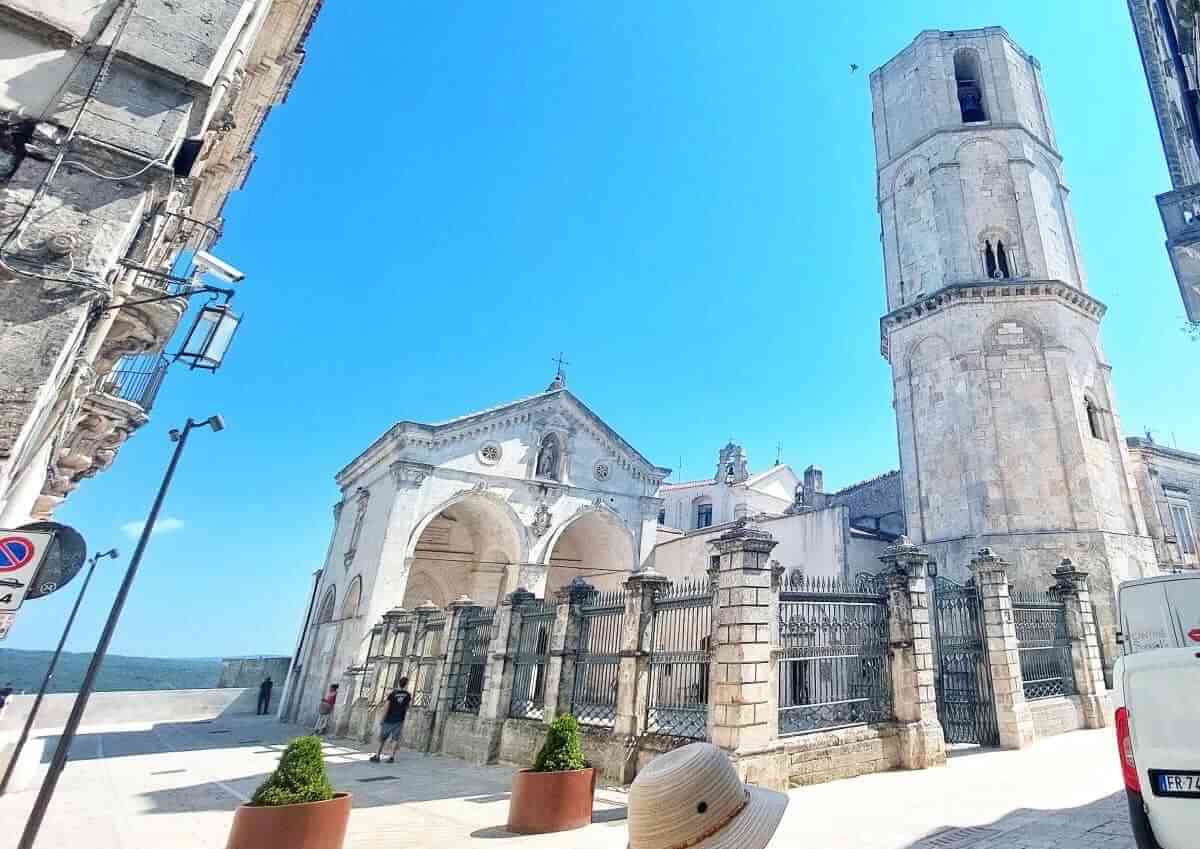
Sanctuary of Saint Michele with the bell tower
⛪ Basilica Santuario di San Michele Arcangelo – Sanctuary of San Michele
The main entrance to the sanctuary is located on Via Reale Basilica, in the historic heart of the town.
The complex of San Michele Arcangelo underwent a major transformation and restoration in the 13th century by Charles I of Anjou. He also rebuilt a bell tower located near the sanctuary in 1282. Originally, it was built by Frederick II as a watchtower. Once, it was 40 meters high, but its current height is 27 meters. The bell tower has four levels and six bells, and the largest one dates back to 1666.
By the way, the sanctuary was under the special protection of Angevin rulers.
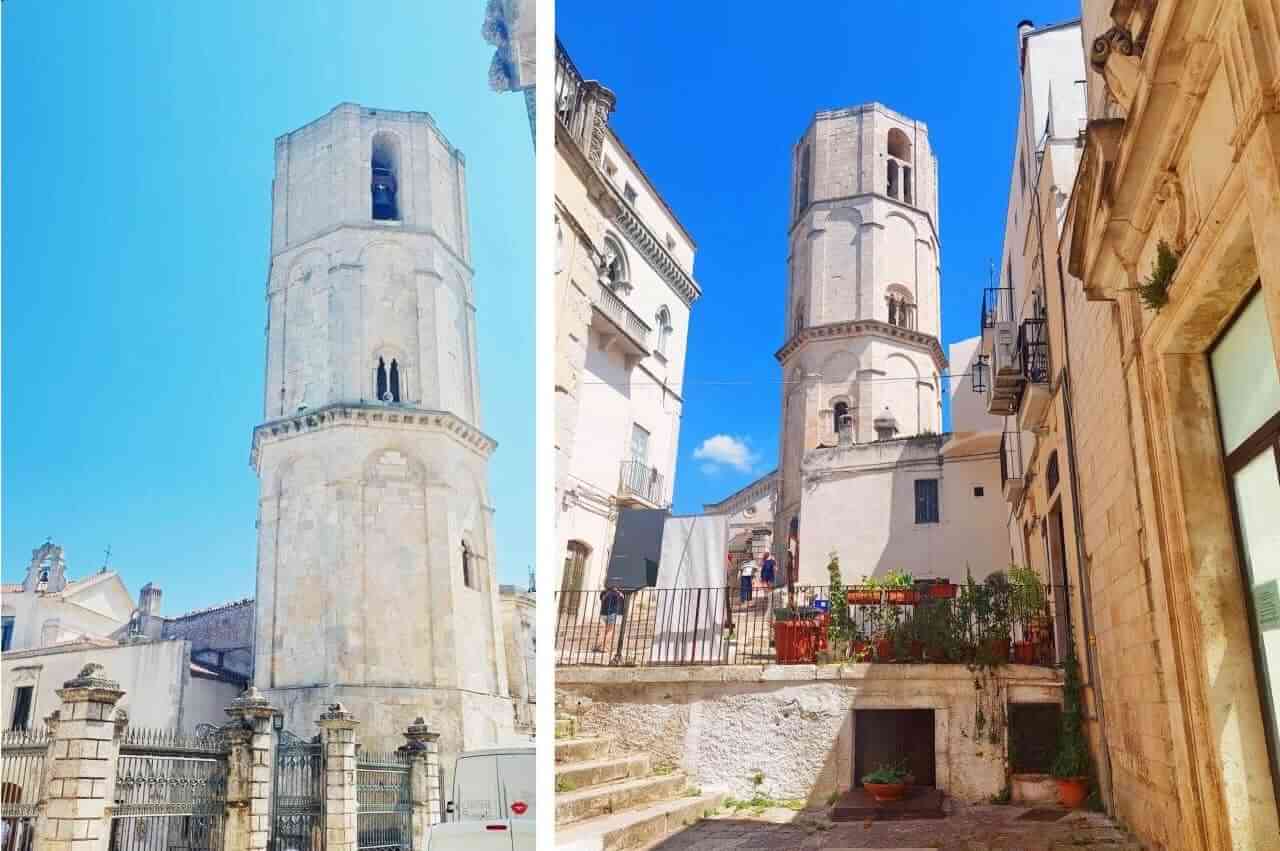
Bell tower of the Sanctuary of San Michele
We passed through a small courtyard (the “Upper Atrium”) and entered the double-arcaded gateway. Originally built in the 14th century, it was modified several times, including its current shape from 1865.
On top of the facade, a small shrine holds the statue of San Michele.
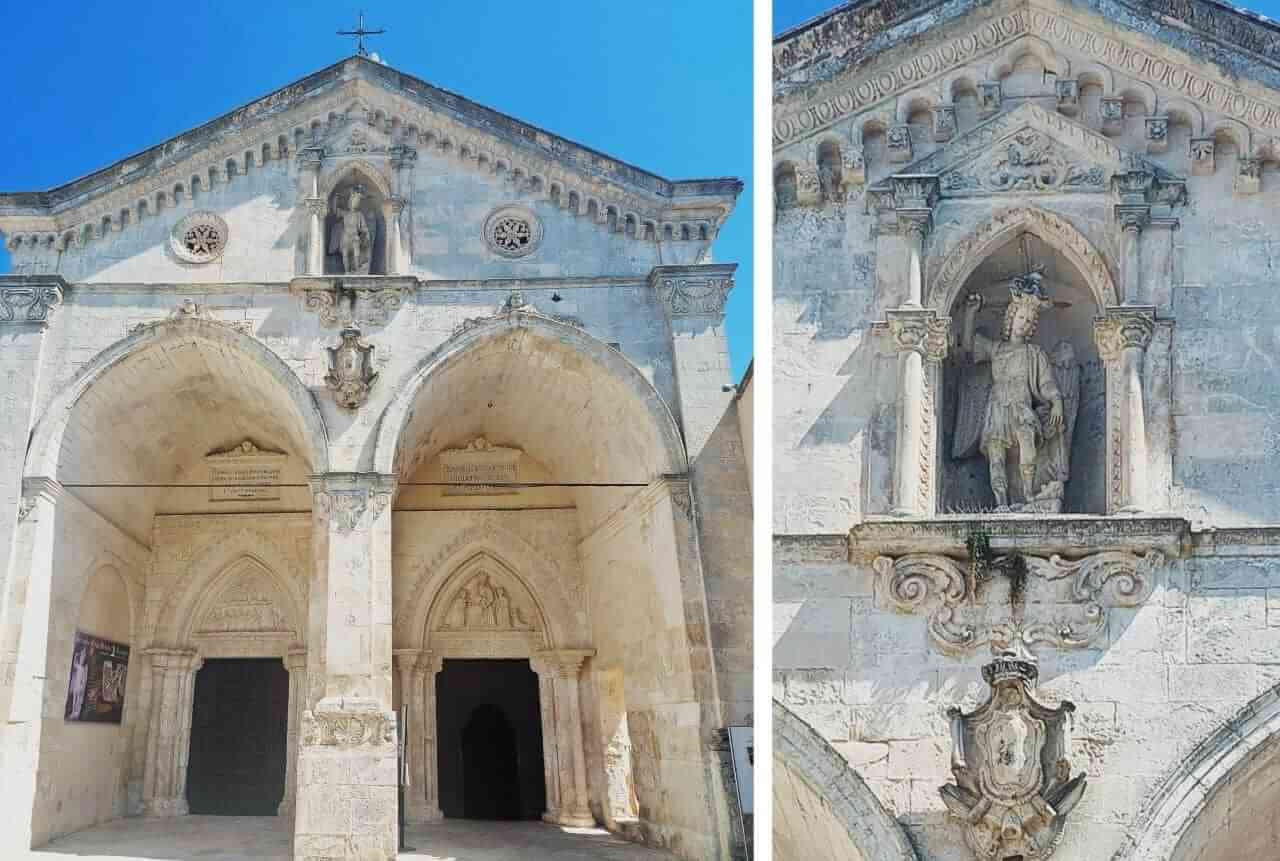
Entrance to the Sanctuary of San Michele
Grotta di San Michele Arcangelo
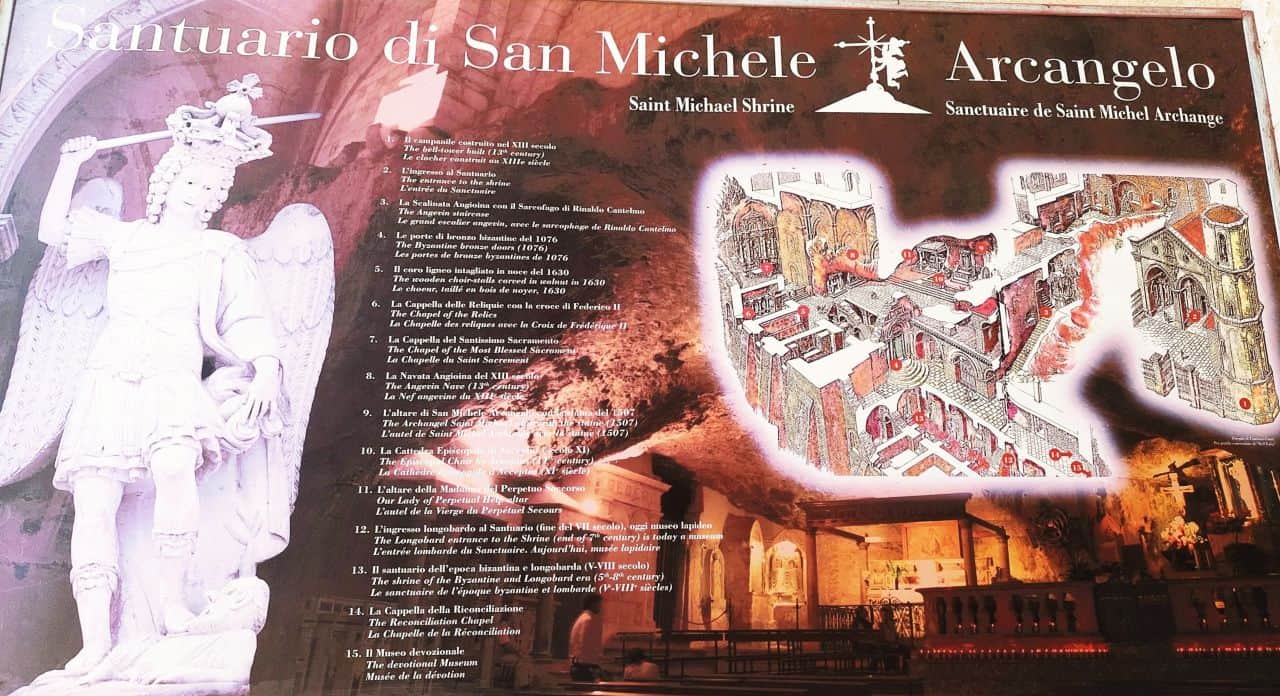
Map of the Sanctuary of San Michele
The marble stairway from the 13th century leads down to the grotto of the sanctuary. There are 86 steps divided into five levels, decorated with statues, votive offerings and various inscriptions.
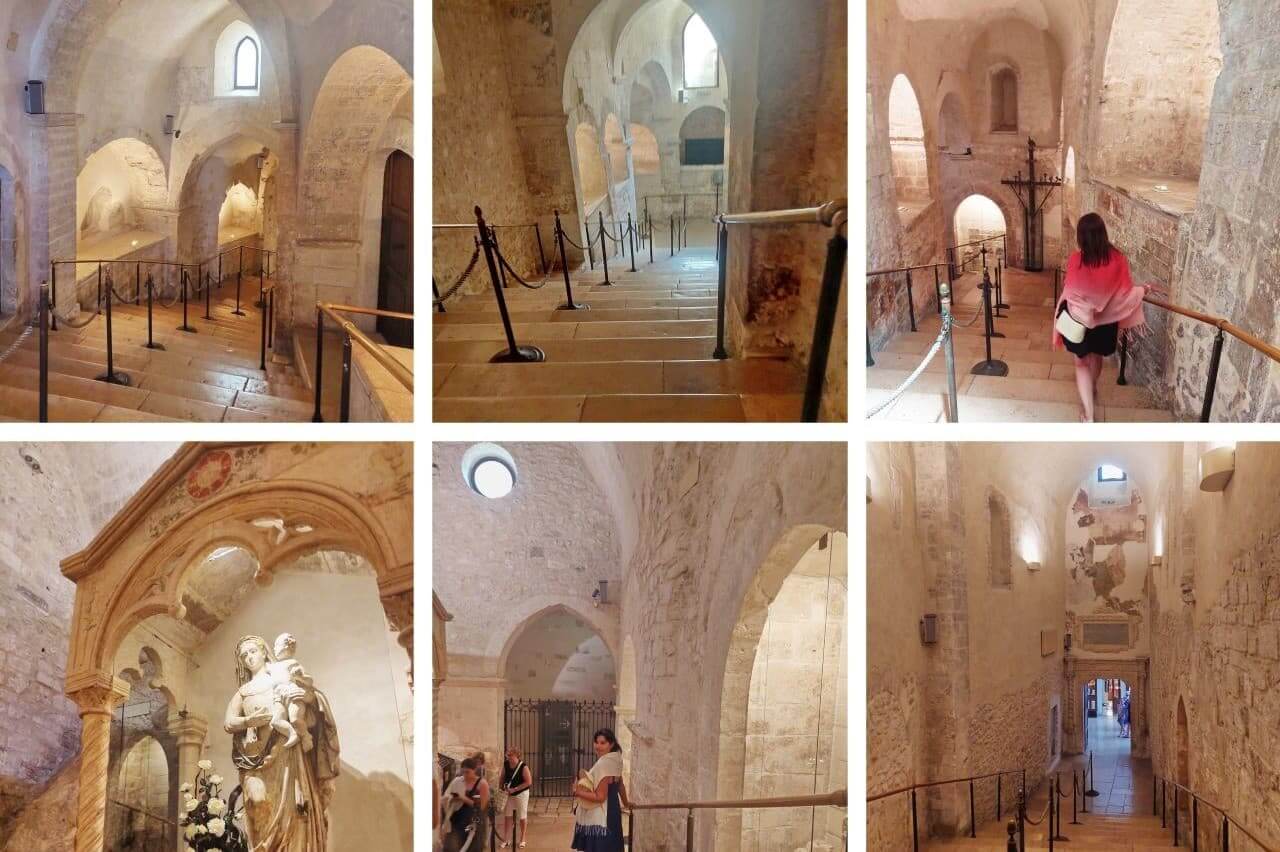
Stairs and the Bull’s Gate in the Sanctuary of San Michele
At the end of the staircase, we passed through the portal known as “Bull’s Gate” (marked by the large fresco above it) and entered the Lower Atrium. On the left side, there is an entrance to the museum, and a small courtyard with old sarcophagi and Lombard crypts is on the right side.
Finally, we came to a large marble portal, the entrance to the sacred Grotta di San Michele. Its bronze doors were crafted in Constantinople in 1076 and donated by a wealthy noble family from Amalfi. They are adorned with 24 panels, with scenes from the Old and New Testaments.
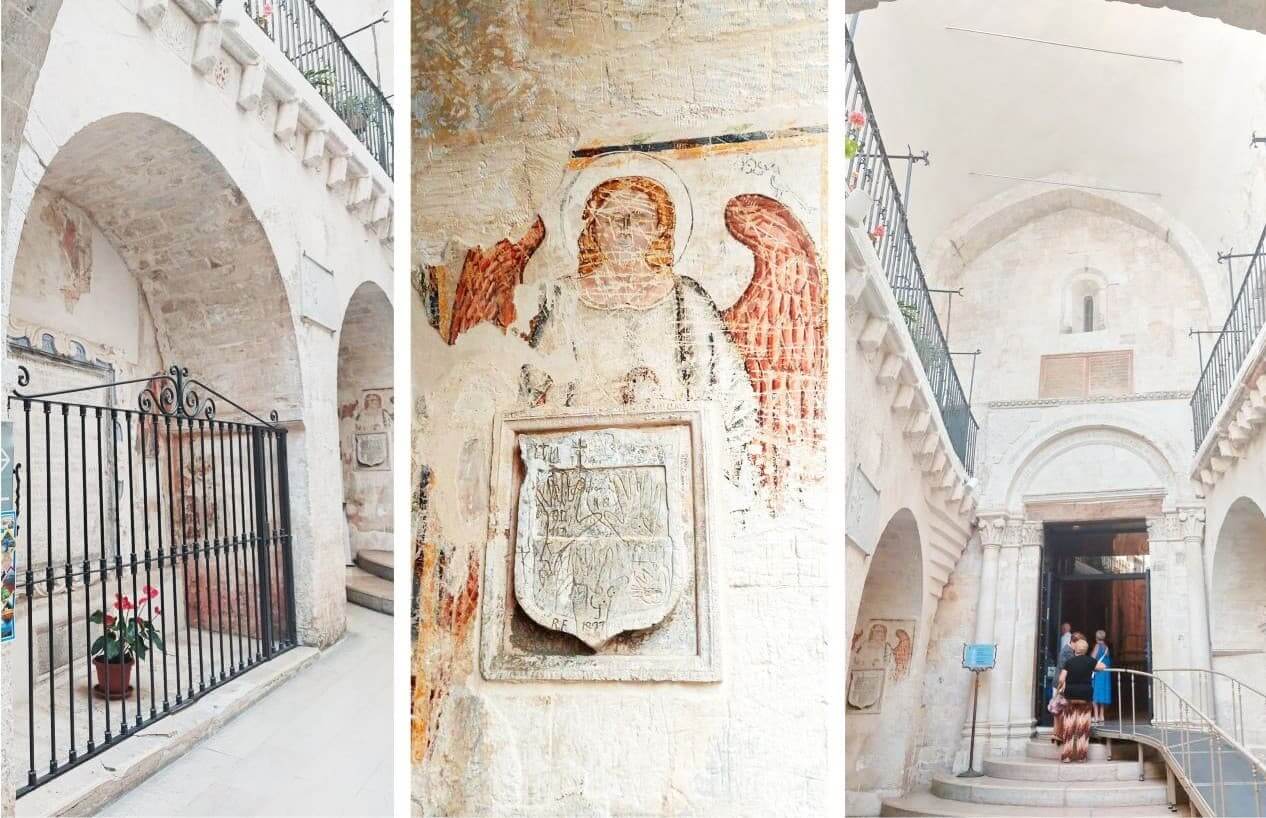
The Lower Atrium and entrance to the Grotta San Michele
Inside the Sacred Grotta
Well, the cave is breathtaking. The Angevin Nave is interwoven with the ceiling of the cave.
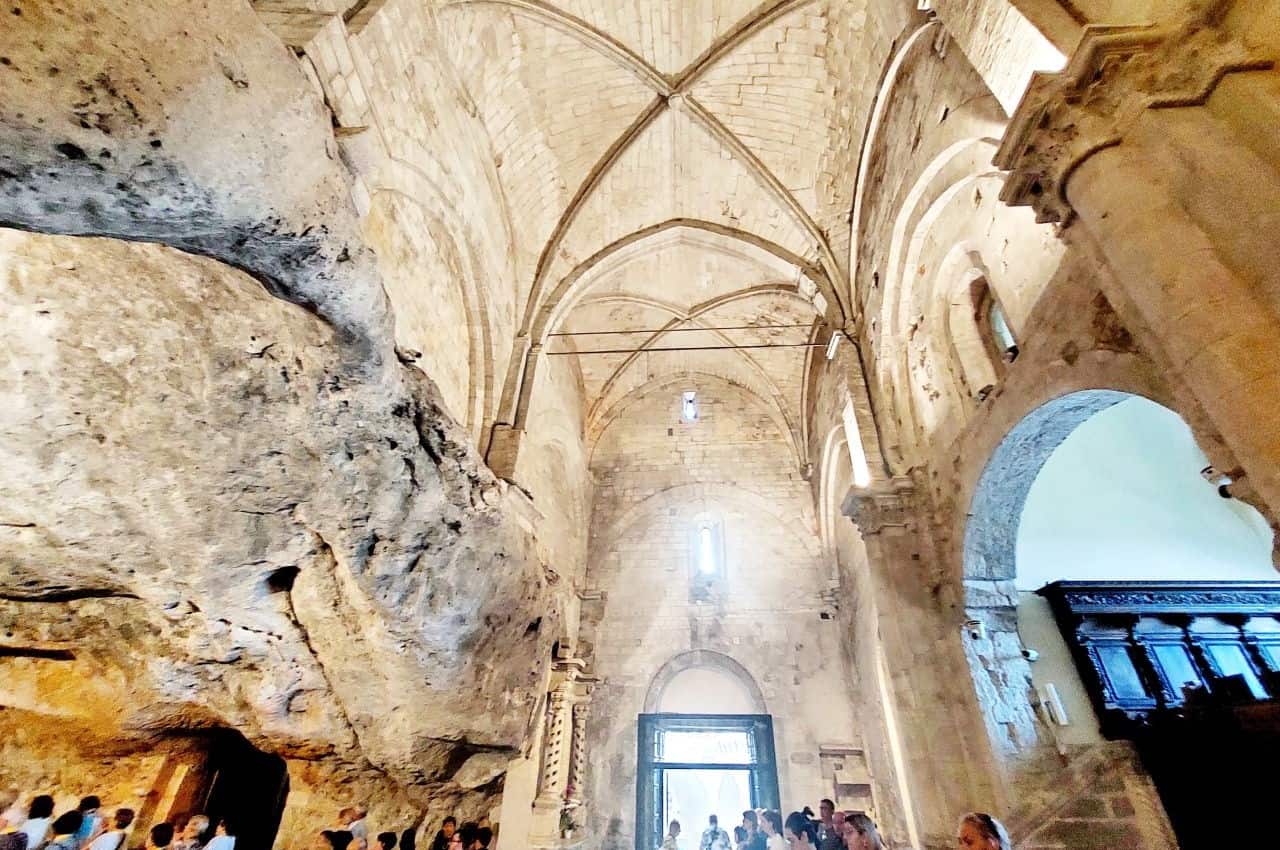
Grotta of the Sanctuary of Saint Michele
On the right side, you can see the Baroque-style altar placed in 1690, which houses the Blessed Sacrament. Three stone statues represent Saint Nicholas of Bari (left), Saint Joseph (centre), and Saint Anthony of Padua (right).
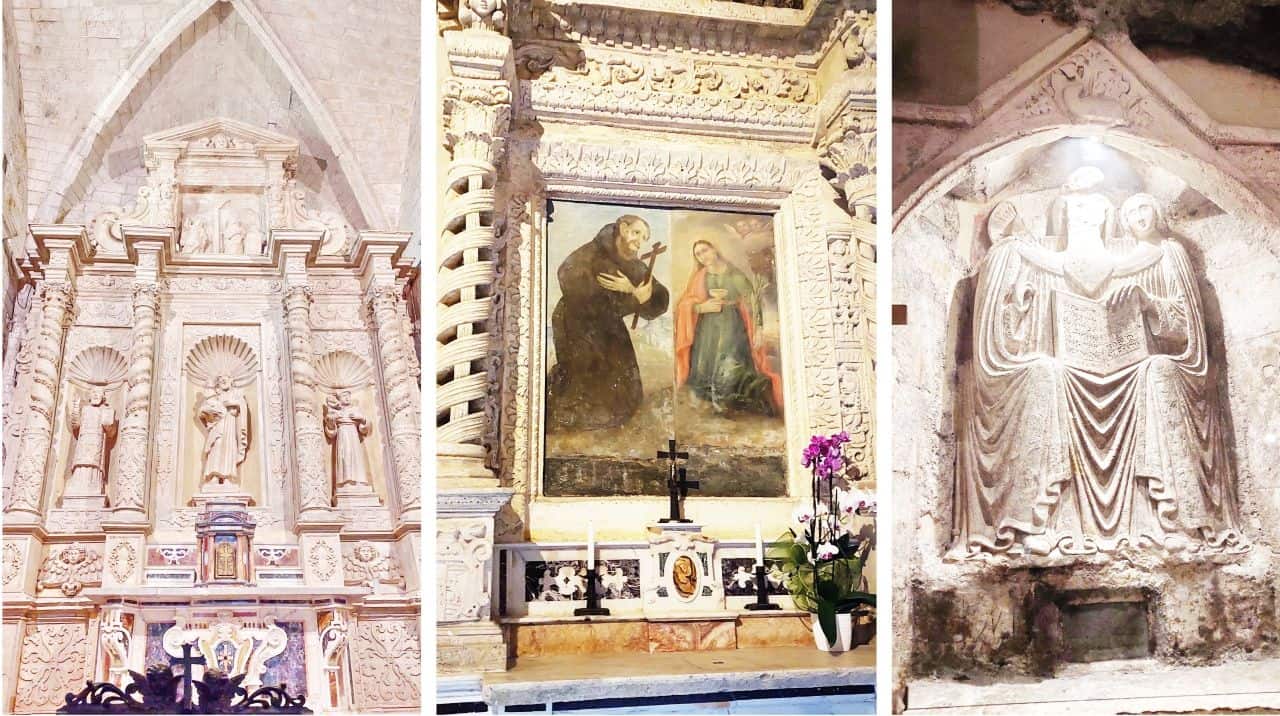
Left: an altar of the Blessed Sacrament, an altar, and the statue of Longobard
On the left side of the presbytery, there is an altar dedicated to the Madonna del Soccorso (Our Lady of Perpetual Help). It is surrounded by four marble columns. Above the altar, you can see a framed fresco from the 17th century, with the image of Madonna del Soccorso, Saint Stephen the First Martyr and Saint Carlo Borromeo.
Behind this altar, there is a small inlet in the rock, known as Pozzetto or the Stilla. It is a “little well” where the pilgrims collected healing water.
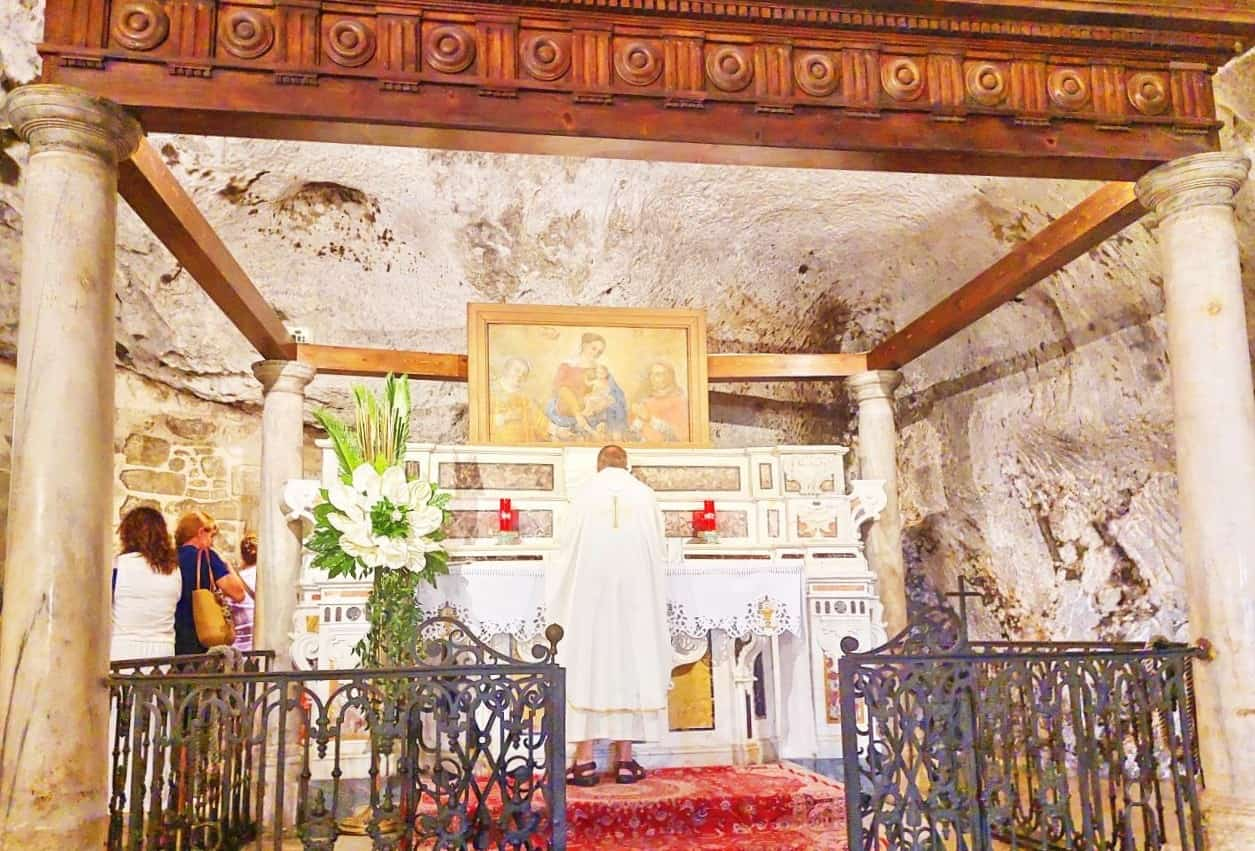
An altar dedicated to the Madonna del Soccorso
The most sacred spot is the altar of San Michele, with its white marble statue, placed in 1507.
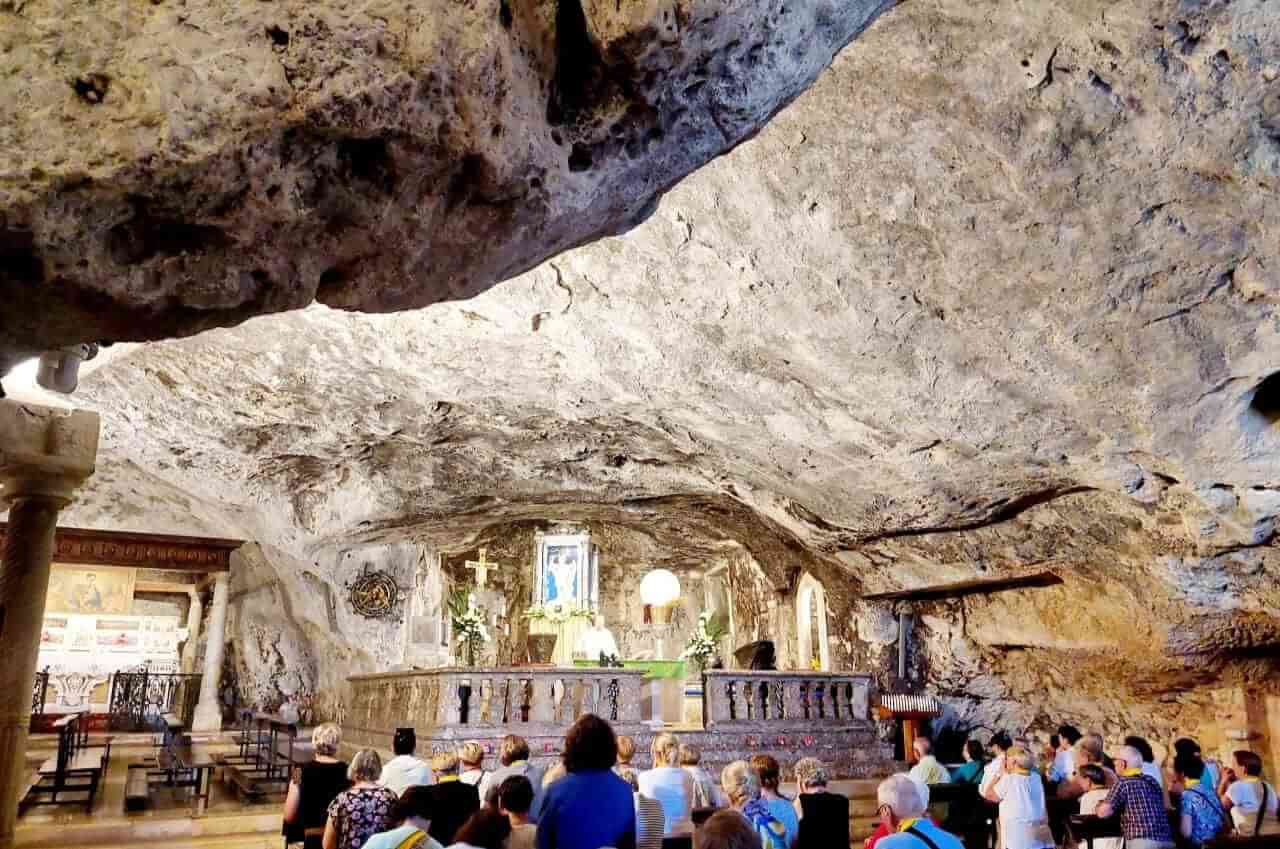
Grotta of the Sanctuary and an altar of San Michele
Pilgrims, numerous popes, including Saint Francis of Assisi, John XXIII, and John Paul II, kings, emperors, and sovereigns have visited this sanctuary. It became one of Christianity’s main pilgrimage destinations.
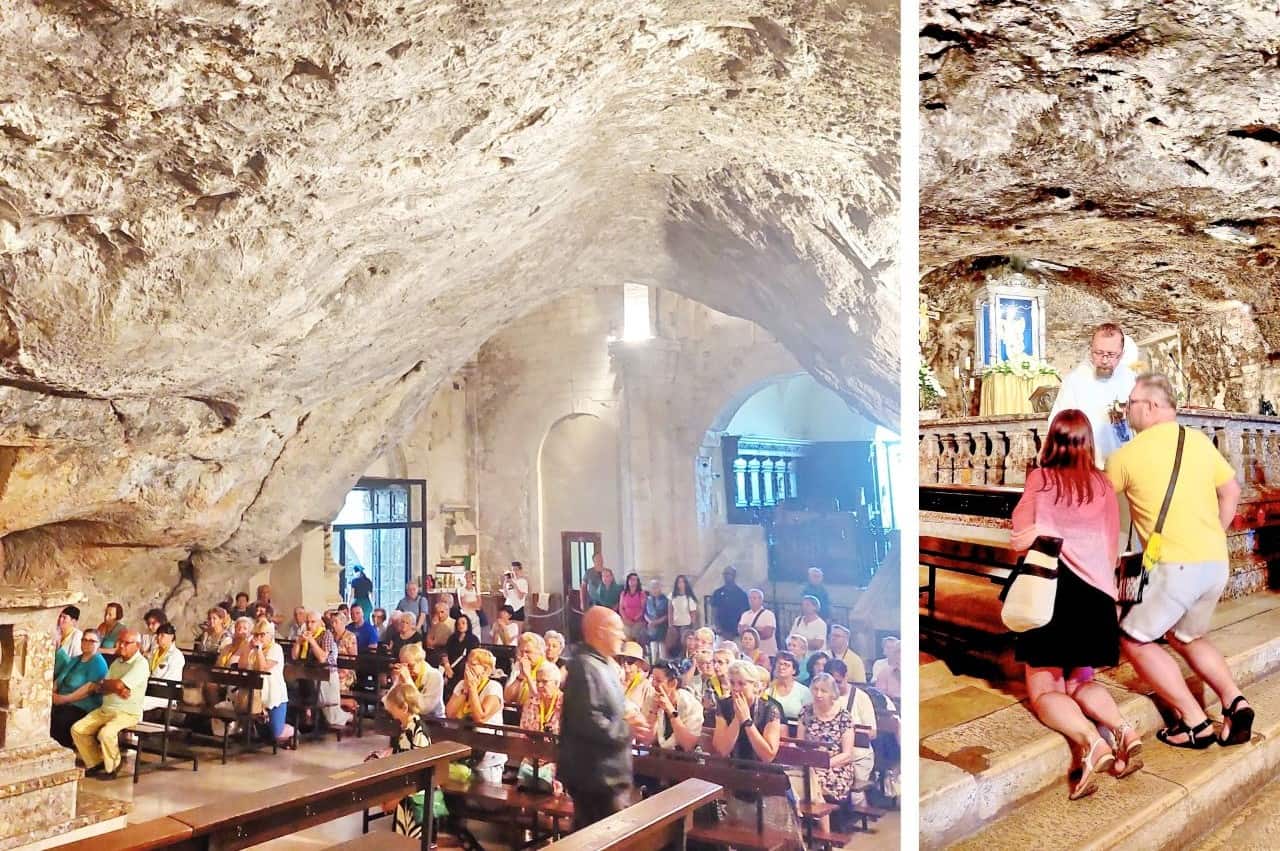
Pilgrims in the Sanctuary of San Michele
Small white stones of the Sanctuary
There is an interesting story about the small white stones from the sanctuary, which represent a unique reliquary.
In 1656, a terrible plague was in Italy. The local Bishop of Gargano prayed to Saint Michael for help for the people. The Archangel appeared and instructed him to bless the grotto’s stones. So, “Anyone who devotedly keeps these stones with him will be immune to the plague.”
According to legend, those who carried the blessed stones were protected from the plague. Others, who were sick, have recovered miraculously.
Since then, the small white stones have been distributed to protect the people from sickness, Satan and evil, as well. The distribution is strictly regulated, and it is possible to have only tiny fragments of white stones. Today, pilgrims and visitors can buy them in small medallions at the sanctuary museum (around 7 EUR). Larger stones are extremely rare, used by bishops and abbots.
Bear in mind that the stones are not magical. They are meant to serve as a spiritual connection with divine energy, God and the cult of San Michele, strengthened by one’s own prayers…
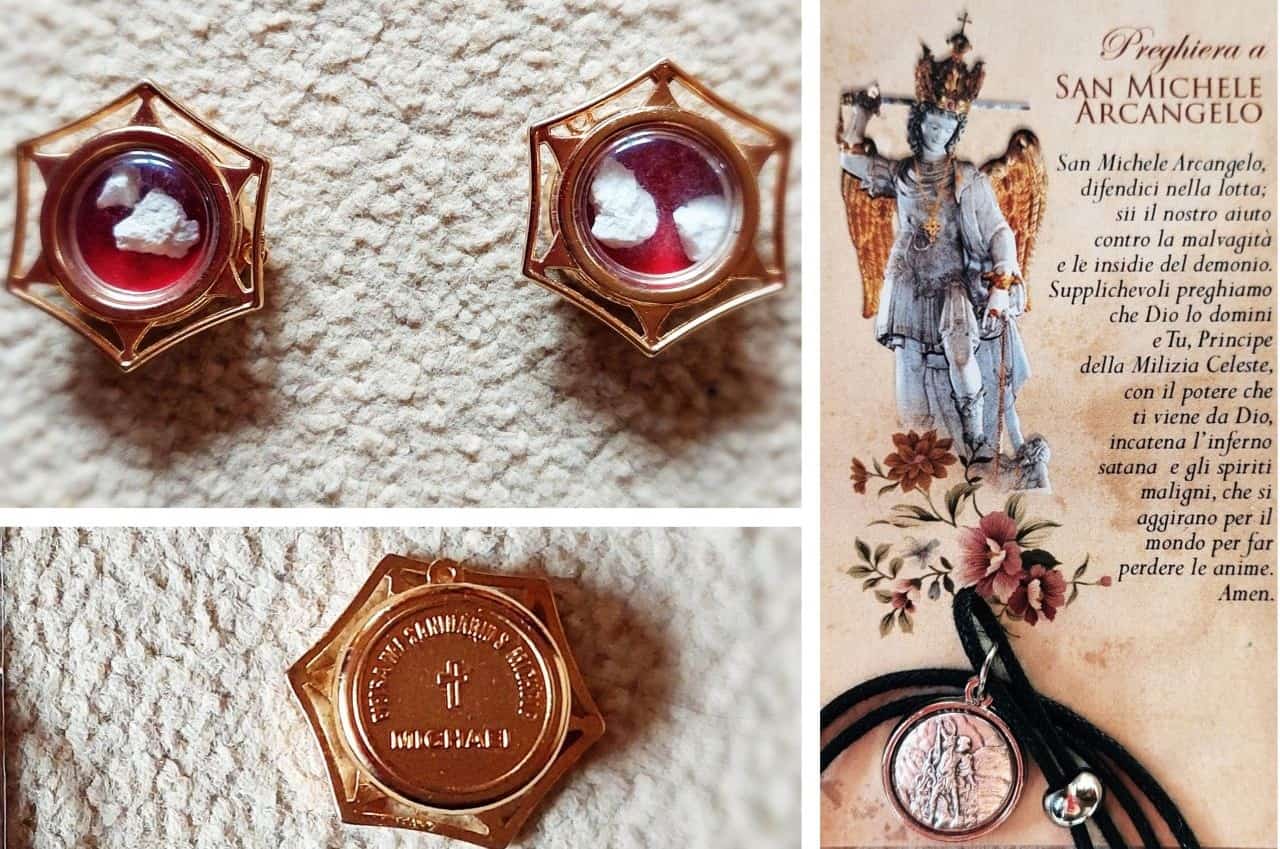
White stones from the Sanctuary San Michele, Monte Sant Angelo
Tips for visiting the Sanctuary
♦ The sanctuary is an active place of worship. So, cover your shoulders and knees when entering the sacred grotto.
◊ The best times to visit the sanctuary is spring and autumn, as the weather is nice, and the crowds are not as overwhelming. The annual feast of Saint Michael is on the 29th of September. It is a special event with procession, music, and celebrations.
♦ Entrance is free, and the price of the ticket for the museum costs a few euros.
Opening hours: from April to October, 7:30 AM to 7 PM, from November to March, 7:30 AM to 6 PM.
You can buy various religious items, guides, and books in the souvenir shop.
◊ You can visit the sanctuary individually or join guided tours to learn more about the history of this sacred place.
⛪ The Sacred Line of Saint Michael
Hm, there is something mysterious and interesting about the Sacred Line of Saint Michael.
In fact, it represents a perfect straight line connecting seven shrines dedicated to the holy Archangel Michael, stretching from Ireland to Israel. Each of these monasteries is nestled in remote places such as cliffs, mountains or islands.
Sometimes, this line is called “The Sword of Saint Michael”. It represents the sword strike of Saint Michael, cutting through darkness and guiding light across the world.
I found this sacred alignment truly fascinating. So let me share a few details about these seven remarkable places.
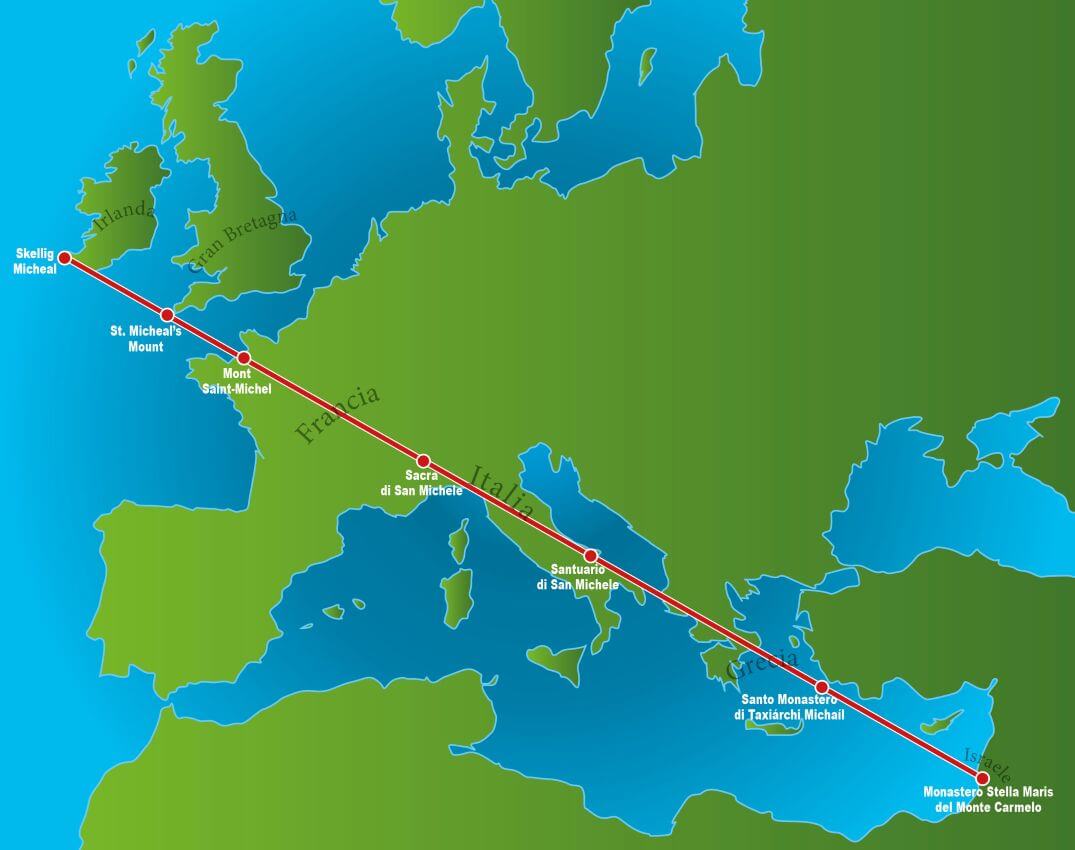
Map: Sacred Line of San Michele, source Wikipedia
⛪ Seven shrines of the Sacred Line of San Michele
1. The Monastery of Skellig
The Sacred Line of San Michele starts from this shrine. It is located on the southwestern coast of Ireland, on the small, remote islet of Skellig Michael.
2. St. Michael’s Mount Abbey
The second shrine is situated on a tidal island in Cornwall, southwest England. It is connected to the town of Marazion by a causeway of granite setts, passable only between mid-tide and low water. The present church was rebuilt in the late 14th century.
3. The Abbey of Mont Saint-Michel
Probably, it is the most famous abbey of San Michele, built on a tidal island in Normandy, France. The architecture looks amazing, and it has become a tourist and spiritual landmark of the country.
4. The Sacred of Saint Michael the Archangel
This sanctuary is nestled in Piedmont, close to the town of Turin in Italy, at a height of 962 m on Mount Pirchiriano. By the way, it served as inspiration for the famous Umberto Eco’s novel “The Name of the Rose”. I am sure that you are also familiar with the film.
5. The Sanctuary of San Michele Arcangelo
It is the oldest shrine in Western Europe dedicated to the Archangel Michele, located in Monte Sant’Angelo, in Puglia.
6. The Monastery of St. Michael Archangel of Panormitis
This Orthodox monastery is situated on the Greek island of Symi, in the Dodecanese archipelago. It is famous for the 2 m high, silver-leafed wall icon of San Michele, which miraculously appeared.
We visited it during our vacation on Rhodes Island in 2023. You can read more about it in one of my next posts.
7. The Stella Maris Monastery on Mount Carmel
And the last shrine is located in Israel, on Mount Carmel, near the town of Haifa. By the way, Mount Carmel is considered the place where the prophet Elijah lived.
🏰 Castello Normanno-Svevo-Aragonese
The town of Monte Sant’Angelo was founded in the 11th century, after the arrival of the Normans. They built the castle, which was expanded over the centuries by Swabian and Aragonese rulers.
The oldest part of the castle is Torre dei Giganti (“Giants’ Tower”), dating back to 979. It is a pentagonal tower 18 m high, with walls 3.7 m thick. Later, it was the residence of several Norman conquerors, while the Swabian Emperor Frederick II restored it and used it as a residence for his mistress, Countess Bianca Lancia. According to legend, the castle is still home to her ghost, whose sighs can be heard especially in the winter nights…
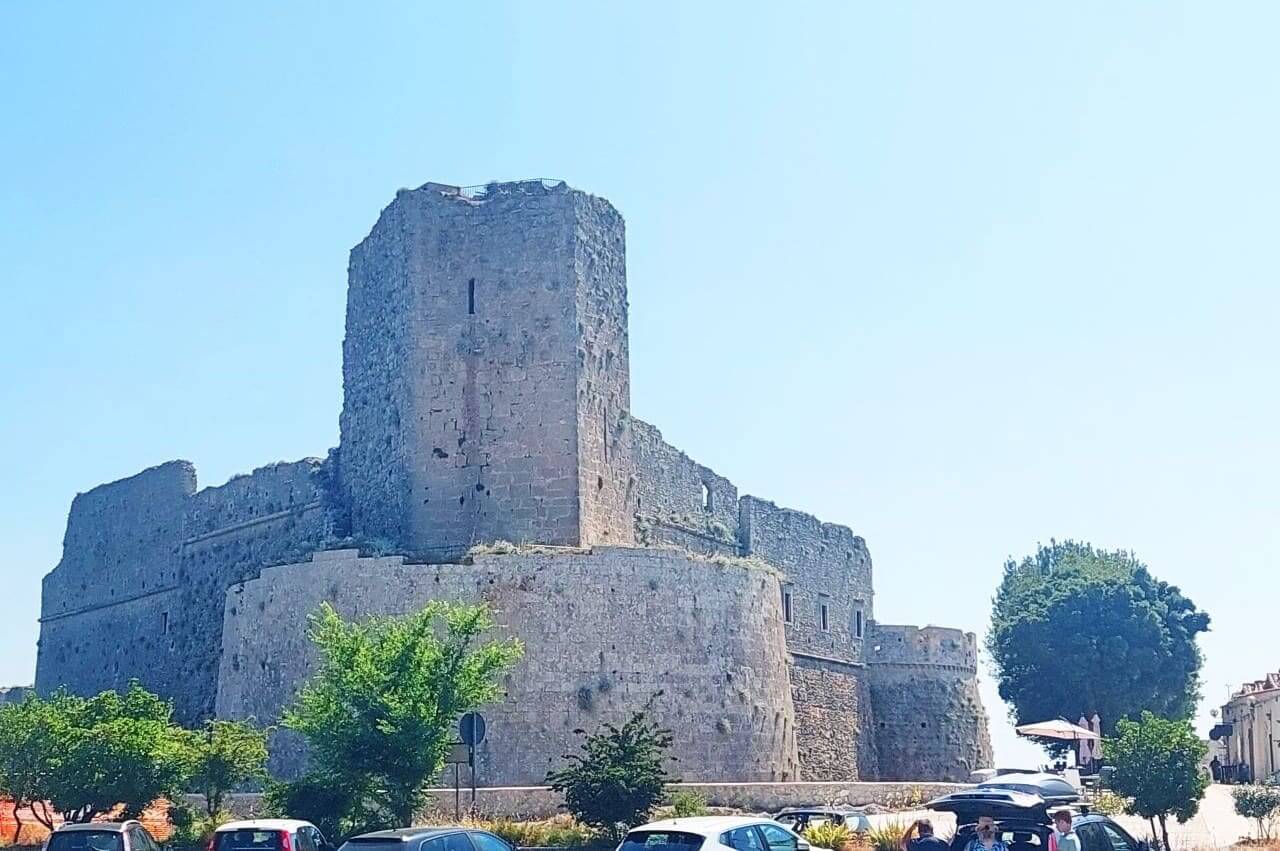
Castello Normanno-Svevo-Aragonese and the Torre dei Giganti
During the Angevin rule, the castle was used mainly as a prison. In the late 15th century, it was rebuilt by Ferdinand I, King of Naples. Over the centuries, the castle was under various rulers until 1907, when it was purchased by the City of Monte Sant’Angelo.
Opening time of the castle: Monday-Sunday, 10 AM – 1 PM / 2:30 PM – 7 PM.
The ticket costs 4 EUR for adults.
From its top, you can enjoy panoramic views of the Gargano mountains, the town and the Adriatic coast.
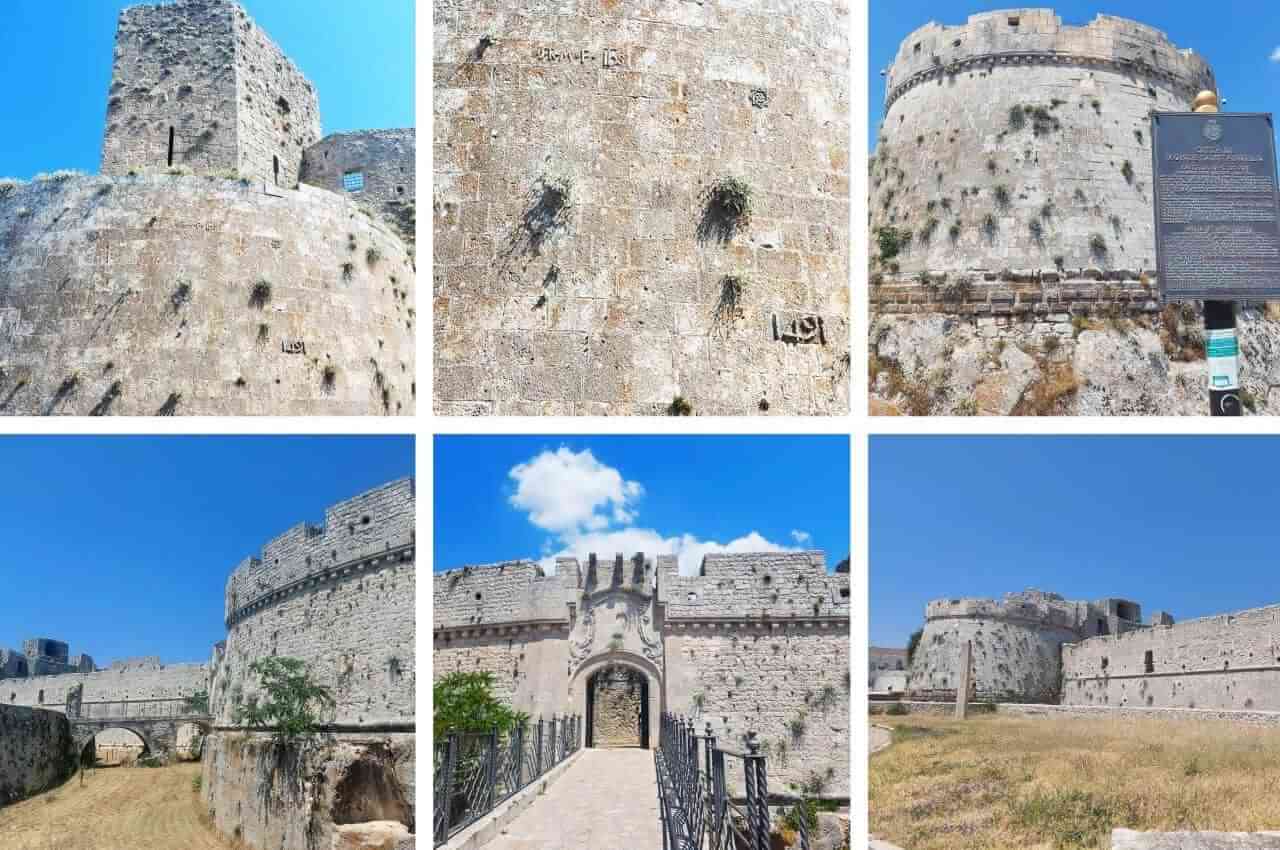
Normanno-Svevo-Aragonese Castle
Via Castello
As we went down from the castle, we walked into Via Castello.
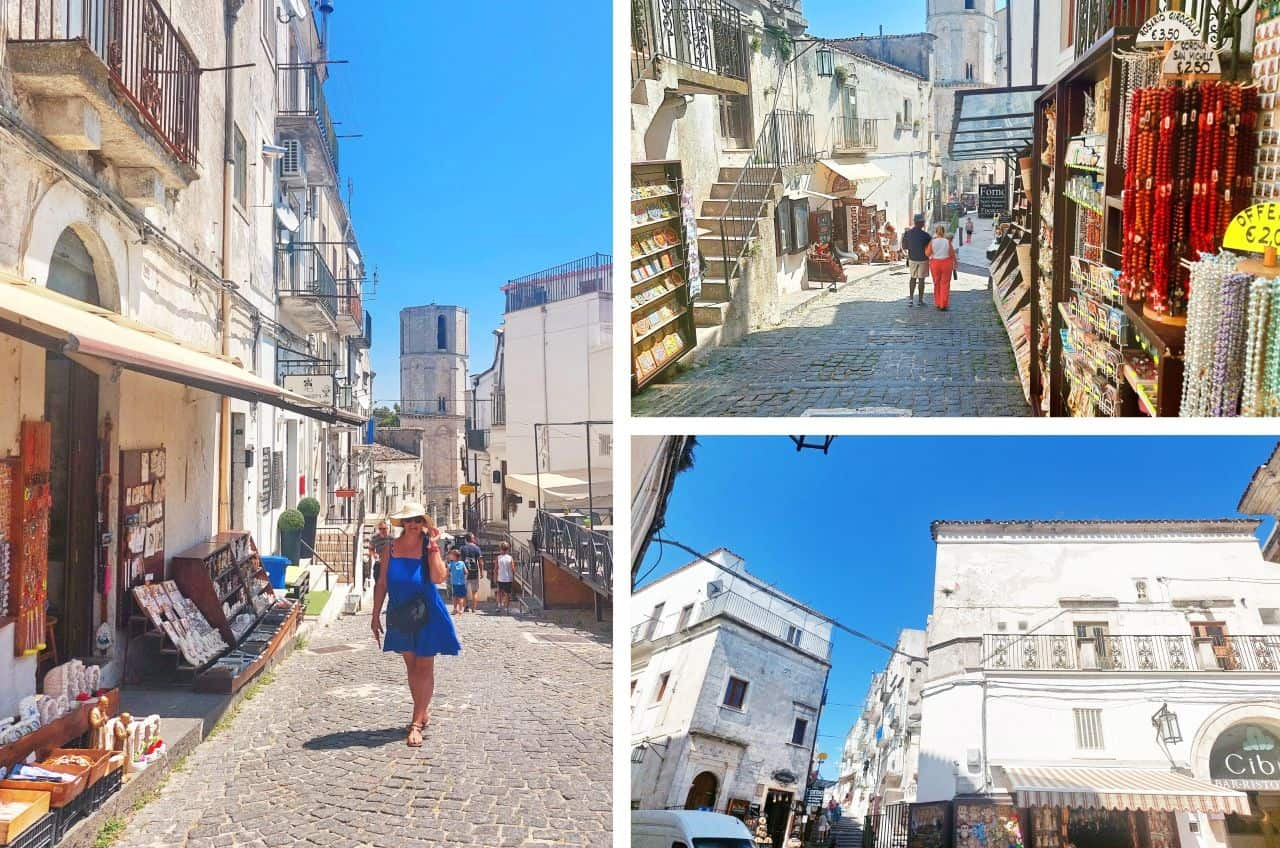
Monte Sant’Angelo, Via Castello
It is an interesting street lined with white houses and small shops selling local products and souvenirs.
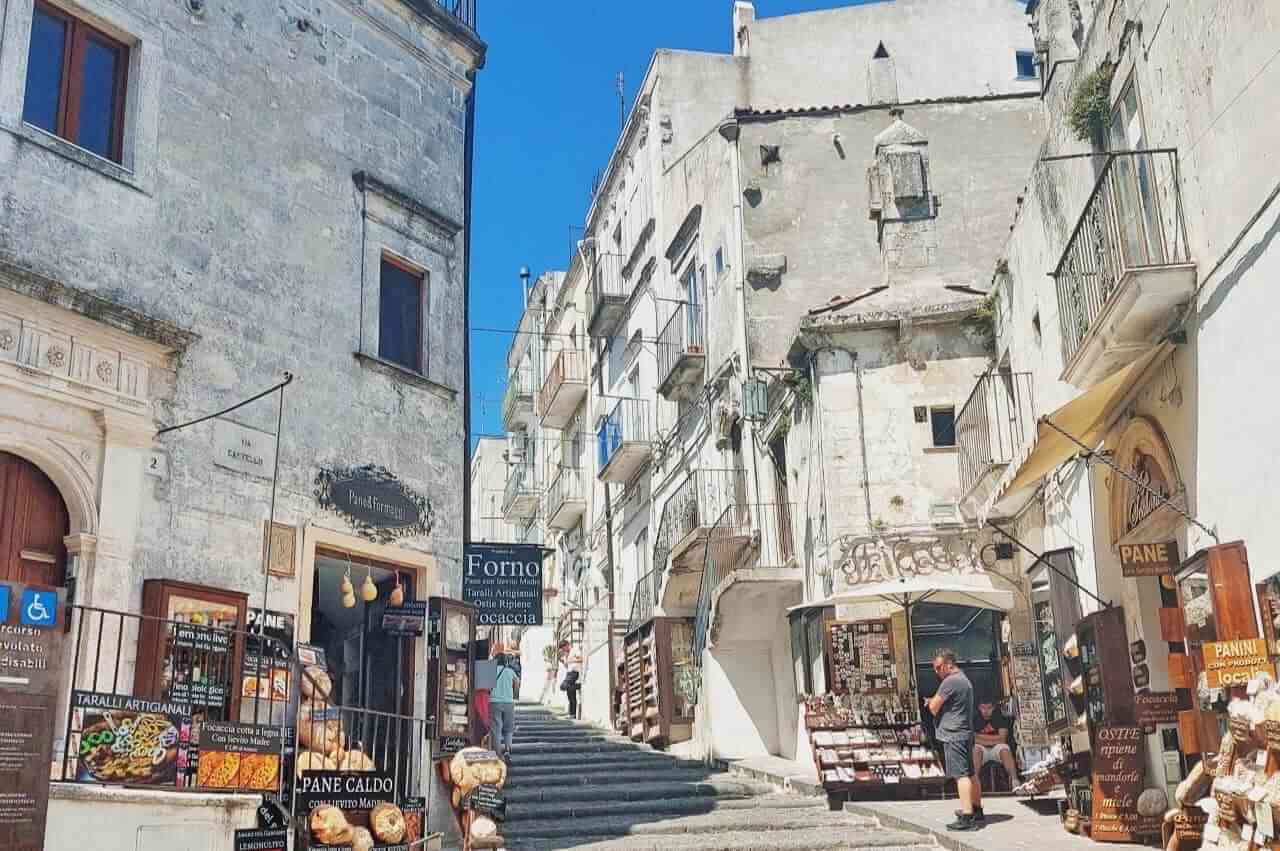
Via del Castello
At the end of the street, you can find the Sanctuary of San Michele and Ruone Junno, the old part of the town.
Also, there you can see the beautiful Palazzo dei Grimaldi, the historic residence of the noble feudal family from Genoa. This baroque palace was built in 1750 for Maria Teresa Grimaldi, the Princess of Gerace. In 1802, the palace and the feudal land were purchased by the University, and it became the first seat of the municipality of Monte Sant’Angelo. Even ruined, it still looks amazing.
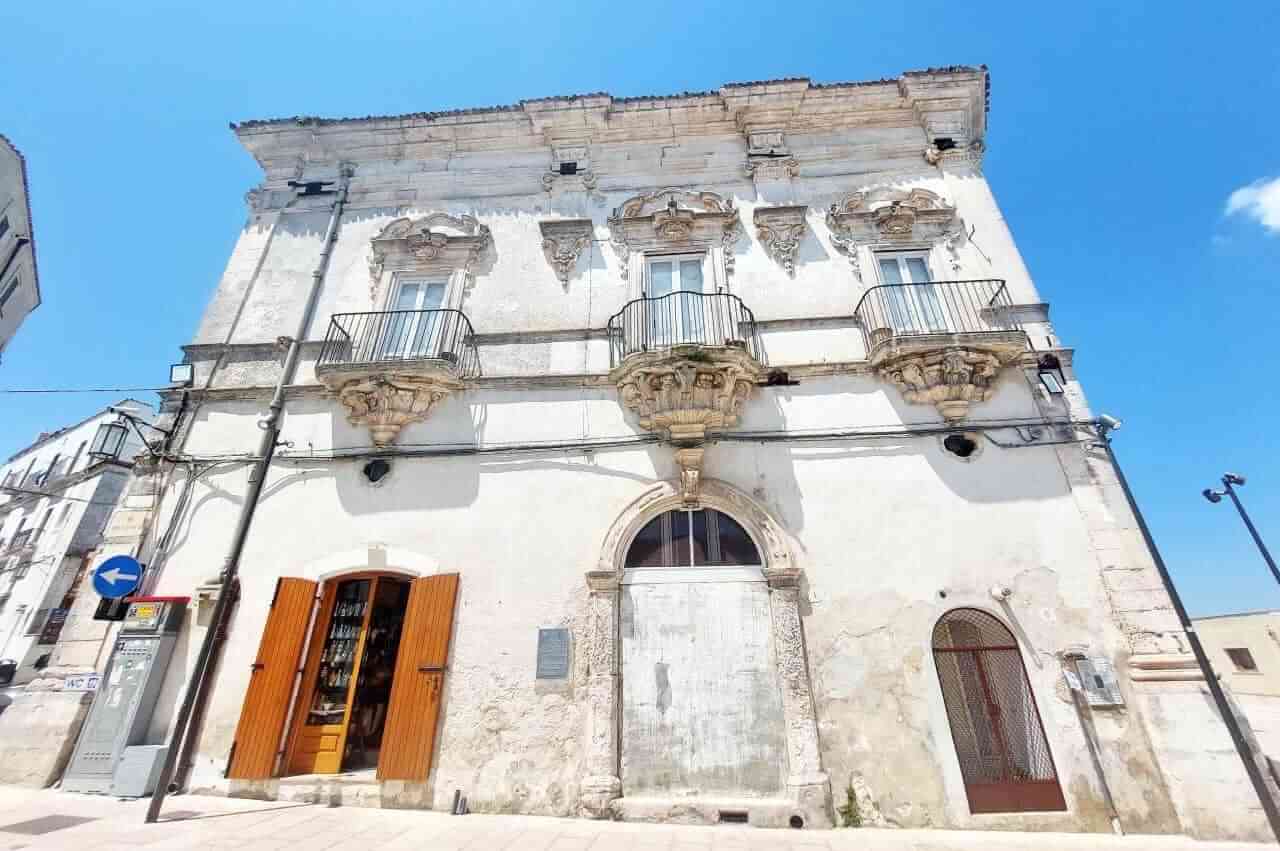
Palazzo Grimaldi
Rione Junno
The medieval quarter of Rione Junno is a labyrinth of cobbled alleys, arches, and whitewashed homes with small terraces and flowers. Walking through its alleys, we had a feeling that we were travelling back in time.
Also, you can visit the Tancredi Ethnographic Museum to learn more about old traditions, culture, crafts, and the daily life of Monte Sant’Angelo’s inhabitants. It is located in the former Franciscan Convent.
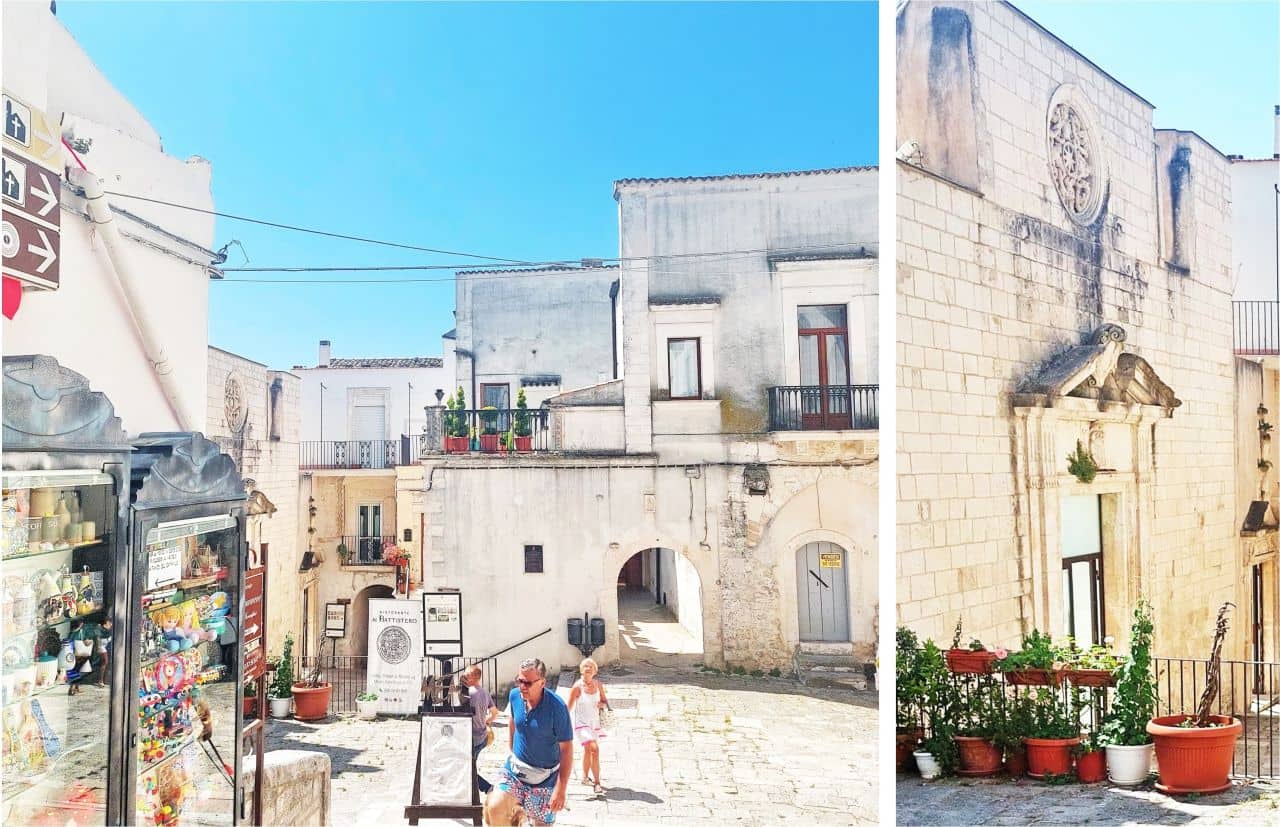
Rione Junno, the entrance to the complex of San Pietro (right)
The Complex of San Pietro
Close to the sanctuary, there is the second most important pilgrimage site in the town. It is the Complex of San Pietro, which consists of three significant buildings.
The Church of San Pietro was partially demolished in 1891. Today, the ruins of granite columns and apse structure from the 12th century can still be seen.
On the left side of the apse, there is an entrance to the Baptistery of San Giovanni. It is also known as the “Tomb of Rothari”, because it is believed that the tomb of the Lombard King Rothari (606-652) was inside. Actually, there is no evidence about it. Probably, the name “Tomba” was given due to a misinterpretation of the word “tumba,” meaning dome.
On the right side, there is the Church of Santa Maria Maggiore, the Cathedral of the town. It dates back to the 11th century, built in the Romanesque-Pugliese style. Its walls are decorated with frescoes depicting angels, saints, and San Michele Arcangelo.
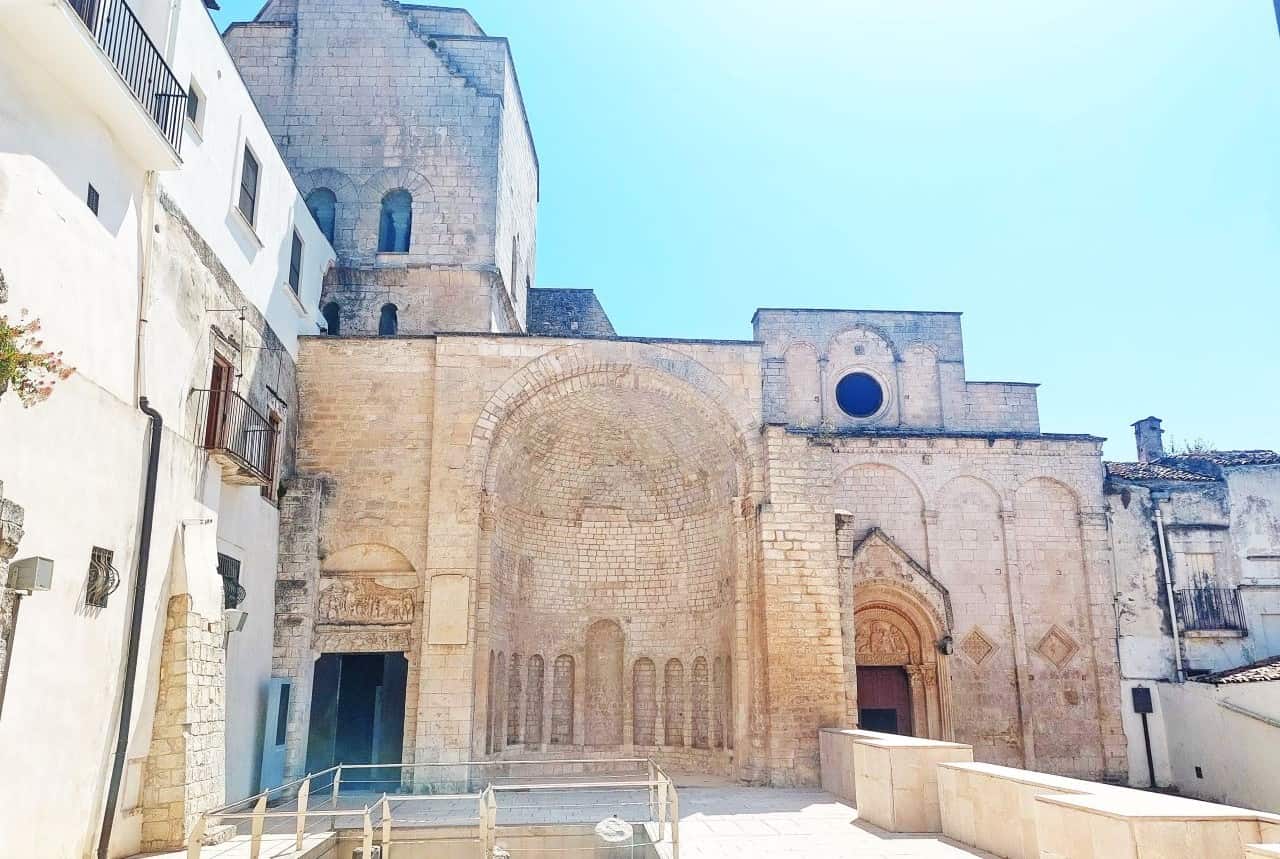
Chiesa di San Pietro, entrance to the Tomba di Rotari (left) and entrance to the Church of Santa Maria Maggiore (right)
Passing by the church and through the narrow passage, we continued our walk along the alleys of Rione Junno.
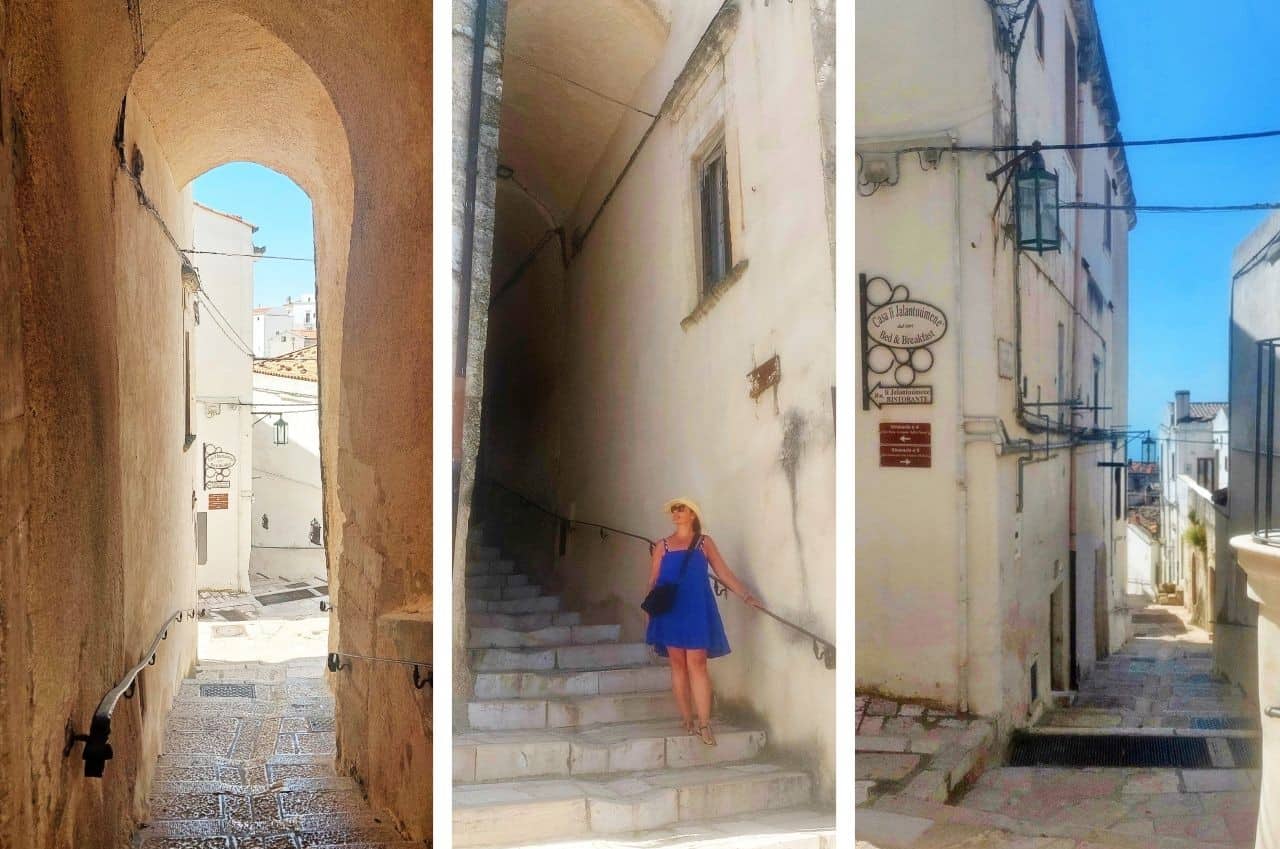
A passage in Rione Junno
Via Garibaldi and Villa Comunale
Going further, we walked along Via Garibaldi, a street filled with old palaces, beautiful houses, and small shops with local products. We took a short break for a delicious cappuccino in the Café Leko on the Piazza Belvedere.
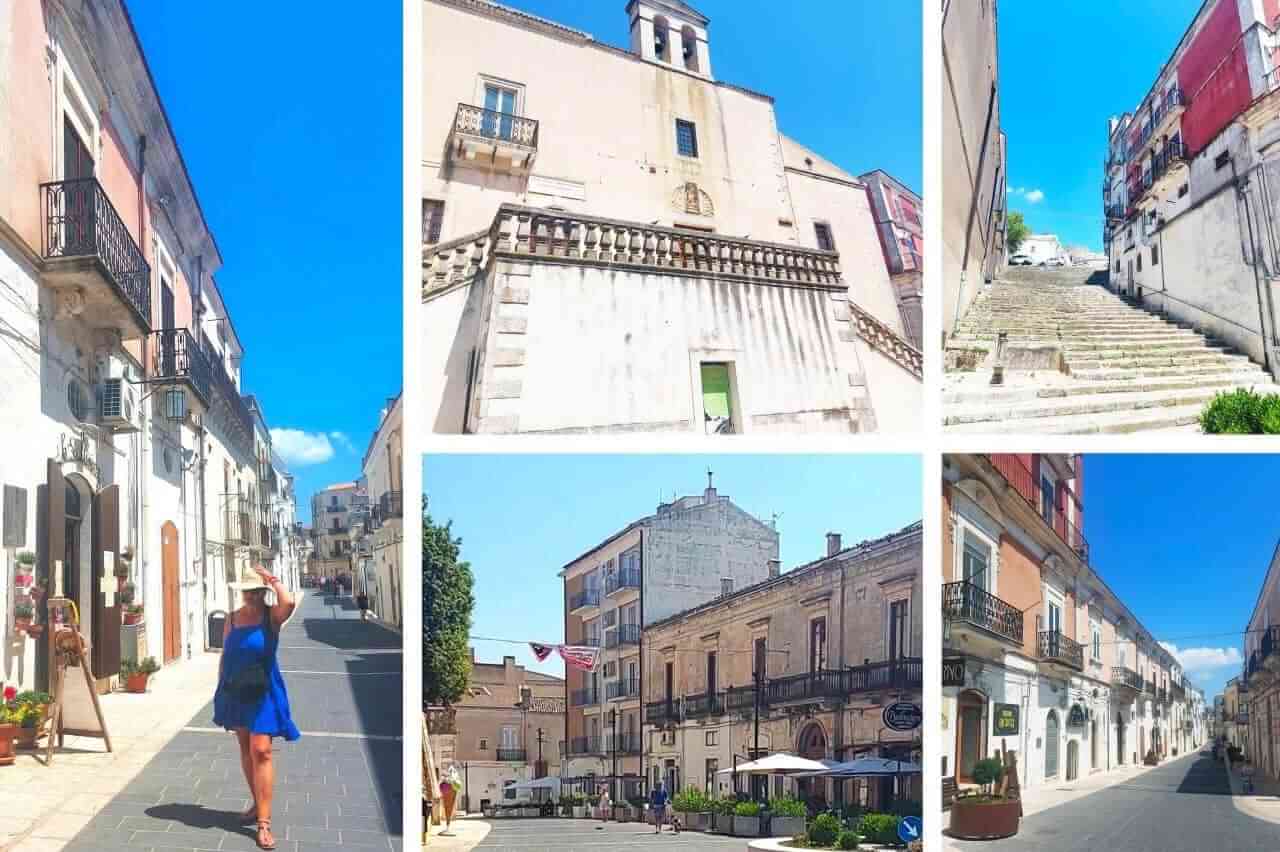
Via Giuseppe Garibaldi
From the nearby public park, Villa Communale, you can enjoy the panoramic view of the town, the blue sea, and the Gulf of Mandredonia.
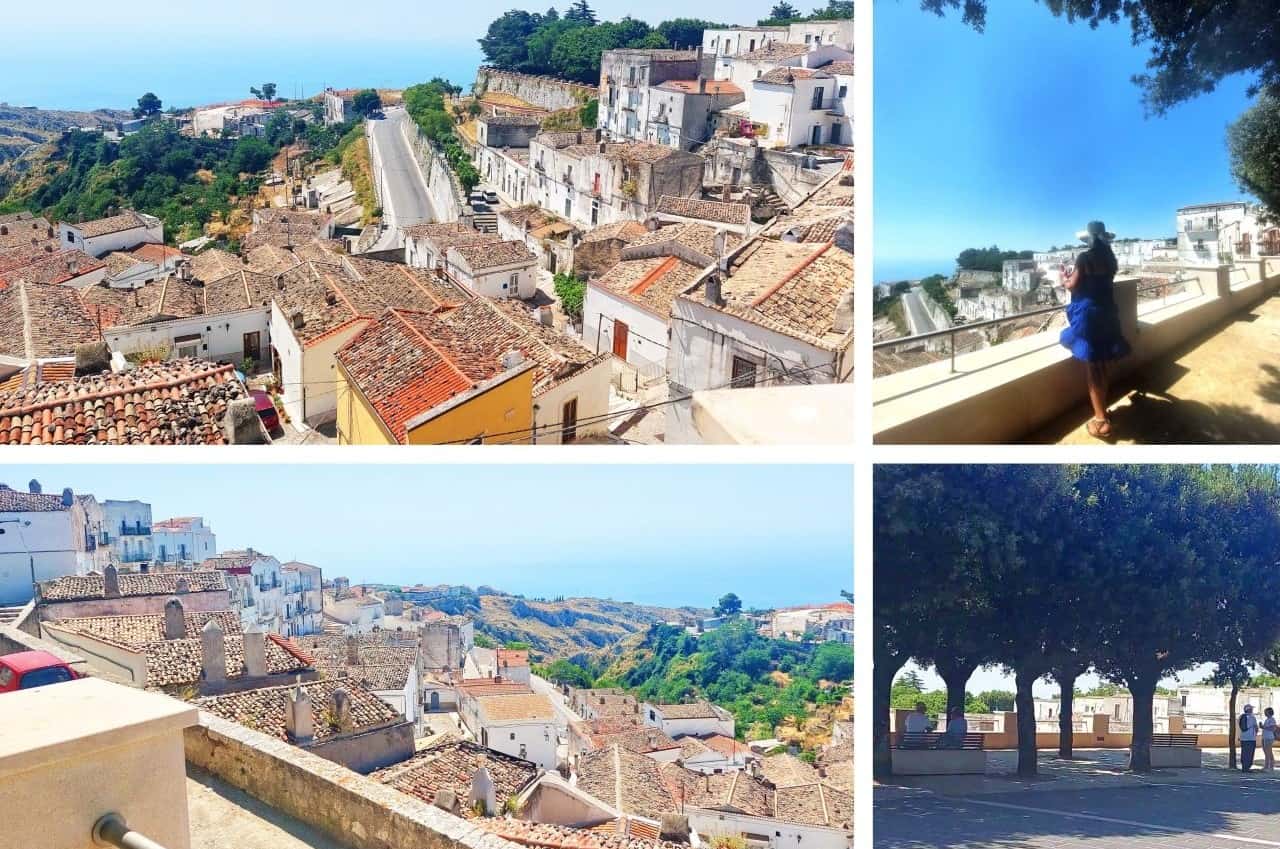
A view from the public park, Villa Comunale
☕🍽️🥖 Cafés, restaurants, and local products
Depending on your time, try delicious local dishes in the popular restaurants. Some of them are Li Jalantuùmene, Pizzeria Il Boccone, Borgo Antico, Osteria del Corso, Profumo-Osteria del Gargano, Al Battistero, Ristorante Medioevo, Cibus…
One of the typical local products is bread, in a rounded shape, with an average diameter of 20 to 100 cm, and a weight between 0.5 kg to 8 kg.
Other local products, such as cheese, handmade pasta, olive oil, taralli crackers, almonds, and wines, are also excellent souvenirs to bring home.
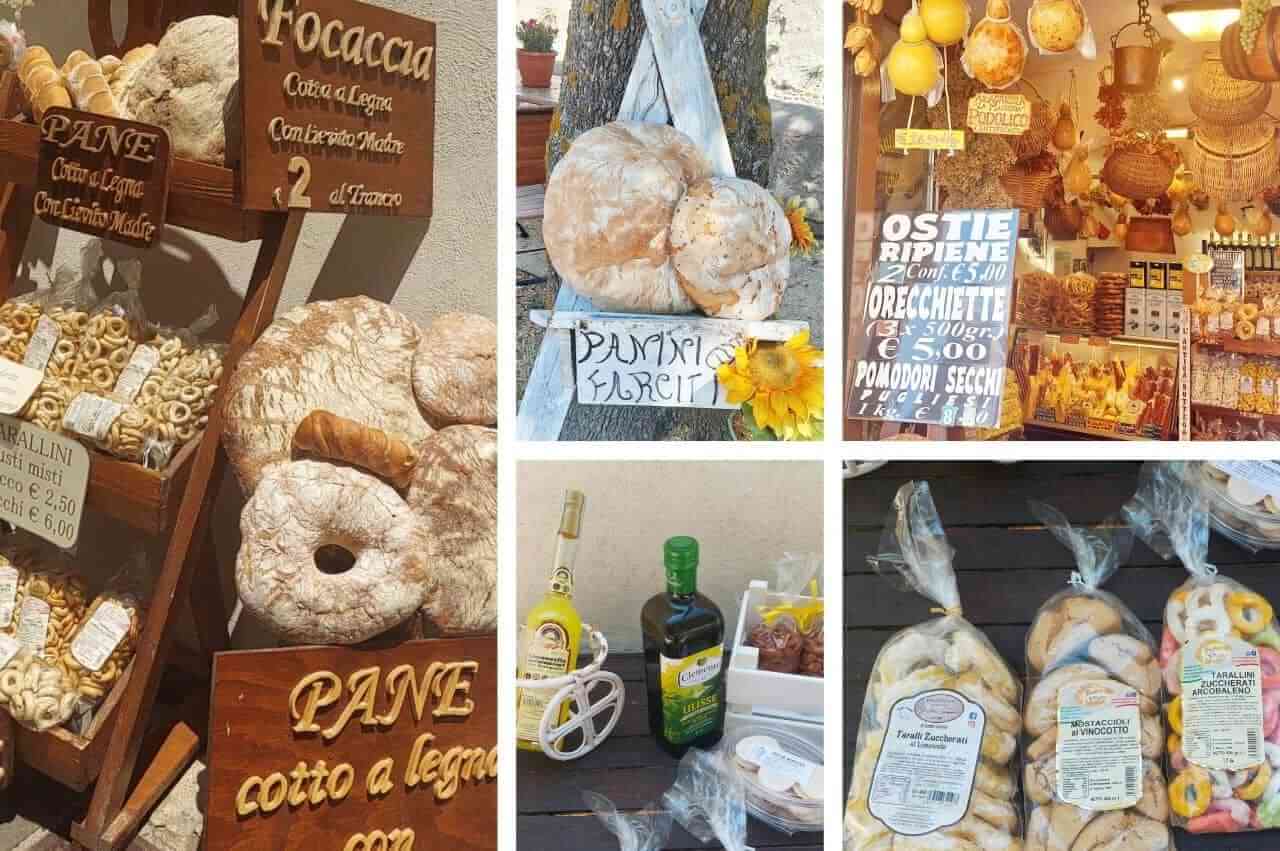
Local products of Monte Sant Angelo
🏨 Accommodation in Monte Sant’Angelo
An interesting option is Le Casette nel Rione, the small houses located in the historic Rione Junno district.
The most luxurious hotels are the Palace Hotel San Michele and the Hotel Relais dei Normanni.
If you prefer a mid-range option, check the Elda Hotel, Casa Masseria dell’800 Gargano, Villa Bisceglia, B&B Angela, or Villa Francesca.
📌 Visit Monte Sant’Angelo and
The Sanctuary of San Michele Arcangelo
The sanctuary in Monte Sant’Angelo is known as the “Celestial Basilica” because it is the only Christian church not consecrated by human hands. In fact, the whole town radiates peace, serenity, and a special spiritual energy.
Around Monte Sant’Angelo, you can also visit some interesting places.
♦ Abbey of Santa Maria di Pulsano is located 8 km from the city. It was built in 591 over a Pagan temple, and it was largely destroyed by an earthquake in 1646.
◊ The sanctuary of Saint Padre Pio is situated in the town of San Giovanni Rotondo, about 20 km away.
♦ Umbra Forest is a protected natural area located in the Gargano National Park.
◊ Amazing towns with authentic style, such as Manfredonia, Mattinata, Vico del Gargano, Cagnano Varano or Vieste.
Whether you are a history lover, a pilgrim, or simply a curious traveller, I am sure that you will enjoy Monte Sant’Angelo. It is a place where history, faith, and prayers are interwined under the spirit of San Michele, the warrior of God, protector, and Prince of the Angels.
After visiting Monte Sant’Angelo, we continued our trip to the coastal town of Manfredonia.
So, stay tuned for new stories from the wonderful region of Puglia…

Leave a Reply
Want to join the discussion?Feel free to contribute!