
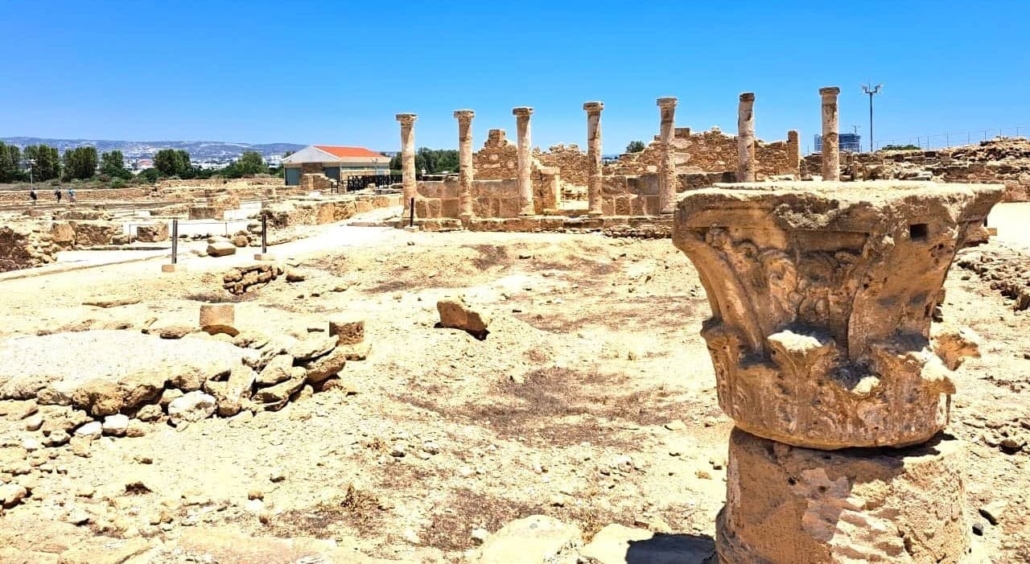
Paphos, the birthplace of the goddess Aphrodite
Welcome to Paphos, one of the most important city-states of ancient Cyprus.
Once a Neolithic settlement and the birthplace of the goddess Aphrodite, it became a major Hellenistic and Roman capital.
Today, Paphos is the capital of the Paphos District of Cyprus and one of the most important tourist places on the island. Walking along the harbour, the smell of salt mingles with the scent of centuries and the magnificent remains of ancient times…
 Disclosure:
This text contains affiliate links, which means that if you book a hotel through them, I can earn a small commission, at no extra cost to you. Thanks.
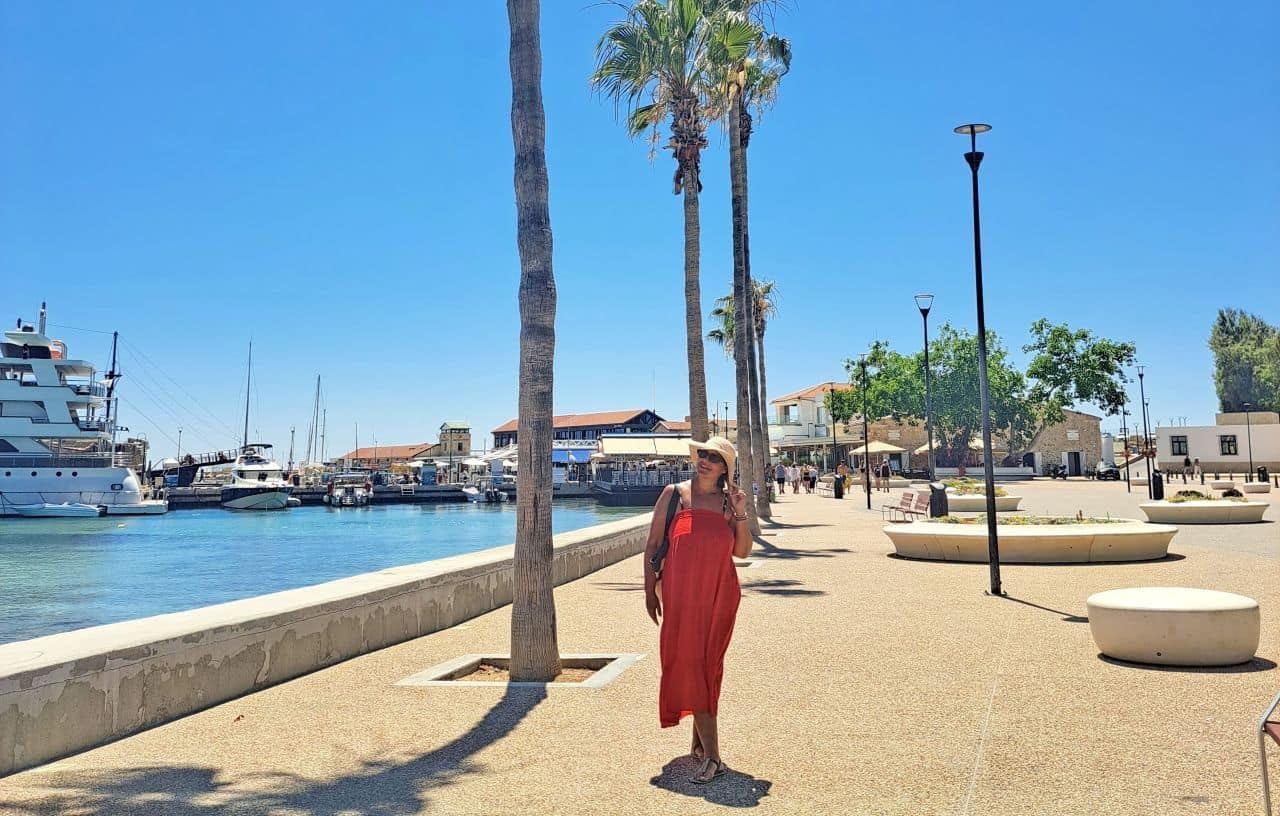
Paphos promenade
📌How to Get to Paphos?
Paphos (also Pafos) is a town located on the southwest coast of Cyprus, about 50 km west of Limassol.
✈️By Air: Paphos has its own Paphos International Airport (PFO), which is well-connected to Europe via many low-cost airlines. The main airport of Cyprus is the Larnaca Airport, approximately a 90-minute drive away.
🚗By car: If you are coming from Nicosia, Limassol or Larnaca, take the highways to Paphos. Renting a car is always a good option, but be aware that you drive on the left side of the road in Cyprus.
🚌By bus: Intercity bus service connects Paphos with Nicosia, Limassol, Larnaca, and other places in the Paphos district. Buses usually operate on an hourly schedule throughout the day from the main Karavella Bus Station, but check the schedule.
You can visit Paphos individually, or during organised one-day excursions from the other towns. For example, we visited it together with the ancient town of Kourion.
📍A few words about the history of Paphos
Based on the legend preserved by Strabo (Greek geographer, 63 BC-24 AD), Agapenor, a hero of the Trojan War, came to Cyprus with the Arcadian fleet due to a storm. He founded Paphos and established the sanctuary of Aphrodite at Palaepaphos.
Actually, it was the Old Paphos, today known as Kouklia, located on a hill. This place has been inhabited since the Neolithic period and later by the Mycenaean Greeks. It became the most important centre of worship for Aphrodite’s cult in the ancient world.
New Paphos (Nea Paphos) was founded near the coast by King Nicocles at the end of the 4th century BC. He built a new harbour town, which became a powerful political and economic centre. Paphos was the capital of Cyprus during the Hellenic and Roman periods, replacing the town of Salamis.
Like Kourion and Salamis, the town was devastated by the strong earthquakes in the 4th century.
Cyprus was under British administration from 1878, and the town was modernised.
Today, Paphos consists of Ktima, the upper residential town, and Kato Paphos, situated on the coast and near the archaeological site.
What to see in Paphos
Due to its important ancient ruins and mosaics, Paphos was inscribed as a UNESCO World Heritage Site in 1980.
The most famous site is the Archaeological Park of Kato Paphos, known for its Roman mosaics. The ancient complex also includes other monuments such as the Agora, the Asklepieion, the Odeon, the Saranta Kolones (Forty Columns) Castle, the Limeniotissa ruins of an Early Christian Basilica, and the Tombs of the Kings.
So, let’s get back to the history of ancient Paphos…
🏛️Archaeological Park of Kato Paphos
The Archaeological Park is situated next to the Paphos harbour, covering an area of nearly 100 hectares.
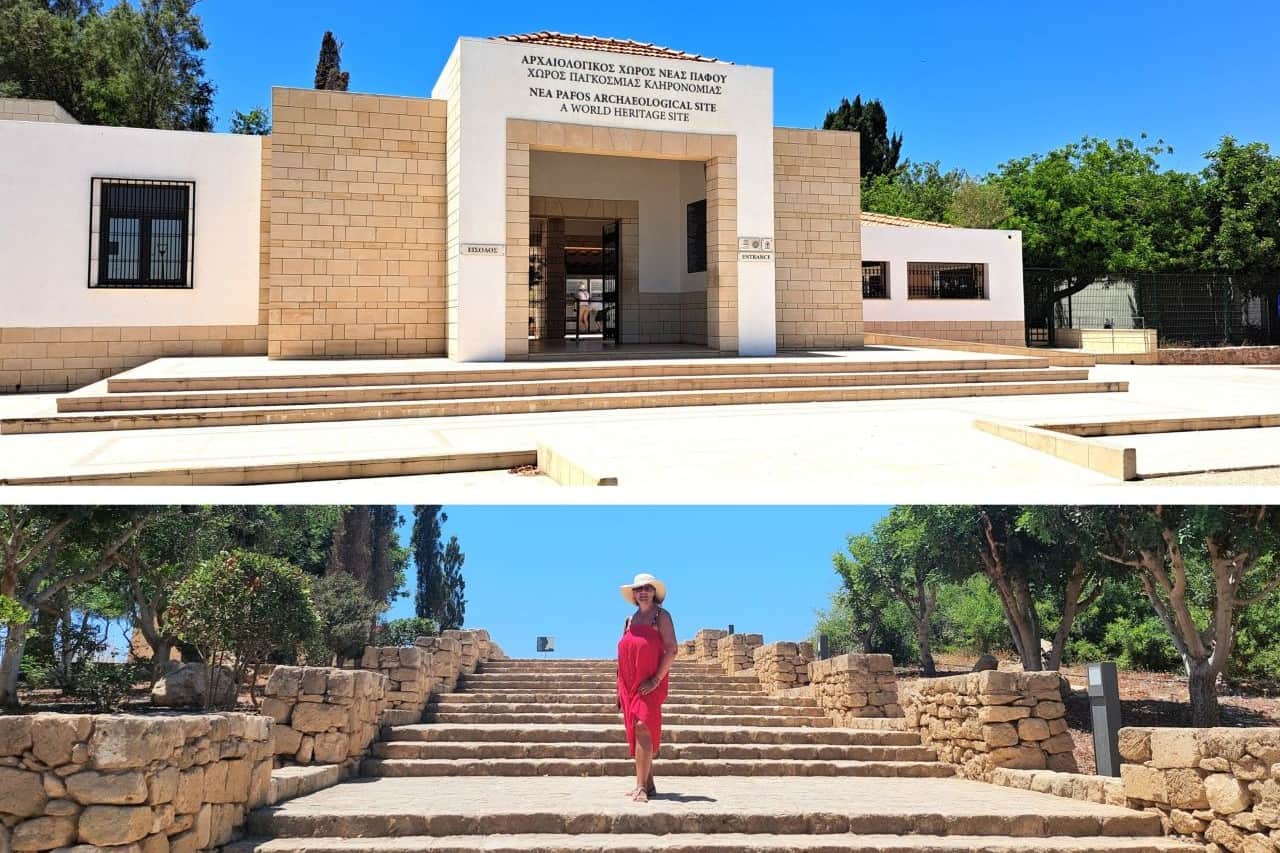
Entrance to the Archaeological Park of Kato Paphos
🎟️ Entrance Fee: 4.50 EUR for the main Archaeological Park.
For the Tombs of the Kings, a separate ticket costs 2.50 EUR.
Entrance is free for students and seniors aged 65 and above.
🕰️Opening Hours:
Daily from 8.30 AM to 7,30 PM during summer (16th April – 15th September).
Daily from 8.30 AM to 5 PM during winter (16th September – 15th April).
🌞Tip: The park is almost entirely open-air with very little shade. Bring plenty of water, a hat, and visit it early in the morning or late afternoon to avoid the Mediterranean sun.
🏠 The Magnificent Mosaic Houses
For centuries, these Roman mosaics lay completely forgotten. In 1962, a local farmer was ploughing his field when he accidentally uncovered some of the best-preserved Roman mosaic floors in the world.
The House of Dionysos, the God of wine
This house covers an area of 2,000 square meters, and its mosaics cover 556 square meters. It was built at the beginning of the 2nd century AD over the earlier building. The villa was destroyed and abandoned after the earthquakes of the 4th century.
The house was named after Dionysus, the god of wine, who was represented on the mosaics. Well, we can say that it was a beautiful and luxurious Roman villa with 40 rooms and 15 mosaic floors. The main official and private rooms were situated around the central courtyard (atrium).
Mosaics in the House of Dionysos
On the left side of the entrance, there is the Hellenistic Scylla Pebble Mosaic Floor (late 4th/early 3rd century BC), from the earlier villa. It represents Scylla, the mythical sea monster, who is part woman, part fish, and part dog.
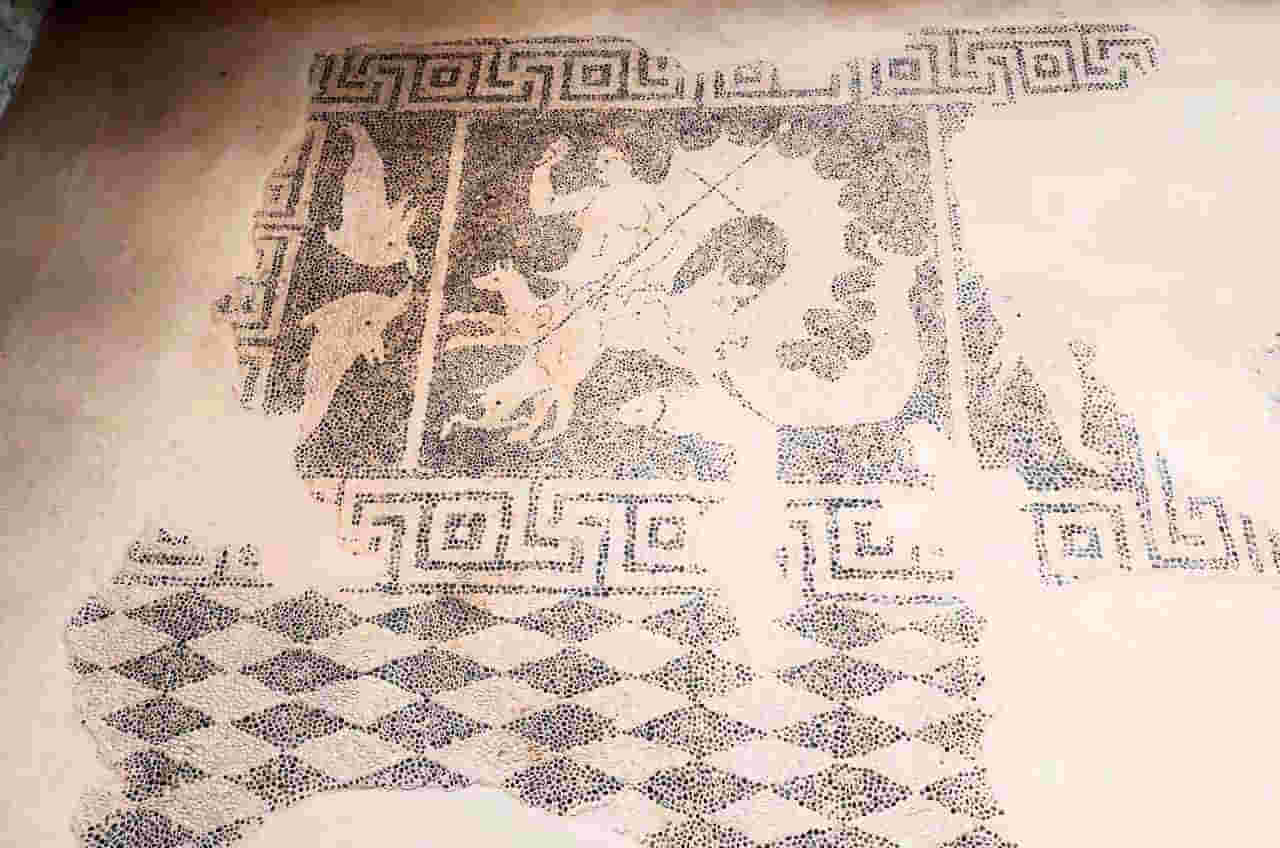
House of Dionysos, mosaic with Dolphins and Scylla, sea monster
Also, at the entrance, there is a large mosaic of Narcissus, son of the river god and the Nymph Liriope.
I believe that everyone is familiar with the story of his beauty, and how both women and men fell in love with him. But he was so proud and didn’t respond to anyone, including the Nymph Echo. Sitting on the bank of a lake, Narcissus fell in love with himself when he saw his reflection in the water. The gods punished him by turning him into a flower, known as the narcissus.
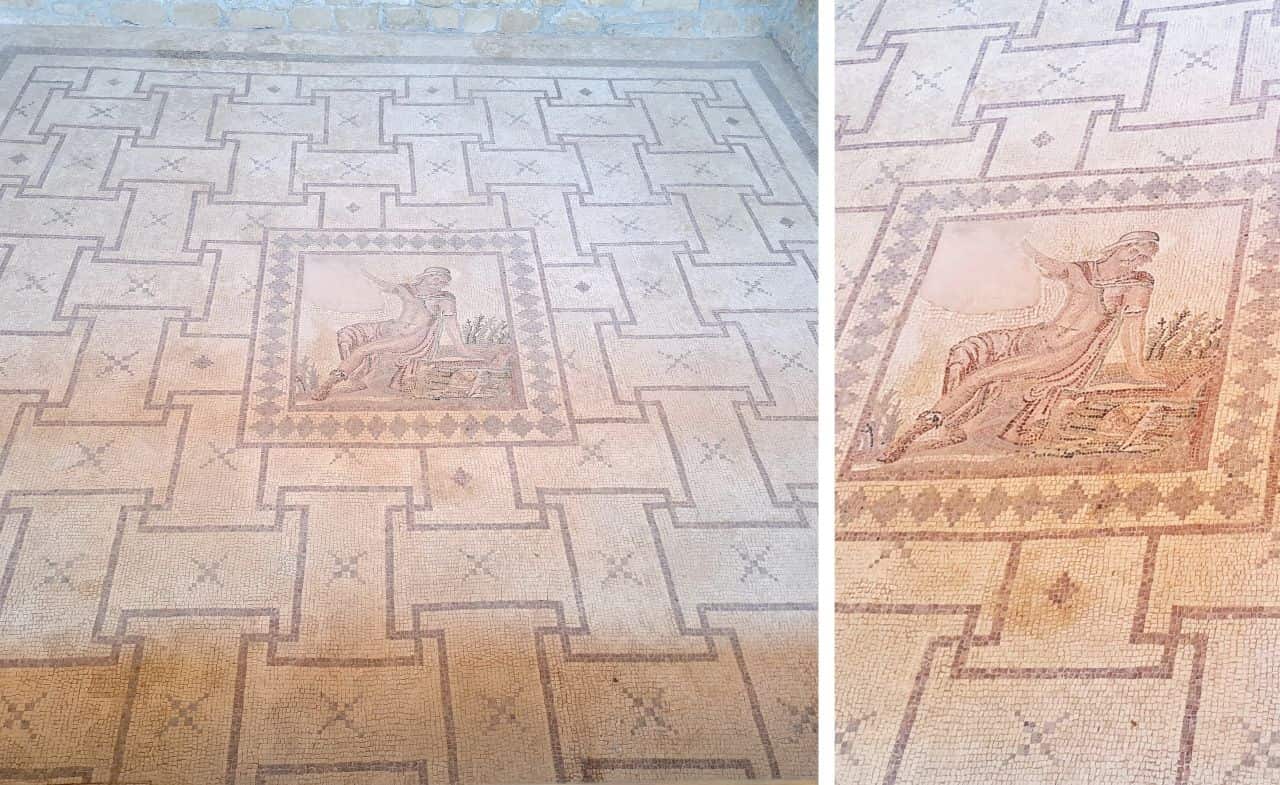
House of Dionysos, Narcissus mosaic
The restored Four Seasons Mosaic dates back to the late 2nd/early 3rd century AD. In the centre is probably Dionysus or Aion, and in the four corners, there are personifications of the four seasons.
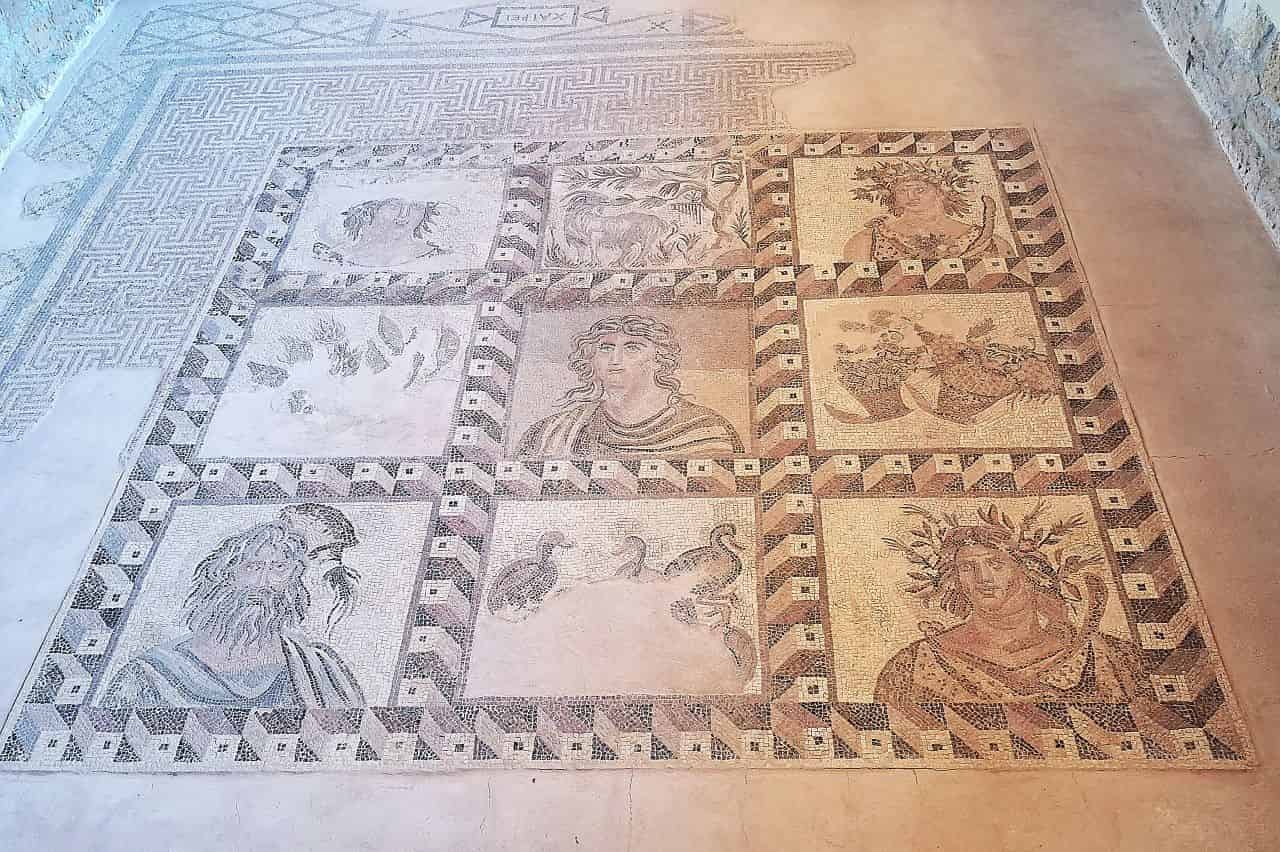
House of Dionysos, Four Seasons mosaic
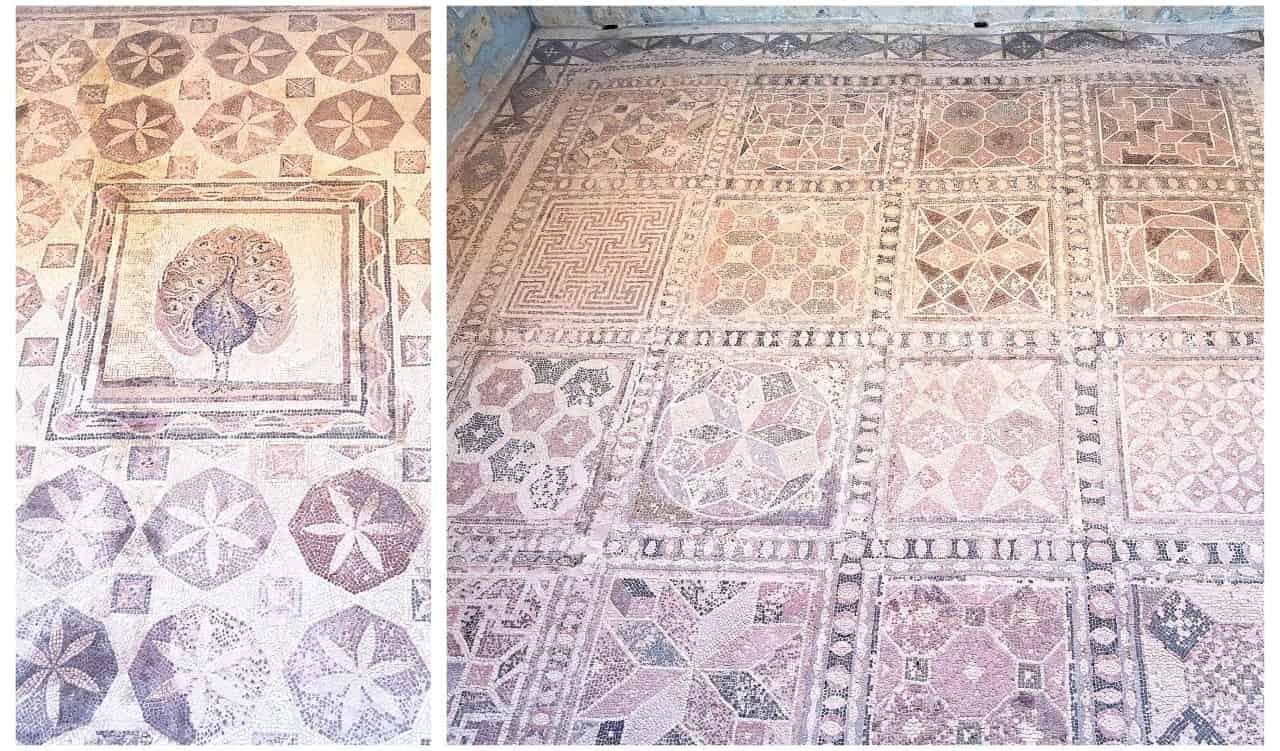
Peacock mosaic and Geometric mosaic with 16 panels
The Triumph of Dionysos is the most famous mosaic in the house. It depicts the god of wine, crowned with ivy leaves, riding a chariot pulled by two leopards, after his return from a military campaign in India. Satyrs and musicians accompanied Dionysos. A panel featuring vintage scenes is nestled in the centre of the room.
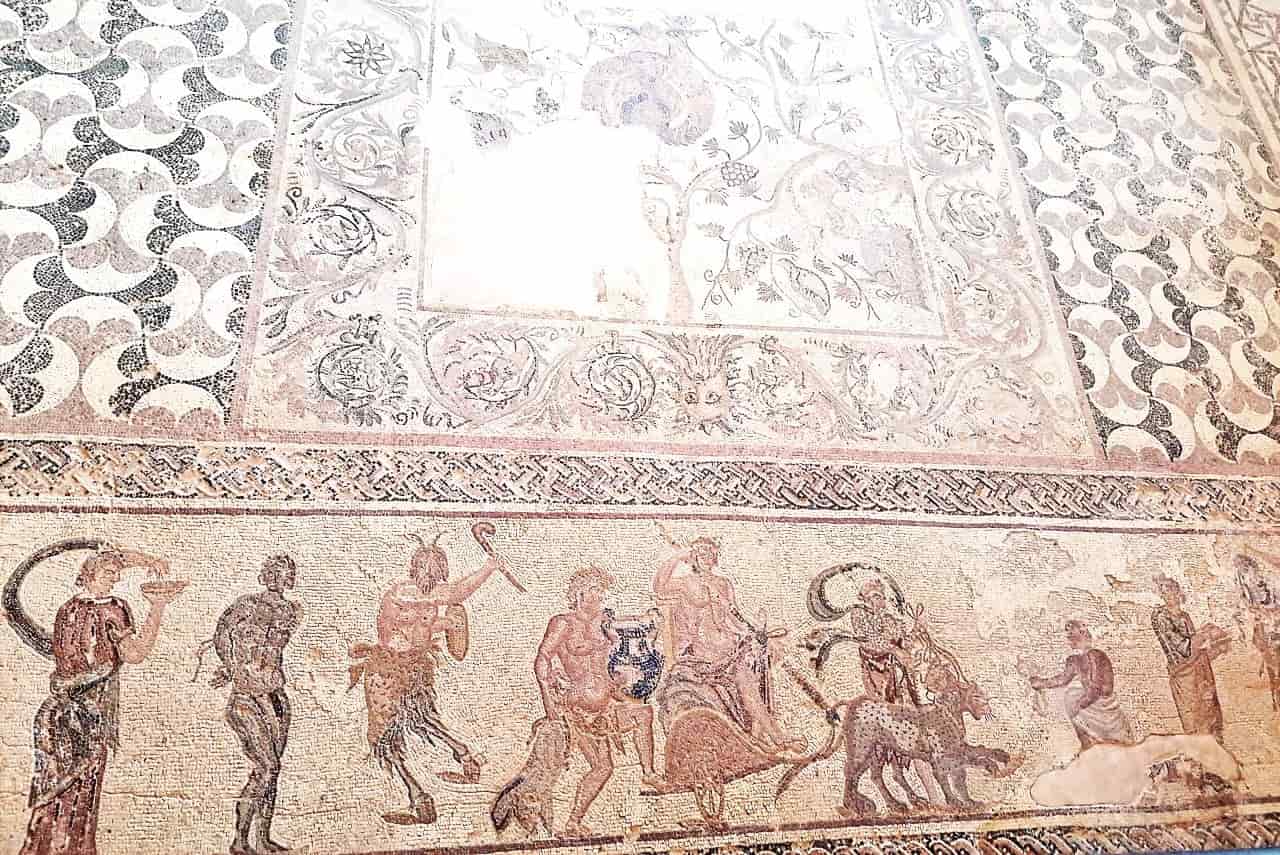
House of Dionysos, Triclinium mosaic, Dionysos triumph, room 4
A large mosaic consists of several interesting panels.
The first is Pyramus and Thisbe, a beautiful mosaic that represents the tragic mythological love story. It shows Thisbe fleeing from a lioness while Pyramus lies dying. This story inspired Shakespeare to write his famous work, “Romeo and Juliet”.
✨ Interestingly, two months ago, I saw the wall painting fresco of Thisbe and Pyramus in the Knight Hall at Brežice Castle in Slovenia. Read more about this beautiful castle here: Fairy-tale Brežice Castle in Posavje.
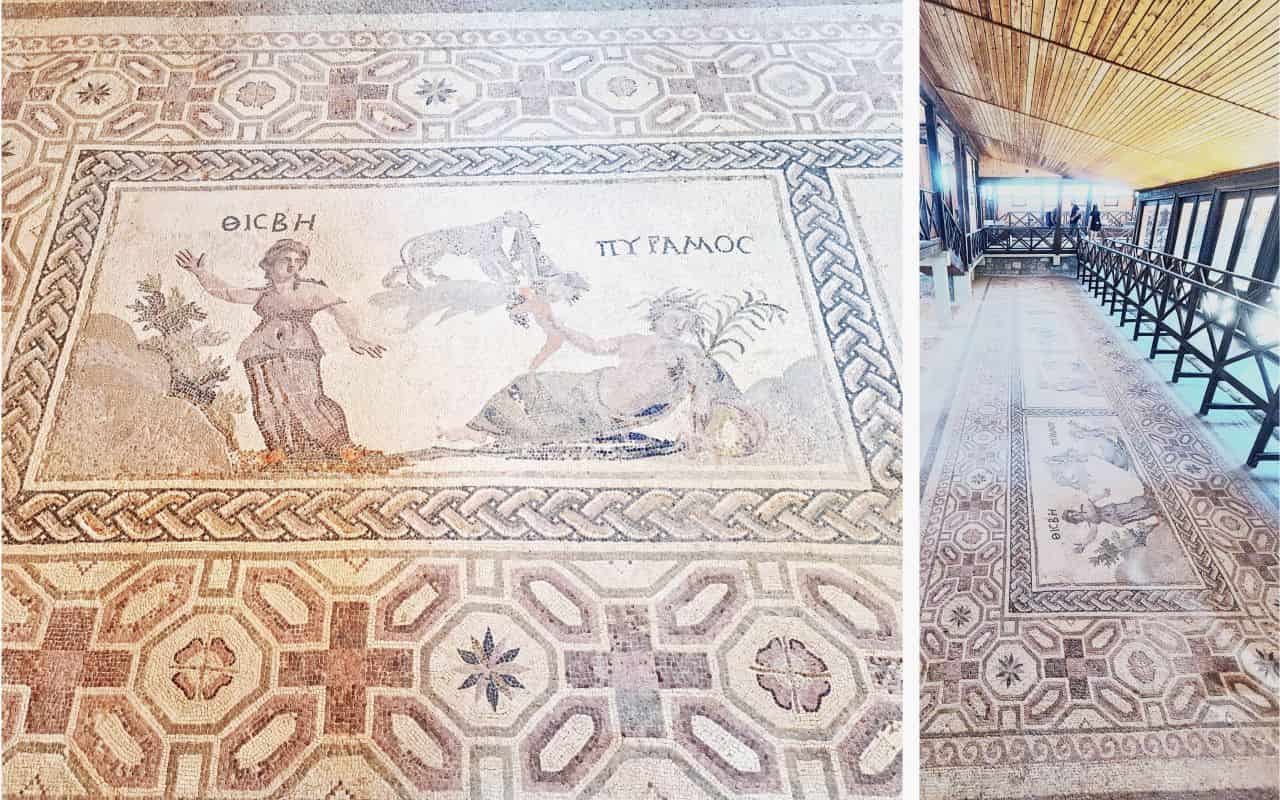
House of Dionysos, Pyramus and Thisbe mosaic
The next mosaic depicts the god Dionysus holding grapes, and a half-naked nymph Acme, then Ikarius, the king of Attica, with an ox-drawn cart filled with wine sacks and two wine drinkers.
Near them, Neptune (Poseidon), god of the sea, is holding a trident, saving Amymone from the angry satyr, while Cupid hovers between them.
The last panel illustrates the mythological love of the god Apollo for the nymph Daphne. She wanted to save her eternal chastity from Apollo, and she is transformed into a laurel tree with the help of her father, Peneus.
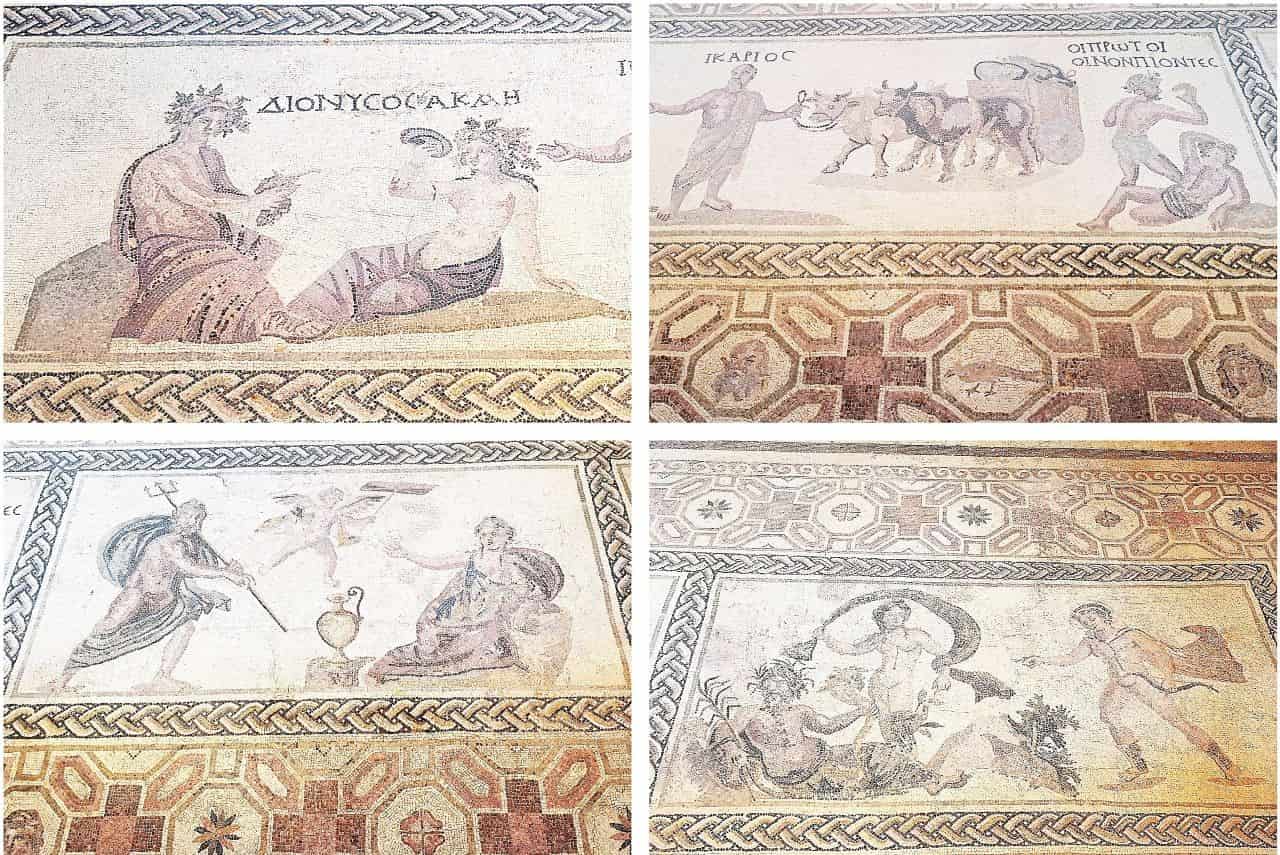
House of Dionysos mosaics: Dionysos and Acme, Ikarius, wine drinkers, Neptune and Amymone, Apollo and Daphne
Another interesting mosaic depicts Hippolytos reading a love letter from his stepmother, Phaedra.
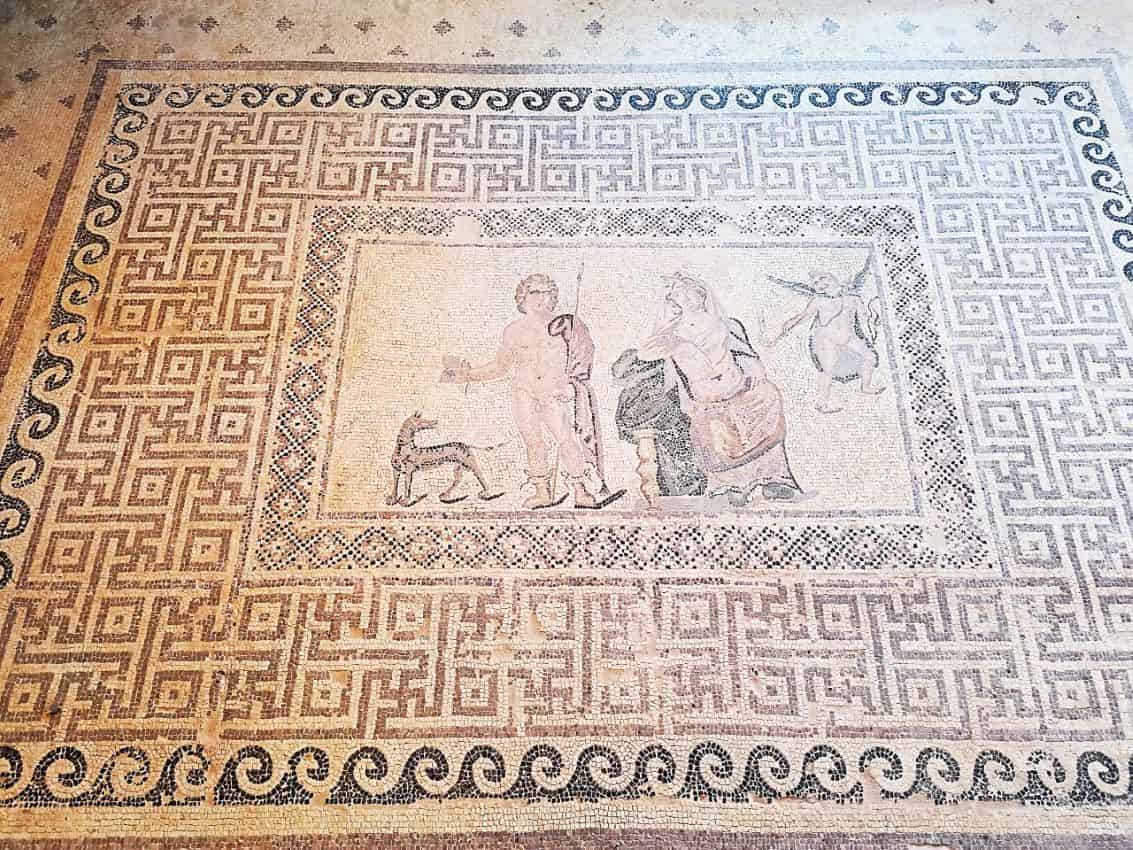
Phaedra and Hippolytos mosaic
The Rape of Ganymede mosaic depicts the god Zeus, transformed into a giant eagle, abducting the handsome Trojan prince Ganymede, and carrying him away to Mount Olympus.
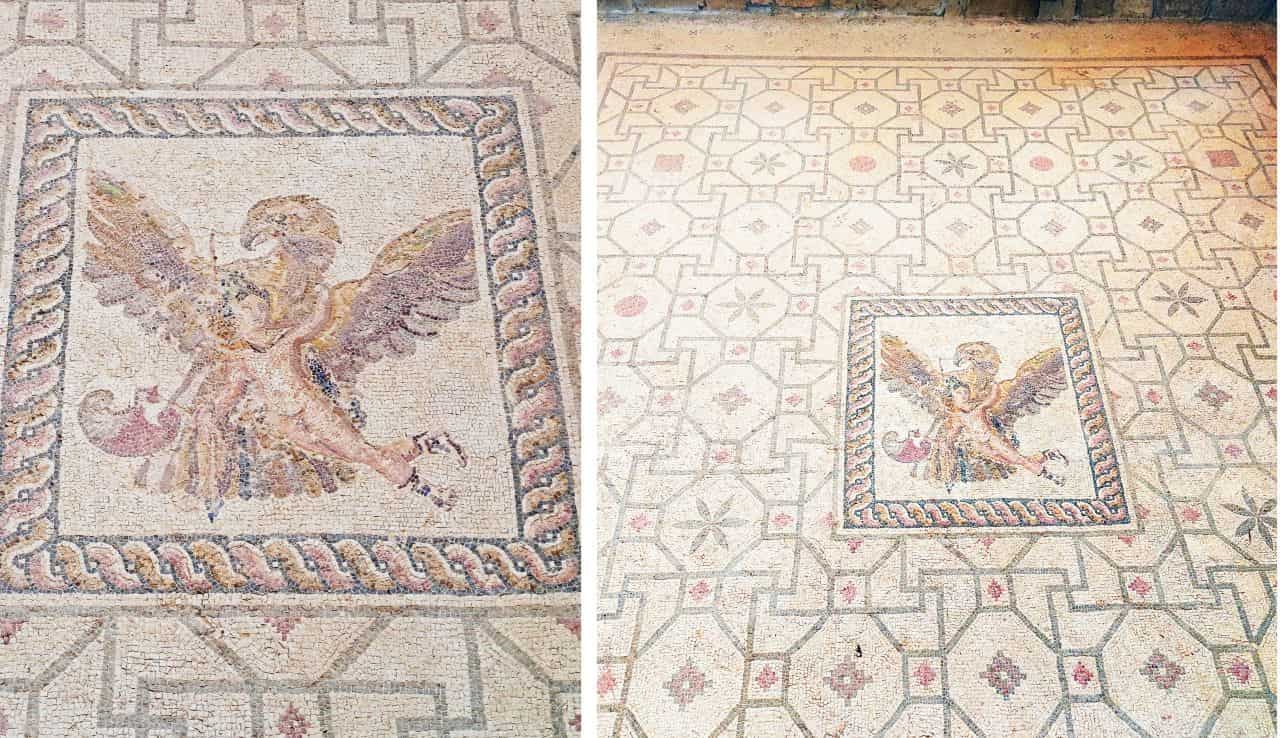
The Rape of Ganymede Mosaic
A large mosaic consists of several panels depicting hunting scenes of hunters with a bear, a leopard, a tiger, and mouflons.
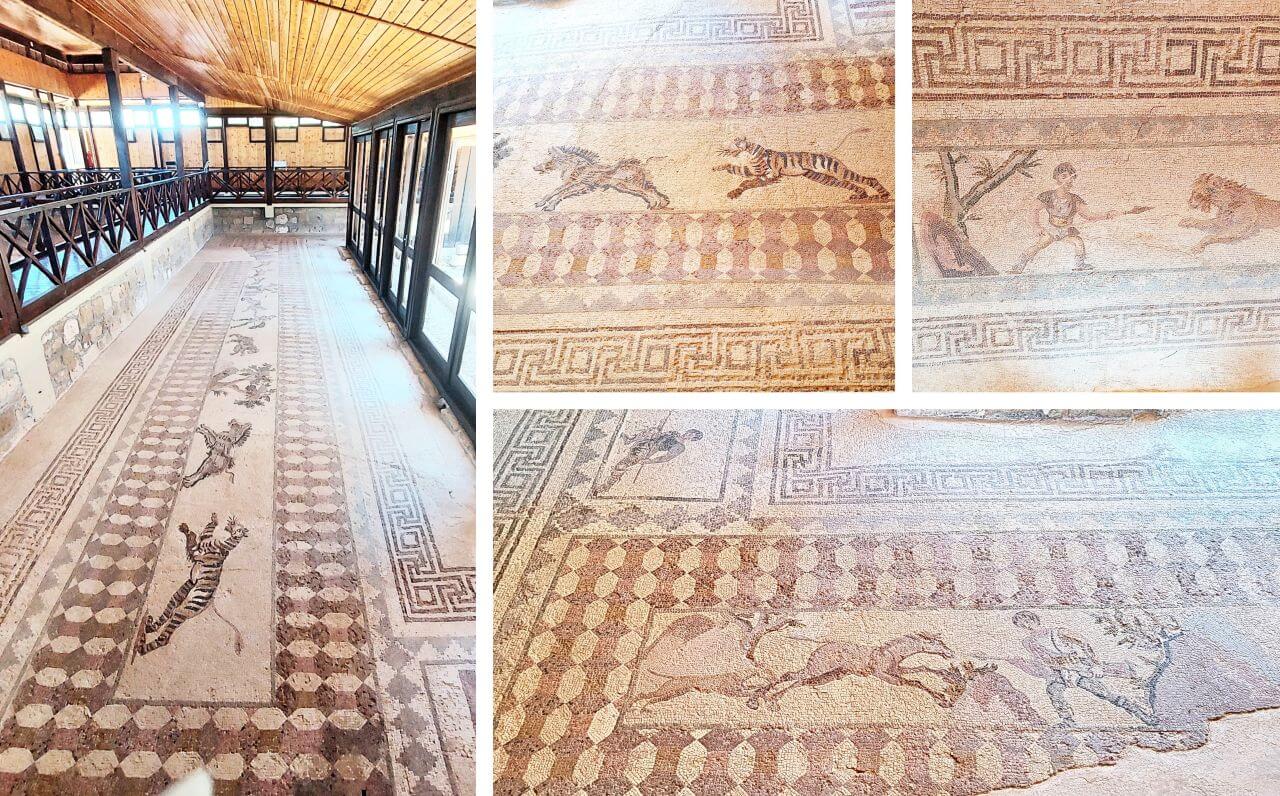
House of Dionysos, Hunting scenes mosaic
The House of Aion
The House of Aion dates back to the 3rd-5th centuries AD. It got its name after the god Aion, the personification of time.
Only a small part of the building was excavated, which shows the reception hall. The House of Aion has been restored with a grant from the A.G. Leventis Foundation. Some parts of the mural frescoes are exhibited in the Paphos Museum.
The spectacular Triclinium mosaic in the main room (reception hall) has five figural panels.
On the left side, there is a scene of Leda, the queen of Sparta, ready to enter the river Eurotas for a bath, while Zeus, who transformed himself into a swan, approaches her. On the right side, a mosaic depicts the Epiphany of Dionysus. The newborn Dionysus is on Hermes’ lap, being presented to Tropheus, his future teacher, and to nymphs preparing for his first bath. Dionysus is accompanied by three personifications: Theogonia, Nectar and Ambrosia. The names of all figures have inscriptions in Greek.
The central panel shows Aion, the god of eternal time, presenting Cassiopeia, the queen of Ethiopia, a winner of the beauty contest with the Nereids (sea goddesses Thetis, Doris and Galatea).
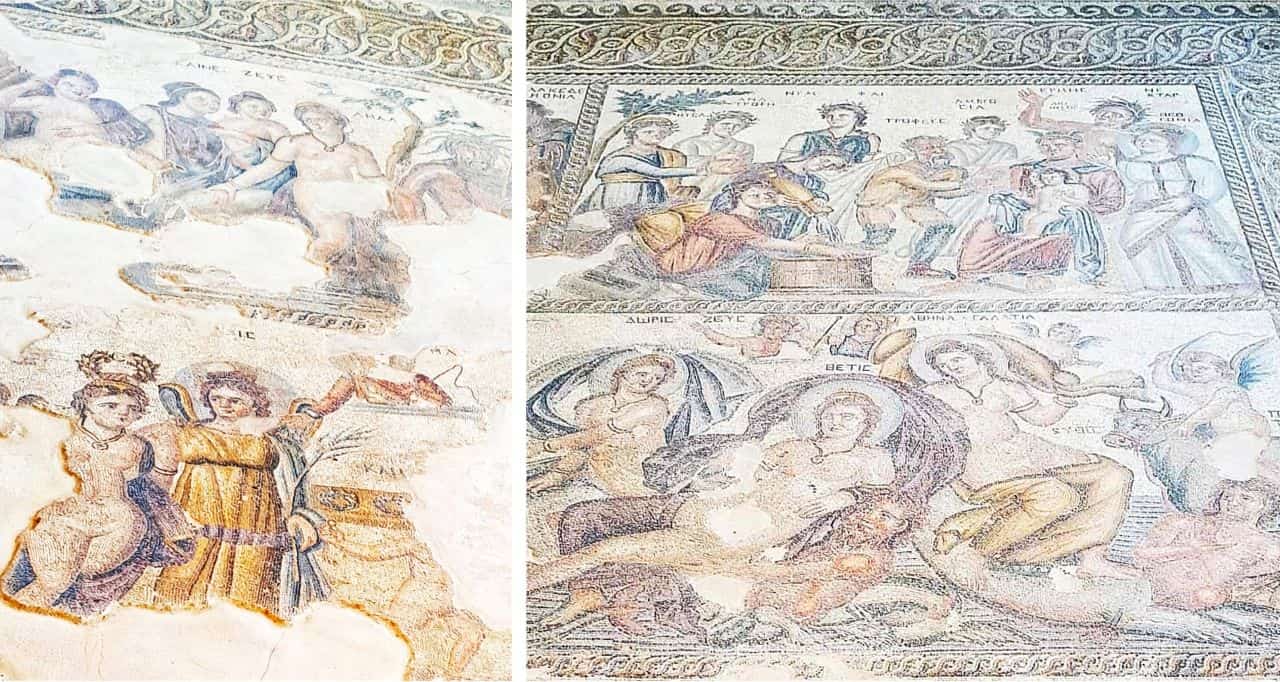
House of Aion mosaic, Leda and the Swan, Enfant Dionysos, and beauty contest between
The lower part of the mosaic depicts the Triumphal Procession of Dionysus through the world, holding a lyre and flute while riding a chariot drawn by two centaurs. A half-naked Maenad leads the procession, and a young satyr offers fruits to the god.
On the right side, there is a scene known as the judgement of the flute player Marsyas, who lost the music contest to Apollo.
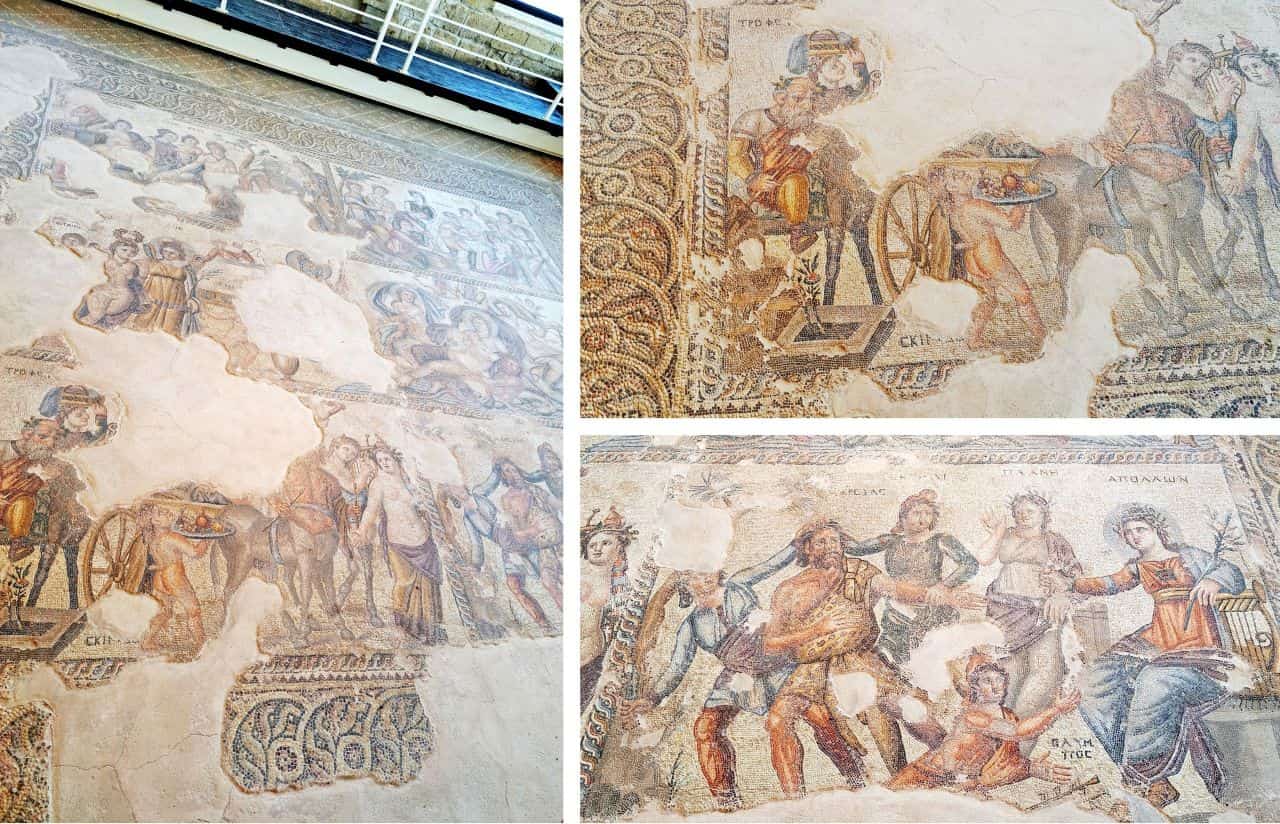
House of Aion mosaic, Dionysian procession, and the judgement of Marsyas
The Villa of Theseus
The Villa of Theseus was actually the luxurious residence of the Roman proconsul (governor). It was built in the 2nd century AD on the ruins of older houses of Hellenistic and Roman times. Over the centuries, the house has had many additions and restorations. Due to the Arab raids, it was used until the early 7th century AD, and then it was abandoned.
The house was named after its oldest mosaic of Theseus, the ancient Greek hero slaying the Minotaur in a labyrinth, watched from the side by Ariadne. The circular floor mosaic is a masterpiece of ancient art. It is so well preserved that the details on Theseus’ shield and the texture of the labyrinth are clearly visible.
✨The whole story about Theseus, Ariadne and the Minotaur can be read in the text:
Discover the secrets of Knossos Palace.
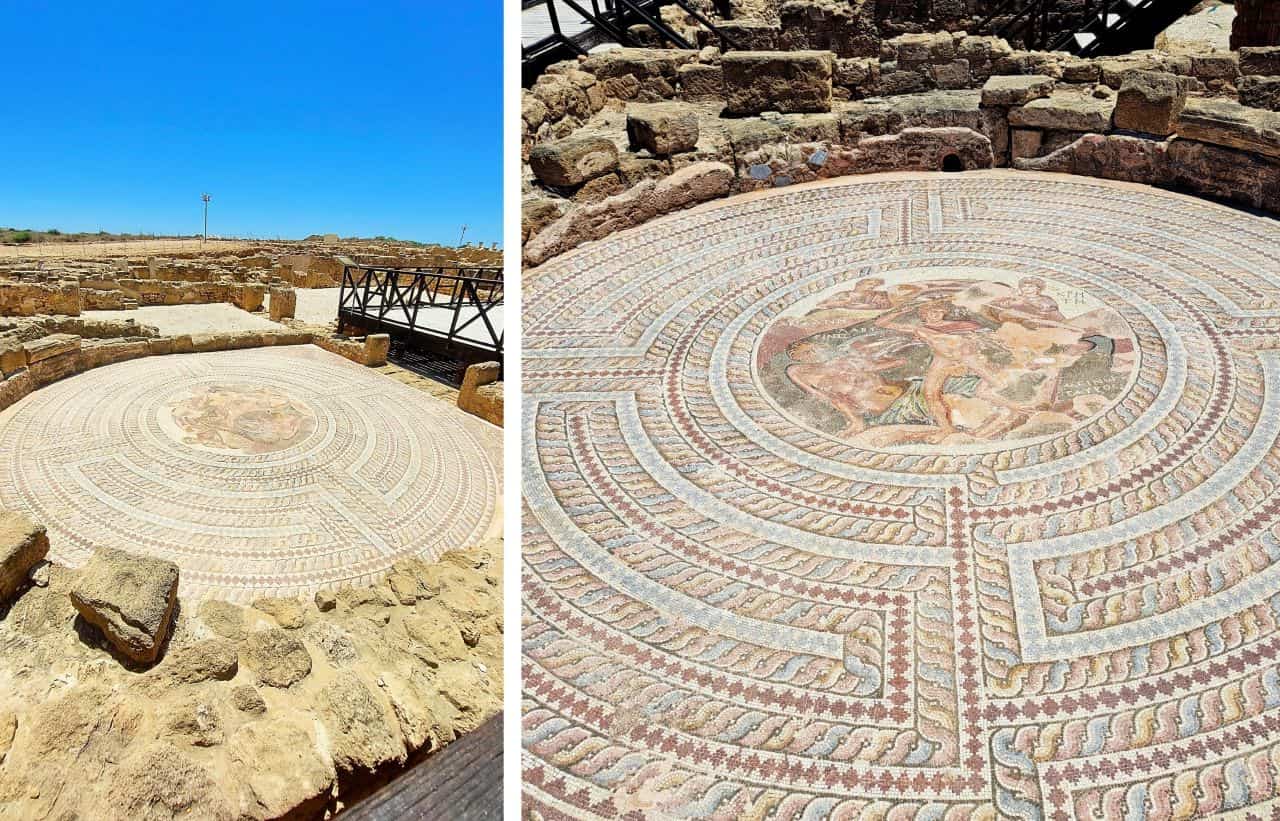
Mosaic of Theseus
By the way, it is the largest Roman villa discovered in Cyprus, spread over 9,600 square meters.
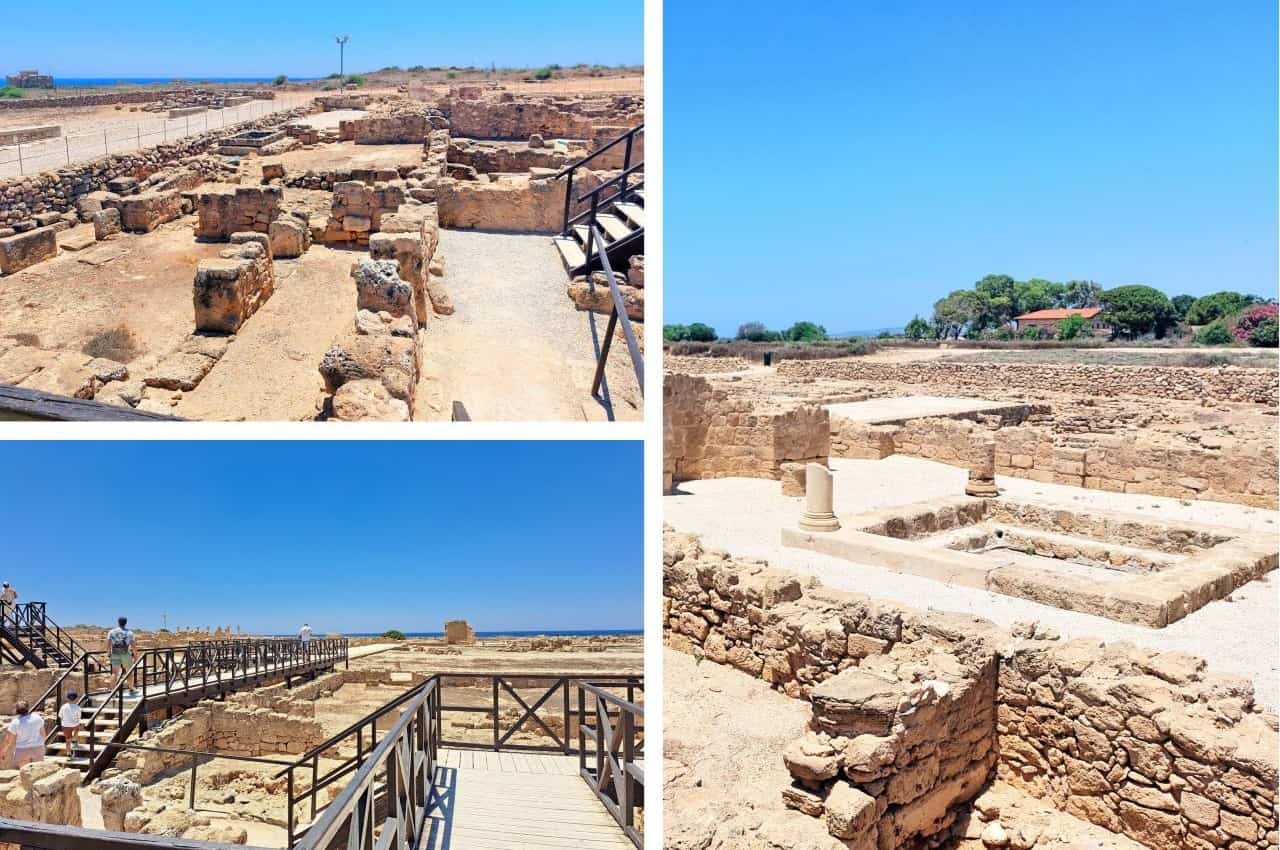
Ruins of the Villa of Theseus
The Villa of Theseus had over 100 rooms in four wings, situated around a large square and courtyard, covered with mosaic compositions. Various workshops, services, public spaces and a bath complex were situated in the southern wing. The public road led to the theatre and city harbour.
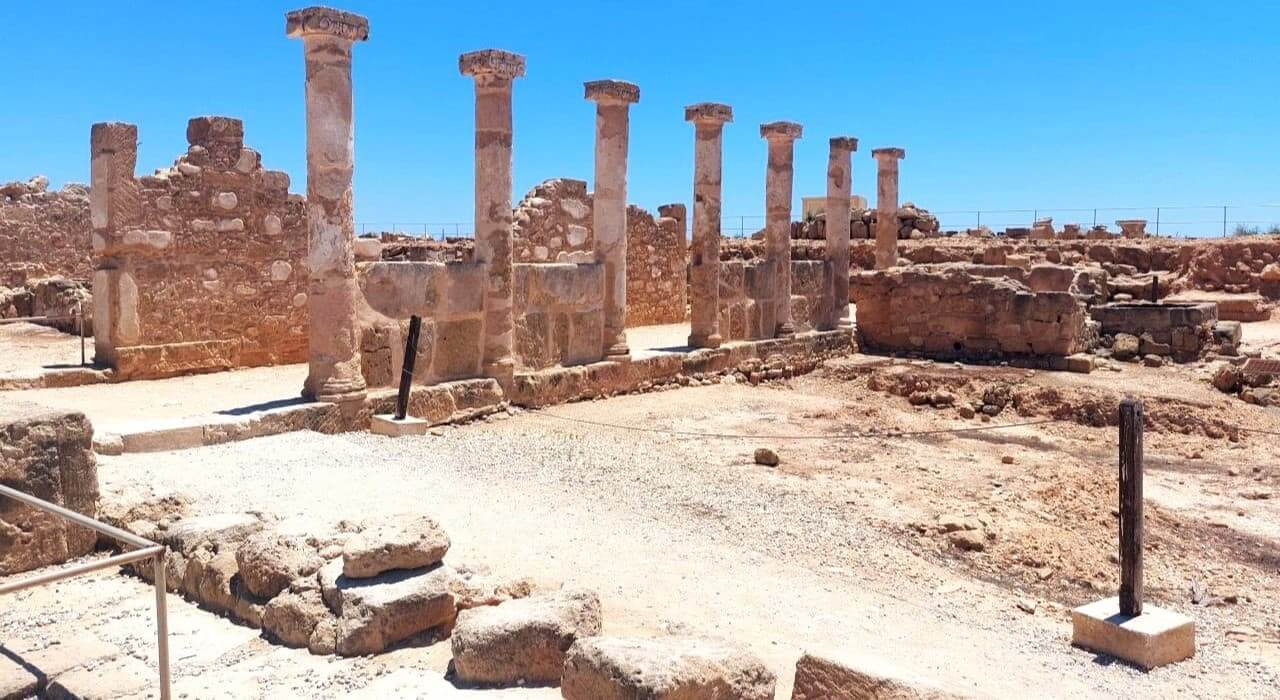
Columns of the Villa Theseus
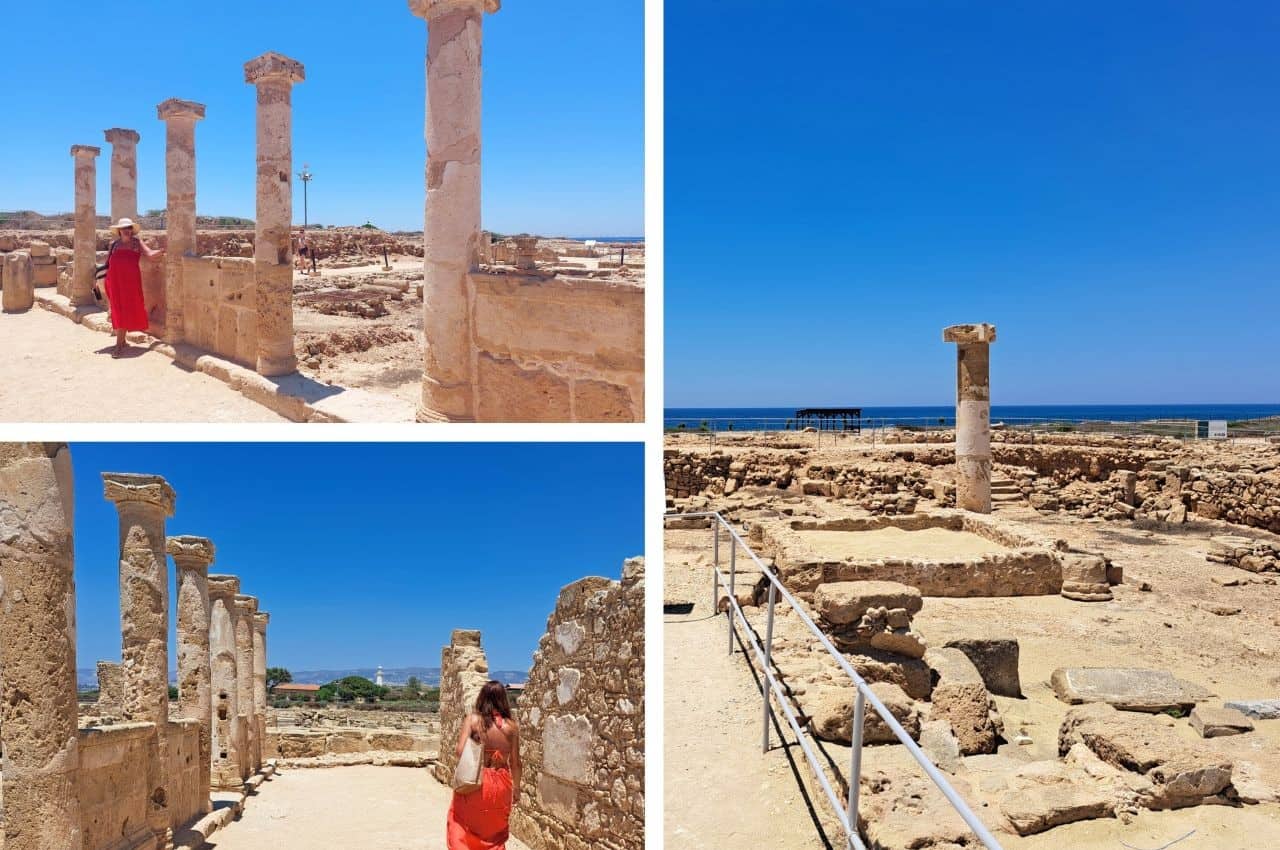
Ruins and columns of the Villa of Theseus
Another interesting mosaic shows Poseidon crossing the sea with his wife Amphitrite, and the Mosaic of Three Horae (Hours) in the Hellenistic House, situated next to the Villa of Theseus.
The House of Orpheus
The House of Orpheus is located east of Theseus’ house, from the Late Roman period (late 2nd to early 3rd century AD).
The house covers an area of about 32 x 42 meters. It is known for the mosaic of Hercules and the Lion of Nemea, and an Amazon with her horse. However, the most famous is the mosaic of Orpheus, depicting the musician Orpheus playing music on his lyre among wild beasts.
Lighthouse
Paphos Lighthouse was built in 1888, when Cyprus was under British administration. It is 20 m high and 36 m above sea level. Once, it was used as a marker for ships going to Paphos harbour from British colonies.
Although it is under the Cyprus Port Authority, it is also under the protection of the Department of Antiquities, as it is situated in the Kato Paphos Archaeological Park. By the way, this area belongs to the Natura 2000 network, which means that thousands of migratory birds have to be protected, especially during autumn and spring.
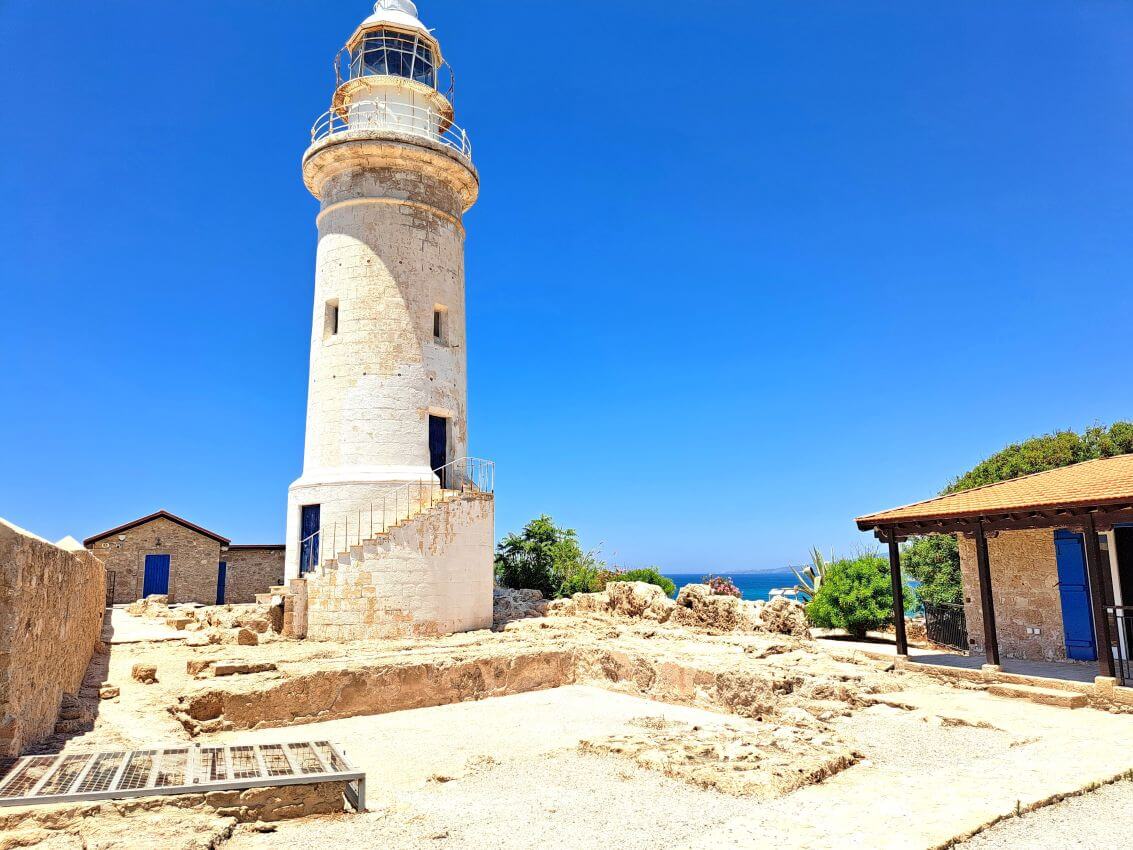
Paphos Lighthouse
Other monuments at the Kato Paphos Park
Close to the Lighthouse, there are several more monuments.
Agora was a 2.5-hectare public market and administrative centre, dating from the 2nd century.
Odeon was built in the 2nd century AD, and it could house about 1,200 visitors.
Asklepion was the healing sanctuary and nursing space, dedicated to Asklepios, the Greek god of medicine and healing.
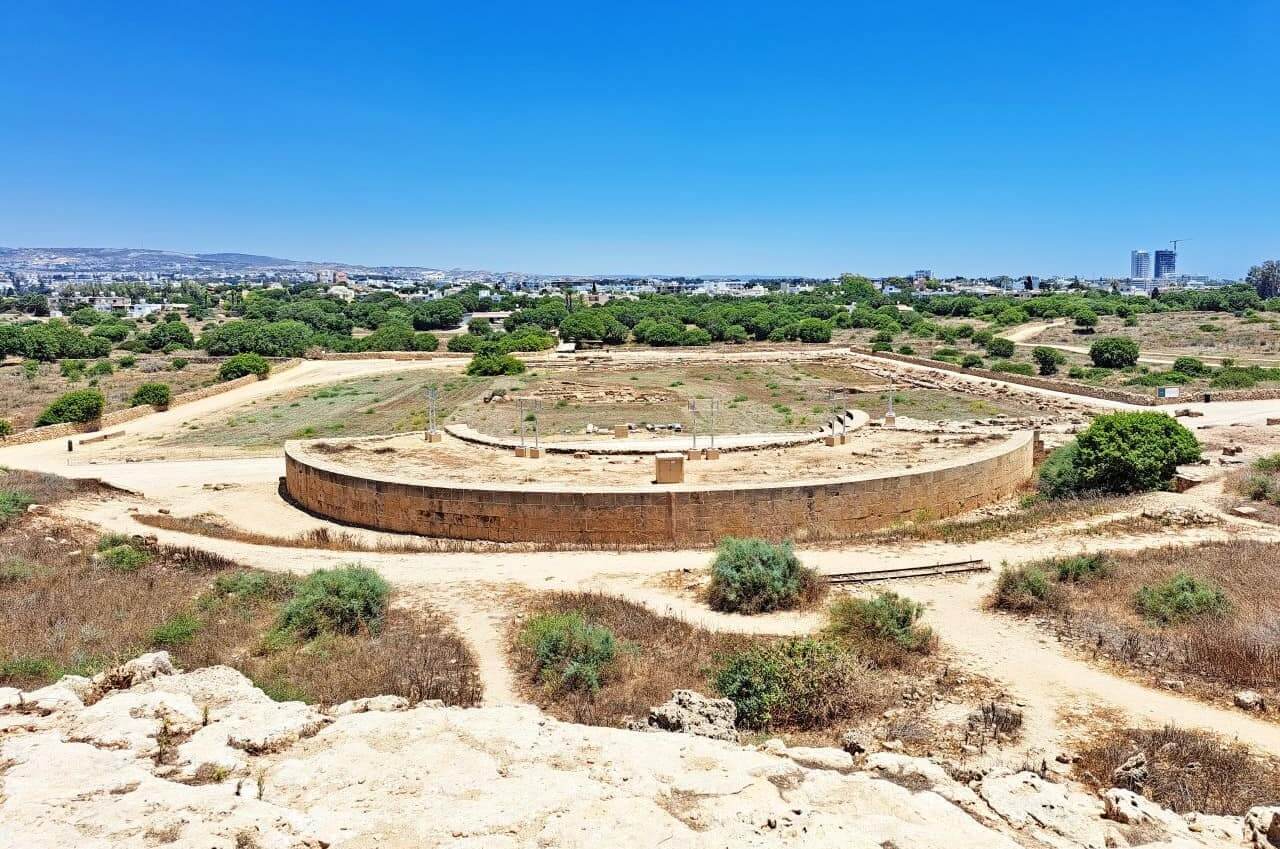
Agora and Odeon
In the northeastern area of the ancient city, you can see the remains of the theatre, dated to the end of the 4th century BC.
Saranta Kolones Fortress is located close to the harbour. It got its name from forty granite columns found on the site, which probably were part of an ancient agora. Originally, the fortress was built in the late 7th century AD under Emperor Heraclius, during the Byzantine period, to protect the port from Arab raids. Later, it was remodelled by the Lusignans, but the strong earthquake in 1222 destroyed most of the fortress; some ruins can still be seen today.
⚓Paphos Harbour
After you finish with your archaeological tour, step right into the colourful everyday life of the city.
Once a trading place, Paphos Harbour is today a charming marina filled with fishing boats and luxury yachts. It is a perfect place for coffee or lunch in one of the traditional taverns with fresh fish and Cypriot halloumi cheese.
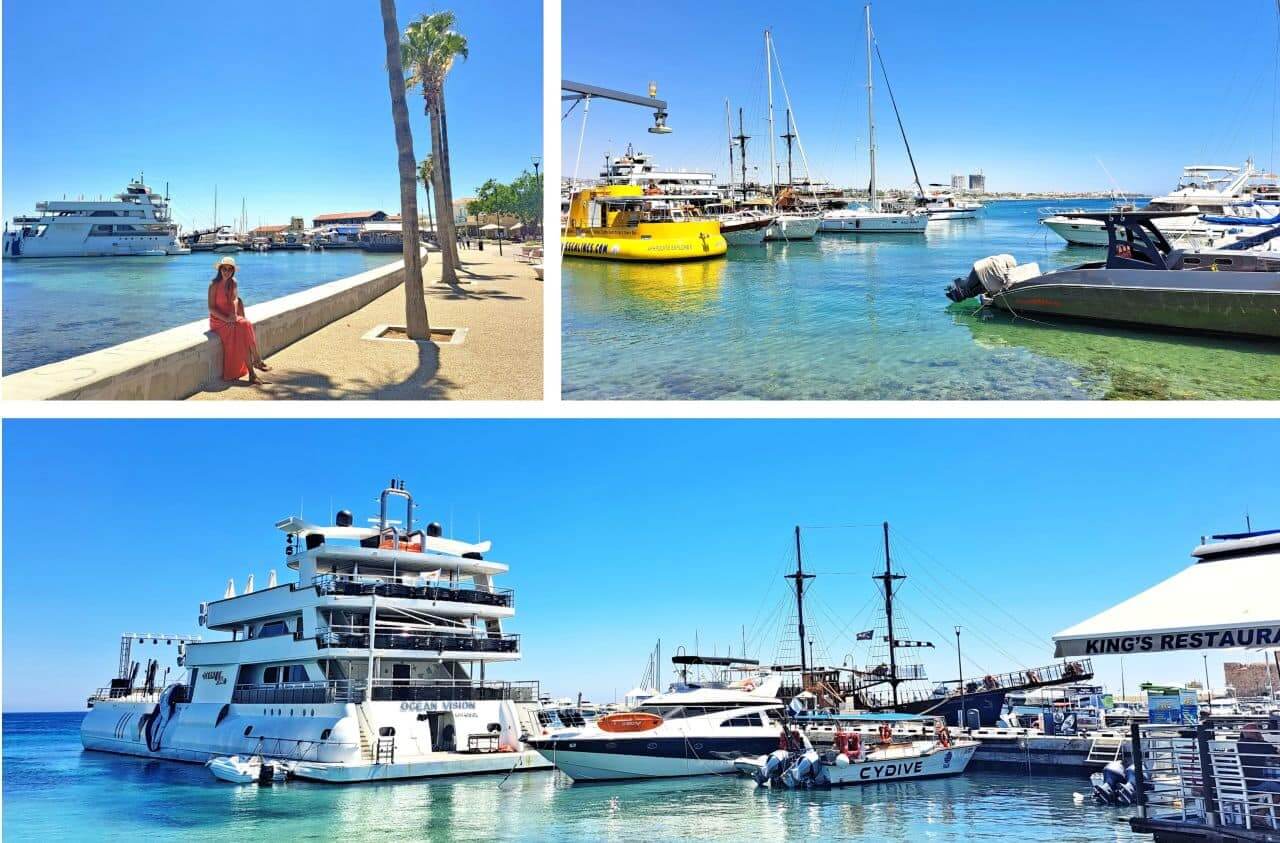
Paphos Harbour
City Promenade is a wide and long palm-tree coastal boardwalk, ideal for a leisurely afternoon stroll and watching the sunset. It is lined with cafes, bars, traditional tavernas, and boutique shops across Poseidonos Avenue.
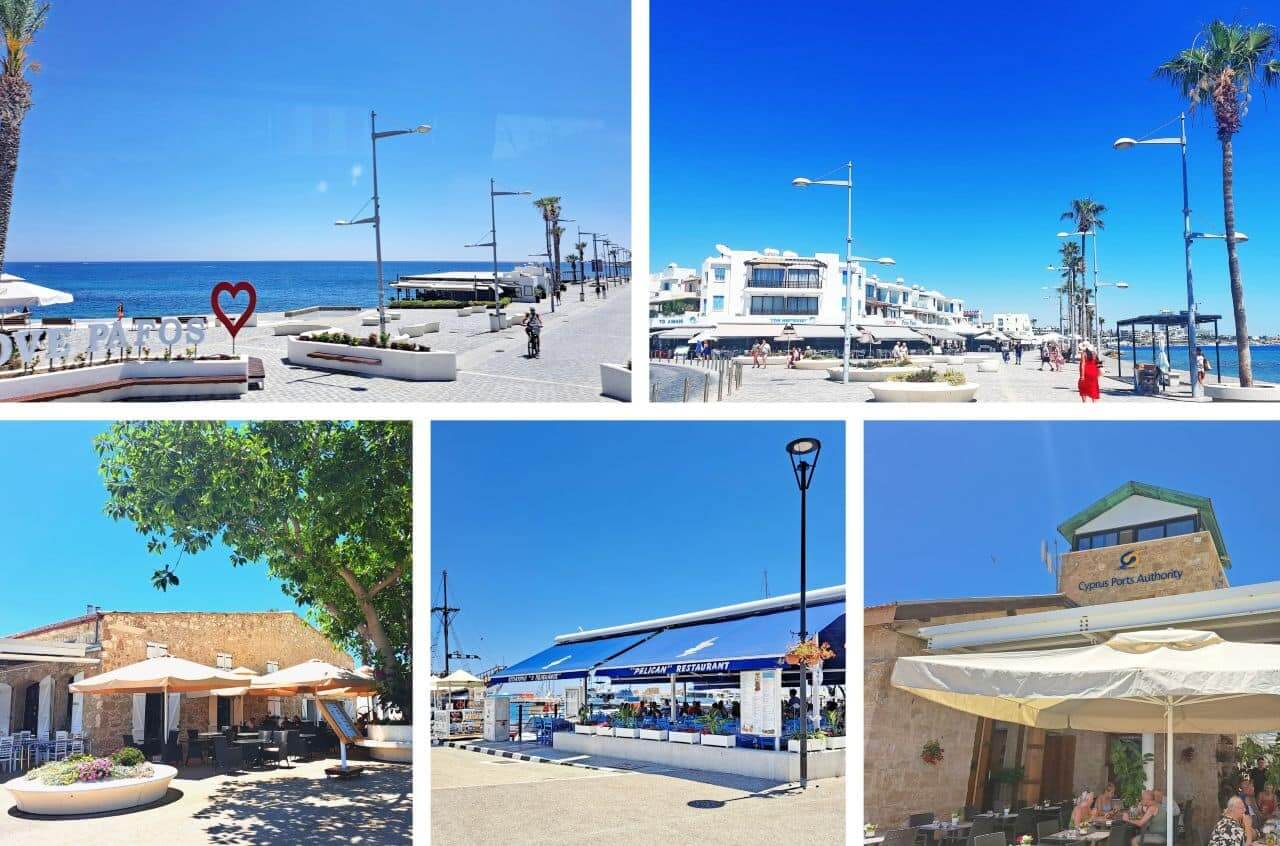
Coastal boardwalk and restaurants
🏰Paphos Castle
The stone castle is located at the western end of the Paphos Harbour. The Byzantines built it to protect the harbour from Arab attacks.
Paphos Castle was built in the 13th century by the Lusignans (crusaders) to replace the Saranta Kolones, an earlier fortress about 600 metres away, destroyed by the earthquake. Later, the Venetians demolished it to prevent it from falling into Ottoman hands. But the Ottomans rebuilt it in the 16th century (hence its current appearance).
Throughout history, the castle has served as a fortress, a prison, and even as a salt warehouse during British colonial rule. Today, it is a tourist attraction, and it is used for cultural events and festivals. The entrance fee is 2.50 EUR.
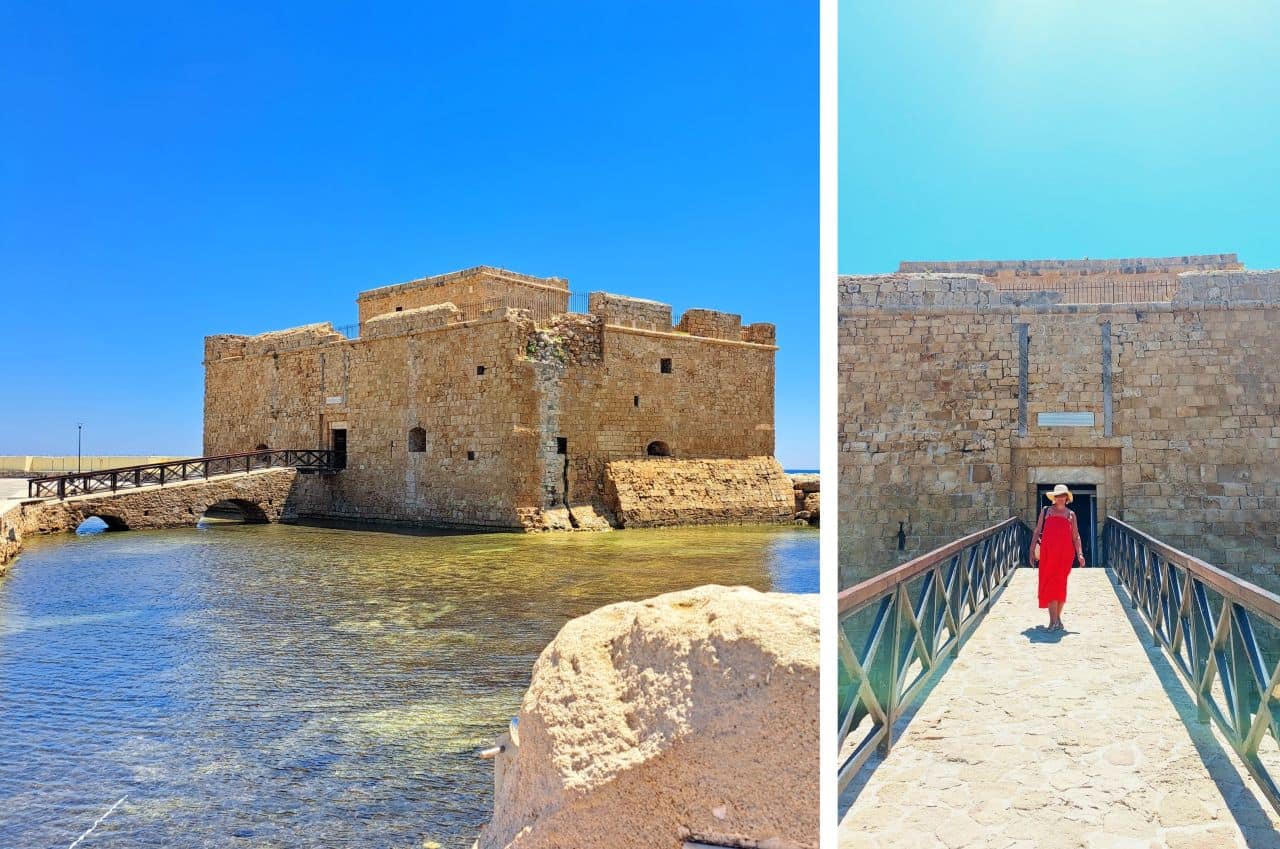
Paphos Castle
Modern Aphrodite
Close to the castle, you can see a modern bronze sculpture, “Modern Aphrodite“. It was installed in August 2016 and created by the famous Cypriot sculptor Yiota Ioannidou, from Paphos.
The sculpture’s name is “Sol Alter” (Second Sun), and it was part of a large project when Paphos was preparing for the title of European Capital of Culture for 2017. It is a modern interpretation of Aphrodite and is dedicated to her.
By the way, the 24th Paphos Aphrodite Festival will be held between the 4th and 5th of September at the Castle Square.
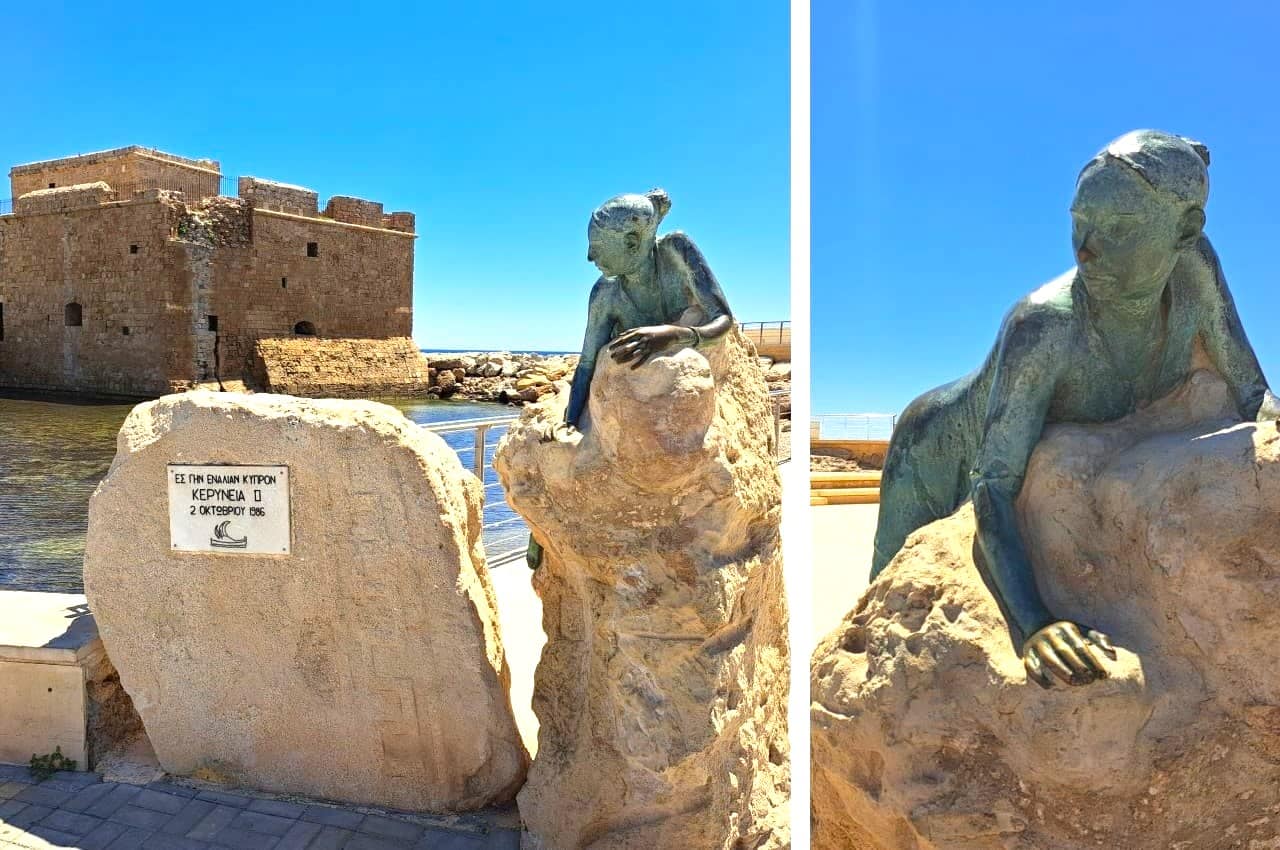
Paphos Harbour, Modern Aphrodite Statue
⛪Panagia Chrysopolitissa
Another interesting place is the Panagia Chrysopolitissa, built in the 13th century over the ruins of the largest Early Byzantine basilica on the island.
It is known for its colourful floor mosaics and marble columns. Among the columns is the Saint Paul’s Pillar. According to tradition, in 45 AD, Apostles Paul and Barnabas preached Christianity in Paphos. But the people of Paphos tied Saint Paul to the pillar and whipped him thirty-nine times. Despite this, he successfully converted the Roman proconsul Sergius Paulus to Christianity, which triggered the Christianization of Cyprus.
Over centuries, it was destroyed and rebuilt several times. Around 1540, the church of Ayia Kyriaki Chrysopolitissa was rebuilt as a Latin Church. Today, both the Catholic Community and the Orthodox Church use Ayia Kyriaki for special services.
🏖️Beaches close to Paphos
Take a look at some interesting beaches close to Paphos.
Paphos Municipal Beach is the most popular among local Cypriots, close to the main tourist area and Poseidone Road.
Vrysoudia Beach is a sandy beach situated near the hotels of the tourist area of Kato Paphos.
Geroskipou Municipal Beach is located about 7 km from Paphos. It is 400-metres long, organised sandy beach with shallow water. Around it, there are restaurants, fish taverns, cafes, and various accommodations.
Coral Bay Beach is located about 6 km north of Paphos, known for its white sand and shallow swimming area.
Venus Beach features coarse golden sand and clear water protected by artificial breakwaters, making it ideal for swimming.
Petra tou Romiou (Aphrodite’s Rock) is a main stop for taking photos, but swimming can be rough due to the deep, rocky waters.
Lara Beach is a remote beach on the Akamas Peninsula, with golden sands and crystal-clear turquoise waters, located about 22 km away. Actually, it is a protected nature reserve with no facilities for green and loggerhead turtles. Bear in mind that it is accessible by a dirt road, so take a 4×4 vehicle.
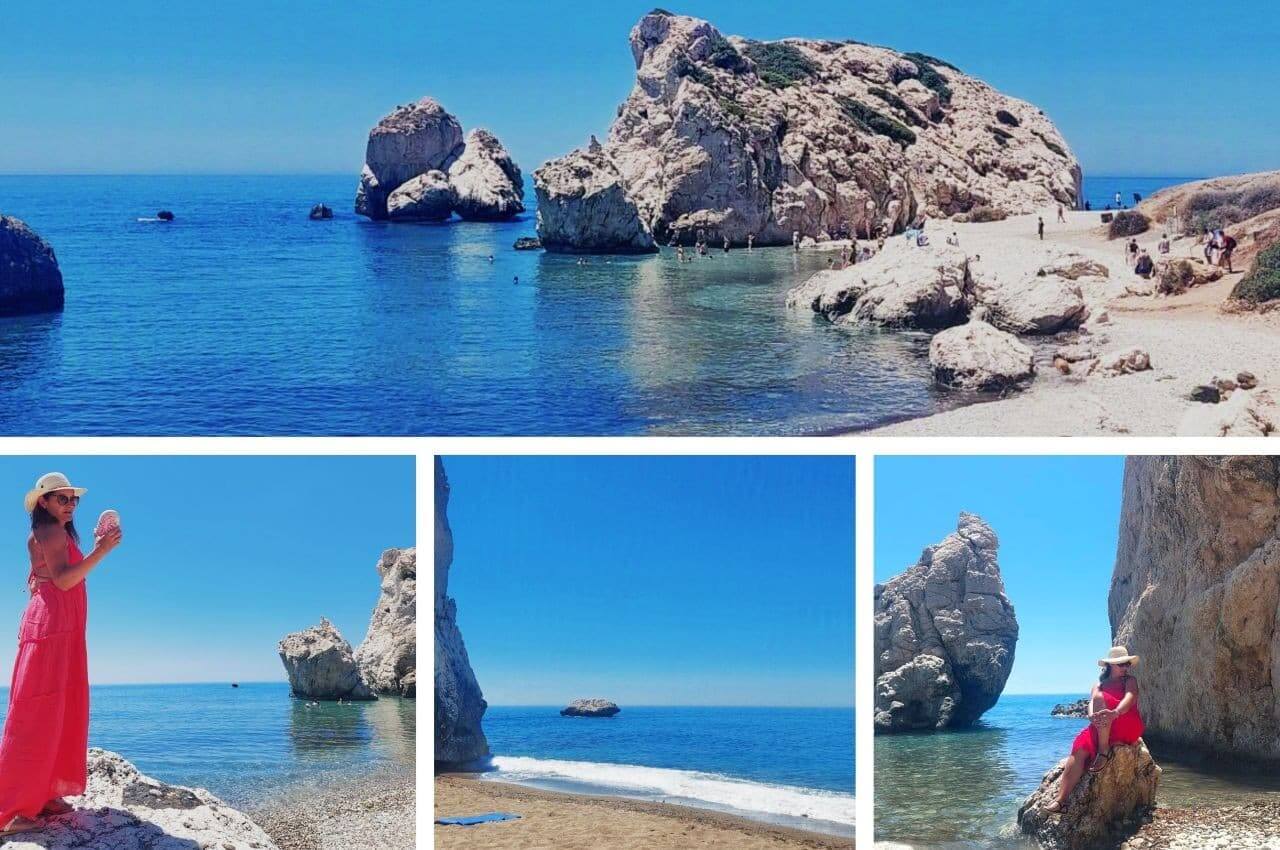
Aphrodite’s Rock
📌What to see close to Paphos
Depending on your time and accommodation, you can visit several places close to Kato Paphos.
♦ Ktima, the old town of Paphos, is located about 2 km from Kato Paphos. It is the main residential and administrative area, with neoclassical buildings, stone-built houses, and narrow streets.
◊ Sanctuary of Aphrodite in Kouklia (Palaepaphos) is the ancient seat of the goddess’s cult, located 16 km to the east.
♦ Tombs of the Kings is the monumental Hellenistic/Roman rock-cut necropolis above the sea, situated 2 km north of the archaeological park.
◊ Petra tou Romiou is the legendary birthplace sea-rock of Aphrodite, 25 km east on the B6 coastal road.
♦ Kourion is a Greco-Roman town, known for its theatre and beautiful frescoes, located about 40 km east.
You can read more about Kourion on the blog: Salamis and Kourion, the towns of ancient Cyprus.
♦ The Troodos Mountains are situated in the central-western part of Cyprus, known for the Omodos village and monasteries inscribed on the UNESCO World Heritage List.
◊ In the village of Yeroskipos (about 4 km away), visit the Agia Paraskevi Byzantine Church from the 9th century. Opposite the church, you can buy delicious traditional delights, Loukoumi, at the Loukoumia Geroskipou “ARSINOE”, a small family-run workshop, open since 1895.
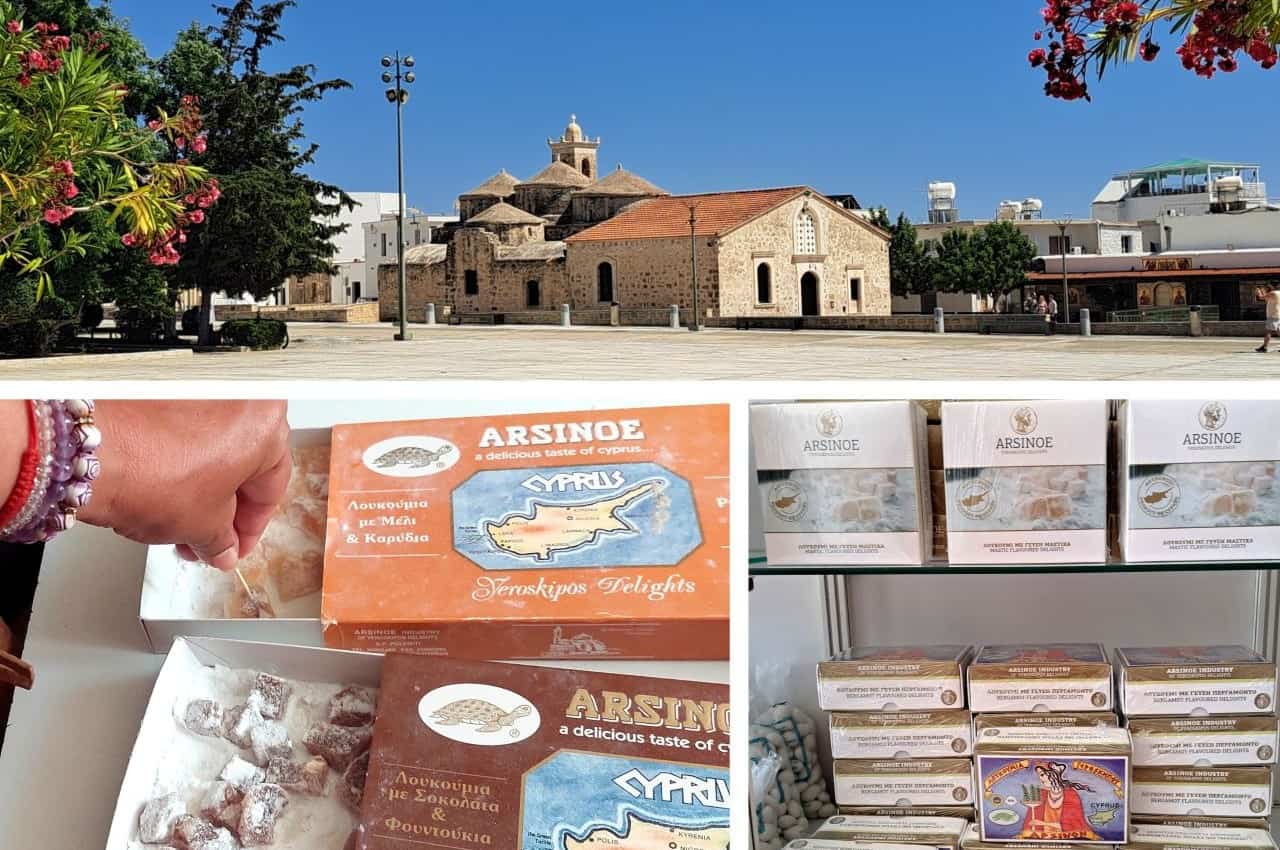
Geroskipou village, Agia Paraskevi Byzantine Church and Arsinoe delight
In a word, there are many interesting things to do and historical places to visit in the Paphos district.
Just plan your days and enjoy this beautiful island.
And stay tuned for new stories about the other towns of Cyprus…

Leave a Reply
Want to join the discussion?Feel free to contribute!