
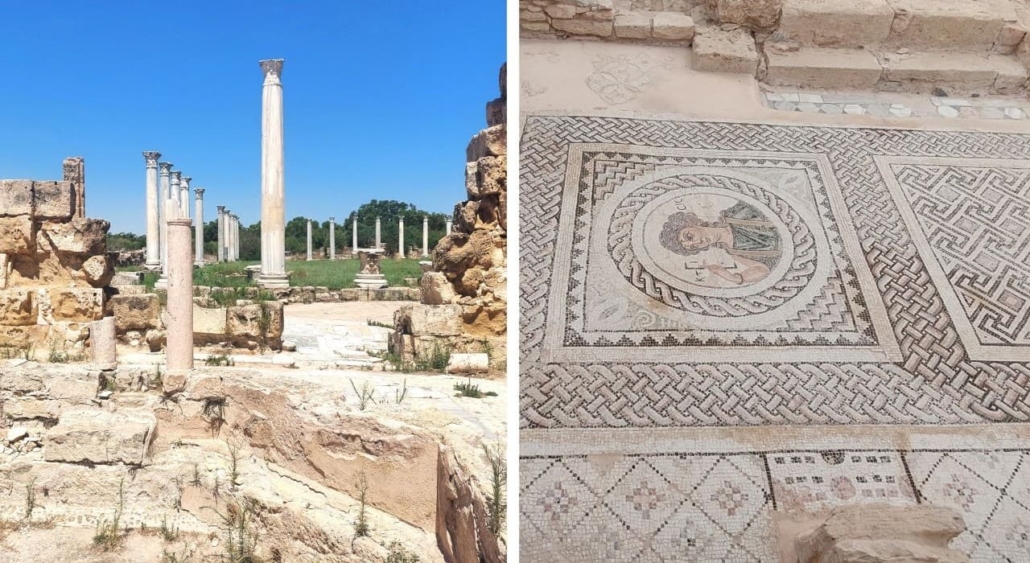
Salamis and Kourion, towns of ancient Cyprus
Salamis, Kourion and Paphos once stood as the most powerful city-kingdoms of ancient Cyprus.
Situated at the crossroads of Europe, Asia, and Africa, this sun-drenched island boasts a turbulent history shaped by numerous empires. Yet, despite centuries of invasions, the breathtaking ruins of these ancient worlds can still be seen today.
Let’s go on a journey through time to explore the captivating past of ancient Cyprus and rediscover its majestic heritage towns: Salamis and Kourion.
 Disclosure:
This text contains affiliate links, which means that if you book a hotel through them, I can earn a small commission, at no extra cost to you. Thanks.
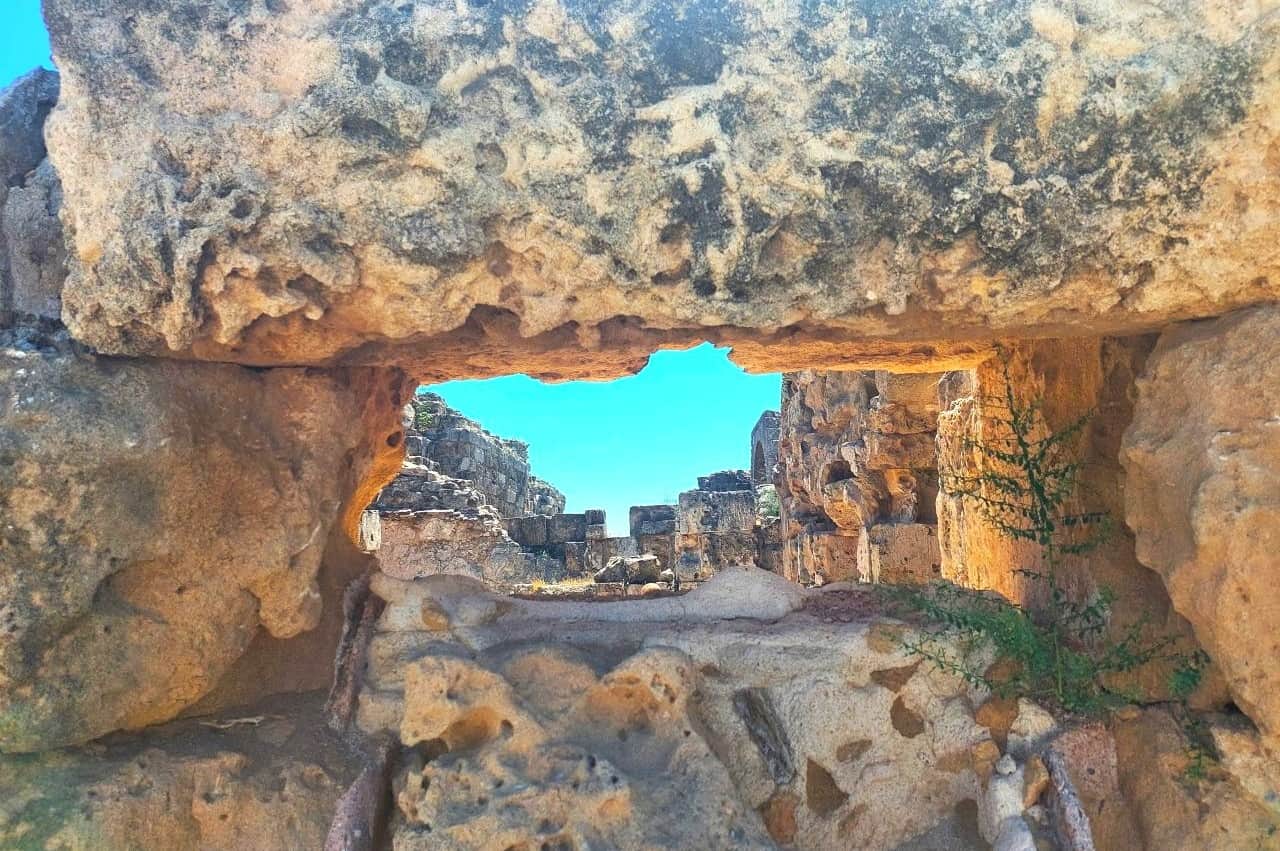
Salamis ruins
The history of ancient Cyprus
Besides its beautiful sandy beaches, Cyprus is known for several amazing archaeological sites.
♦ According to the artefacts found at Aetokremnos on the southern coast, it is believed that the earliest evidence of human activity dates back about 12,000 years.
The first settlements were Choirokitia, dating back to approximately 7,000 BC and Kalavassos, around 8,000 BC.
♦ During the Chalcolithic period (4,500-2,500/2,300 BC), metalworking developed on the island due to the appearance of copper implements. Also, trade was established with other regions around the eastern Mediterranean.
◊ In the late Bronze Age (1,600-1,050 BC), the Mycenaean Greeks settled the island, bringing their language, religion, and Greek culture.
Cyprus became prosperous, and ten city-kingdoms were established from 1050 to 325 BC. The most important and famous among them were Salamis, Kourion and Paphos. The Phoenicians, who came from Tyre in the 9th century BC, colonised some cities of Cyprus and founded the city of Lapathus.
♦ Over the centuries, the island maintained its autonomy under the rule of the Assyrians (709-663 BC) and the Egyptians (560-540 BC). Then, it became part of the Persian Empire (529-522 BC).
♦ Hellenistic period & Ptolemaic Rule (332-58 BC)
After aiding Alexander the Great in his sieges, Ptolemy was awarded the island, making Cyprus part of Egypt. The arts, literature and trade flourished during the Hellenistic period.
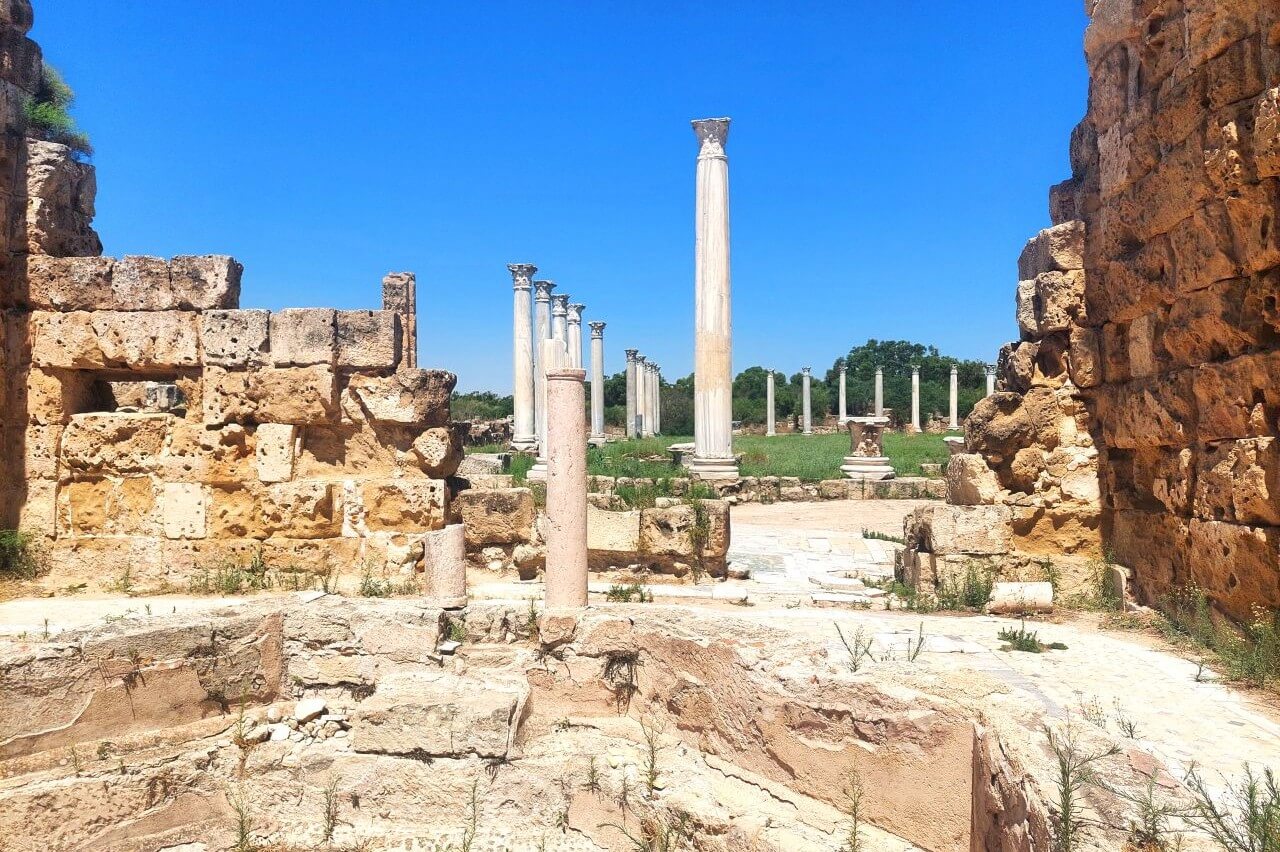
Salamis, Baths and marble columns of the Gymnasium
Roman period
From 58 BC to 395 AD, Cyprus was part of the Roman Republic, actually the Roman province of Cilicia.
It was a period of economic growth and prosperity, although the seat of the governor was moved from Salamis to Paphos. The Roman emperors Trajan and Hadrian restored the town and constructed public buildings. The remains of wonderful Roman villas, mosaics, and theatres can still be seen today, such as in Kourion and Paphos.
After the division of the Roman Empire, Cyprus became part of the Byzantine Empire, and Christianity became the official religion.
During the following centuries, it was ruled by the Franks, Venetians, Ottomans, the British, and currently, the Turks in Northern Cyprus. But, it is another story.
Salamis
Salamis is situated on the eastern shore of Cyprus, about 6 km from the modern town of Famagusta.
It spans an area of one square mile, extending along the coast of today’s Turkish Republic of Northern Cyprus. Bear in mind that the Deryneia crossing near Famagusta is the most convenient spot to explore this part of the island. And don’t forget your passport because you have to cross the Green Line (the UN buffer zone).
Salamis is easily reached by car or taxi from Famagusta. There are local minibuses, but they don’t run frequently, so check the schedule. You can also visit it within the organised excursions by local agencies, as we did with EMAN travel agency.
Usually, Salamis is visited together with Famagusta’s Old City and Varosha, and you can read about it in one of the following texts.
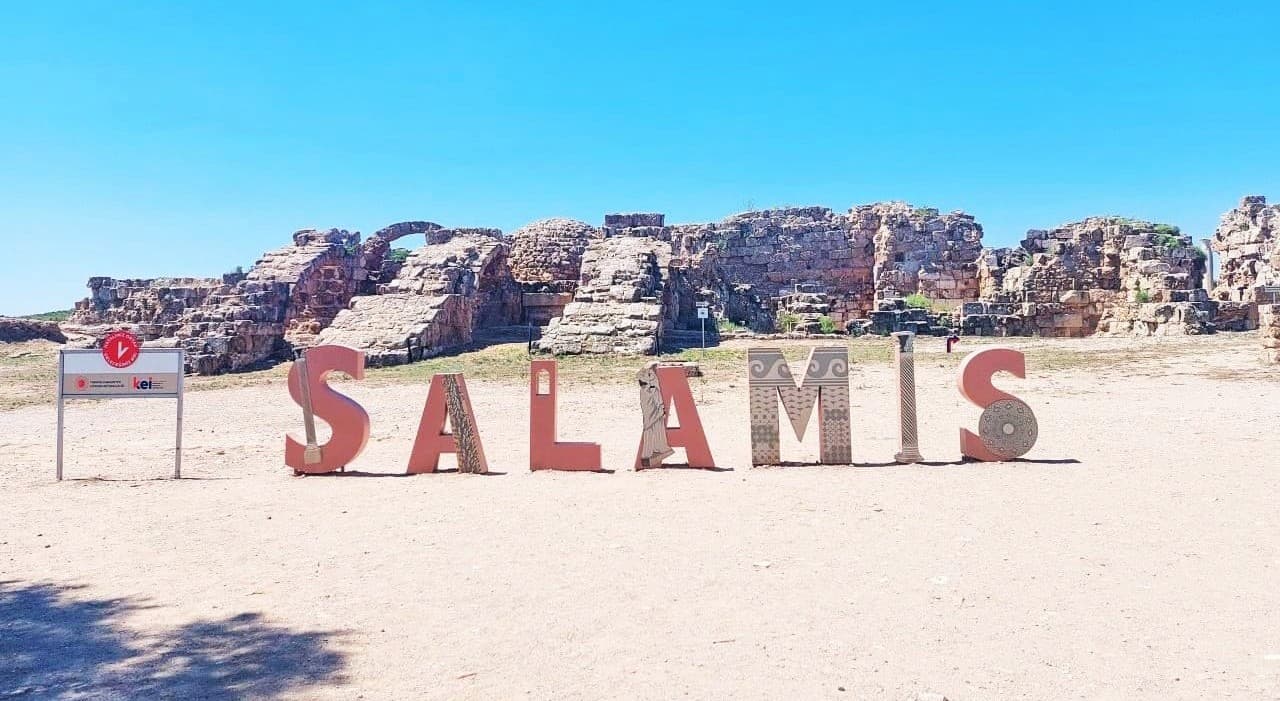
Entrance to the Salamis archaeological site
📅Opening time and ticket price
♦ Entrance Fee: 150 Turkish lira (TL) (approximately 3 EUR) for adults, 50 TL for students/reduced price.
◊ Opening Hours:
Daily from 8 AM to 7 PM, during the summer season (April to October).
Daily, from 9 AM to 5 PM during the winter season (November to March).
♦ Wear comfortable shoes, and bring water, sunscreen and a hat with you, because there is almost no shade.
Ancient Salamis
According to tradition, the founder of Salamis was the Greek hero Teucer, son of Telamon, king of the Greek island of Salamis. By the way, Teucer was one of the soldiers who attacked Troy inside the Trojan horse.
After the Trojan War, King Telamon disowned Teucer because he had failed to avenge his brother Ajax, a powerful warrior, who fought for the Greeks. Even though Ajax managed to retrieve Achilles’ body, he was not chosen to lead the Greek army. Instead of Ajax, they had chosen Odysseus, the king of Ithaca. Unable to bear the humiliation, Ajax planted his sword into the ground and fell upon it.
Since Teucer could not return home after the war, he founded his own town on Cyprus around 1100 BC. He named it after his home island of Salamis, near Athens.
Salamis was the capital of Cyprus for over a thousand years, starting around 1100 BC. It was also the most important political and cultural centre, and because of its harbour, the town became a wealthy port for trade with Phoenicia, Egypt, and Cilicia.
Like other towns in Cyprus, it survived the occupations of various invaders, previously mentioned in the text.
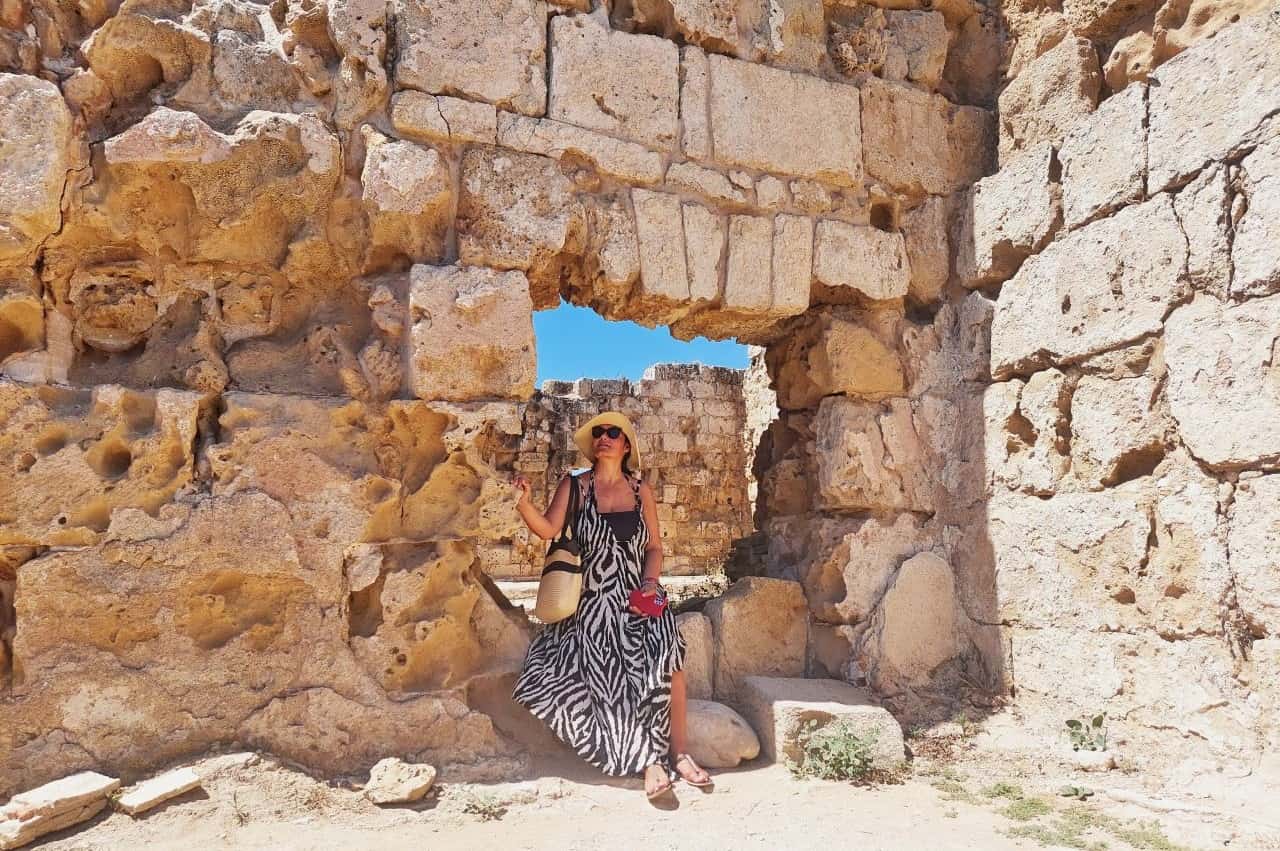
Ruins of the Salamis Bath complex
What to see today at Salamis
Archaeological excavations of Salamis began in the late 19th century under the auspices of the Cyprus Exploration Fund. But many of these finds are now in the British Museum in London. Everything stopped in 1974, after the Turkish invasion of the island.
Although a large part of the ancient city is still unexcavated, some remains from the Roman and Byzantine periods can be seen today. Actually, it is the largest ancient city site in Cyprus.
The Gymnasium & Collonaded palaestra
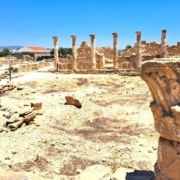
The most impressive part of the site is the Gymnasium and the Collonaded palaestra.
The first traces of the Gymnasium date to the Hellenistic period, when Greek colonists established athletic training facilities in Salamis. The structure that we can see today was built in the 2nd century AD, specifically during the reigns of emperors Trajan and Hadrian.
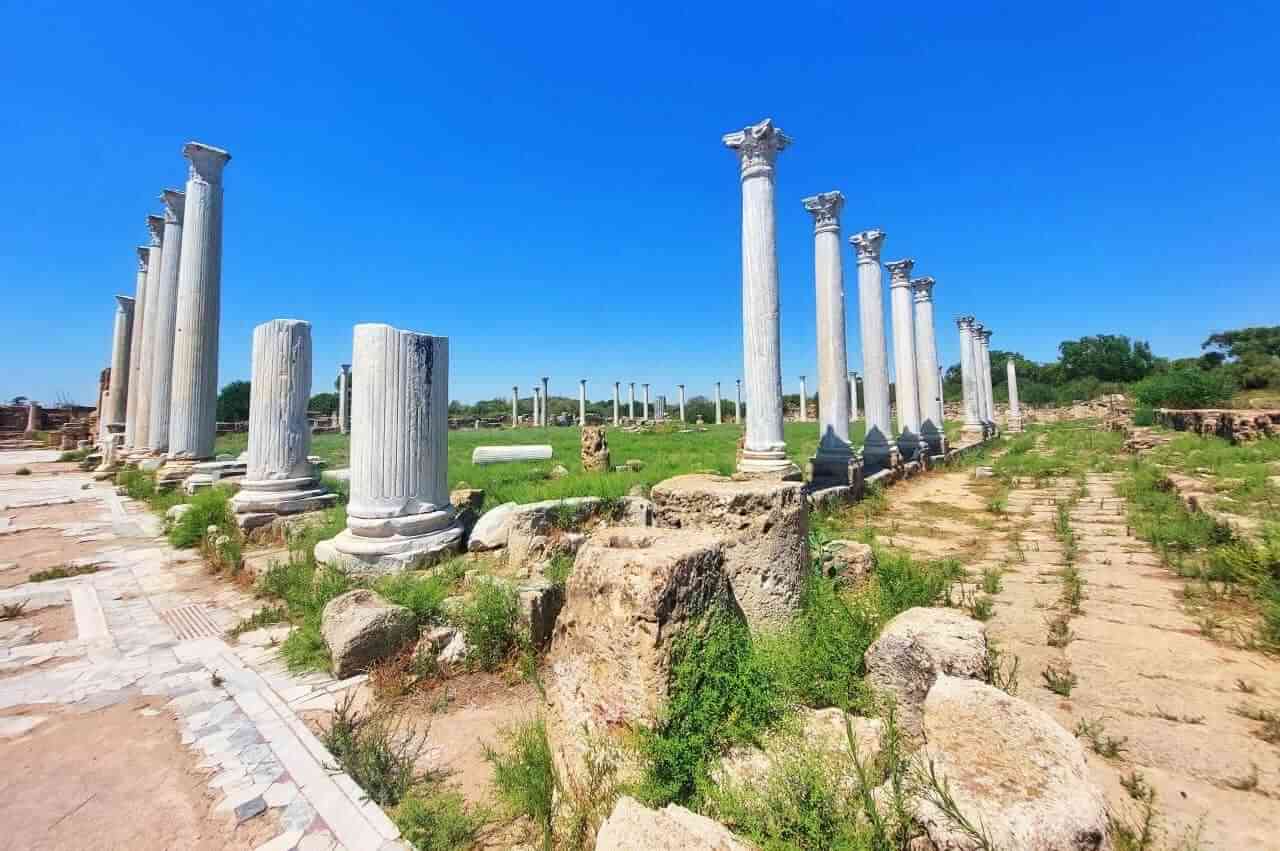
Ancient marble columns of the Gymnasium and palaestra in Salamis
The Roman engineers rebuilt the Gymnasium after a devastating Jewish revolt in 116 AD. The new complex had a collonaded palaestra, a large open courtyard surrounded by covered walkways on all four sides. These shaded areas provided better conditions for training of athletes.
The gymnasium was not only a place for training, but also for social contacts, intellectual development, religious observance, and bathing.
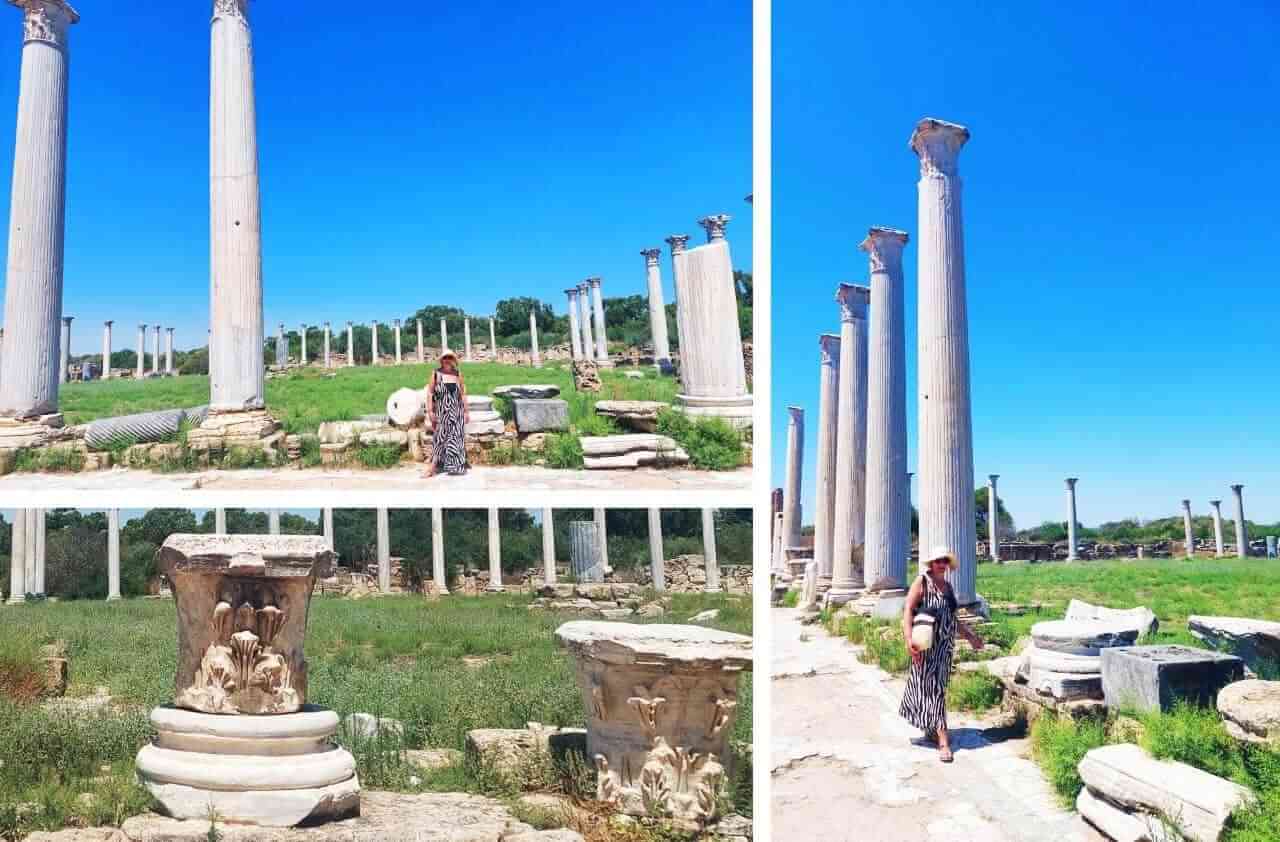
Gymnasium of Salamis
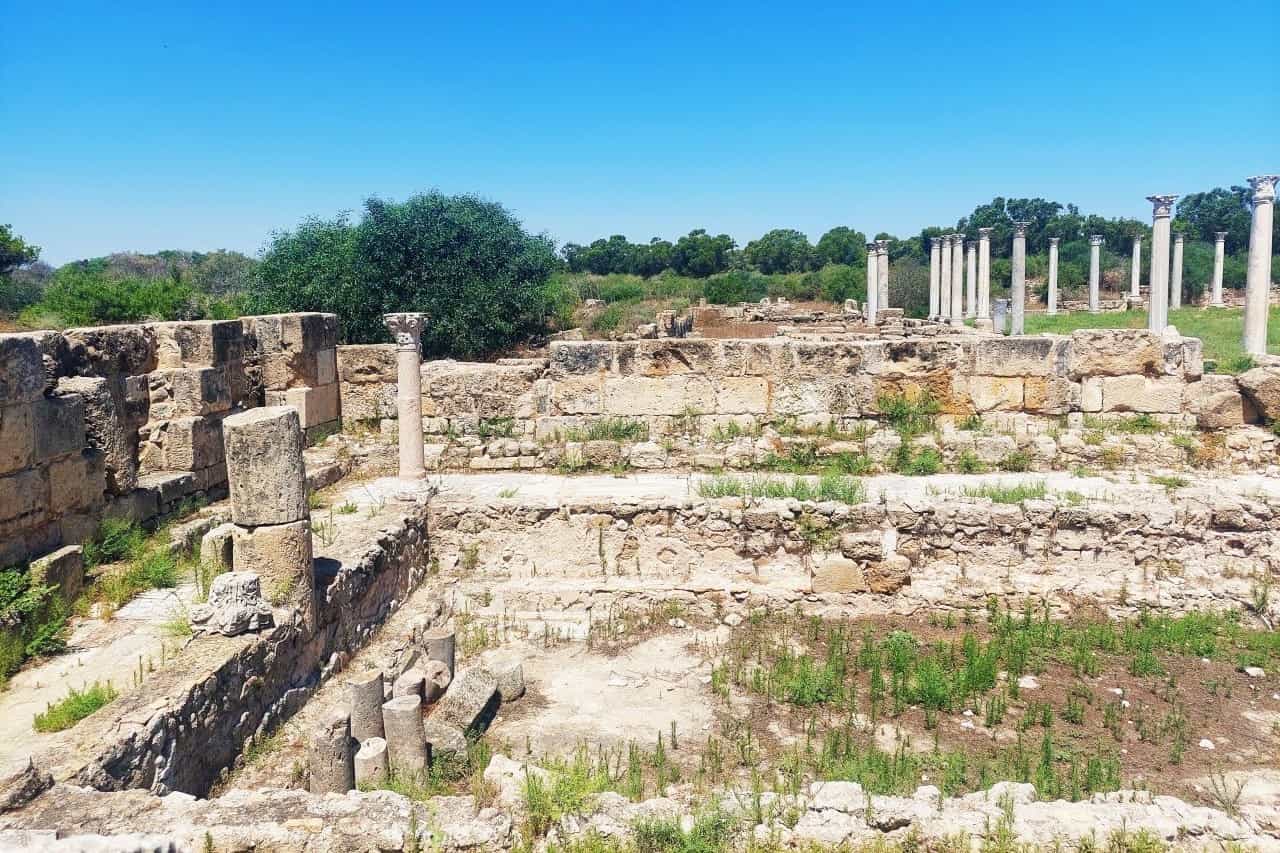
Salamis ruins
The Roman Baths in Salamis
Well, it is widely known that the Romans were obsessed with baths.
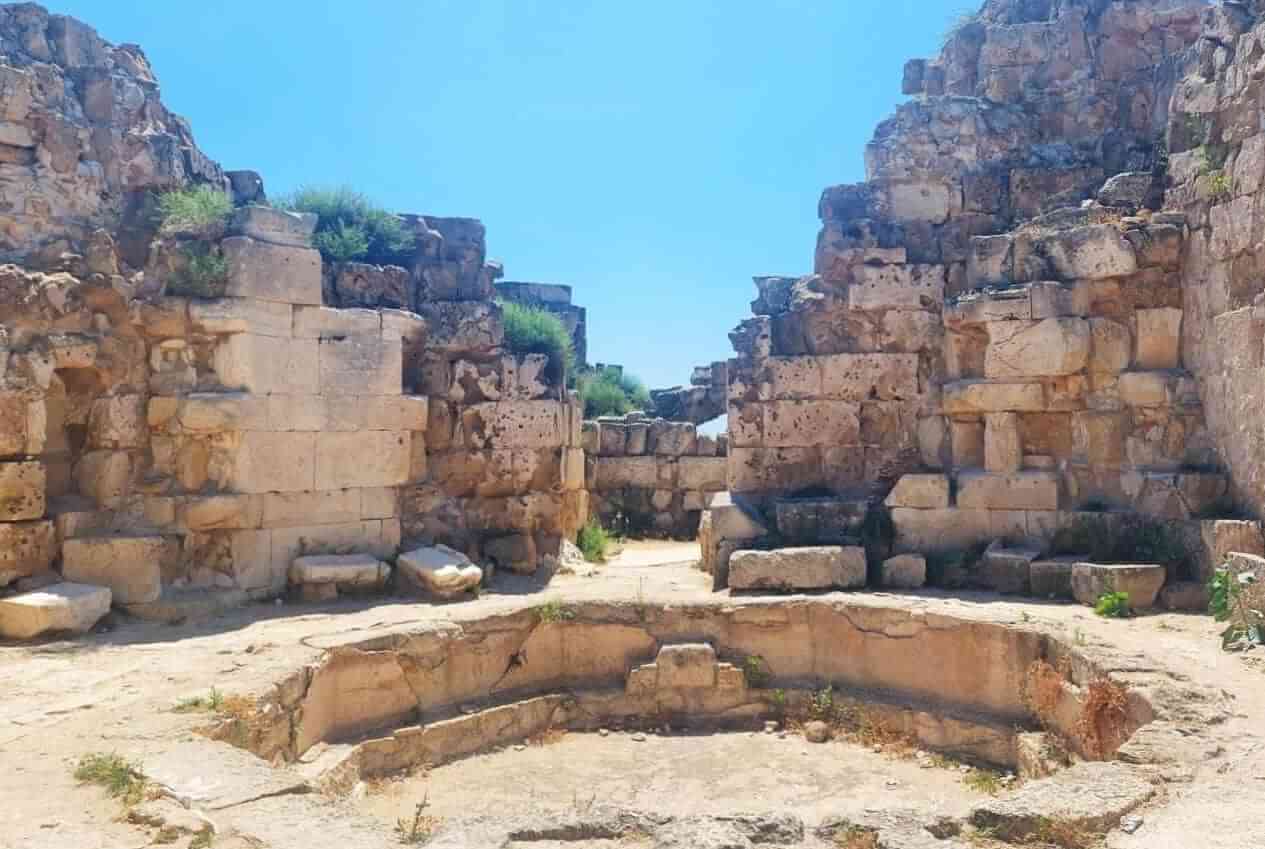
Roman bath ruins in the ancient Salamis
Around the Gymnasium, they built a Bath complex consisting of the Sudatorium (hot baths), the Caldarium (steam bath) and Frigidarium (cold baths). Some ruins, including an underfloor heating system, can be seen today.
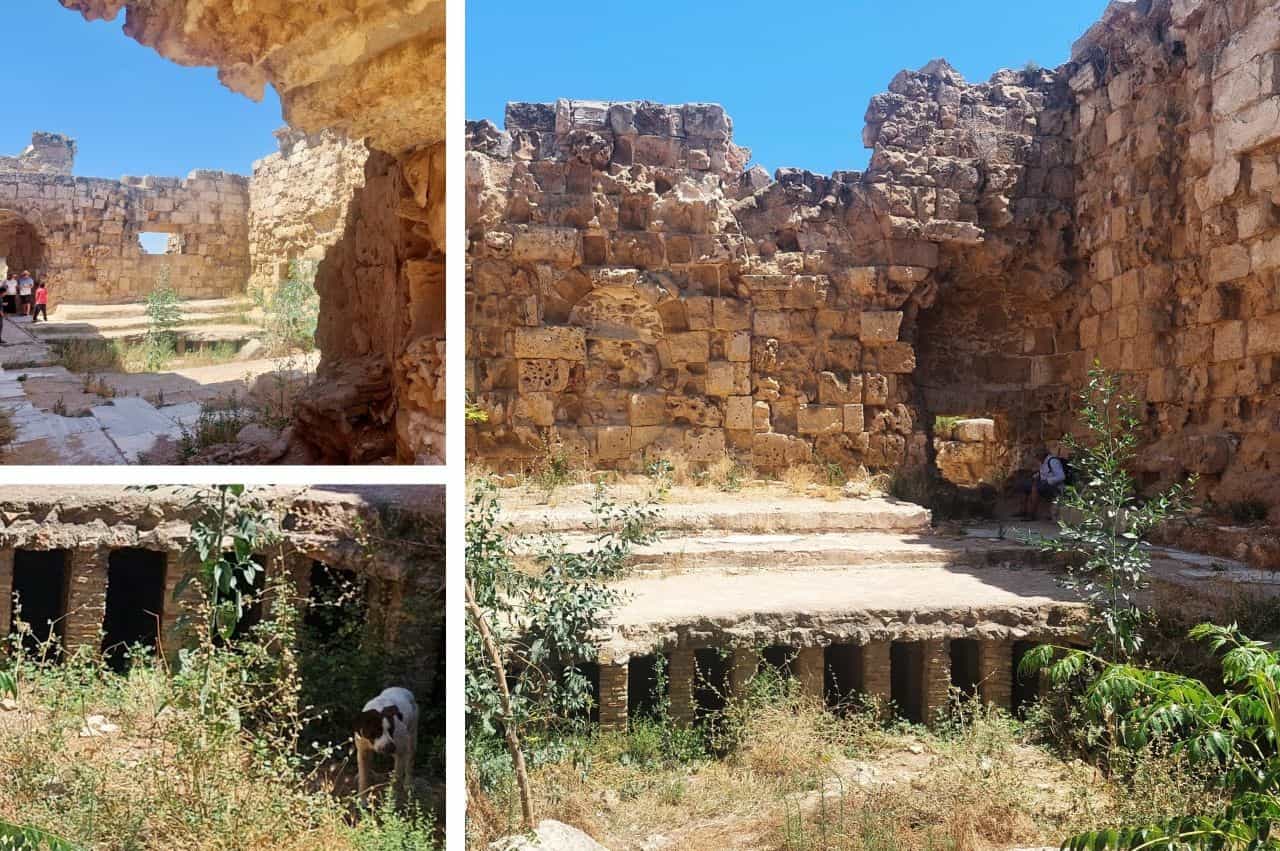
Underfloor heating system of Salamis
Under one of the arches, there are fragments of the oldest replica of a fresco from the 3rd century AD. It represents Hylas, one of the Argonauts, chasing the Golden Fleece, rejecting the nymph near the river.
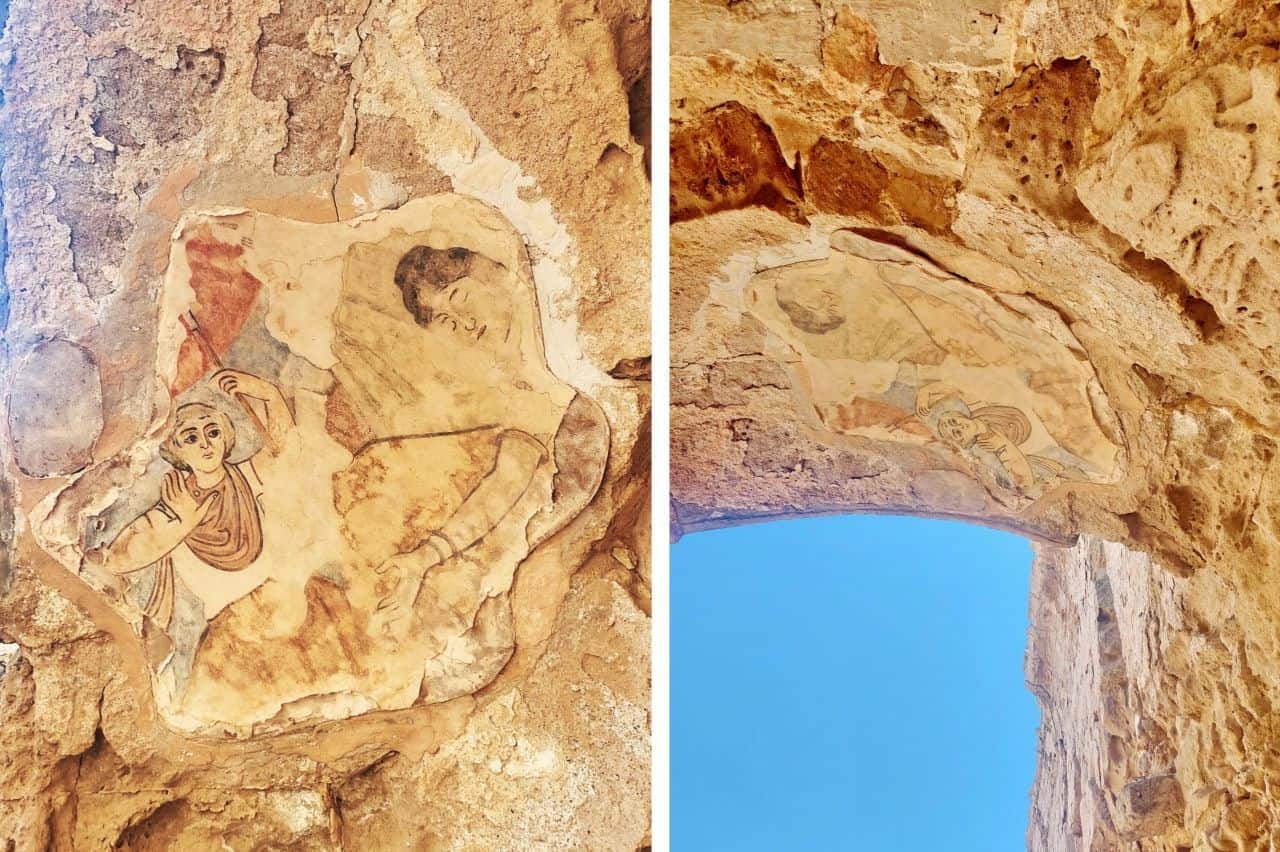
Fragments of fresco with Hylas, Argonaut, Salamis
Adding the bathing facilities to the Gymnasium, it became a complete social centre. The town was decorated with mosaic tiles, frescoes, and numerous statues of Roman deities.
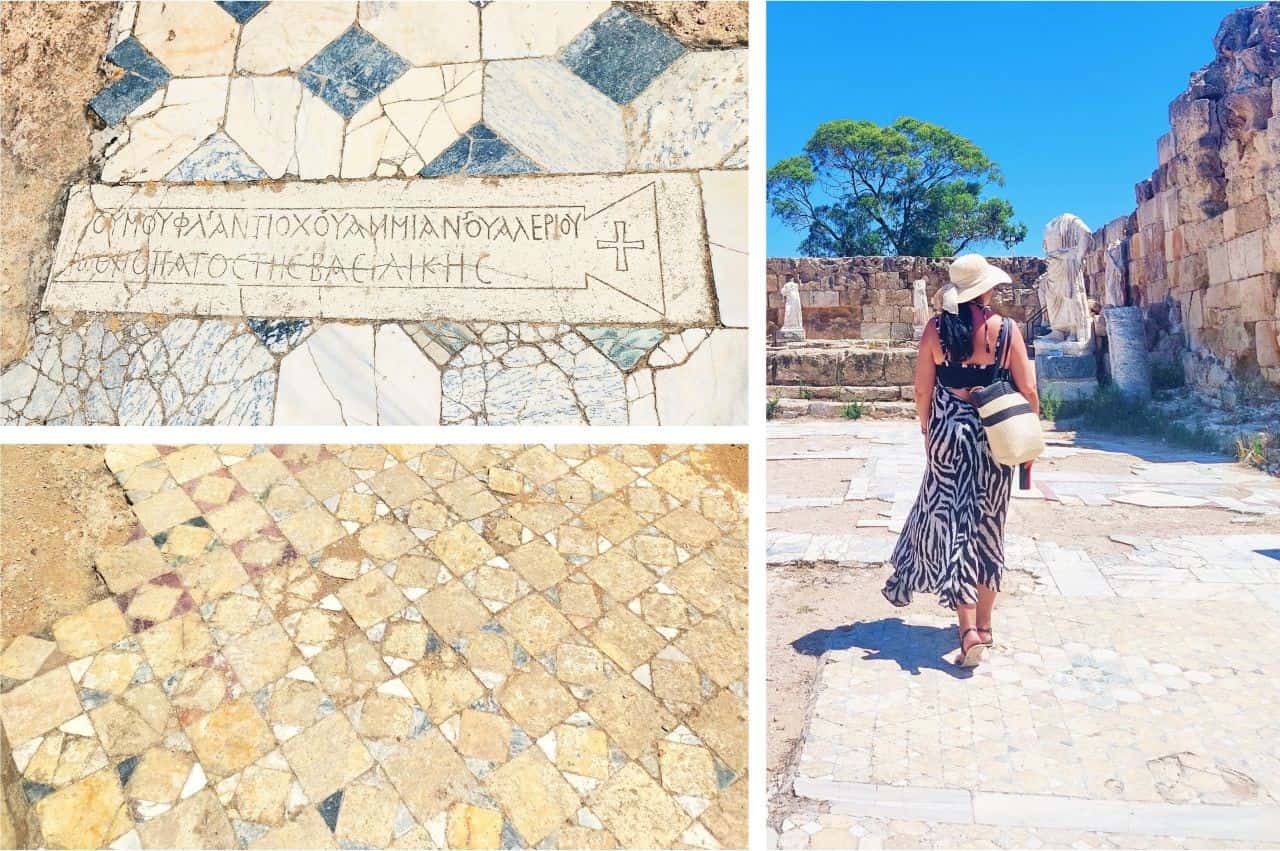
Mosaic floor on the Salamis site
However, many of the statues were damaged during the Christian period around 400 AD, together with other pagan and Roman elements, during the persecution of pagans in the late Roman Empire. Some statues have been transferred to the District Archaeological Museum.
But some marble statues and their replicas without heads are still standing around the former marble pool at the north-east corner of the Gymnasium’s portico.
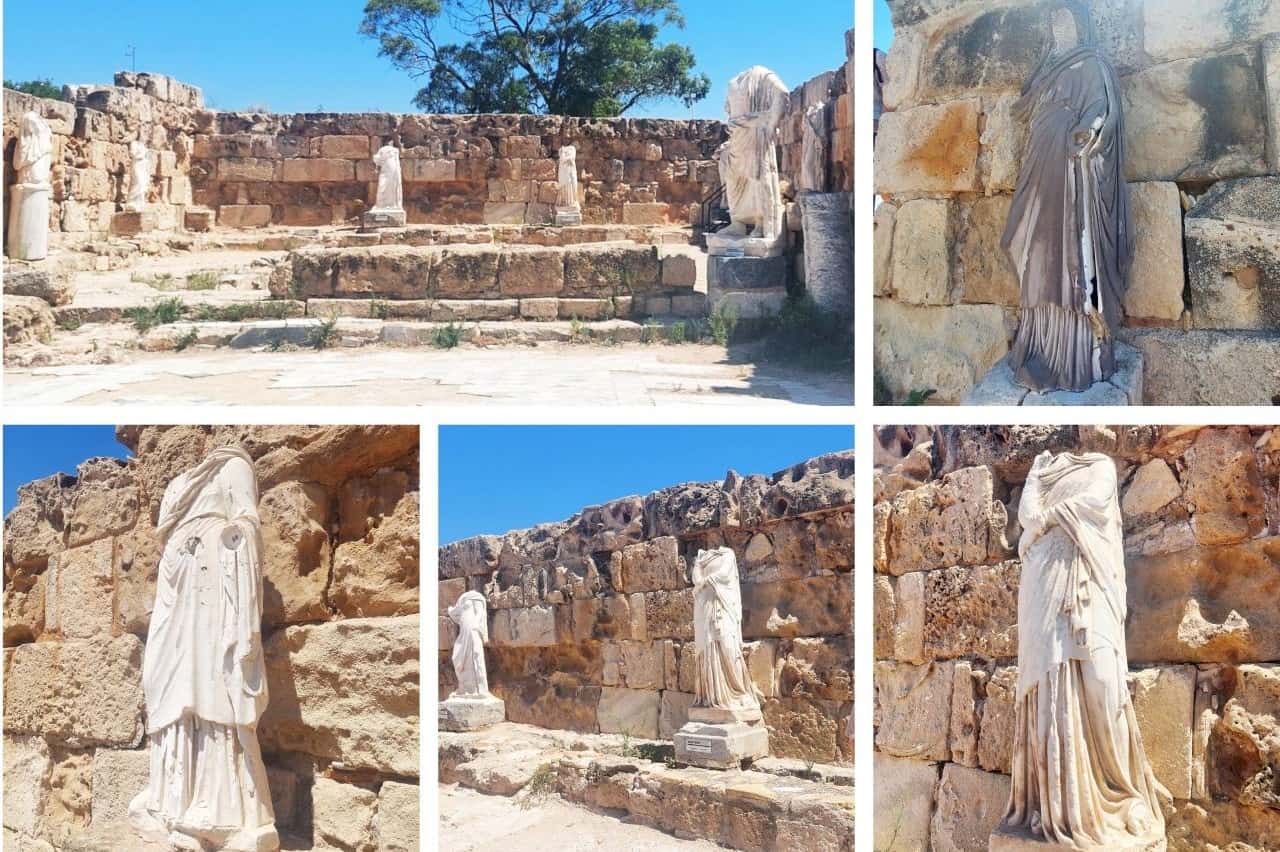
Statues near the Roman Baths and Gymnasium at the Salamis site
The Roman Theatre
At a short distance from the Gymnasium and baths, you can see the Roman Theatre, one of the largest ancient theatres in the Eastern Mediterranean.
The theatre was built during the reign of Emperor Augustus in the early 1st century AD (27-14 AD), and completed by Trajan and Hadrian in the early 2nd century AD (98-138 AD).
The original theatre had 50 rows of stone seats (today only 22 rows), accommodating up to 15,000 spectators. It was destroyed in an earthquake in the 4th century AD. Only the lower rows survive today, but the acoustics in the theatre are still fantastic. The theatre is partially restored and occasionally hosts cultural and theatrical performances during the summer.
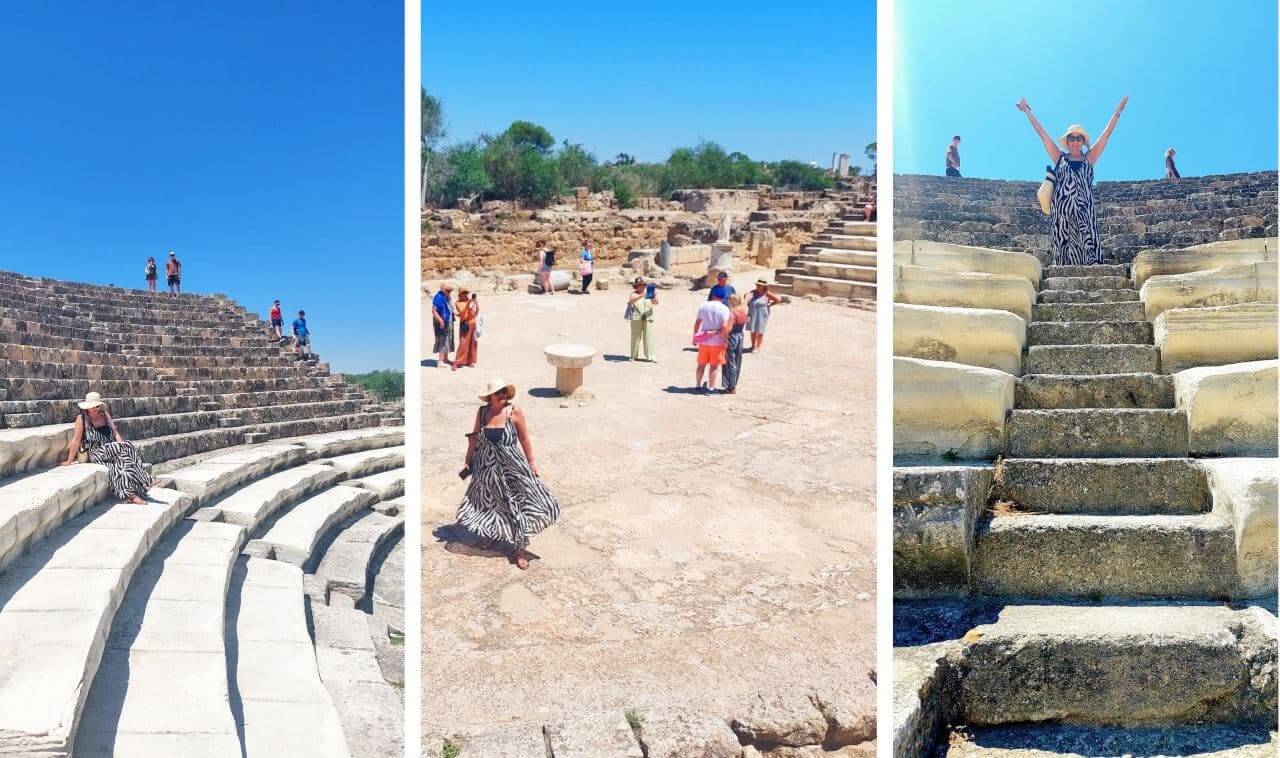
Roman Theatre
The altar and statues
The altar is still situated in the centre of the large, semi-circular orchestra floor. It was used for ritual offerings dedicated to Dionysus, the Greek god of wine and theatre, before dramatic plays and festivals began.
During the Roman period, parts of the theatre (including the orchestra area around the altar area) were modified into an arena for other spectacles, including water displays or athletic events.
Once, the stage was decorated with columns and statues. One of them, a replica of Apollo, is still standing on the edge of the orchestra.
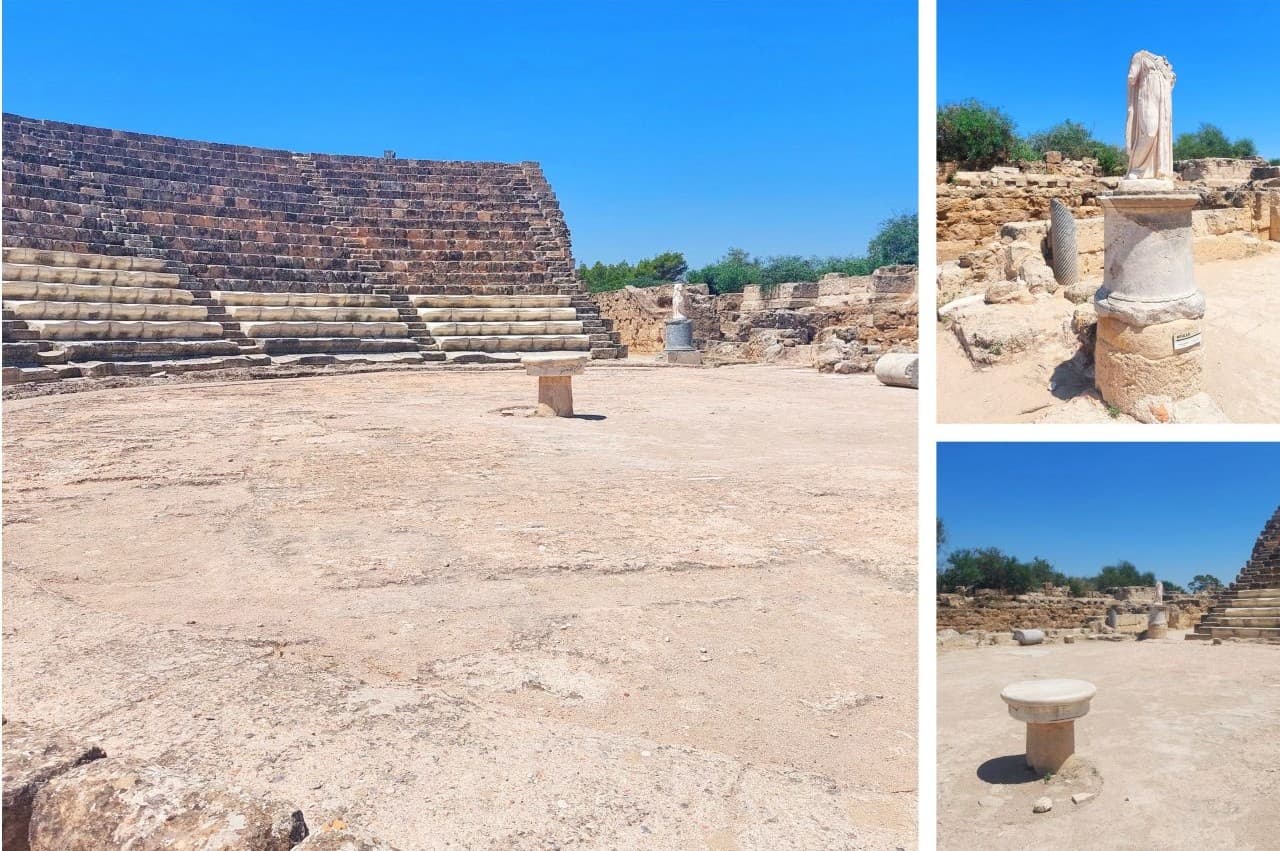
Salamis, Altar in the Roman Theatre
The end of Salamis town
Unfortunately, severe earthquakes in 332 and 342 AD (the second one was followed by a tsunami) devastated Salamis.
The Christian Emperor Constantius II rebuilt it on a smaller scale and renamed it Constantia.
In the 7th century AD, it was attacked by the Arabs, and the harbour also silted up. The surviving population moved to today’s Famagusta, and Salamis was abandoned.
Generally, it takes one to two hours to visit the main site. However, if you like to visit other parts of the Salamis complex, such as the Royal Tombs, the Byzantine basilicas, the Agora, a large cistern, the Temple of Zeus, and Byzantine walls, it takes more than one or two hours.
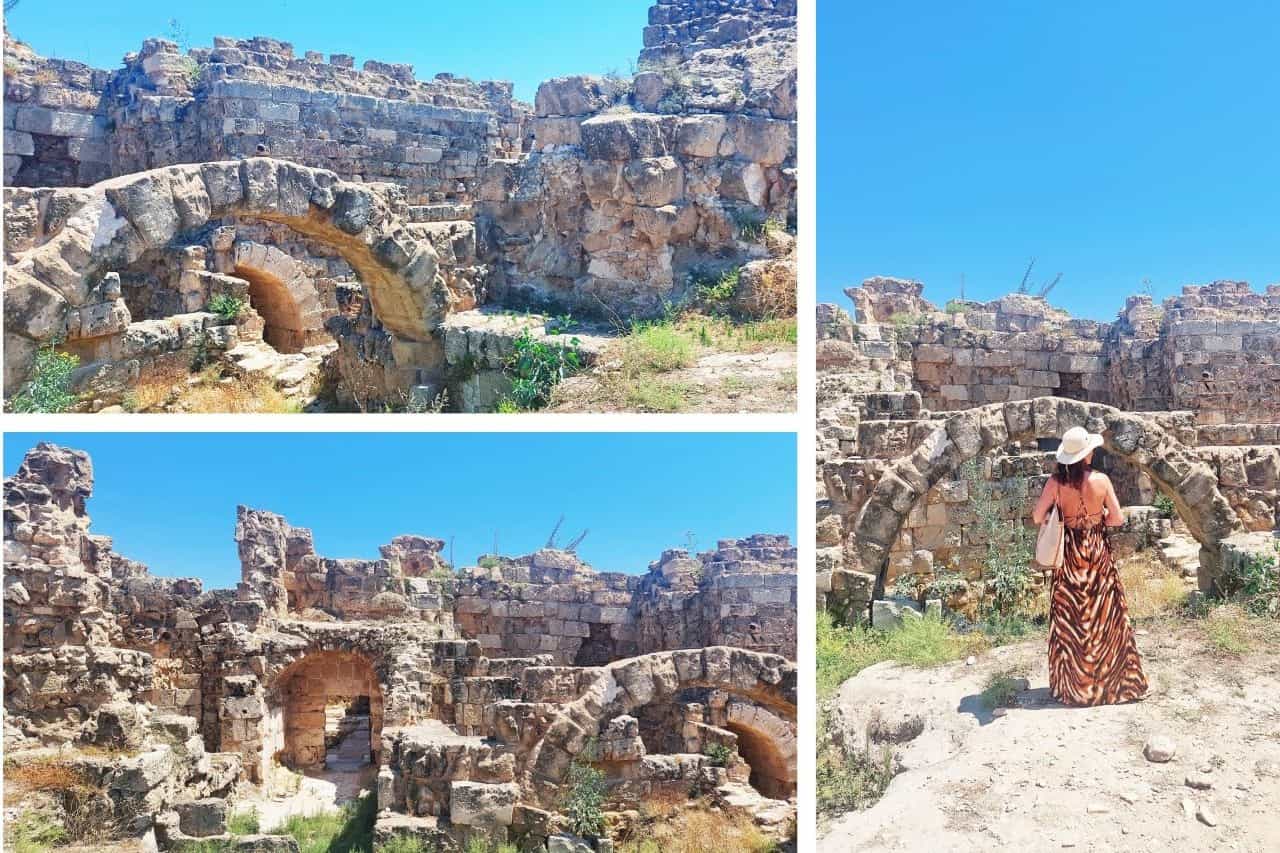
Salamis ruins
⛪Christianity and the Monastery of Saint Barnabas
After Salamis, we visited the Monastery of Saint Barnabas (Ayios Barnabas), located only 2 km west of Salamis.
Saint Barnabas is the patron saint of Cyprus, born in Salamis. He was a member of the early Christian community in Jerusalem and the companion of Saint Paul. So, Saint Barnabas tried to spread Christianity in Cyprus, but he was killed and secretly buried (around 61–75 AD).
In the late 5th century, his grave was discovered through a dream of Bishop Anthemios. The Emperor Zeno built a basilica near the spot where the body of Barnabas was discovered. He granted autonomy to the Church of Cyprus and established the St. Barnabas Monastery.
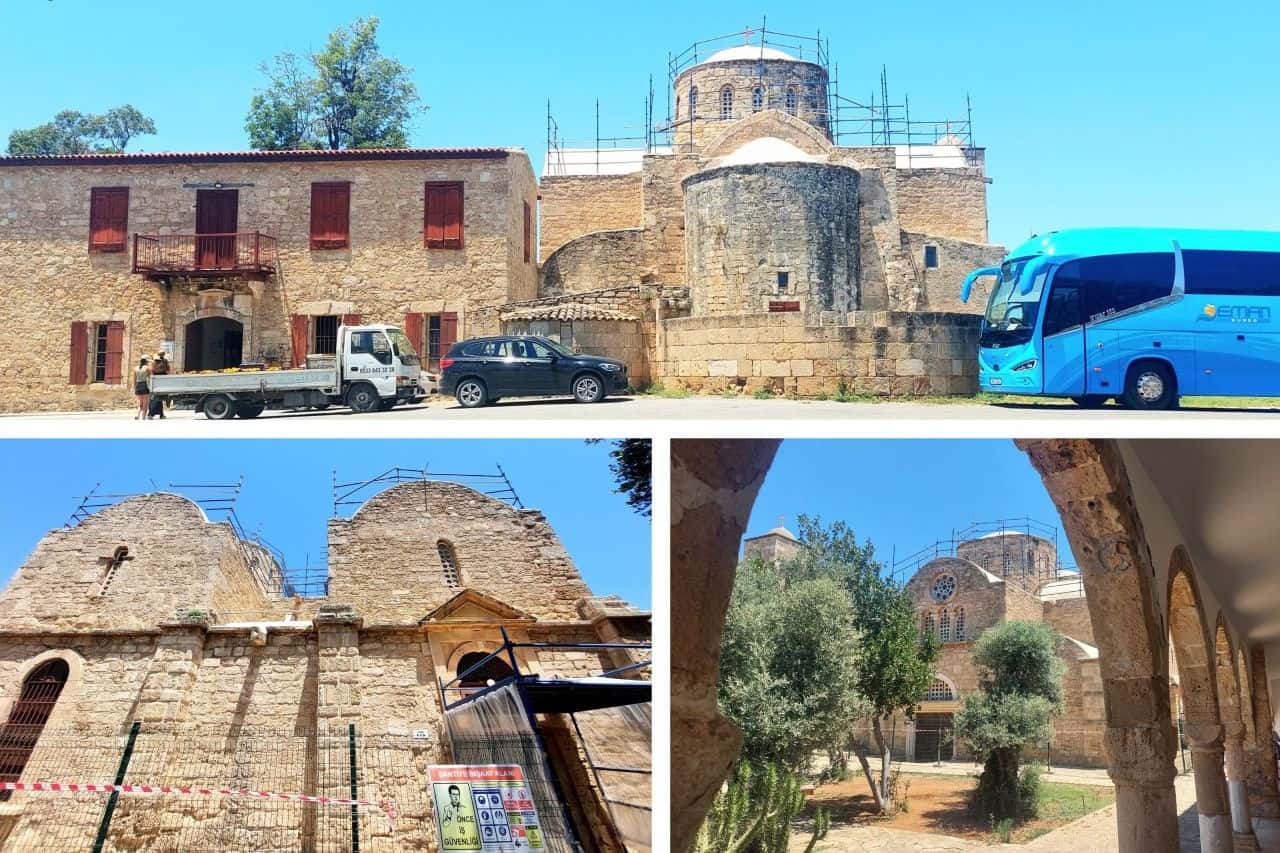
Saint Barnaba Monastery
The current form of the buildings dates back to the 18th century. In 1974, after the Turkish invasion, only three priests were in the monastery, but they moved out in 1976, and the monastery was abandoned. After the restoration in 1991, the monastery church was transformed into the Icon Museum, where icons, dome paintings, and other religious artefacts can be seen today.
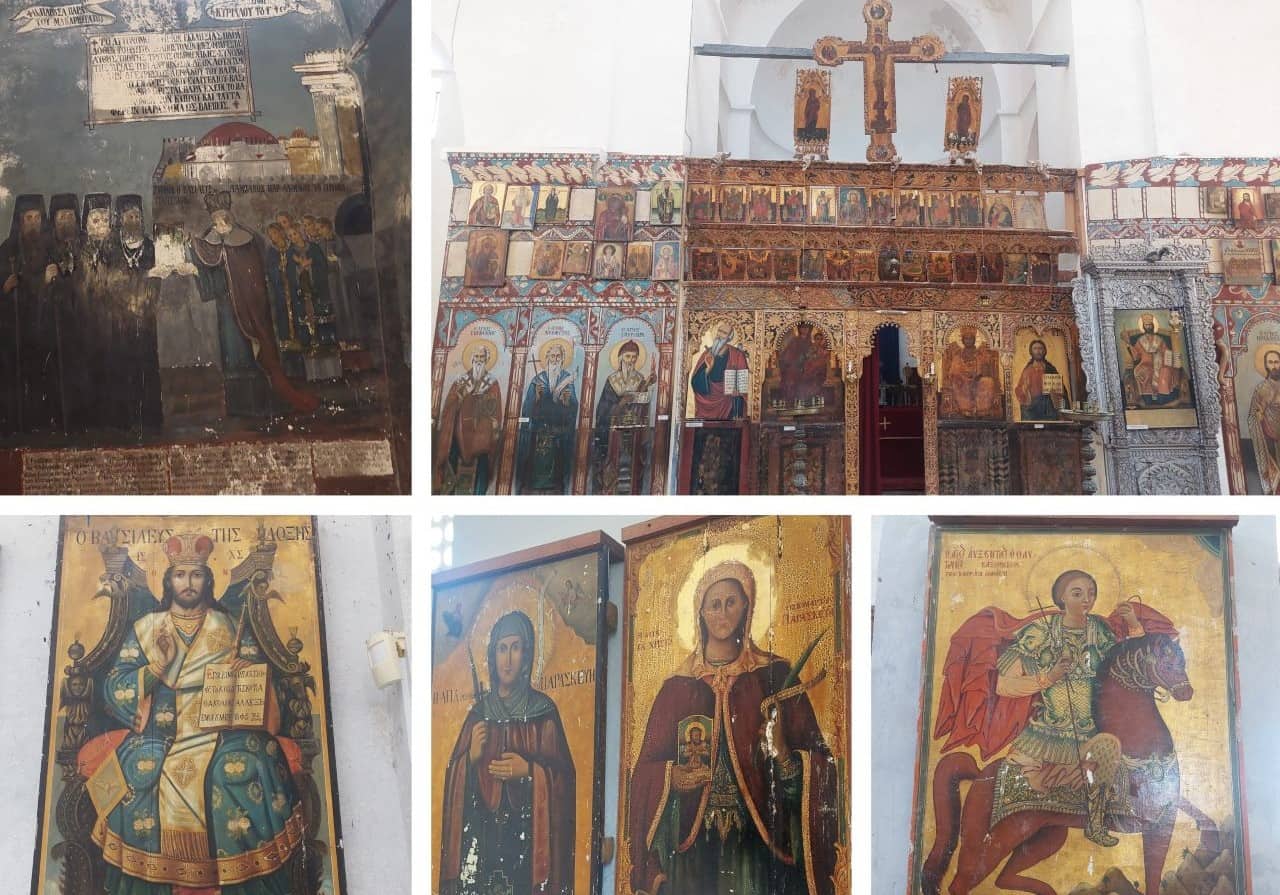
Inside the Saint Barnaba Monastery
The Archaeology Museum, with the artefacts found in Salamis, is also situated in the former monastery rooms.
Opening hours of the monastery: daily, from 8 AM to 4.30 PM.
The entrance fee is 150 TL (around 3 EUR) for adults.
A short distance from the monastery, you can visit St. Barnabas’s mausoleum, built on the spot where his remains were discovered.
The feast day of Barnabas is celebrated on the 11th June.
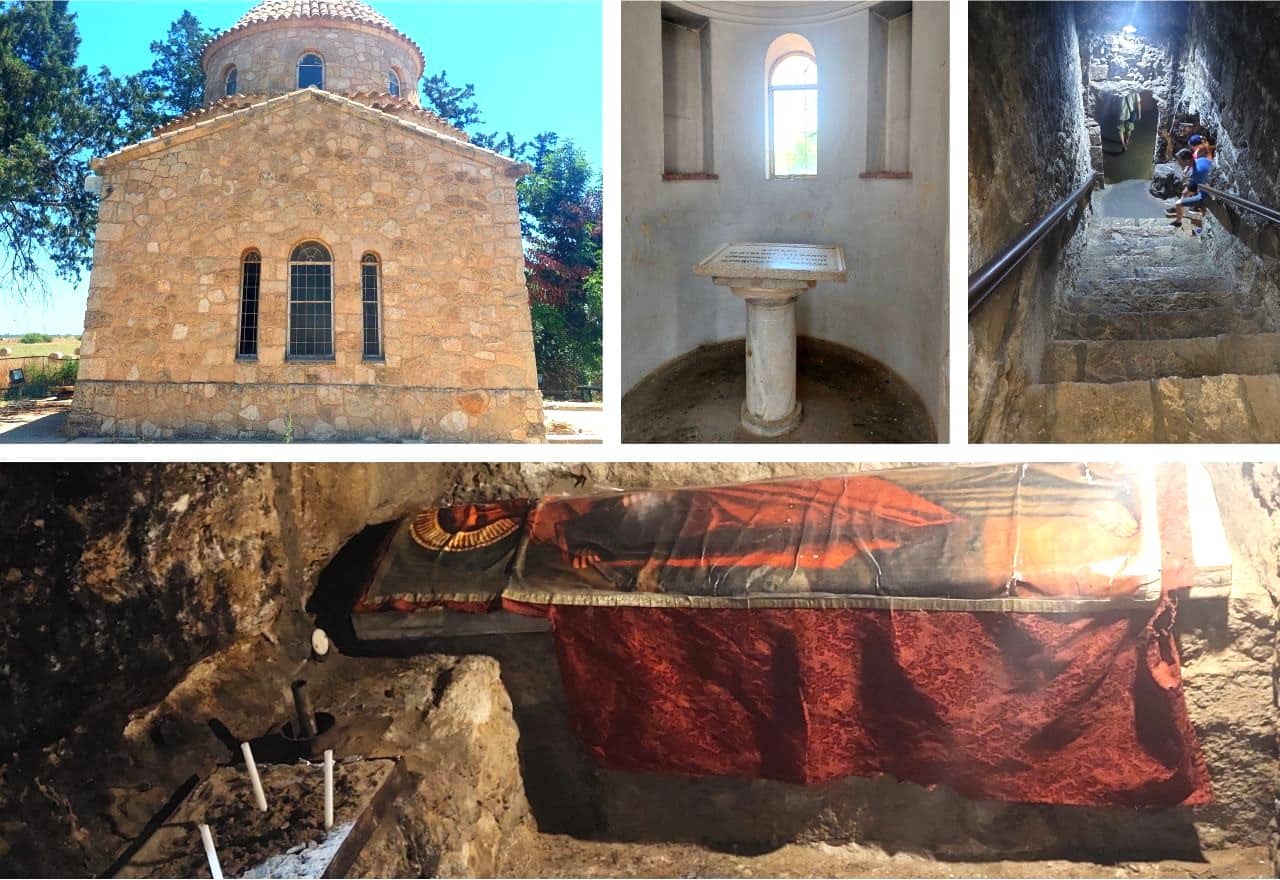
Saint Barnaba Mausoleum
Kourion (Curium)
Kourion is situated on a cliff on the southwestern coast of Cyprus, about 19 km west of Limassol, on the road toward Paphos.
Actually, it is located near Episkopi, a village that is partly in the Limassol district, and partly in the British Overseas Territory of Akrotiri and Dhekelia.
You can get to Kourion by car or by public bus line 16 from Limassol. Also, you can take a guided tour, daily organised by tour operators from Limassol, Ayia Napa and other cities. For example, we visited Kourion and Paphos during an excursion guided by the EMAN travel agency.
📅Opening time and ticket price
Entrance Fee: 4,50 EUR for adults.
Opening hours: Daily from 8.30 AM to 7.30 PM in summer, and 8.30 AM to 5 PM in winter.
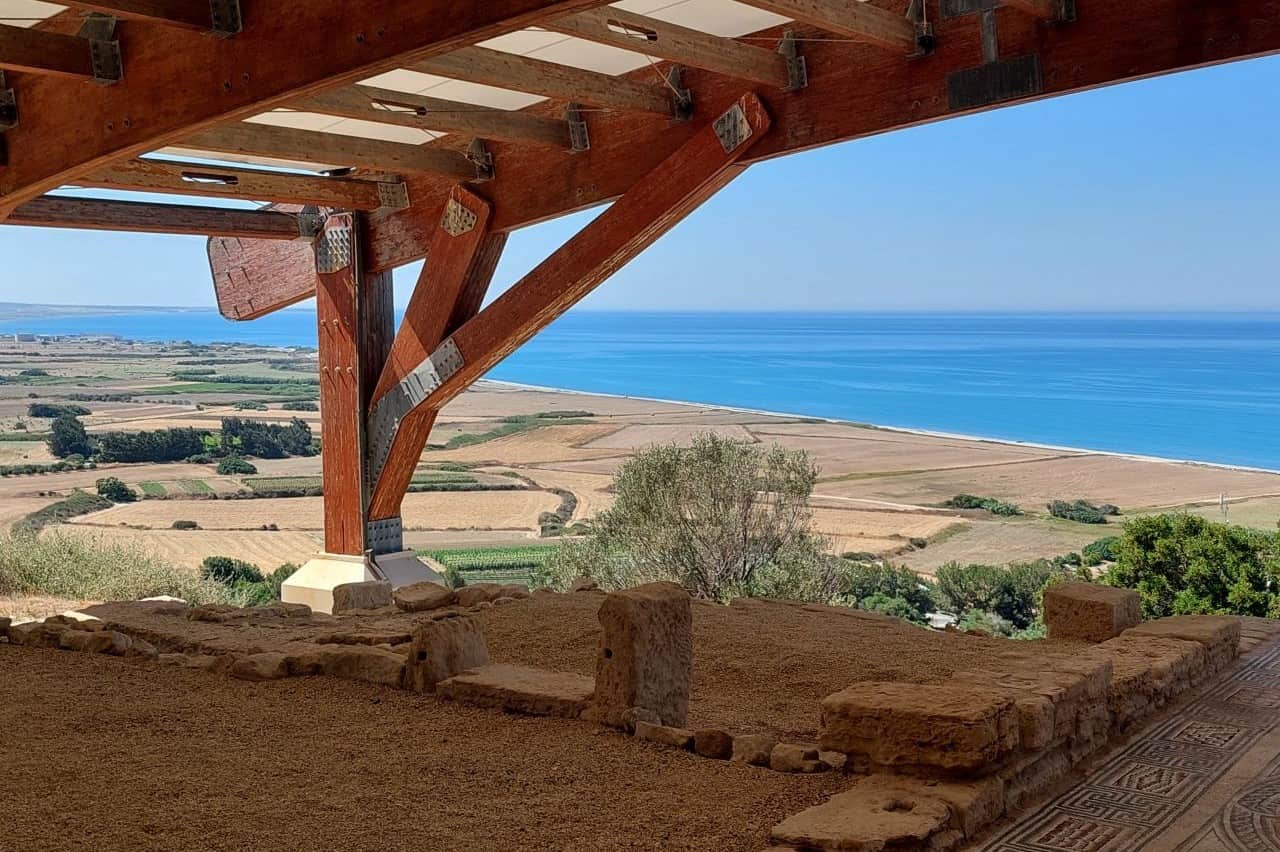
A sea view from the Kourion site
The history of Kourion
It is believed that the site of Kourion was first inhabited during Neolithic times, around 4,500-3,900 BC.
According to the tradition documented by the Greek historian Herodotus (5th century BC), and later by the geographer Strabo (1st century AD), Kourion was established by Greek settlers from Argos in the 12th century BC, after the collapse of the Mycenaean palaces. It got its name after its founder, Koureus, the son of Kinyras, the first king of Cyprus.
Kourion became an important city-kingdom during the Hellenistic, Persian, and Alexander the Great era, as well as in the Ptolemaic, Roman, and early Byzantine periods.
The most prominent ruins that we can see today belong to the Roman Era, during which the town of Kourion flourished. It was also a cultural and religious centre, due to the nearby Sanctuary of Apollo Hylates.
However, like Salamis and other towns in Cyprus, the catastrophic earthquake destroyed Kourion in the 4th century AD. There is a sad story about the earthquake, like a frozen moment. Archaeologists found the skeletal remains of a family: a mother holding her baby and a father trying to protect them from falling debris.
Kourion continued as a Byzantine city for several centuries, but it was abandoned in the 7th century due to the various political and economic changes, including the Arab raids. The city’s water supply system was destroyed, so the people relocated closer to the Kouris River, which is today’s village of Episkopi.
What to see today at Kourion
Overlooking the Mediterranean Sea, this archaeological site is one of the most photogenic historic spots on the island.
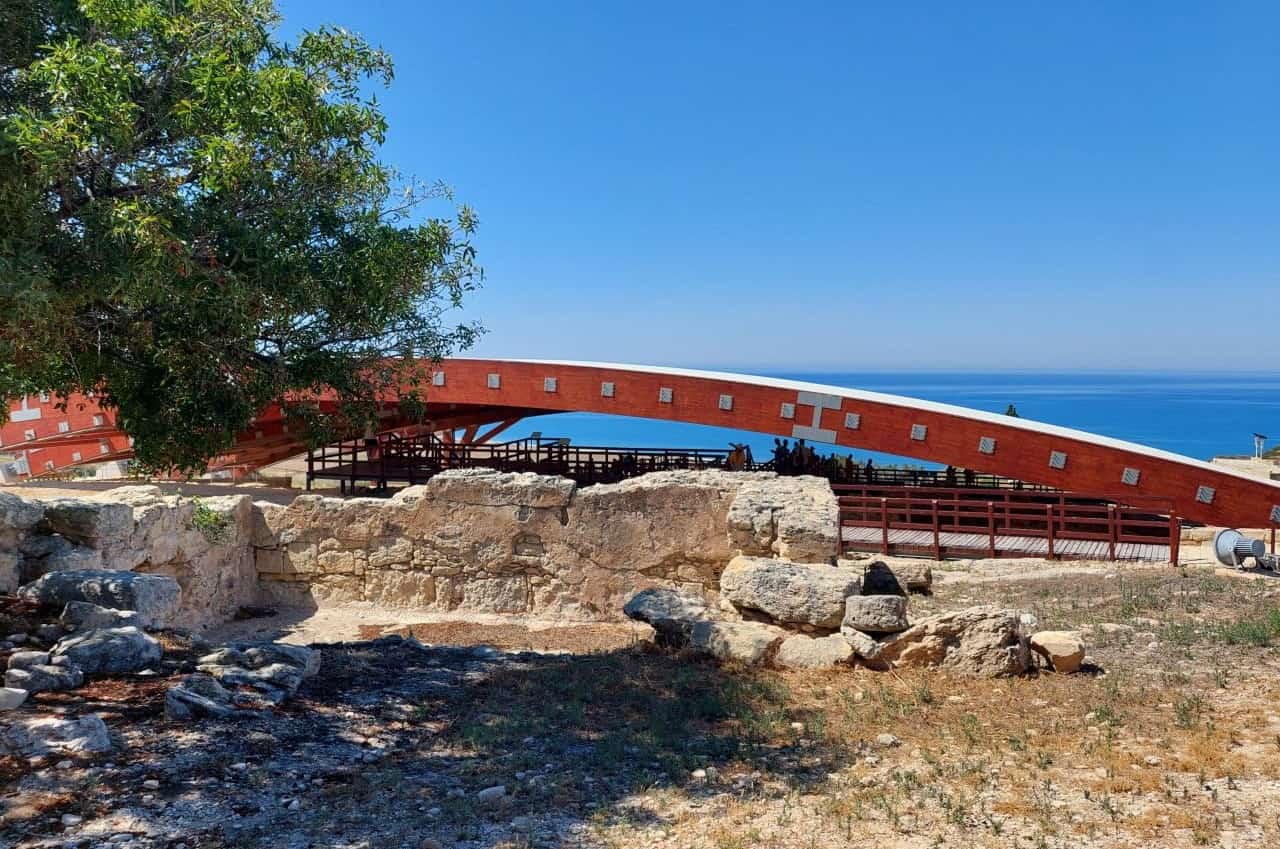
Kourion, the House of Eustolios, with a roof structure
The House of Eustolios
First, we visited the House of Eustolios, located on the southeastern edge of the Kourion Hill. It is protected by a roof structure that allows visitors to enjoy the site all year round.
It was a Roman villa dating back to the middle of the 4th century AD. Its owner, Eustolios, converted it into a public space, and a preserved inscription shows that he donated the baths to the citizens of Kourion.
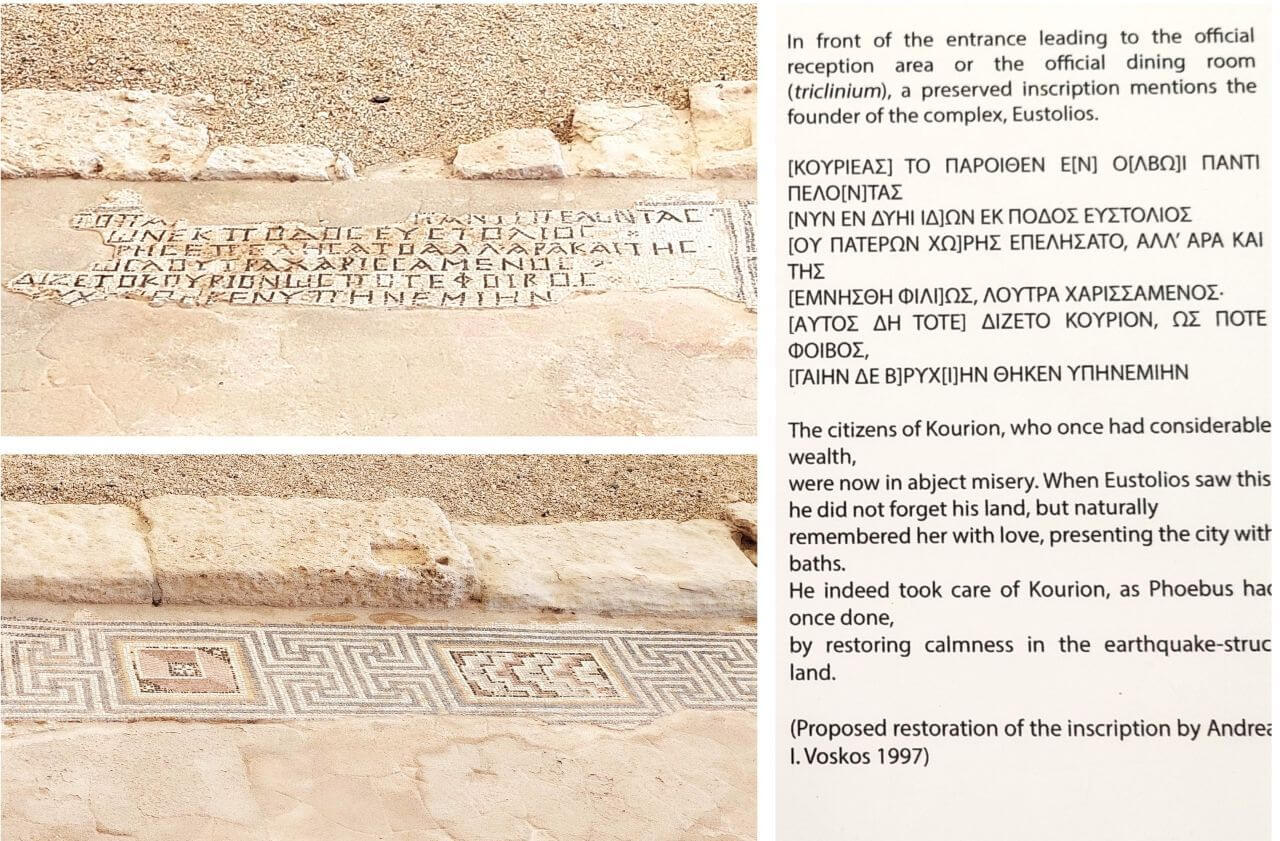
The inscription of the owner, Eustolios
The House of Eustolios had more than thirty rooms arranged around courtyards and bathing facilities, on three levels. The oldest remains date back to the Late Hellenic period (150-50 BC). It was modified and expanded in the 4th century AD, but its final form and floor mosaic were made during the reign of Theodosius II (around 408-450 AD).
Visitors entered from the west through a forecourt into a vestibule. Even today, a welcoming mosaic inscription can be seen, which greeted visitors with the words: “Enter for the good luck of the house.”
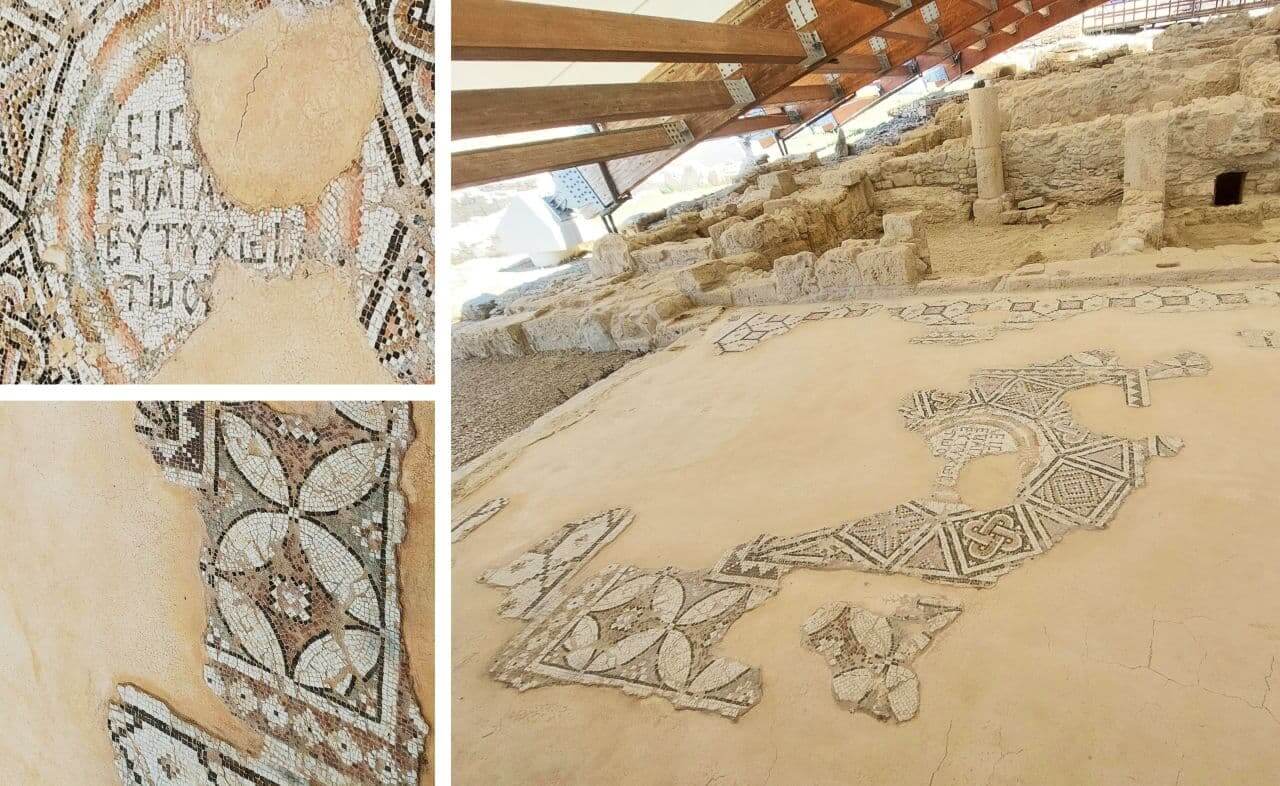
Welcome mosaic at the House of Eustolios
Like in other Roman baths, the baths of Eustolios’ villa consist of three main bathing areas. The largest part is the cold room (frigidarium), then the warm room (tepidarium), and the third is a hot room (caldarium). The hot baths were heated with a hypocaust system, a specially designed space under the floor. The furnaces pushed hot air beneath terracotta floor tiles and through wall flues.
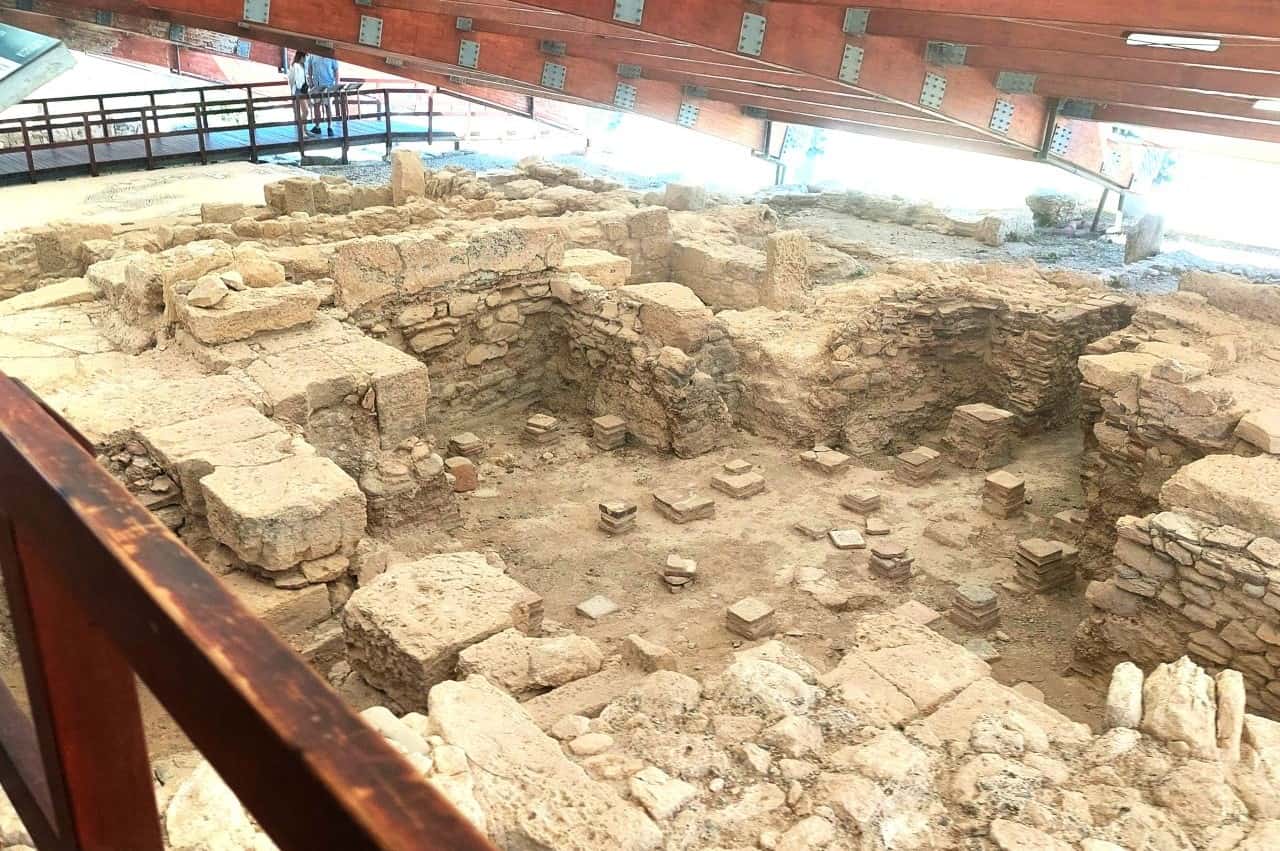
Kourion, Baths in Eustolios complex
The villa is famous for its fantastic geometric mosaic floors. One of them is the large Ktisis Mosaic, located next to the cold room. This famous 5th-century mosaic of Ktisis is the personification of the Creation of the World. It presents a young woman holding iron clamps and a measuring stick with a length of 30 cm, which is a Roman foot measurement.
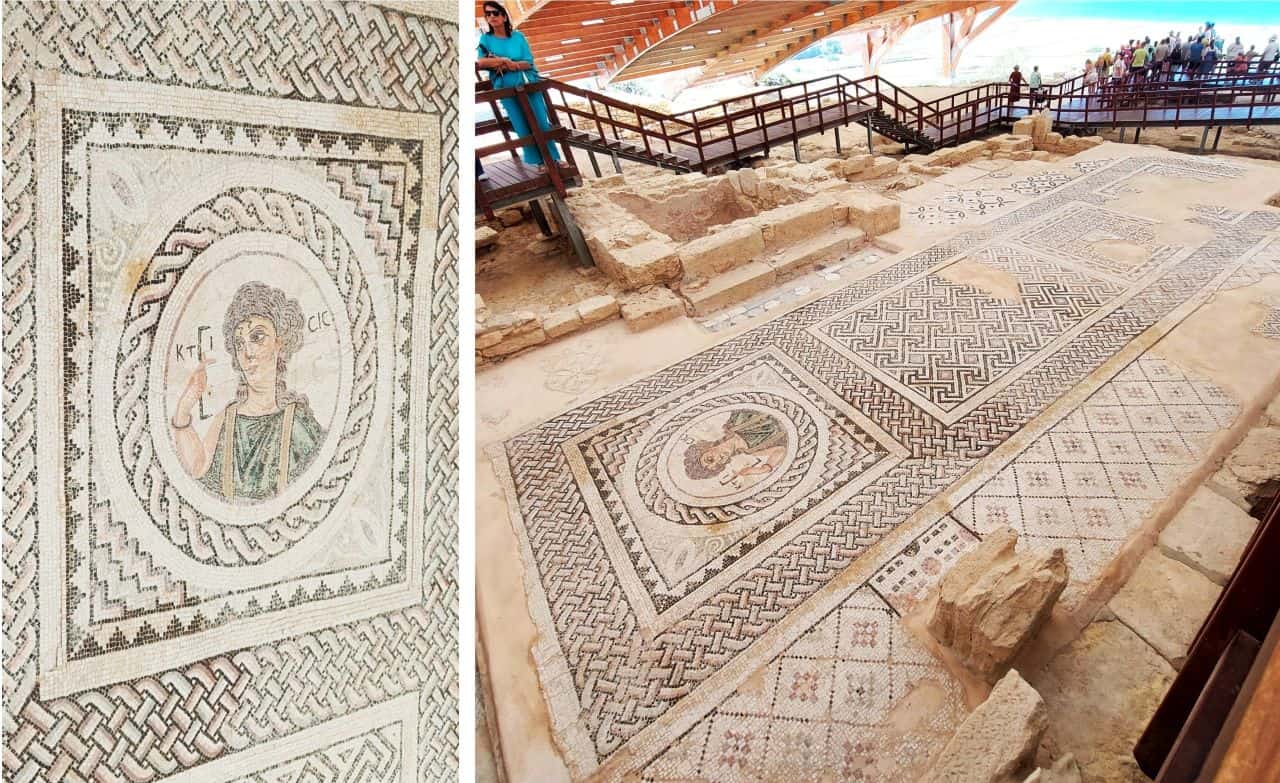
Ktisis Mosaic, House of Eustolios
An inscription in the eastern portico indicates the building’s connection with the new religion, Christianity. Instead of large stones or copper, it is secured with the blessed symbols of Christ.
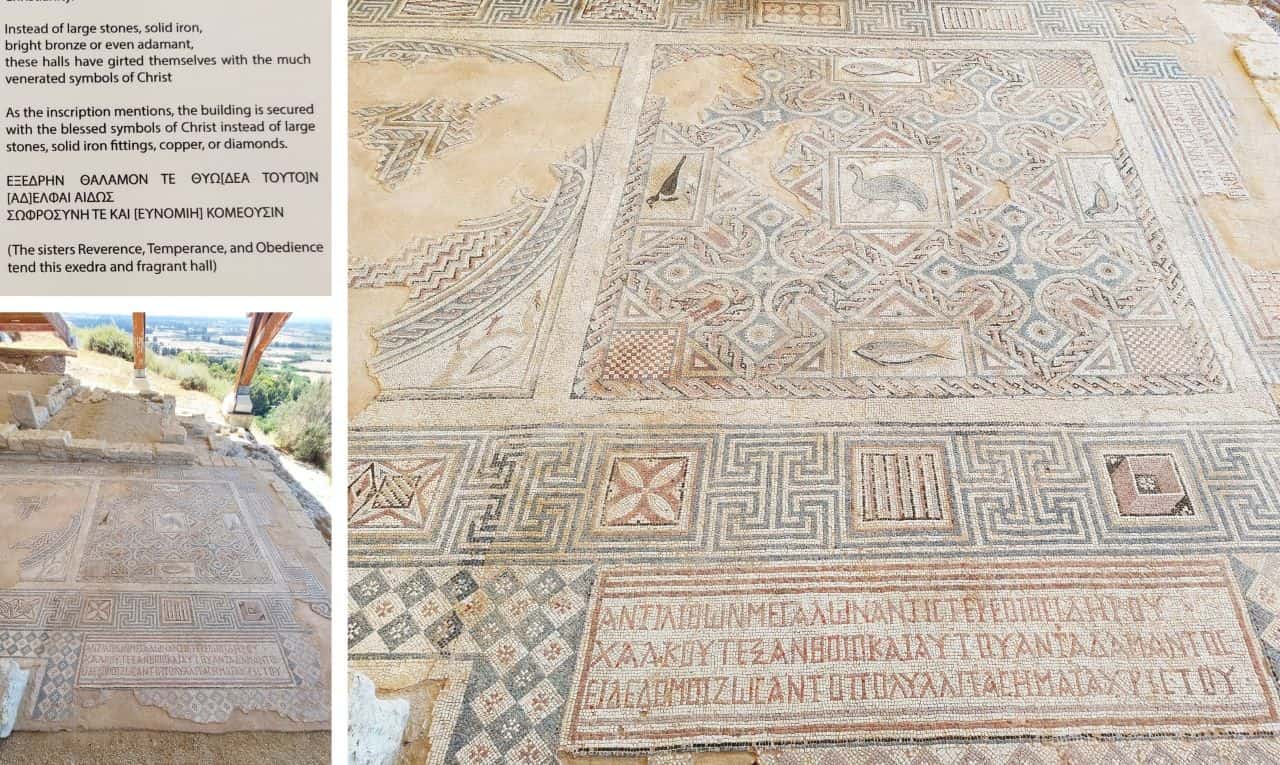
Kourion, House of Eustolios, an inscription on the eastern portico
The infrastructure of the House of Eustolios is amazing, hidden under the mosaics and tiles. Even today, we can see the remains of the plumbing system and network of reservoirs, cisterns, terracotta pipes, and water channels that once ran beneath the floors and through the walls.
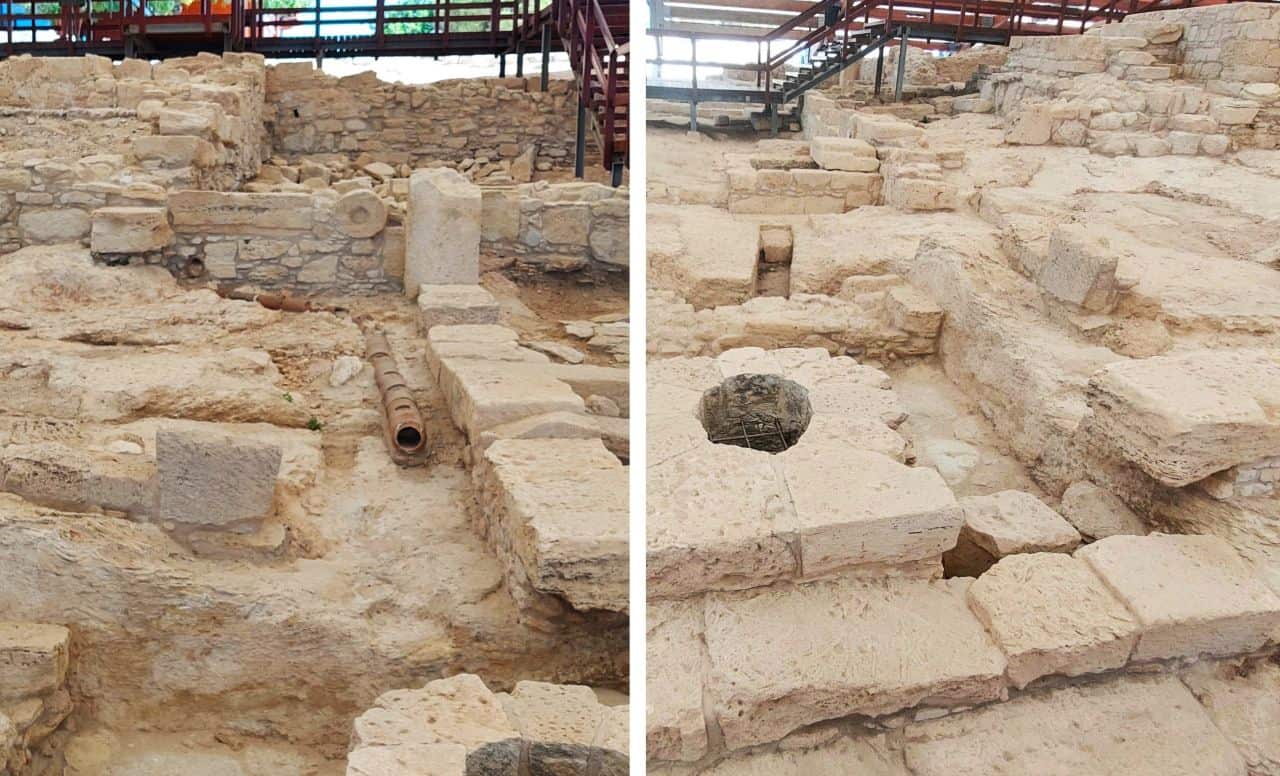
Kourion, ruins of the House of Eustolios
The Greco-Roman Theatre
Close to the House of Eustolios, you can find the Greco-Roman Theatre, originally built in the 2nd century BC.
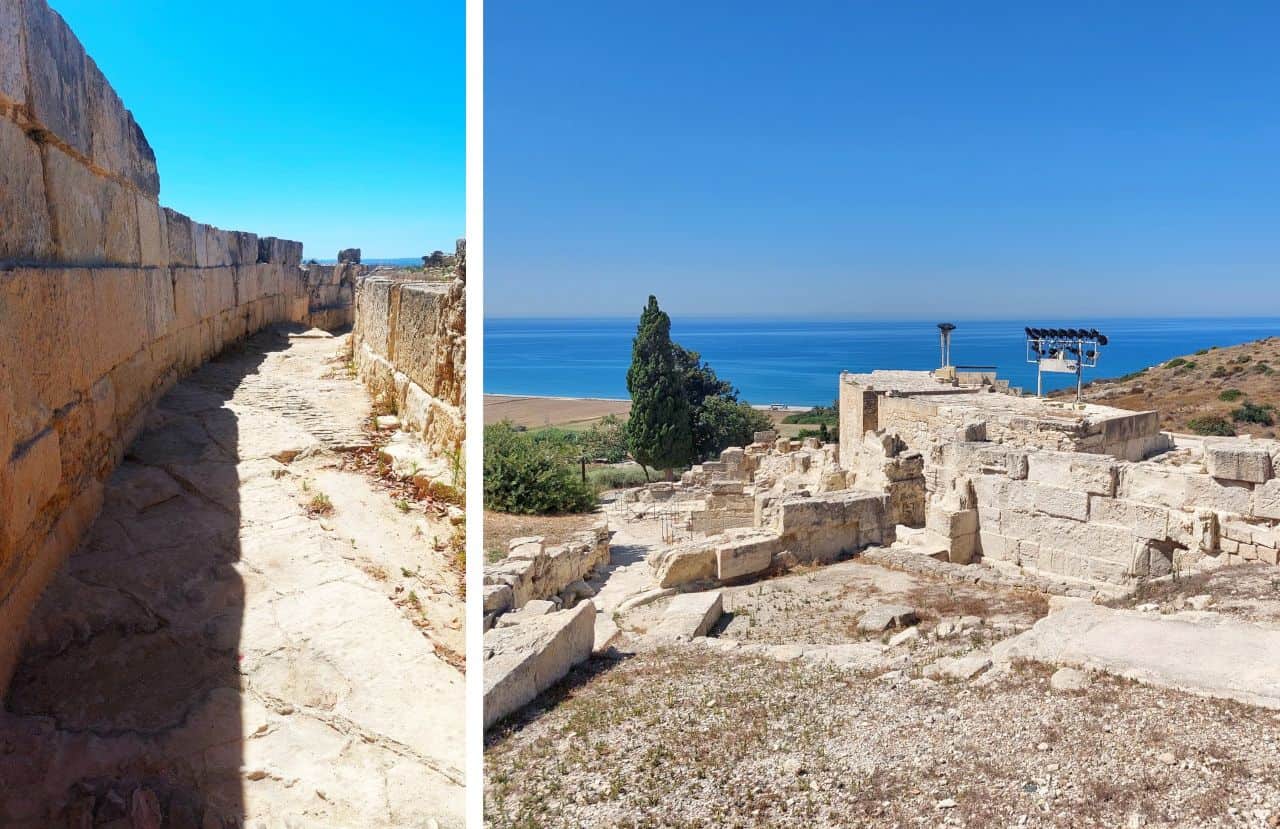
Kourion, path to the Greco-Roman Theatre
Once, it could house up to 3,500 spectators. During the 3rd century AD, the theatre was transformed into an arena, used for fights with wild animals. It was probably destroyed by earthquakes between 365 and 368 AD, and then it was abandoned.
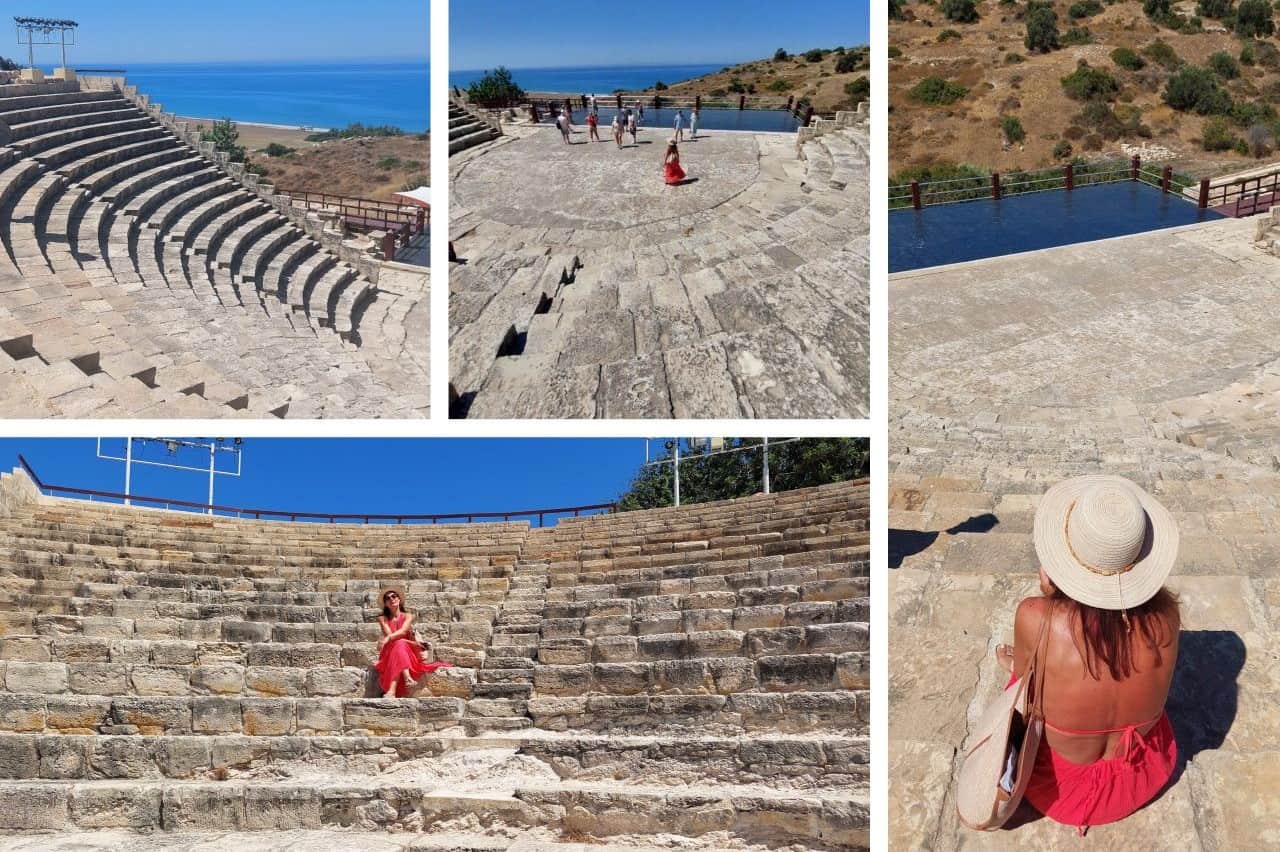
The stunning Greco-Roman Theatre
By the way, the theatre was excavated between 1935 and 1950, and it was restored in the early 1960s. Today, it is still used for live open-air musical and theatrical performances during the summer, such as the International Festival of Ancient Greek Drama (check more details here: https://www.greekdramafest.com/tickets/).
It was an amazing feeling, sitting on the stone seats, gazing out at the blue sea behind, and imagining what it had looked like in ancient times…
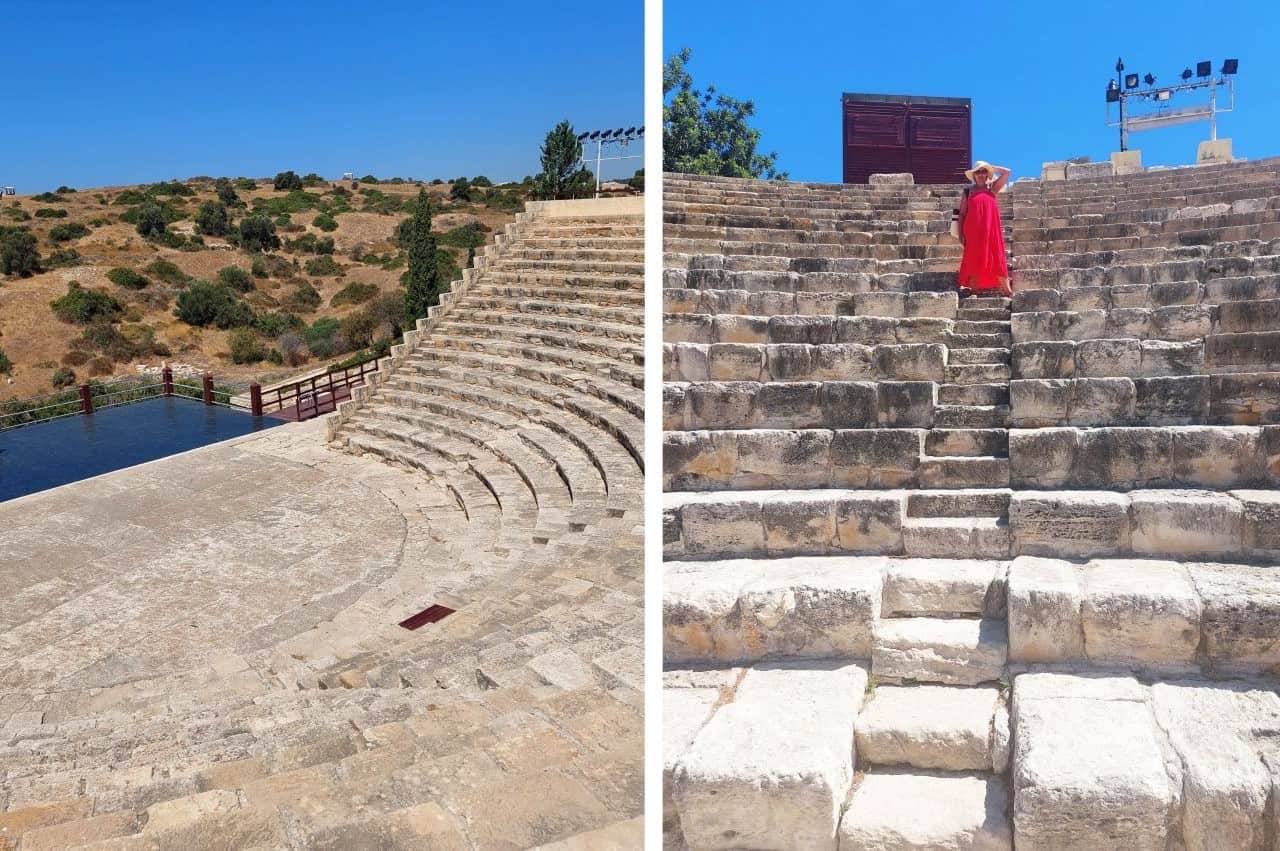
The Kourion Theatre
Kourion complex
If you have enough time, you can visit several places in the Kourion ancient complex.
♦ The Ancient Stadium dates back to the 2nd century AD, and it had a capacity of 6,000 spectators.
◊ The House of Gladiators and the House of Achilles are villas known for their impressive scenes of gladiator combat, depicted on mosaics.
♦ The Sanctuary of Apollo Hylates was one of the main religious centres of ancient Cyprus, dedicated to Apollo Hylates, the god of the woodland.
◊ The Early Christian Basilica from the 5th century shows the transition from paganism to Christianity.
♦ The Roman Forum and Agora date back to the early 3rd century, serving as a marketplace and meeting place. There are also bath complexes and a nymphaeum.
None of them is situated in the same place, so you have to walk around. Wear comfortable shoes, bring water and a hat with you.
You can also visit Kourion Beach, located in the Episkopi Bay. It is 1 km long, known for windsurfing due to strong winds and waves.
🏛️Ancient Salamis and Kourion
For anyone interested in ancient history, Salamis and Kourion are must-visit places on Cyprus.
Near the turquoise-blue waters of the Mediterranean Sea lie two city-kingdoms, known for their rich history and glorious days in ancient Cyprus.
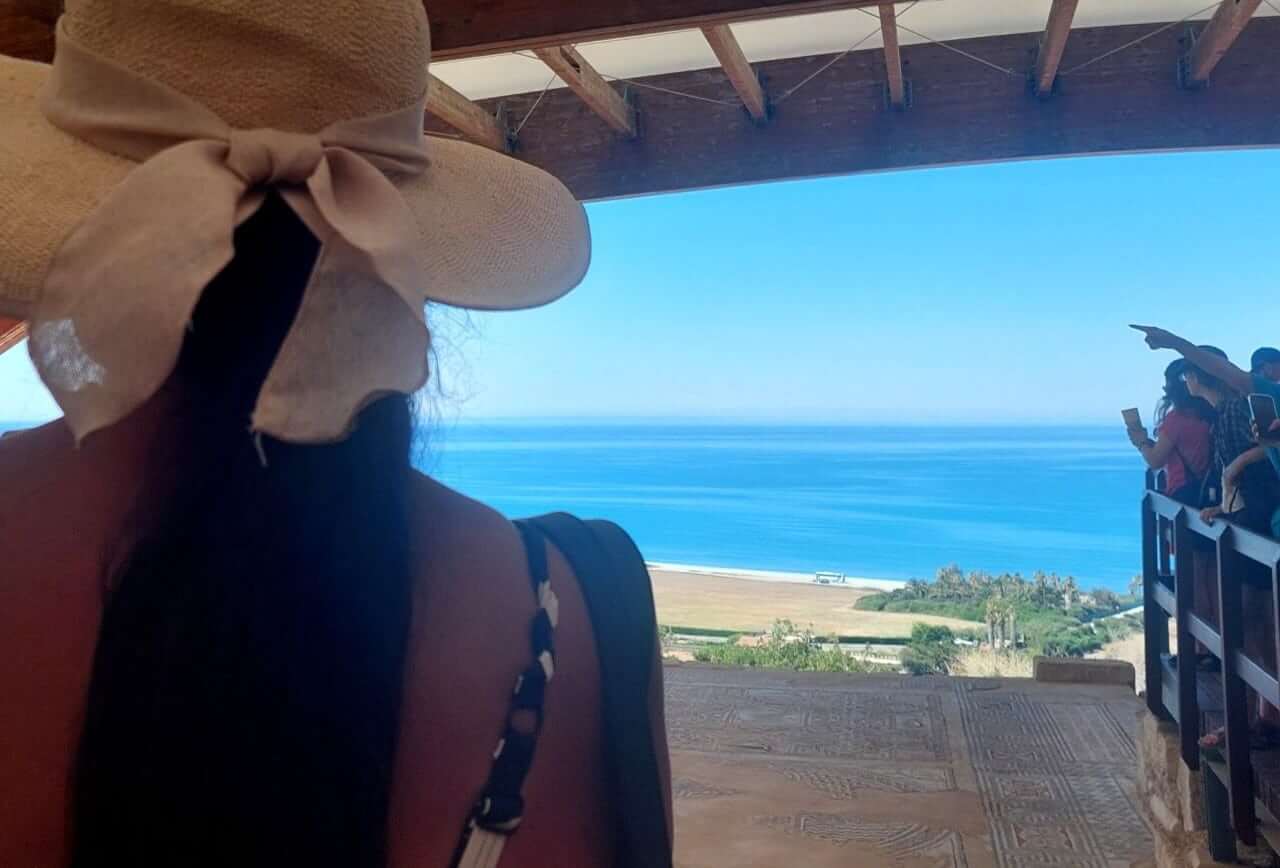
A view from Kourion
Stay tuned for the new story about Paphos, another fantastic archaeological site with stunning mosaics…
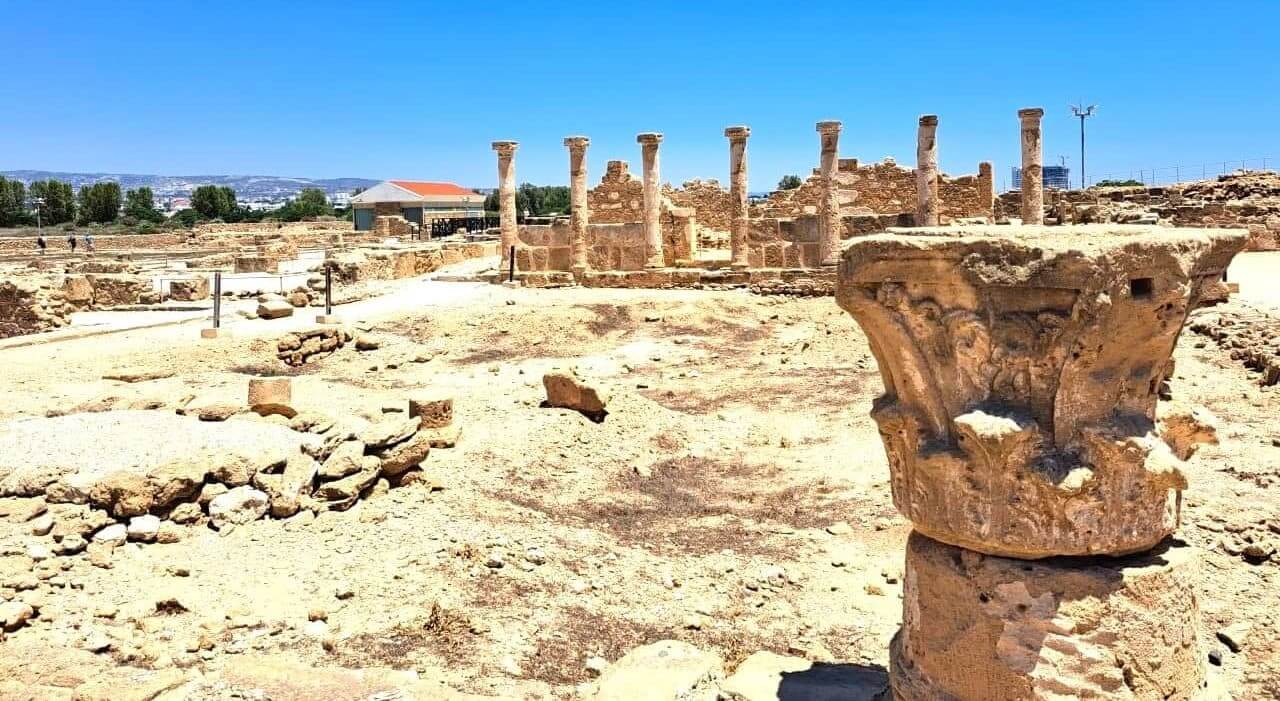
Cyprus, Archaeological Park of Kato Paphos

Leave a Reply
Want to join the discussion?Feel free to contribute!