
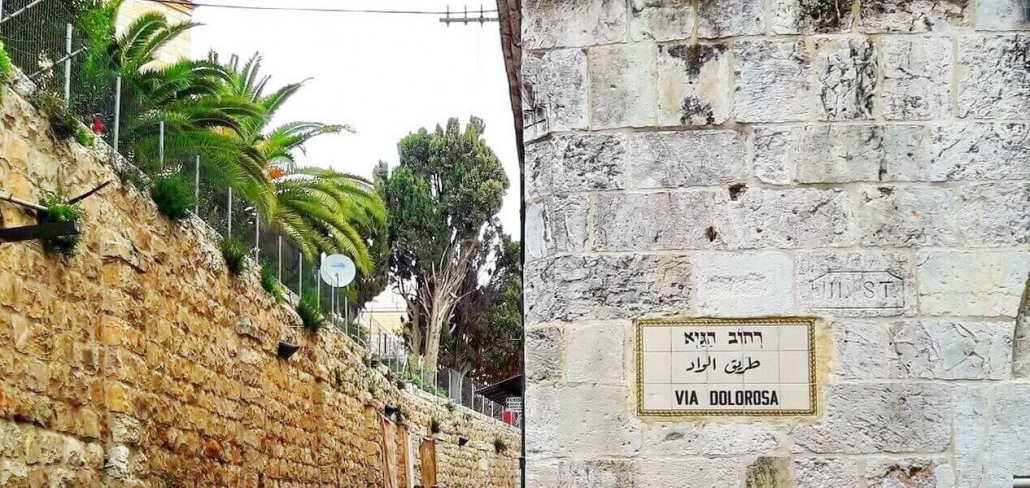
Via Dolorosa, the path covered with tears
Via Dolorosa is the most sacred path for Christians in the Old Town of Jerusalem. It is believed that Jesus walked this path before his crucifixion.
Actually, Via Dolorosa is not one street. It consists of several parts of a few streets, and it has been a pilgrimage route for centuries. Since this route was changed several times, some scientists think that it cannot be that path. But today’s version of Via Dolorosa dates from the 18th century.
You can walk this way alone or with a guided tour. But you will always be surrounded by many pilgrims and tourists from all over the world.
Jerusalem syndrome
Have you ever heard about Jerusalem syndrome?
In a word, it is a group of various mental phenomena. Some visitors begin to identify with Jesus and other religious figures. They read parts of the Bible, sing psalms, and experience enlightenment. But, interestingly, the syndrome affects Jews, Christians, and Muslims, as well as those who have no connection with these religions, and those who have not previously shown signs of any mental problems.
A few words about Jerusalem and the Old City
When we talk about the history of Jerusalem, there are mostly references to events related to the last days of Jesus’ life and his crucifixion. However, the story is very complicated because Jerusalem was ruled by many dynasties and kings.
Usually, today tourists and pilgrims visit the most sacred places, such as the Mount of Olives with the Church of the Ascension, and the Jewish cemetery. Then they go along the Kidron Valley to the Garden of Gethsemane and the Church of all Nations.
You can enter the old city of Jerusalem through some of the remained gates. Maybe it sounds strange, but it covers less than 1 km2 and is the holiest place for Jews, Christians, and Muslims.
Pay attention not to get lost in the labyrinth of narrow streets, walls, churches, shops and crowds of pilgrims and tourists, especially if you are part of a guided group. So, we carefully followed our guide, Tanja Ben Haim Marčetić, because the alleys look very similar!
The Old City is divided into 4 unequal and intertwined parts and quarters: Jewish, Christian, Armenian, and Muslim. And Via Dolorosa, the most sacred path, winds between them.
👉 You can read more about fascinating Jerusalem here.
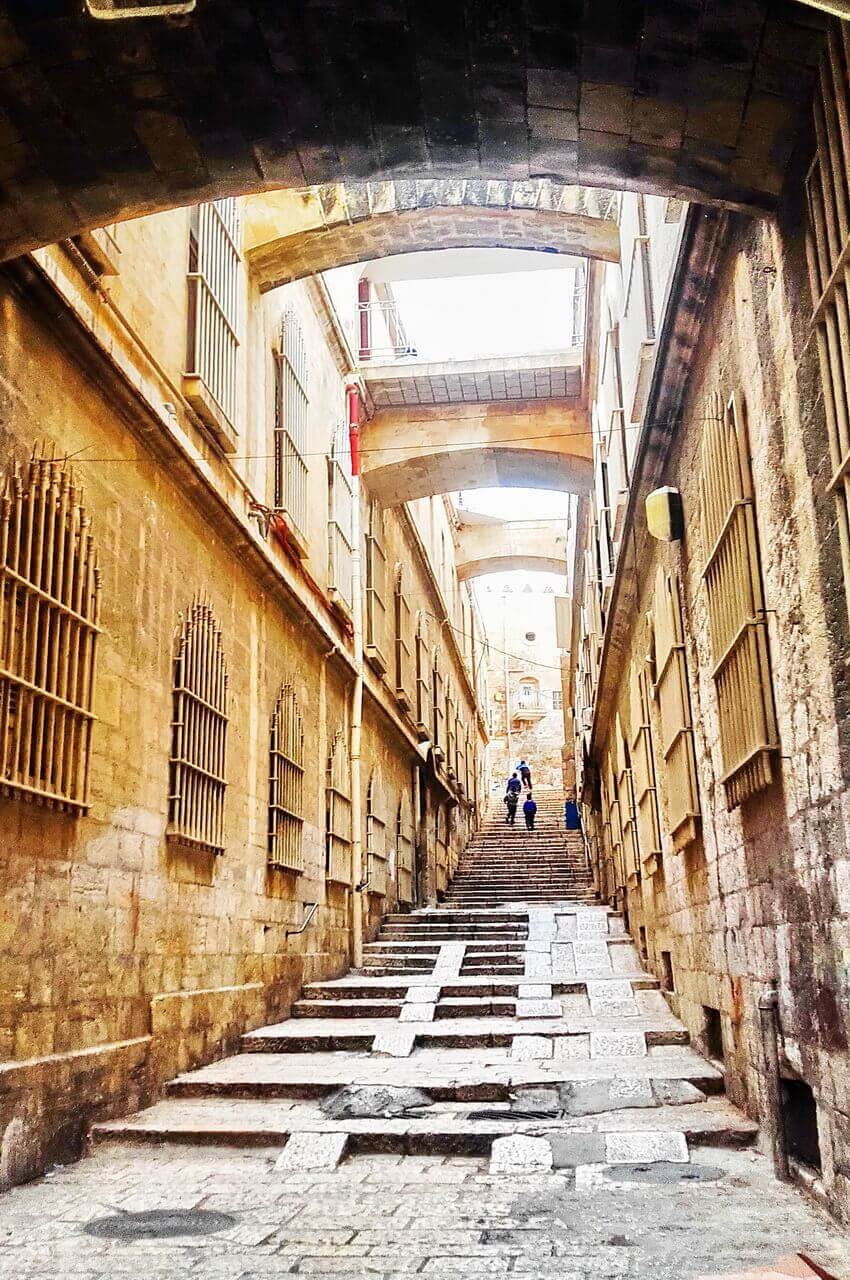
Jerusalem Street in the Old City
The sacred path of Via Dolorosa and 14 Stations of the Cross
In the Muslim Quarter, along Via Dolorosa towards the Lion’s Gate in the Old City, there is the Praetorium or Prison of Christ. It is believed that Christ was imprisoned there before he carried his Cross. Today, it’s administered by the Greek Orthodox Patriarchate of Jerusalem.
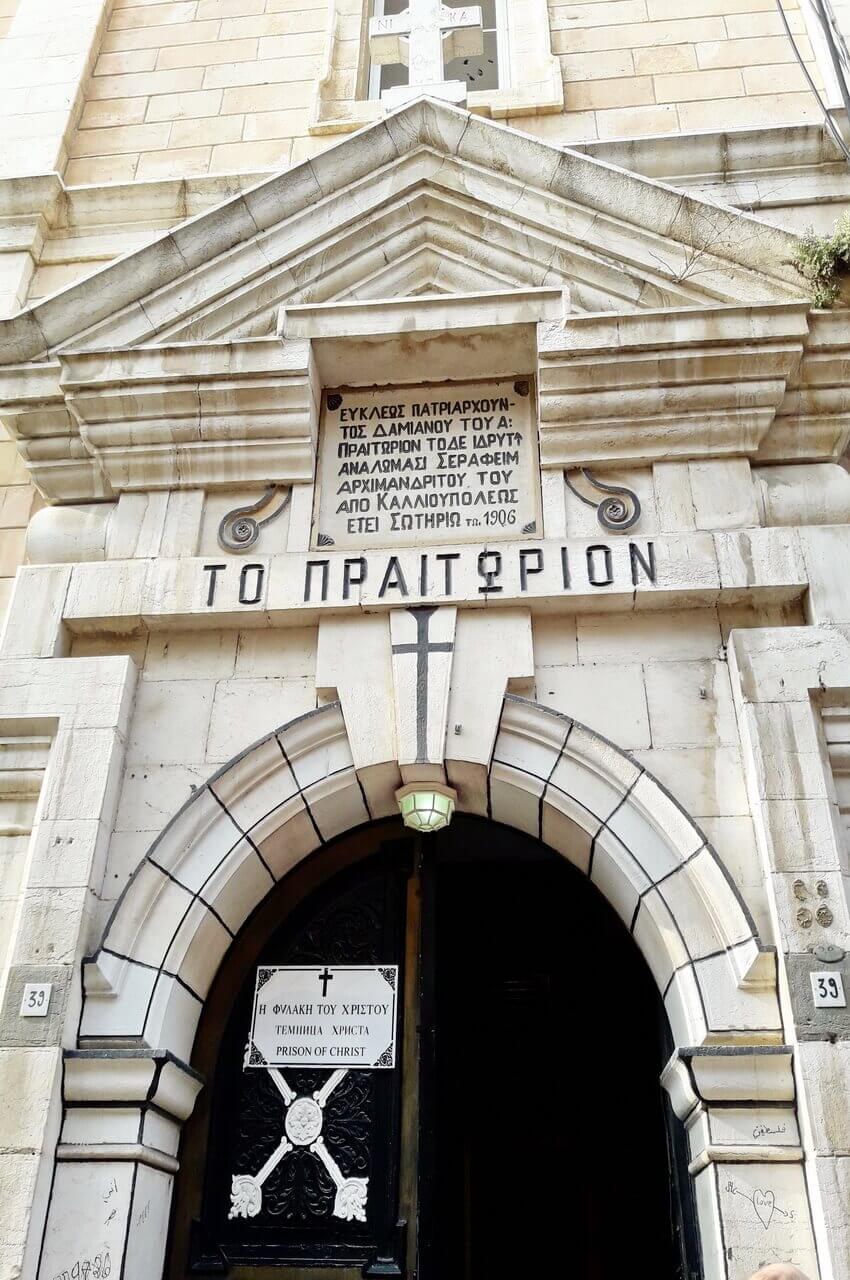
Prison of Christ
Via Dolorosa is about 600 meters long and consists of 14 Stations of the Cross.
Today’s route begins from Lions’ Gate and leads through the Old City to the Church of the Holy Sepulchre. It is believed that it was a path which Jesus walked carrying the cross to Golgotha Hill.
Stations are marked with black plaques, Roman numbers, and various chapels and sculptures. So let’s mention all 14 stations of the Holy Cross and the Way of Sorrows.
Via Dolorosa, I Station: Jesus is condemned to death
The first station is located in the Muslim Quarter.
It is believed that once there was the Antonia Fortress, a citadel built by Herod the Great. But today, this place is the courtyard of the Muslim Umariya Elementary School for boys.
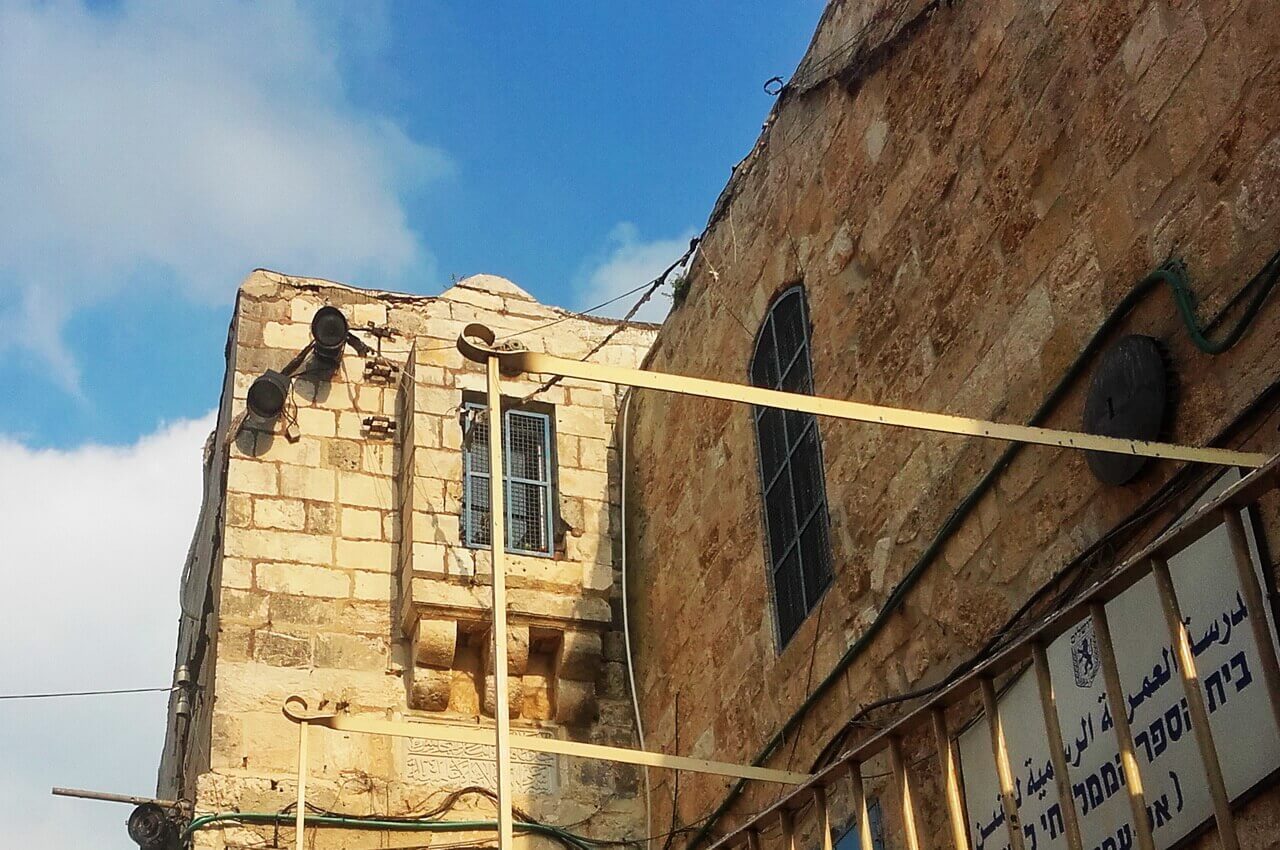
Via Dolorosa, I Station, Jerusalem
At that time, Pontius Pilate was the fifth governor of the Roman province of Judaea. According to the 19th chapter of John’s Gospel, he condemned Jesus to be whipped and death by crucifixion at the place called Lithostrotos
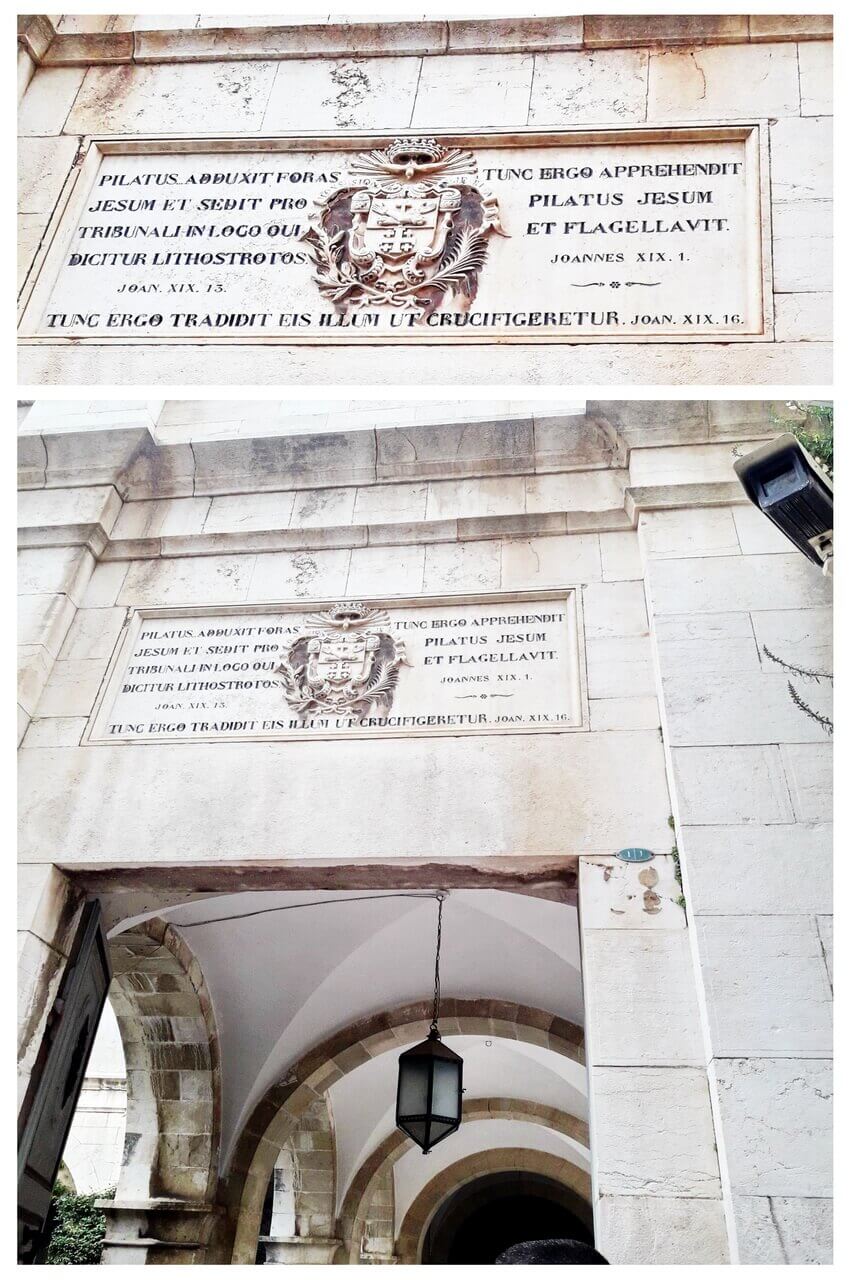
Via Dolorosa, I Station
II Station: Jesus carries his cross
Across the street and courtyard from Umariya School is a Franciscan complex that consists of two churches.
The Chapel of the Flagellation was erected on the place where Roman soldiers whipped Jesus and put the crown of thorns onto his head.
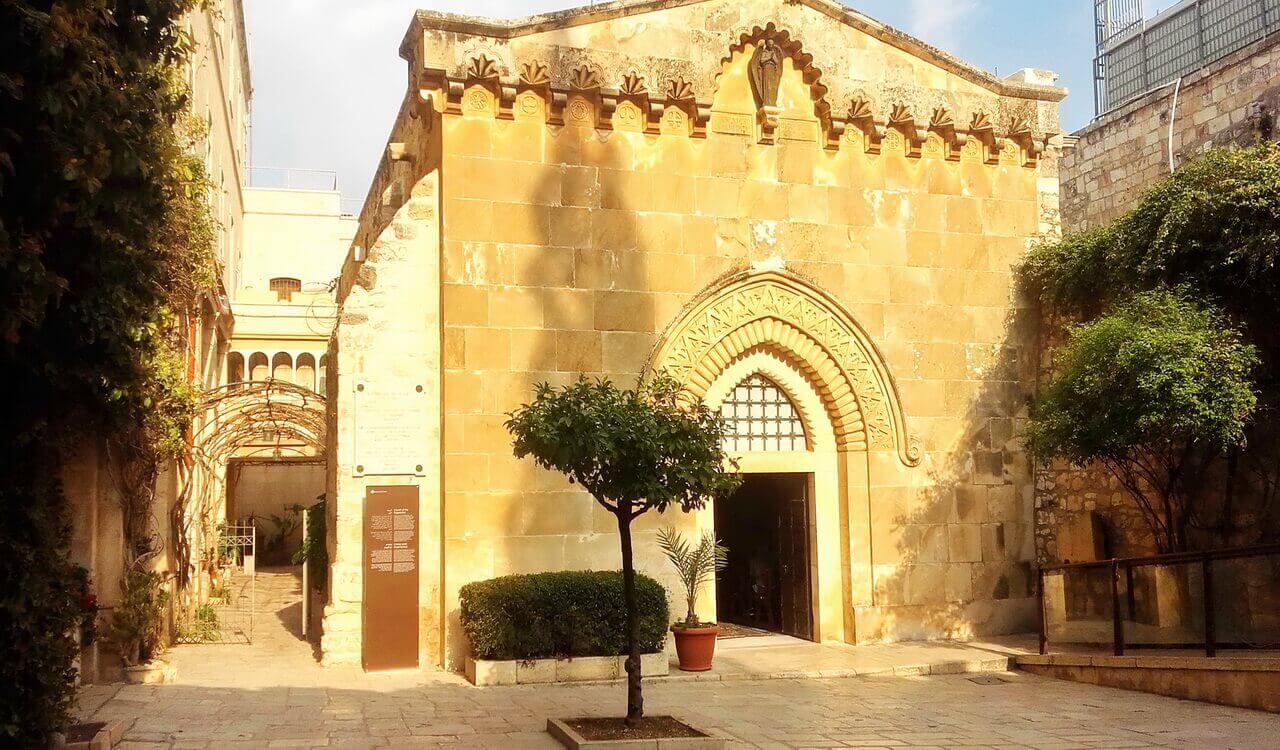
Chapel of the Flagellation, Via Dolorosa II station
The second one is the Chapel of the Condemnation and Imposition of the Cross, where Jesus received his cross.
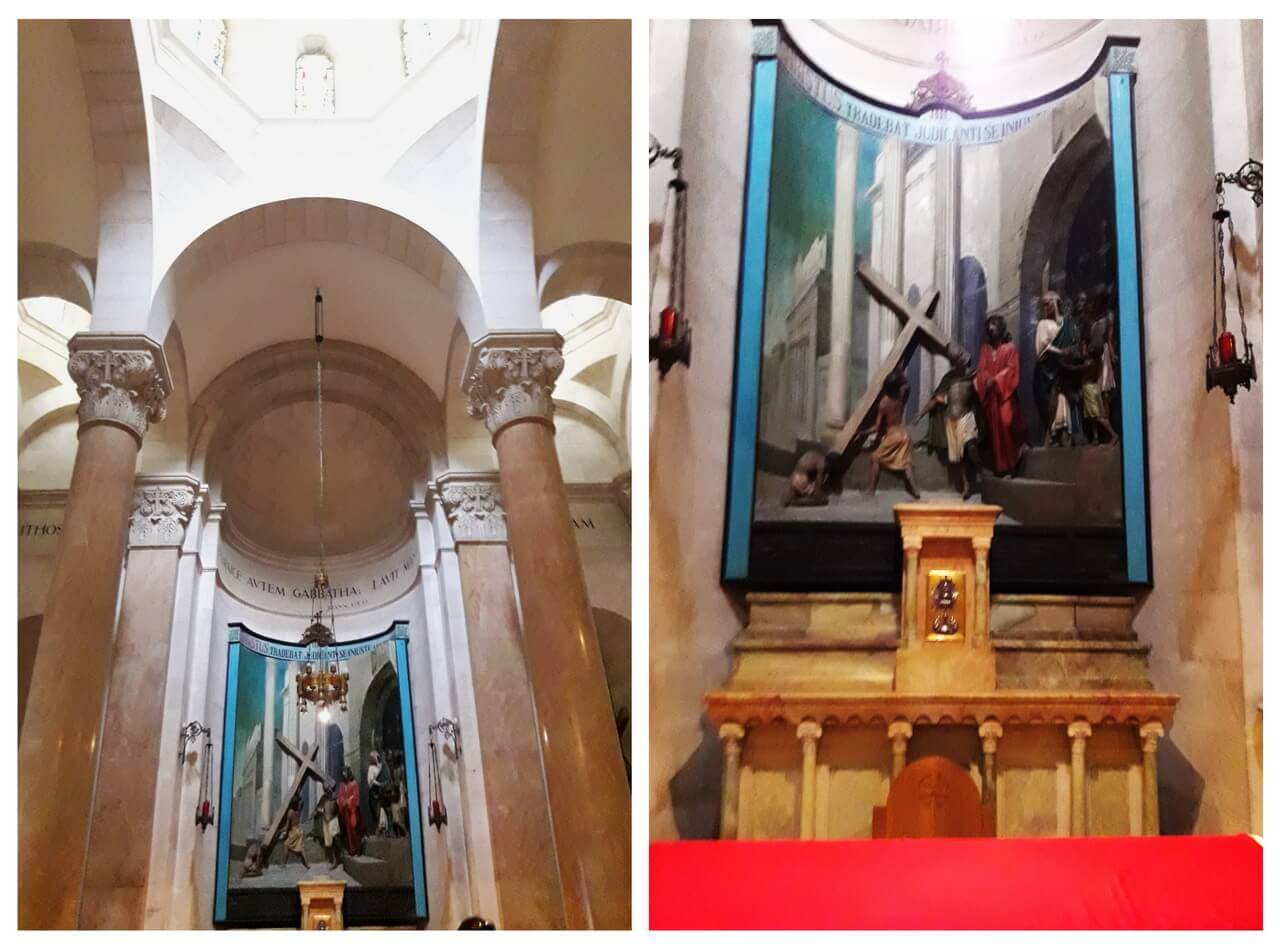
The altar of the Church of Condemnation
Even today, you can see a Roman soldier’s game carved in the Lithostrotos pavement under the Zion Sisters convent.
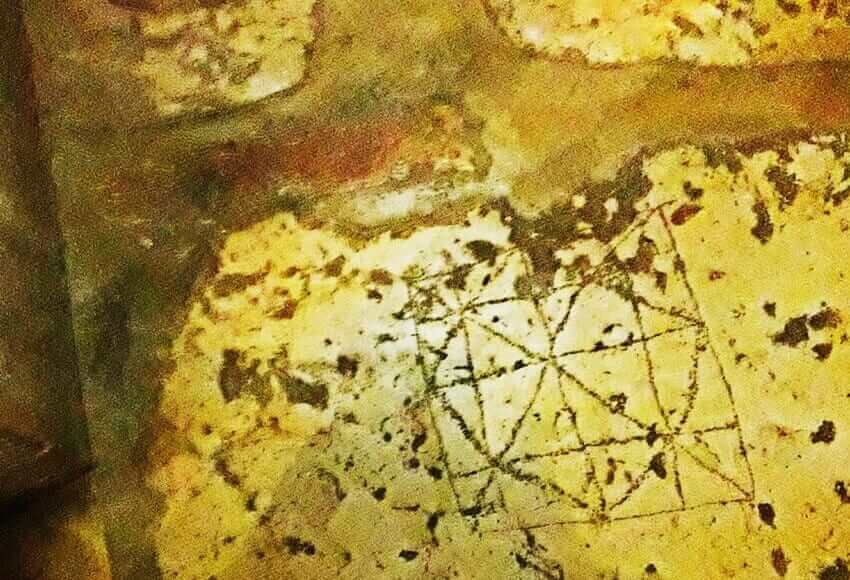
Roman soldiers game on the pavement under the Zion Sisters’ convent
There is a map of the Old City of Jerusalem on one of the walls of the church.
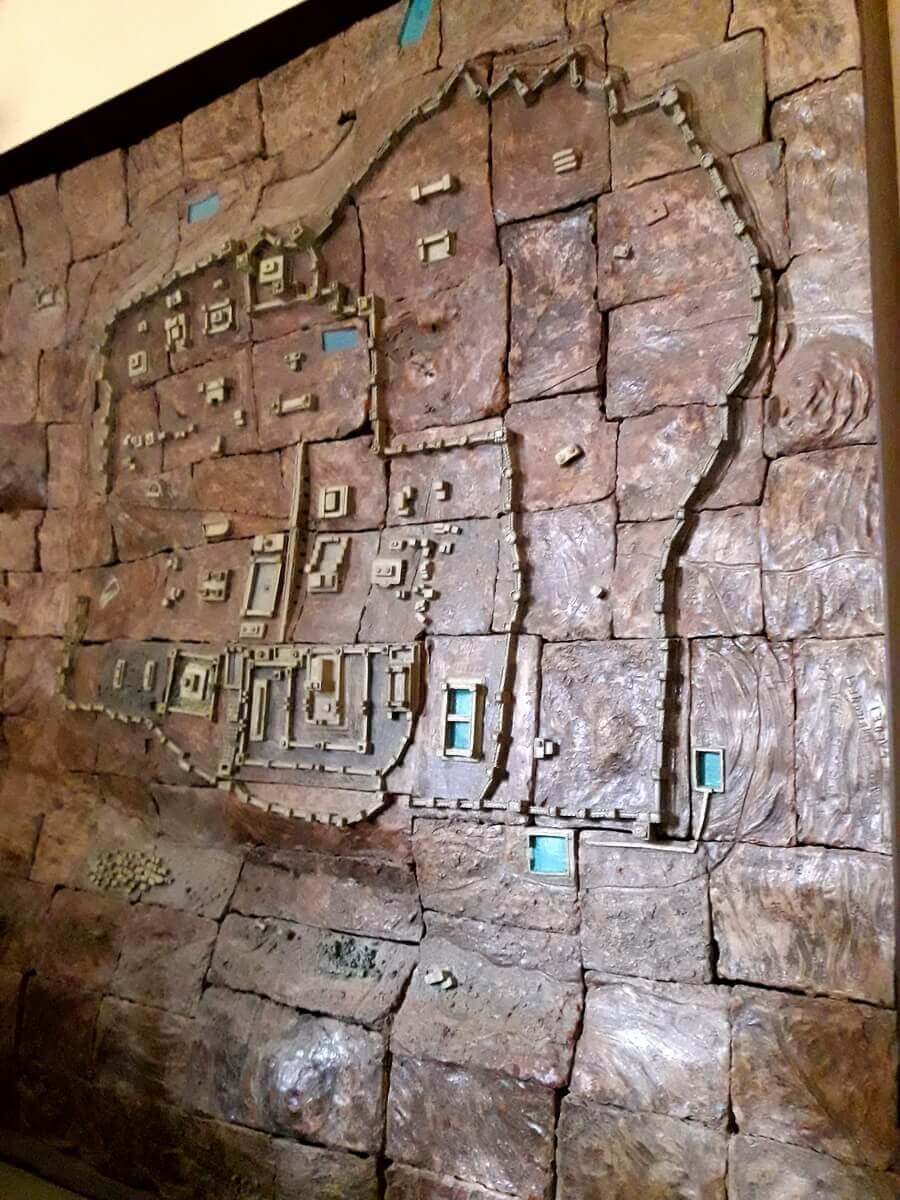
The old map of Jerusalem
Also, every Friday, at three o’clock in the afternoon, the procession of the Franciscan Order starts at the Monastery of the Flagellation. This free tour leads you along the stations of Via Dolorosa, with the reading of relevant quotations from the Old and New Testaments.
III Station: Jesus falls for the first time
This station signifies the place where Jesus fell for the first time carrying his cross.
Today, it is the place of the Polish church, which was built in the 15th century by the Armenian Catholic Patriarchate. Above the church entrance, you can see a relief depicting Jesus stumbling while carrying his cross.
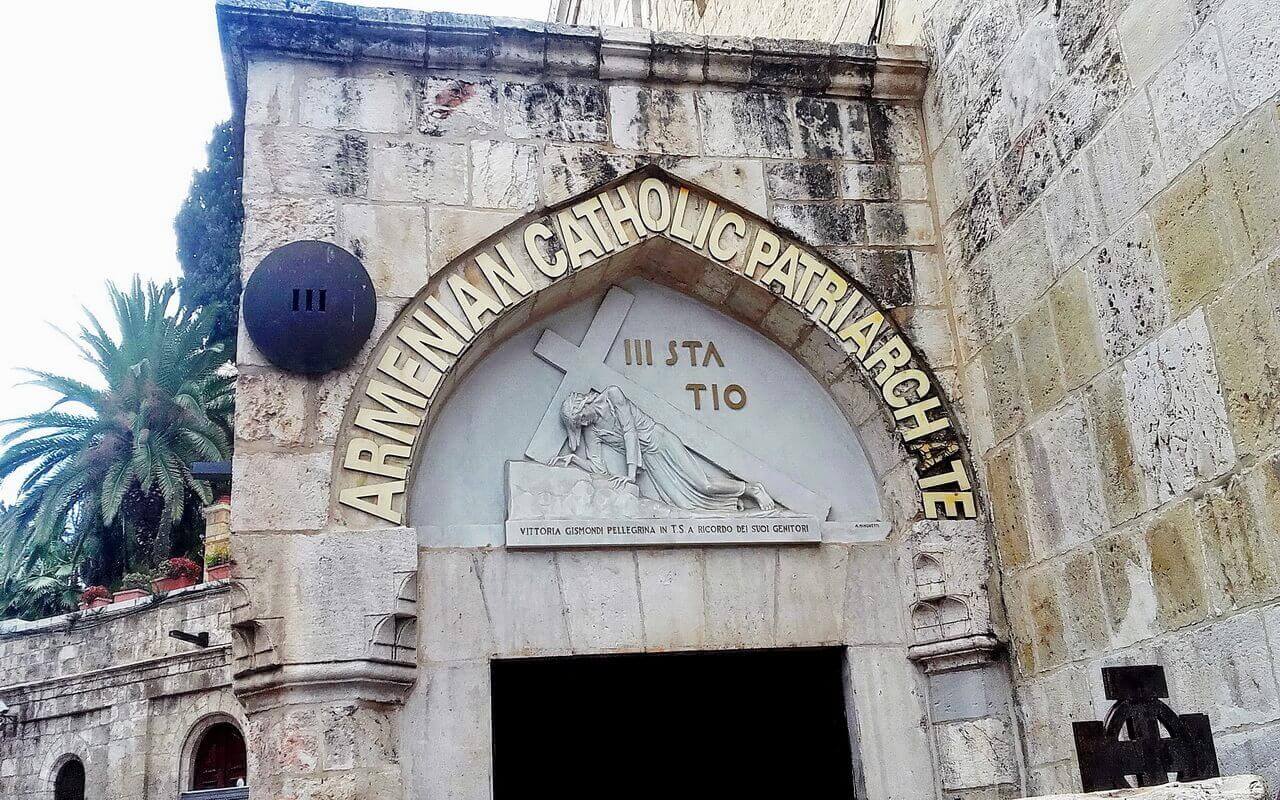
Via Dolorosa, III Station, Armenian Catholic Patriarchate
IV Station of Via Dolorosa: Jesus meets her mother
Next to the 3rd station is the 4th, the place where Jesus meets his mother.
This scene can be seen as a relief in front of today’s Armenian Church.
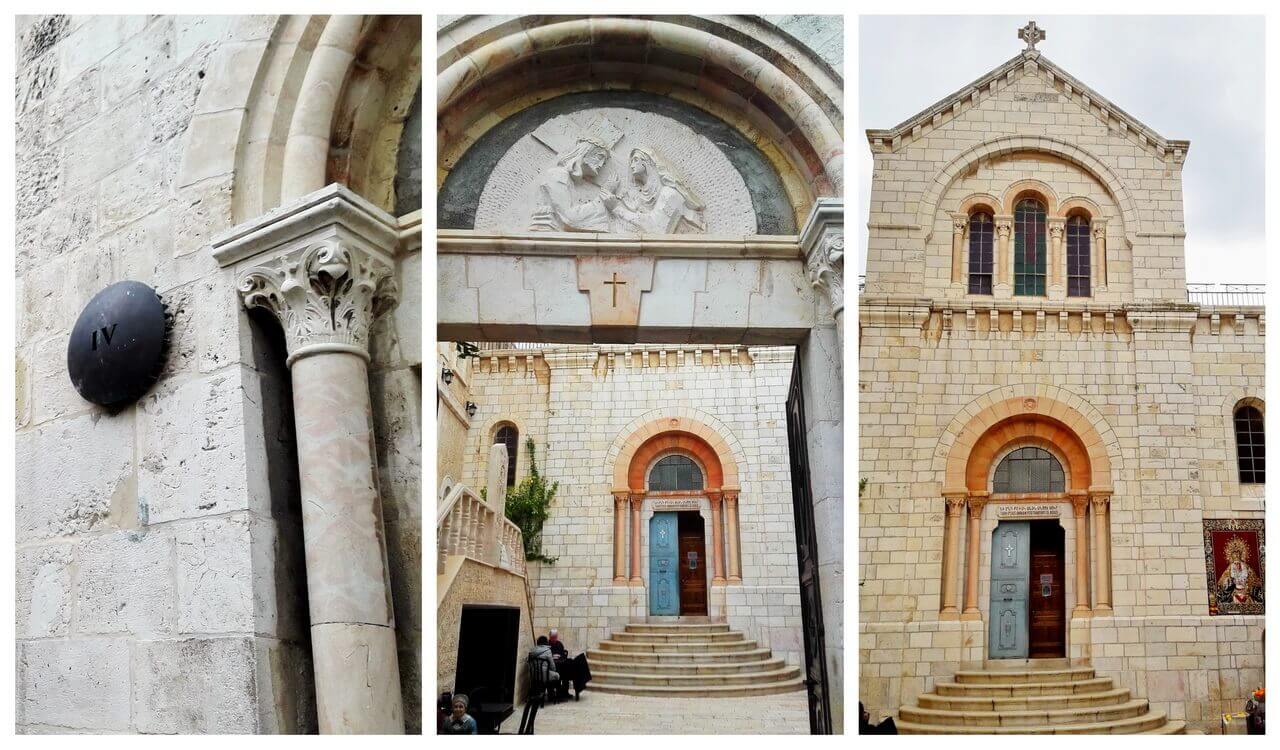
Via Dolorosa, IV station, Jerusalem
V Station of Via Dolorosa: Simon of Cyrene helps Jesus carry the cross
The fifth station was a place where Simon of Cyrene helped Jesus to carry the cross.
He was in pain and agony because the wooden cross was very heavy. It is believed that one small hollow in the wall was the imprint of Jesus’s hand when he stopped to rest for a while.
Once, it was a small church for the first Franciscans when they arrived in Jerusalem in the 13th century. But today’s chapel is from 1895. This station is also marked by the Jerusalem Cross.
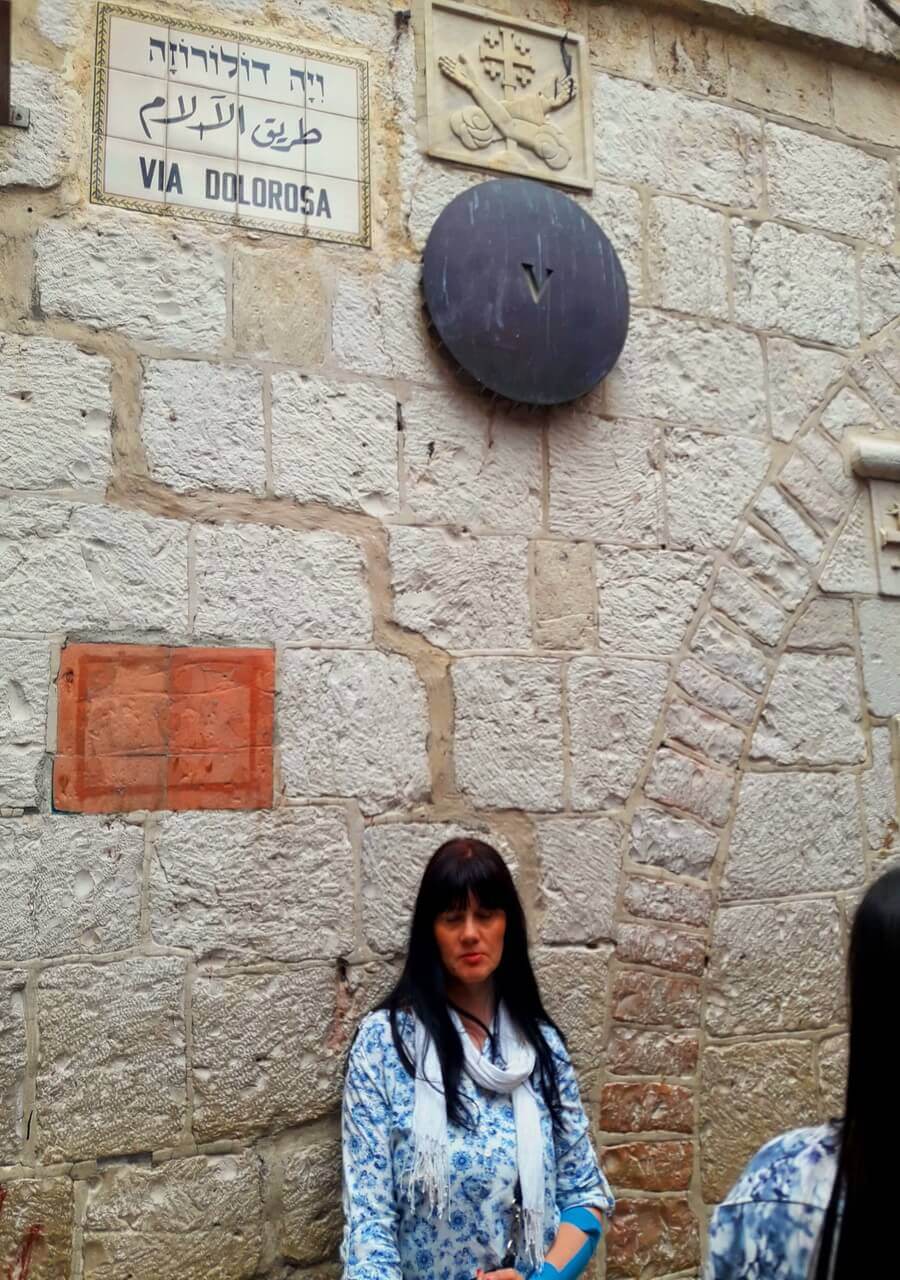
Via Dolorosa V Station, The Chapel of Simon of Cyrene
I have to say that this station leaves me speechless for one more reason.
Here you can see me, standing beside the small chapel. But in this photo, there is also one girl with dark hair and a white-blue shirt, looking just like me! Well, I know, it was just one captured moment in the crowded Via Dolorosa street. And at the same time, also a strange coincidence for me 🙂
VI Station of Via Dolorosa: Veronica wipes the face of Jesus
The sixth station marks the home of a Jerusalem woman called Veronica.
She wiped the face of Jesus of blood and sweat, and it is believed that the shape of his face was left on her veil.
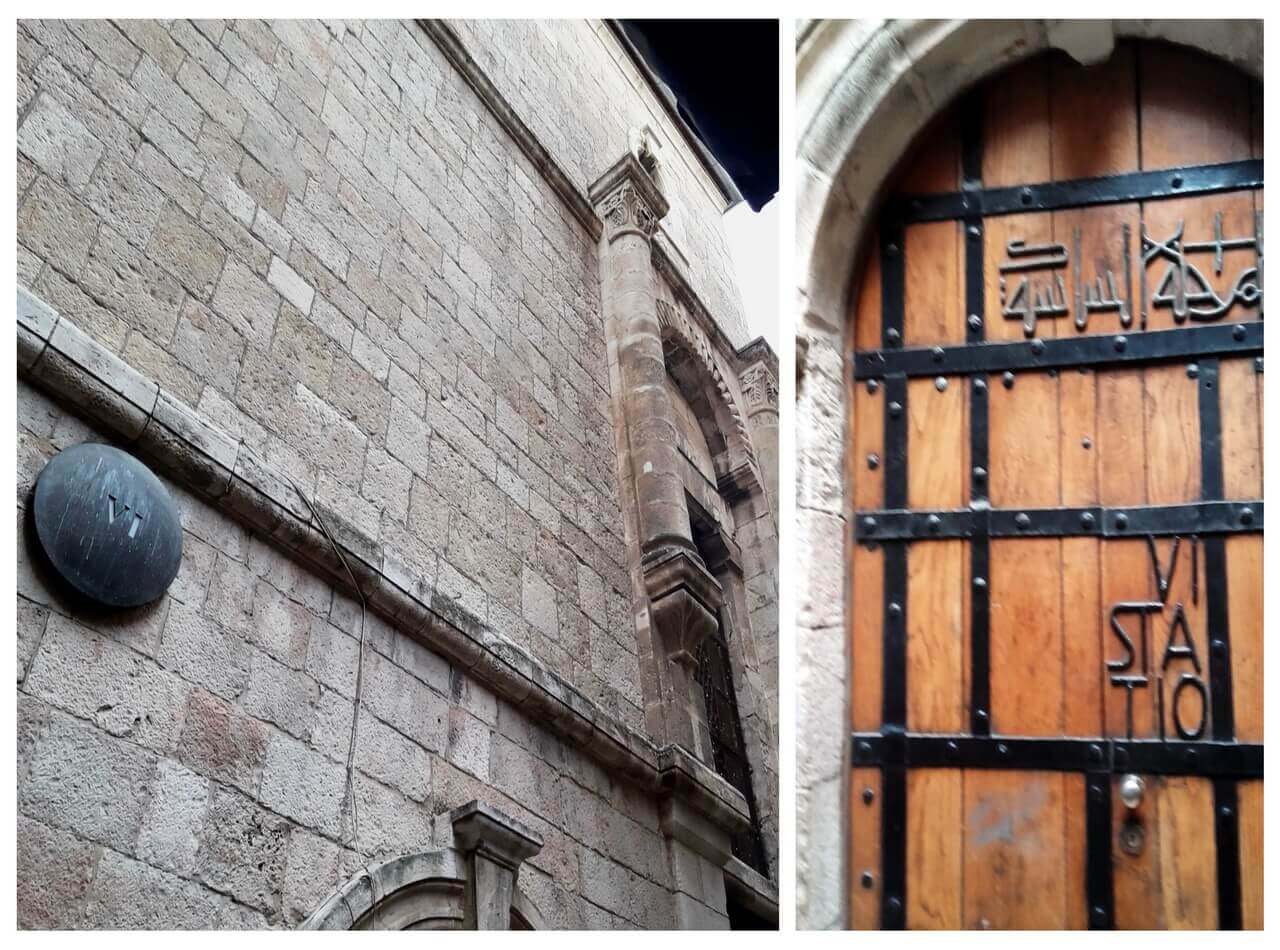
Via Dolorosa, VI station
So this sacred Veil of Veronica (lat. Sudarium) is kept in St Peter’s Basilica in Rome as a Holy relic. At this place, now there is the small Chapel of the Holy Face.
VII Station: Jesus falls the second time
Going around the street, under the weight of the Cross, Jesus fell for the second time.
It is believed that it was the place where Jesus passed through the Gate of Judgment. At that time, the crucifixion took place outside the city walls on Golgotha Hill. Today, there is a small Franciscan chapel at that place.
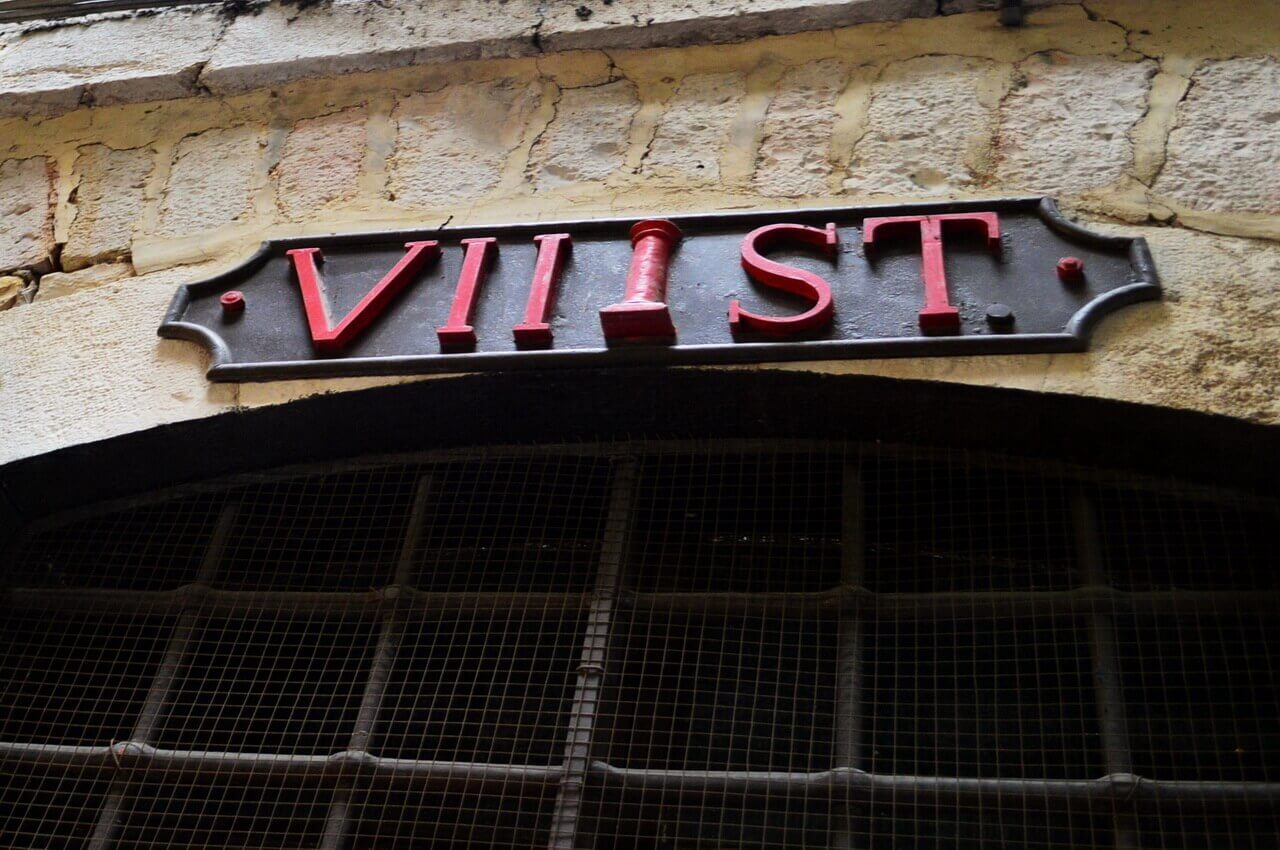
Via Dolorosa, VII Station
VIII Station: Jesus talks to the women of Jerusalem
This place was where the “daughters of Jerusalem wept for Jesus”. So Jesus stopped there, telling women not to weep for him but for themselves and their children. Today, this is a place of the Greek Orthodox church, and the embedded little cross is in the wall.
IX Station: Jesus falls a third time
The ninth station is the place where Jesus faltered for the third time before his final climb to Golgotha. It is marked by the St Helen Coptic Orthodox church, dedicated to Emperor Constantine’s mother, Helena.
Via Dolorosa: X – XIV stations and The Church of the Holy Sepulchre
The last five stations are located in the Church of the Holy Sepulchre.
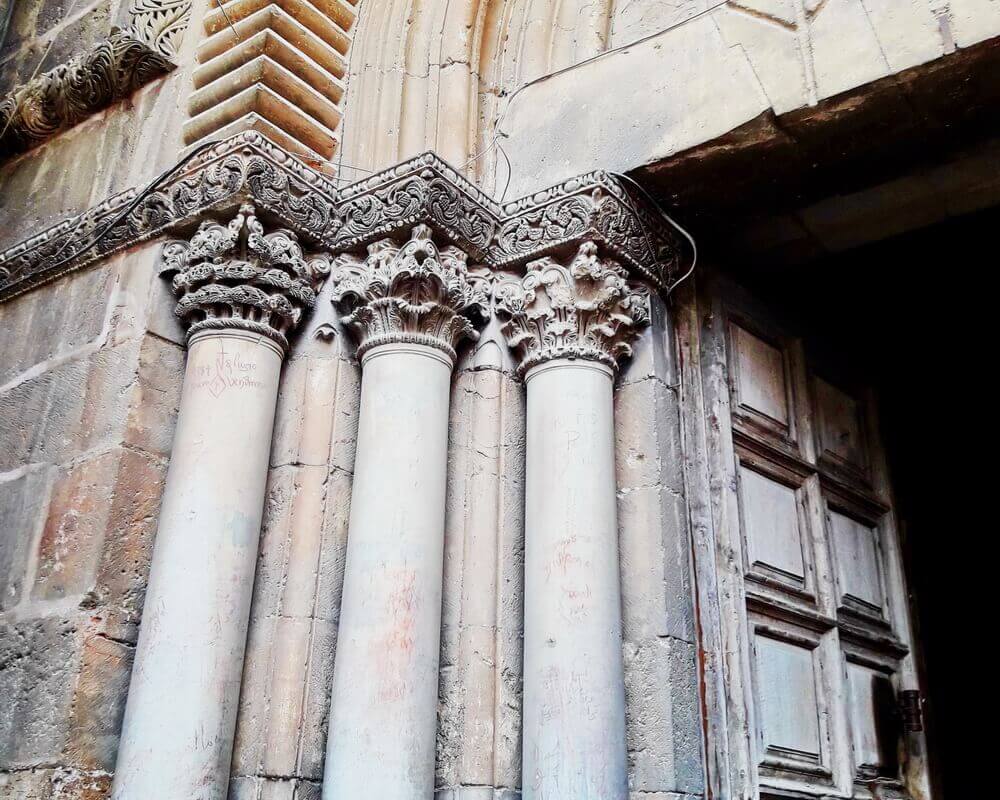
Columns in the entrance: The Church of the Holy Sepulchre
X Station: Jesus is stripped of his garments
The Chapel of the Franks is located to the right of the Sepulchre entrance.
It marks where Roman soldiers stripped Jesus’s garments before the crucifixion.
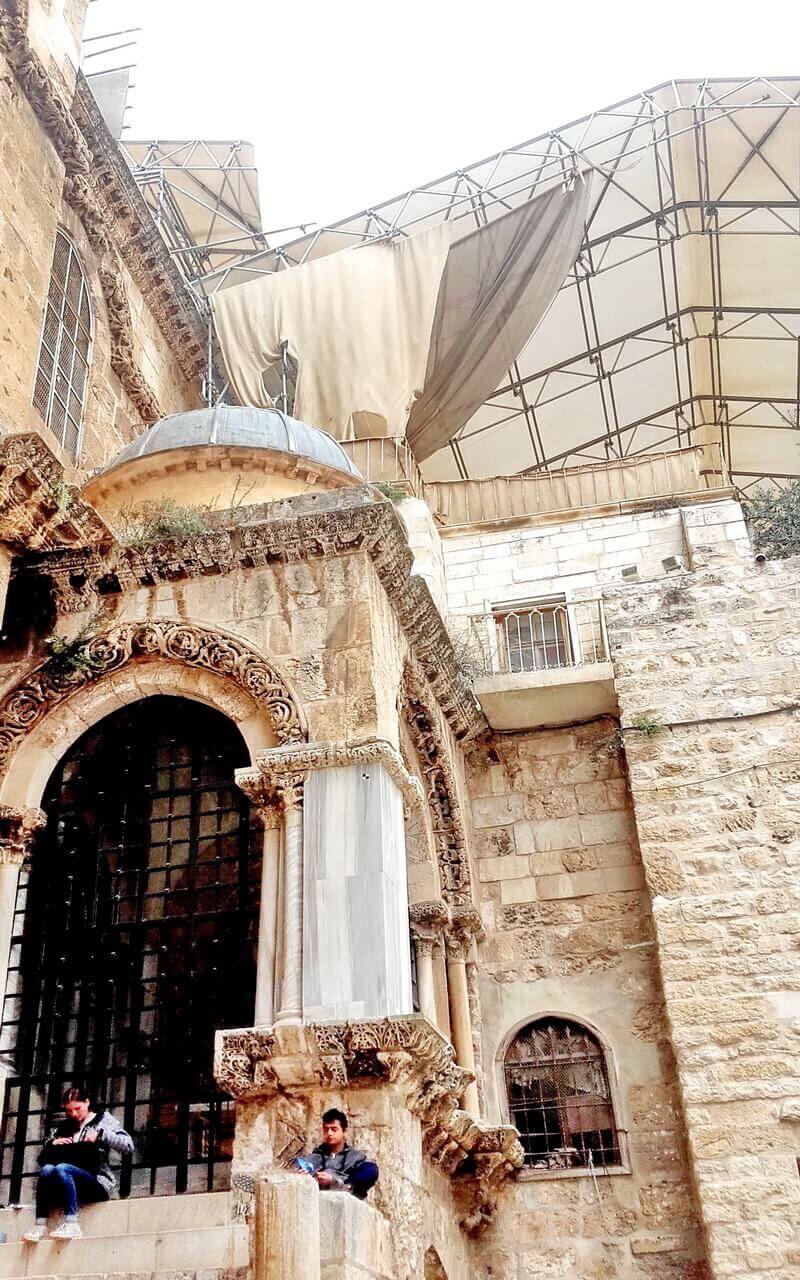
X Station, The Chapel of the Franks, Via Dolorosa
XI Station: Jesus is nailed to the cross
Just behind the wall of the 10th station, there is XI station, the place where soldiers nailed Jesus on the wooden cross. And after they crucified him, they gambled to see who would get the parts of his clothes.
According to the New Testament, at that moment, Jesus said: “Father, forgive them, for they know not what they do”. Well, I can say that we are probably all familiar with these words.
XII Station: Calvary, Jesus died on the cross
So when you enter the Church of the Holy Sepulchre, there is a narrow stone stairway leading to Golgotha on the right side. This hill is also known as Calvary, which is the Latin word for the skull, because once the hill was skull-shaped.
In fact, in Jesus’s time, it was outside the city walls of Jerusalem, and a place where the executions took place. That is why the word Golgotha is usually used to describe someone’s huge pain and suffering. Also, the chapel of the first man, Adam, is located directly below the Calvary. According to tradition, the blood of Jesus fell on his bones during the crucifixion.
Today, this area is administered by the Greek Orthodox Church.
The Altar of the Crucifixion
During our visit, the place was very crowded with pilgrims from many nations. In fact, we spent almost one hour going from the stairs to the Altar of the Crucifixion. Some people were praying quietly, some were crying, and some of them were reading the Bible. It is a strange feeling to stand in such a holy place, surrounded by people pushing one another to get to the place of Jesus’ crucifixion as soon as possible.
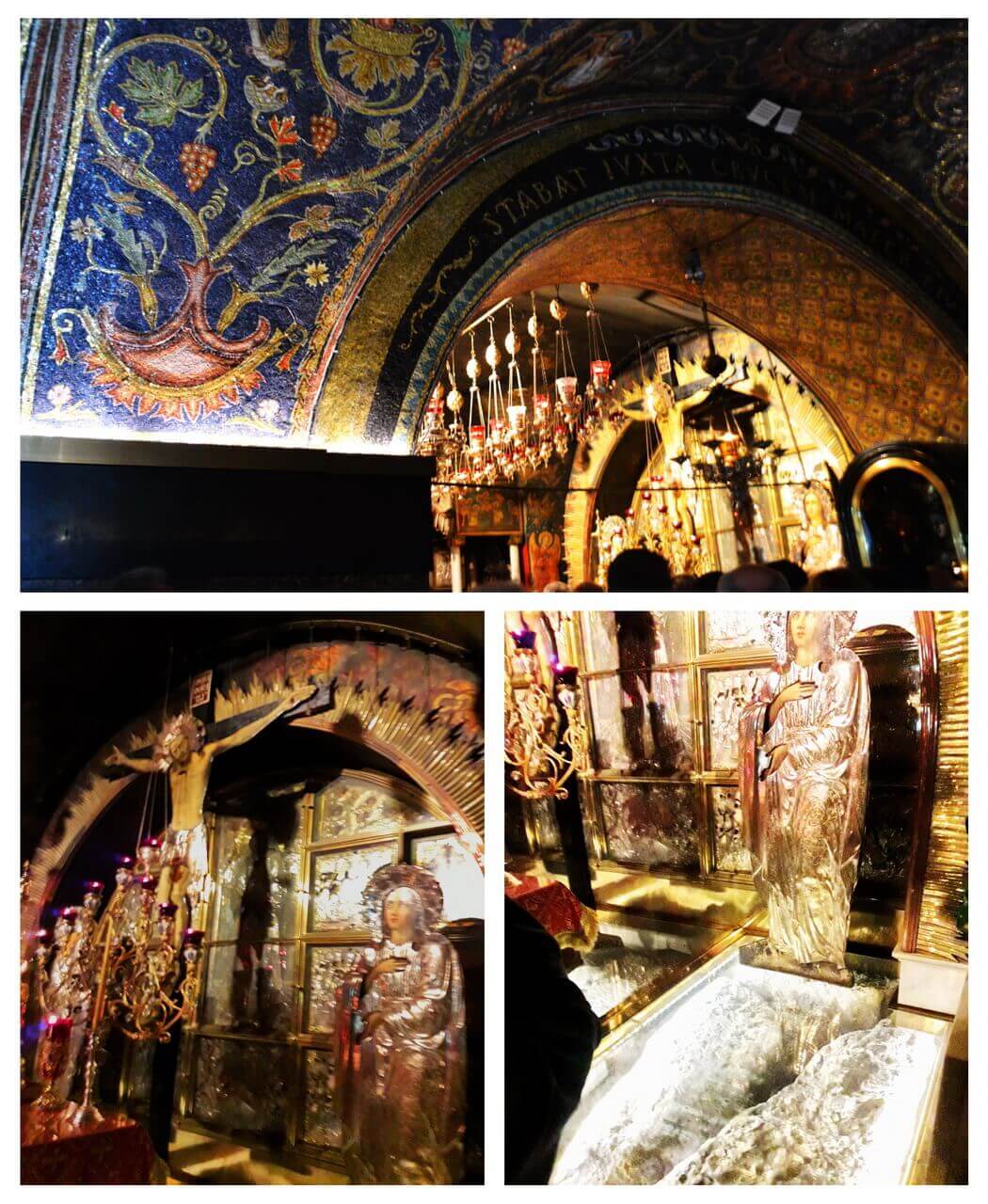
The Altar of the Crucifixion, with the rock of Calvary, encased in protective glass
The altar is at the place where the cross with the nailed Jesus once stood. It is the place of Jesus’ death, as well. All pilgrims go down on their knees and put their hands to reach through the hole in the rock where the cross was. Behind the Altar, there is a gold shining icon of Jesus on the cross and the Virgin Mary.
On the right side of the Altar, there is part of the cracked Golgotha rock, encased in protective glass. According to the New Testament, when Jesus gave up his spirit, “The earth shook, and the rocks split”.
The Lance of Longinus or the Spear of Destiny
Well, there is something that I would like to mention about Jesus’s last minutes.
According to beliefs, a Roman soldier known as Longinus stabbed Jesus in the ribs with a lance to make sure he was dead. The blood and water flowed from Jesus’s body, which was considered a miracle. In fact, the blood symbolises his humanity, and the water his divinity.
There are many replicas of this lance and various stories about where the original lance could be now. For example, it can be in the Vatican, under the dome of St. Peter’s Basilica, in the Imperial Treasury at the Hofburg Palace in Vienna, or even in Armenia. Actually, it became the Holy Lance, and it is believed that it holds sacred and magical powers. Well, it means that the person who possesses it has the power to rule the world.
XIII Station: Jesus is taken down from the cross
Actually, this station is the first thing you do when you enter the Church of the Holy Sepulchre. It is the Stone of Anointment.
According to tradition, Joseph of Arimathea and Nicodemus took Christ down from the cross. There were also the Virgin Mary, the mother of Jesus, and Mary Magdalene. The women helped them to anoint Jesus’ body with mira and oils and wrap it in shrouds, as was the Jewish custom for burial at that time.
This stone is yellow-dark pink, and you can feel the mild smell of the stone. I expected that its surface would be cold. But it wasn’t, maybe because of the oil, or maybe because of pilgrims who are praying and putting their hands on the stone. I don’t know, but you have a feeling of some strange kind of energy below your hands. Today’s marble stone was placed in 1810 to protect the original stone underneath.
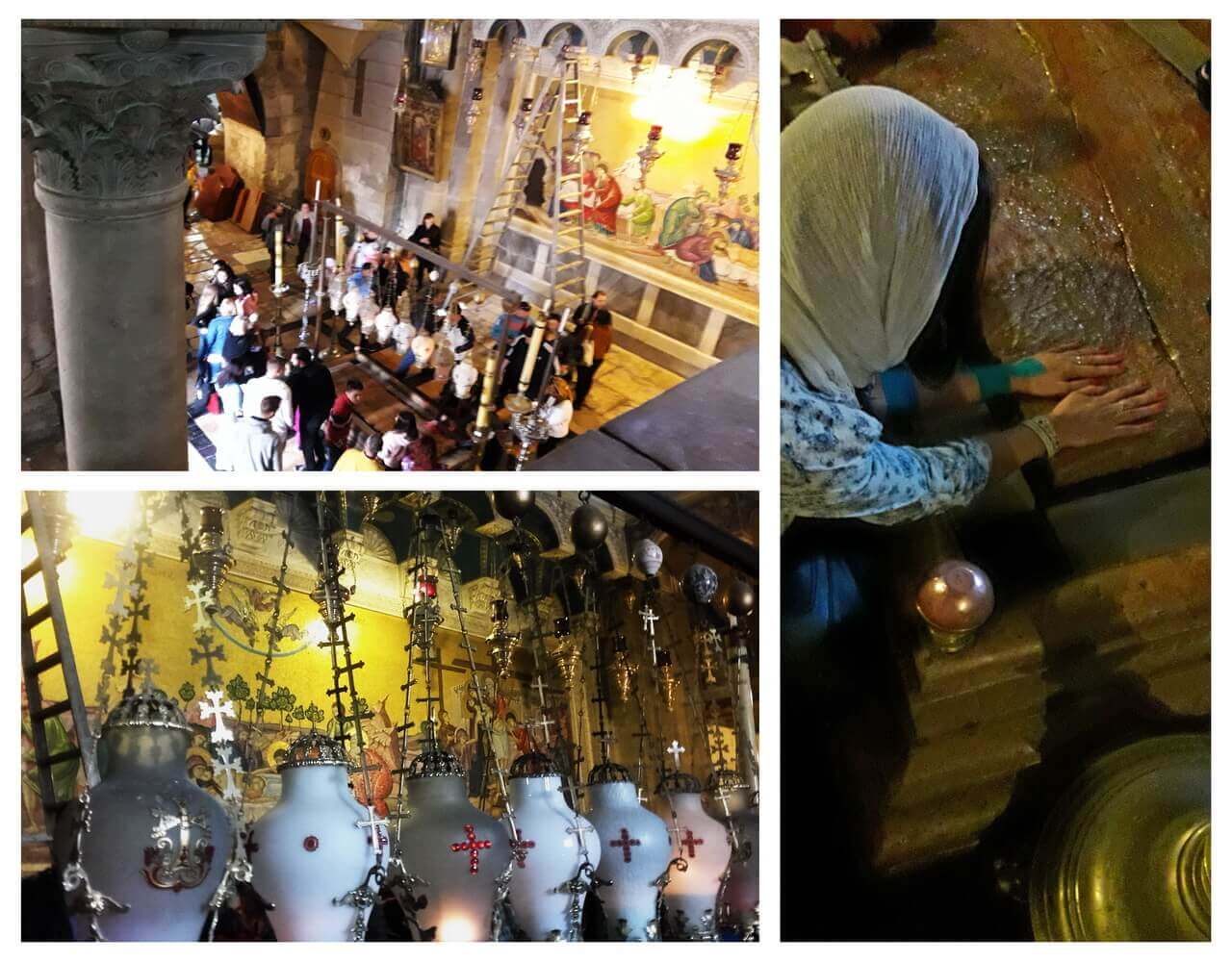
Jerusalem, The Stone of Anointing in the Church of the Holy Sepulchre
The eight lamps are hanging over the stone. They are contributed by Armenians, Copts, Greeks and Latins. And beside it, there is a huge wall mosaic that represents the events following the crucifixion.
XIV Station: The tomb of Jesus: Aedicule, the last station of Via Dolorosa
Jesus was buried in the cave which Joseph had prepared for himself. They put a large stone to close the cave, as was the custom at that time. One of its small pieces, known as the Angel’s Stone, could be seen there as well. Also, Roman soldiers guarded the tomb because of the fear that Jesus’s followers could steal the body.
The Aedicule
Around the remains of the cave, there is a small shrine inside the Church of the Holy Sepulchre and a huge Rotunda: The Aedicule.
In front of it, there are big candlesticks and chandeliers.
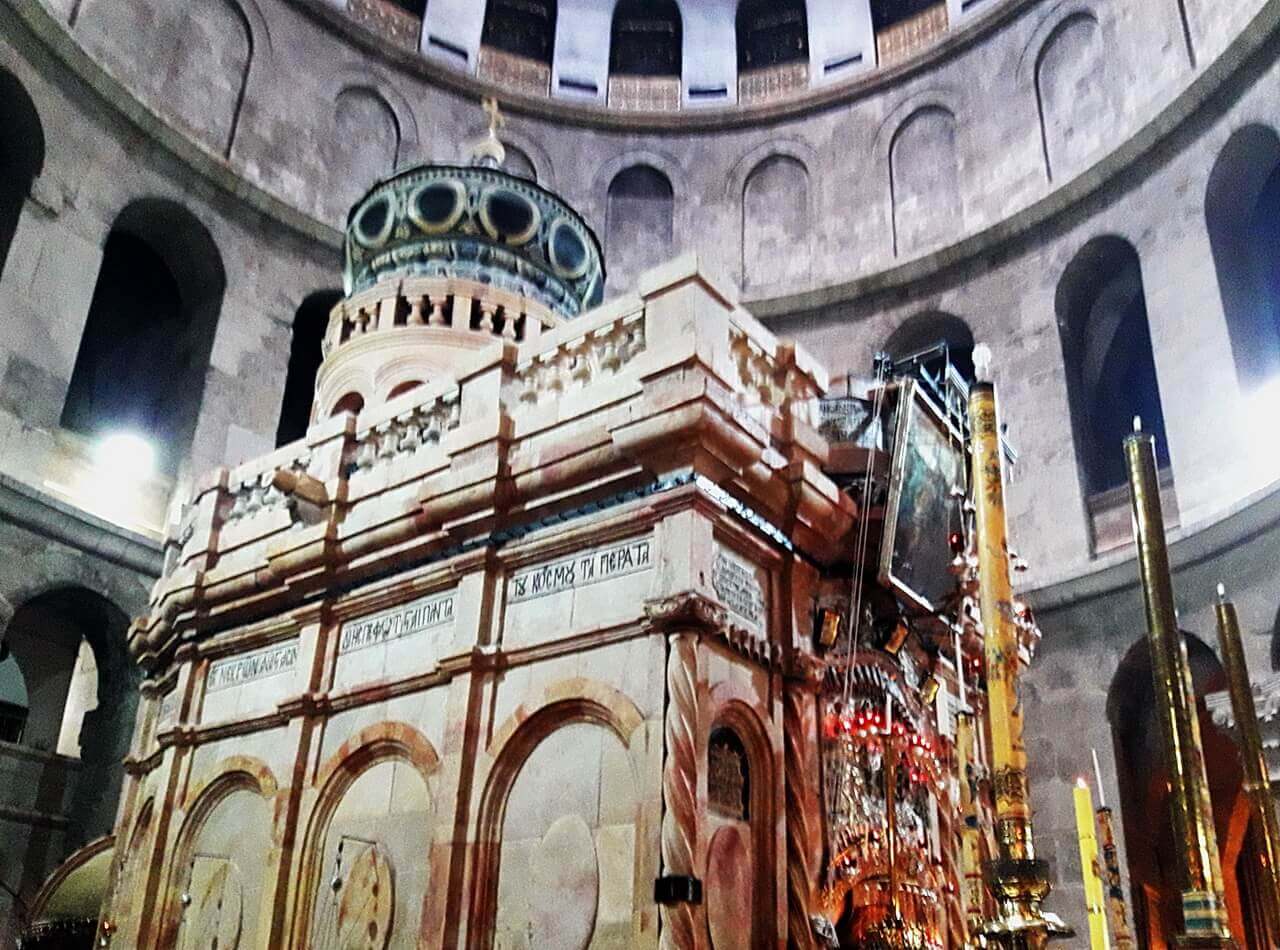
The Aedicule, The Church of the Holy Sepulchre
The chapel of the tomb is about 2×2 meters. One monk was inside it, and since there were many people still waiting in front of the chapel, we had only a few seconds to be there. On the right side, there is a marble part, which supposedly was the bench where Jesus’ body was placed.
The feelings are mixed. You are so excited because you are in the most sacred place of Christianity. On the other hand, you don’t have enough time to calm down and to be fully aware of the moment and this Holy place. So the tomb is empty.
According to Christian belief, he was exalted life as Christ and Lord on the third day after his crucifixion. And he was firstborn from the dead, ushering in the Kingdom of God.
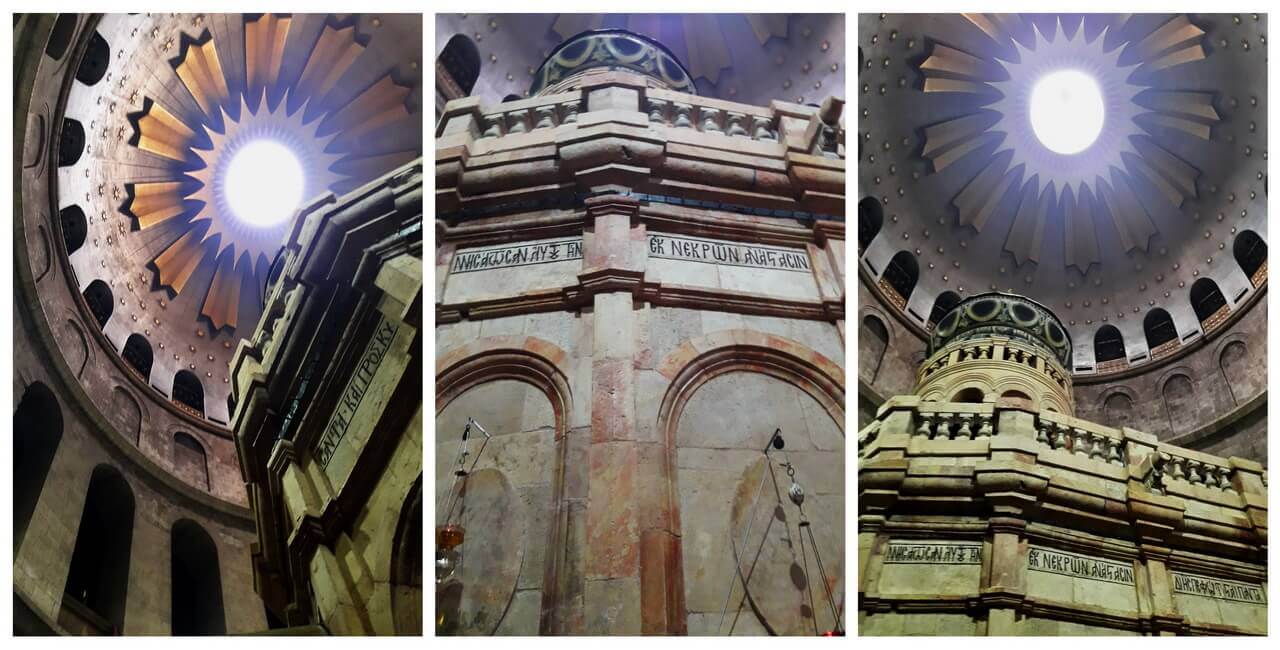
The Aedicule, The Church of the Holy Sepulchre
We waited about one hour to enter the Edicule, going around it with other pilgrims. But I can say that we were lucky to have an opportunity to enter the tomb. Just before Easter and our trip to Israel, the huge reconstruction ended in the spring of 2017. And we were there in the last days of March 2017 – amazing!
A few words about the Church of the Holy Sepulchre
The church is located a few steps from Muristan Square in the Christian quarter.
It was built under the rule of Roman emperor Constantine the Great in 335, on the former place of the temple of the goddess Aphrodite. Actually, his mother, St Helena, uncovered the place of Jesus’s crucifixion and restored a few important Christian sites. Among them are the Church of the Nativity in Bethlehem, the Church of Eleona on the Mount of Olives, and Saint Catherine’s Monastery in Sinai, Egypt, as well.
Well, this church has a long and very turbulent history. It was damaged and restored many times during the centuries and survived under the rules of the Neo-Persian Empire, Fatimid Caliphate, Byzantine Empire, Crusaders, Saladin, Ottomans, British, Jordan, and now is under Israeli rule. Definitely, it deserves a new story. The present look dates back to 1810.
Besides the Edicule and the Stone of Anointing, there is the Greek Orthodox main church, Catholicon, the Crusader-era Armenian Chapel of St. Helena, the Armenian monastery, the Syriac Chapel, Franciscan Chapels, the Coptic Chapel, the Prison of Christ, and several various chapels.
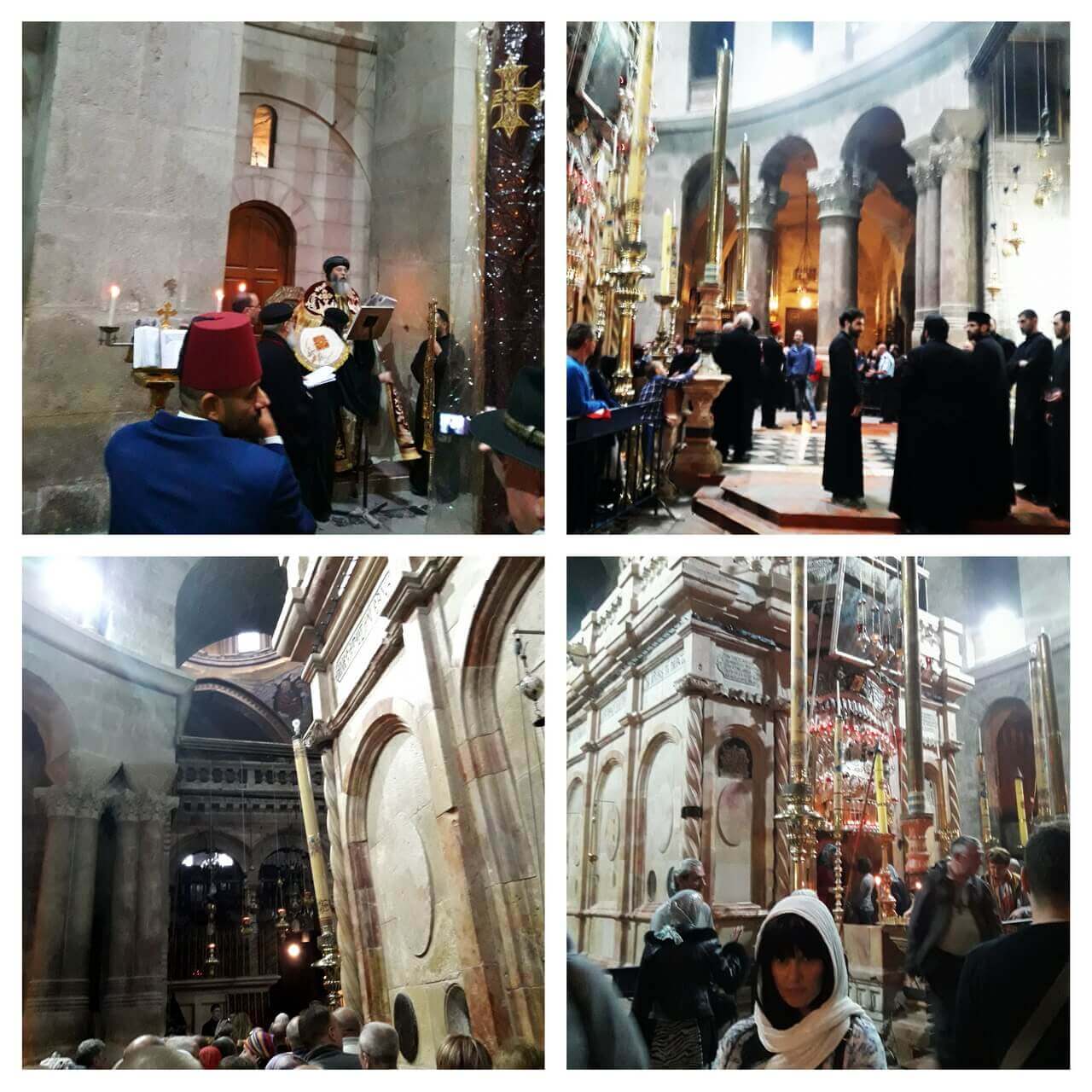
Inside the Church of the Holy Sepulchre
Take a brief look at some interesting facts about the Church of the Holy Sepulchre
- The Church property is shared among the Greek Orthodox Church, Roman Catholic Church and Armenian Apostolic Church. Also, there are the Coptic Orthodox Church, the Syriac Orthodox Church and the Ethiopian Orthodox Church.
- It is the main headquarters of the Greek Orthodox Patriarch of Jerusalem.
- The Greek Orthodox Patriarchate has been the official representative of the entire Christian community since 1463.
- Statutes of property and regulations concerning the roles of churches are regulated by Status Quo, a decree of Ottoman sultan Osman III from 1757. According to the decree, no changes could be made without consensus from all six Christian communities.
- As a result of the Status Quo, a ladder placed before 1757 on the church façade remains in the same place even today.
- Two Muslim families, Nusseibah and Judeh, ceremoniously unlock the Church every morning and lock it every night.
- Every year, on a Great Saturday, the day before Orthodox Easter, there is a ceremony known as the Holy Fire, as a symbol of the resurrection of Jesus. And the holy fire is shown only to the Orthodox Patriarch of Jerusalem.
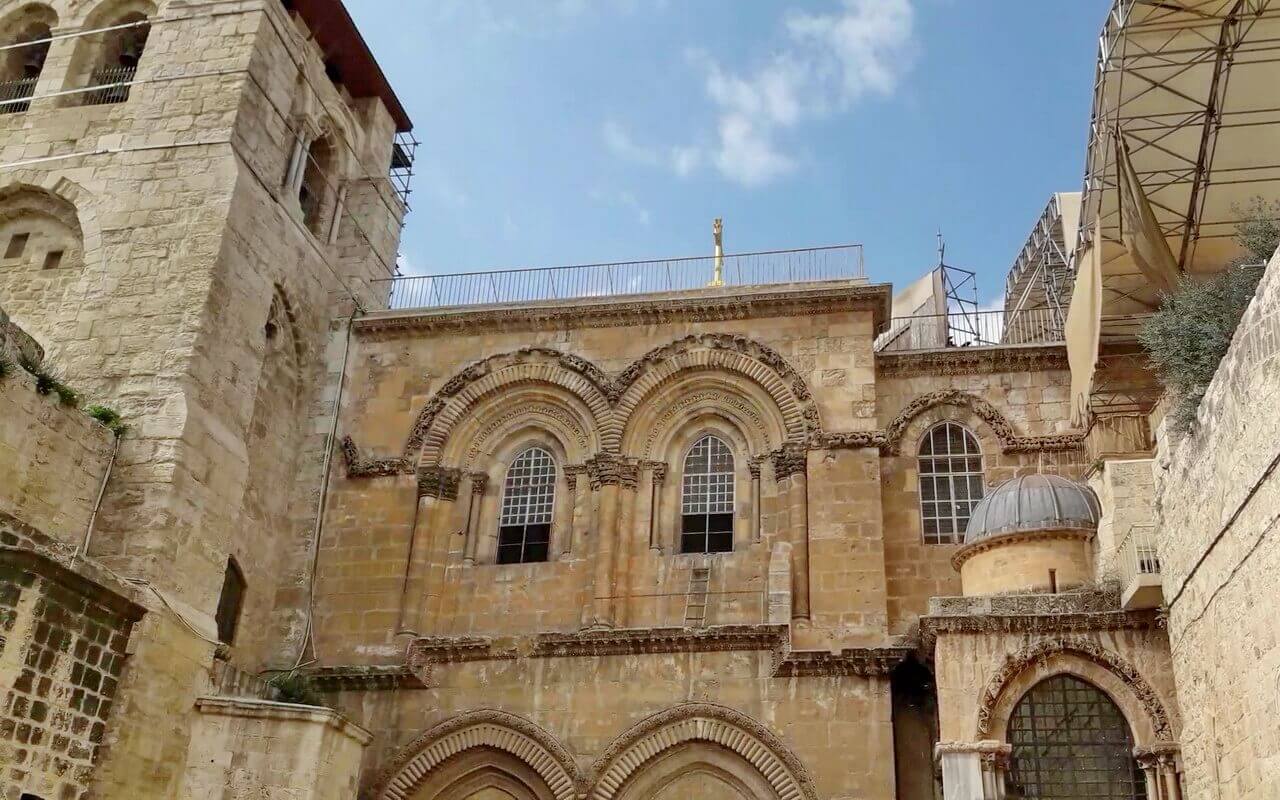
Doors and ladder on the Church of the Holy Sepulchre
Pilgrim Certificate
So when you follow Jesus’s steps around the streets of Jerusalem and visit some places in the Holy Land, you can get the Pilgrim Certificate.
Usually, if you travel with an organised group, your guide will arrange for this certificate to be issued by the Ministry of Tourism of Israel. Also, the Greek Patriarchate issued “gramata”, a kind of confirmation of the adoration of Christ’s tomb and the Holy Land.
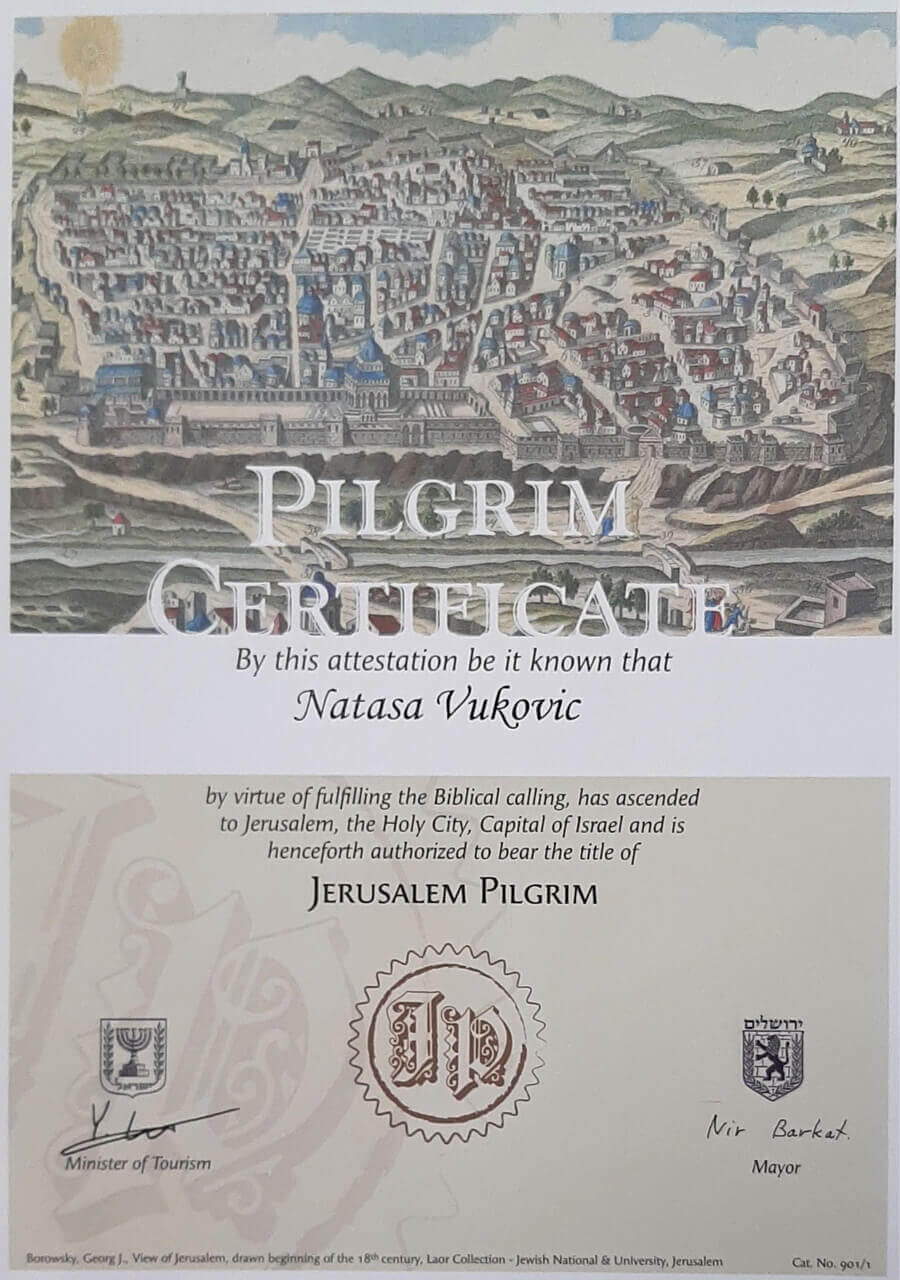
Jerusalem Pilgrim certificate: Natasa Vukovic
“Hajji” title
And there is something more interesting.
Christians who go on a pilgrimage to the Holy Land, visit a specific number of saints, fulfil a seven-day fast, receive communion in Jerusalem, obtain the consent of the Orthodox patriarch, the patriarchate and his clergyman, can get the title “Hajji” or “Hadzi”. It can be put in front of the pilgrim’s first name and his descendants in front of their surname. Originally, it was used for Muslims who visited Mecca, and then in Christianity. Actually, it means “one who was at the worship”.
And don’t forget to light a bundle of 33 candles, which represent the number of Jesus’ age.
You can take it home and buy the candles for your family, friends or close people, as a sign of peace and happiness. For example, usually in Serbia, with these tiny candles, people light candles for the Serbian family fest – “slava”. Also, they could be lit in tough times for good health and while praying. Although four years have passed since we visited Jerusalem, the candles still smell wonderful, just as the first time I lit them in the Church of the Holy Sepulchre.
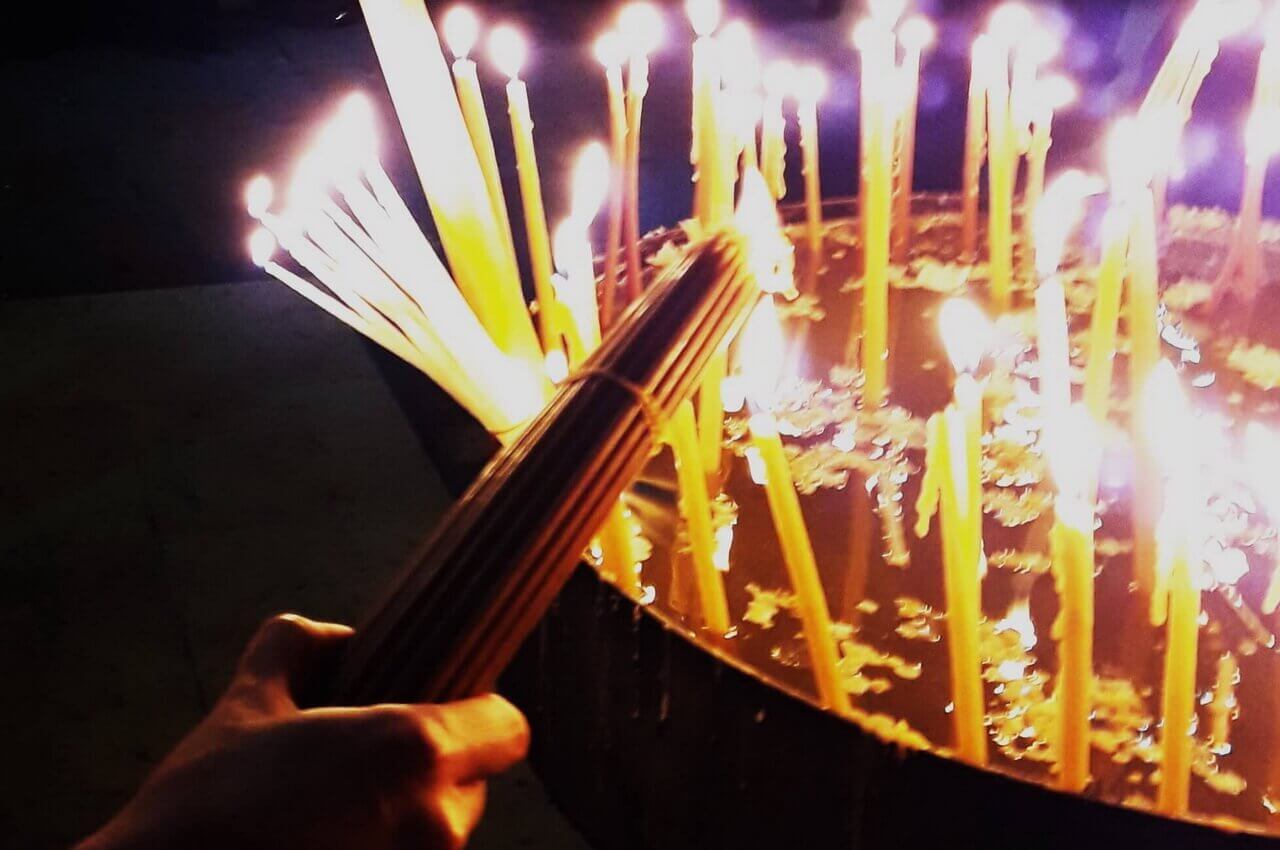
Pilgrim candles in the Church of the Holy Sepulchre
Via Dolorosa and pilgrimage to Jerusalem
Visiting Jerusalem and the Via Dolorosa is an amazing journey.
Regardless of whether you come as a tourist or for worship, you will certainly remember this journey all your life.
Amazing history remains, churches and shrines will affect all your senses.
The energy of the crowd, the city, and holy places will take you to another world.
Maybe you will get Jerusalem syndrome and have enlightenment.
And maybe you will find what you are looking for.
It is only up to you to choose what you want and what you believe.
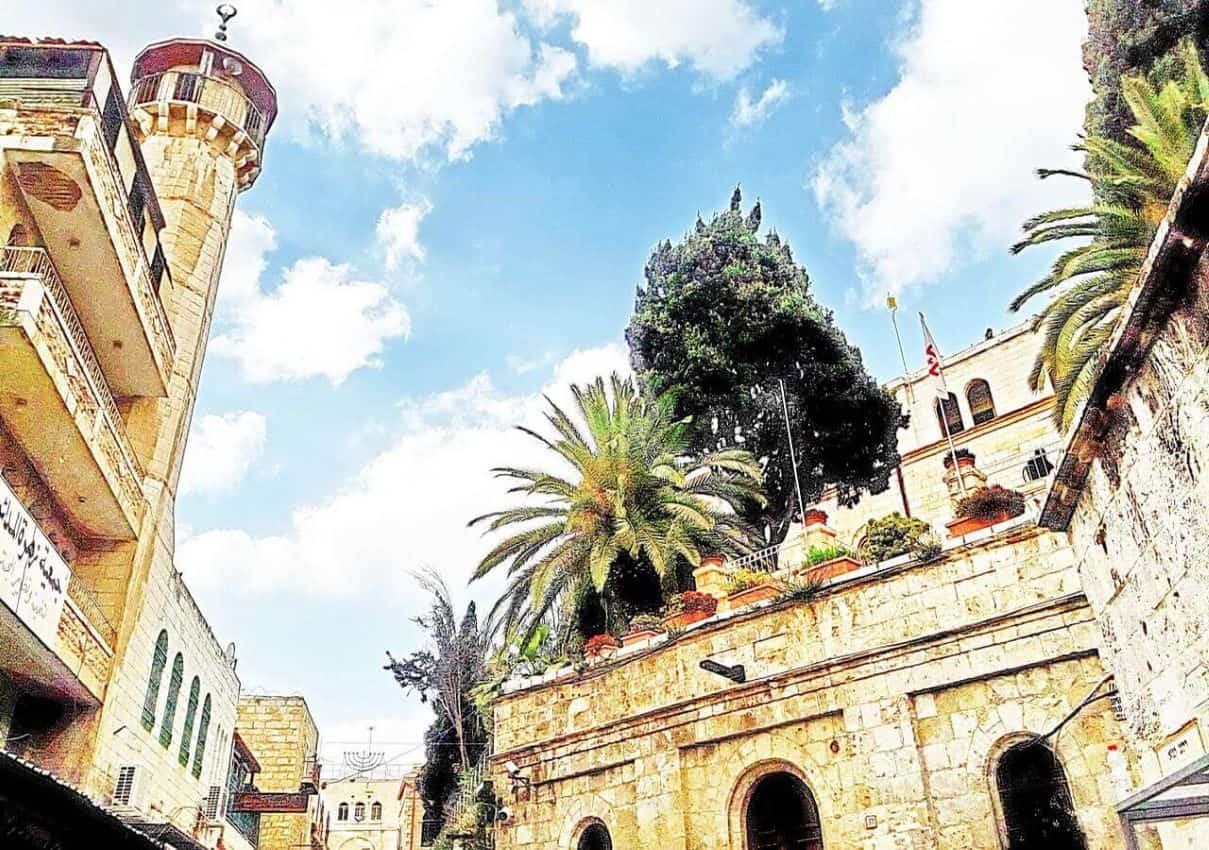
Strolling around the Old Town of Jerusalem
 www.nataniatravel.com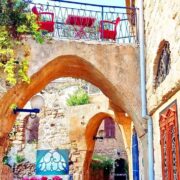

Trackbacks & Pingbacks
[…] about Via Dolorosa you can read here, and more about Jerusalem, you can read […]
[…] 14 stations of Via Dolorosa, the path that Jesus walked on the way to his crucifixion. You can read here more about Via […]
Leave a Reply
Want to join the discussion?Feel free to contribute!