
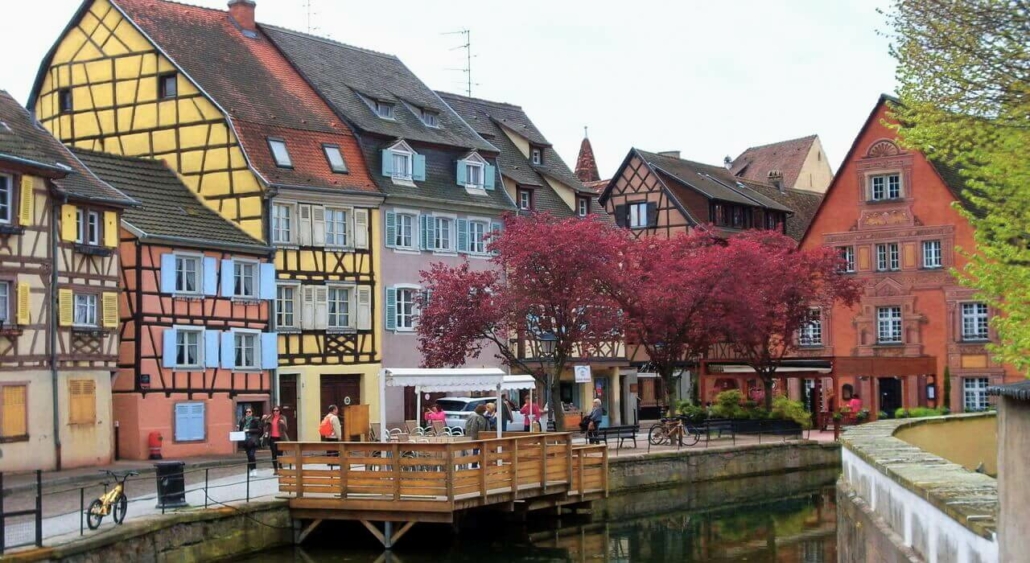
Colmar, the fairy tale town in Alsace valley
Colmar is a small town from a fairy tale.
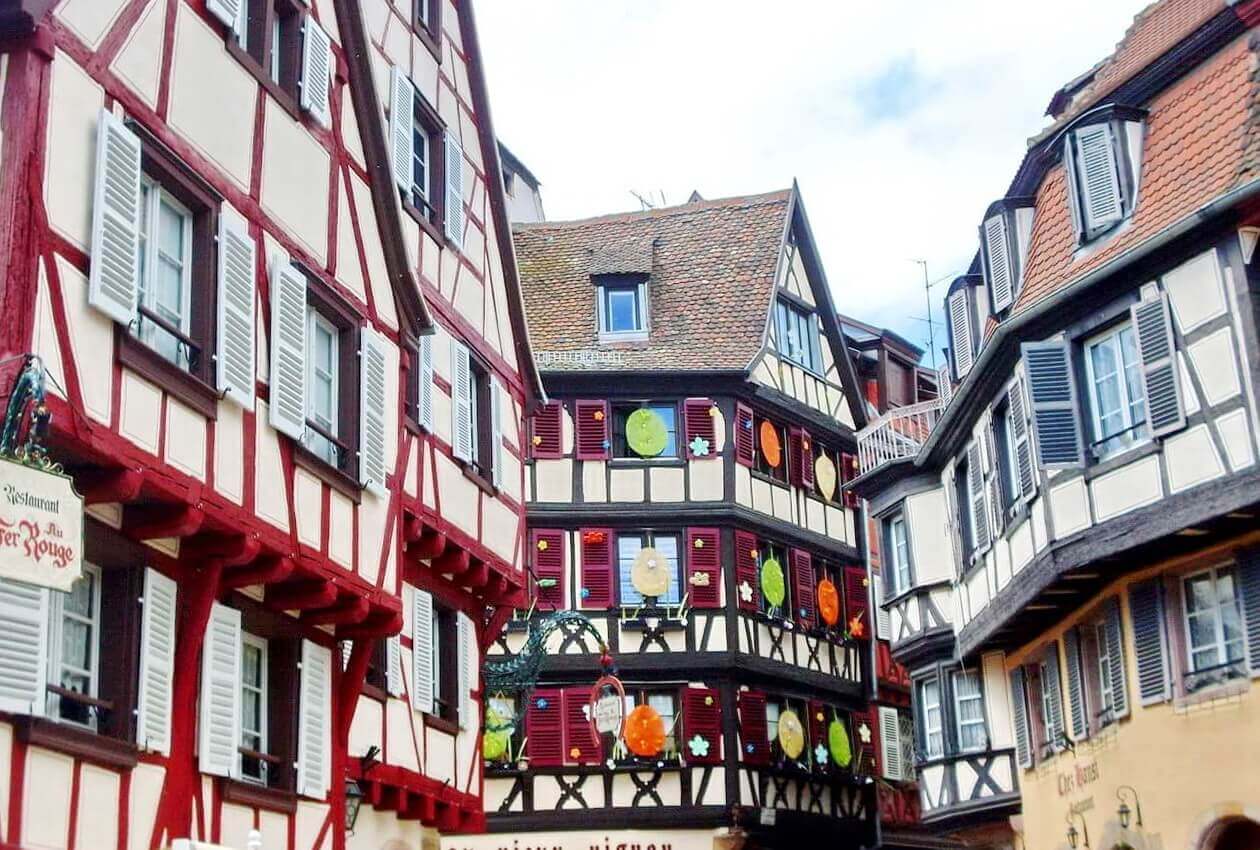
The houses in the old city of Colmar
When you step into its old part, you only want to get lost among the winding alleyways and colourful houses.
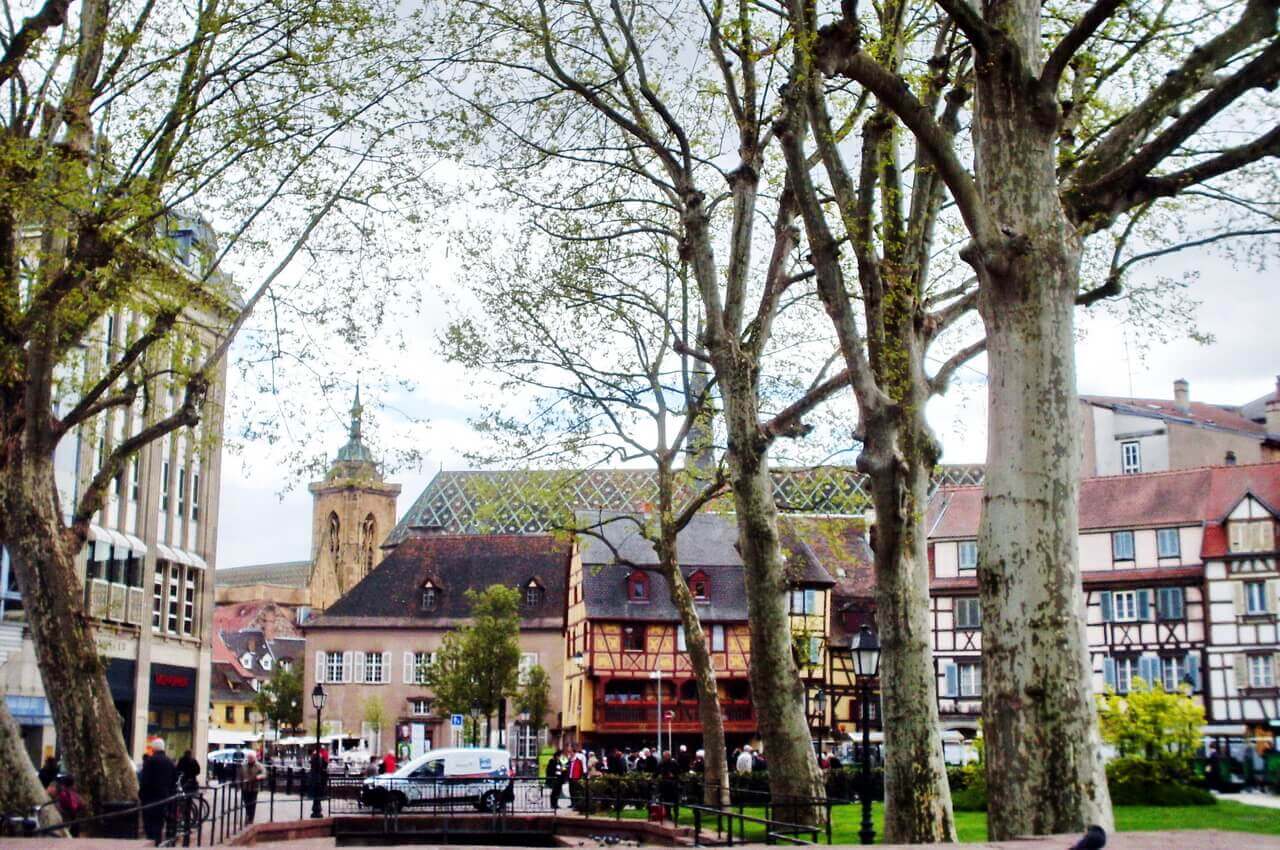
Colmar
Each of them is painted in a different colour, with flowers on the windows and various decorations. It is additionally decorated during the Christmas holiday, which makes it even more interesting.
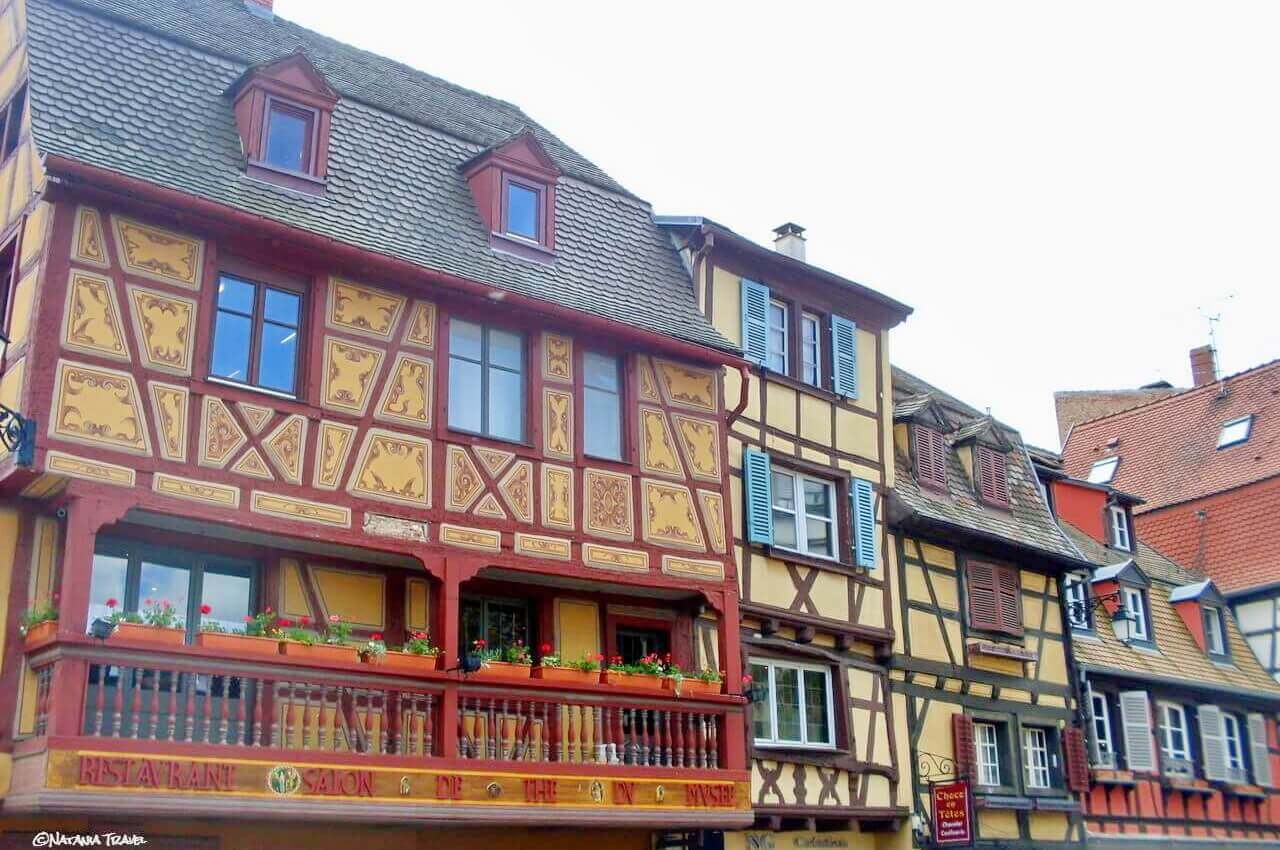
The restaurants and houses in Colmar, Alsace
We spent a few hours in Colmar during our journey through the Alsace and Schwarzwald regions with the Filip travel agency, in April 2016. Well, it was a very pleasant walk around the houses, bars, and shops with food, vines, and souvenirs.
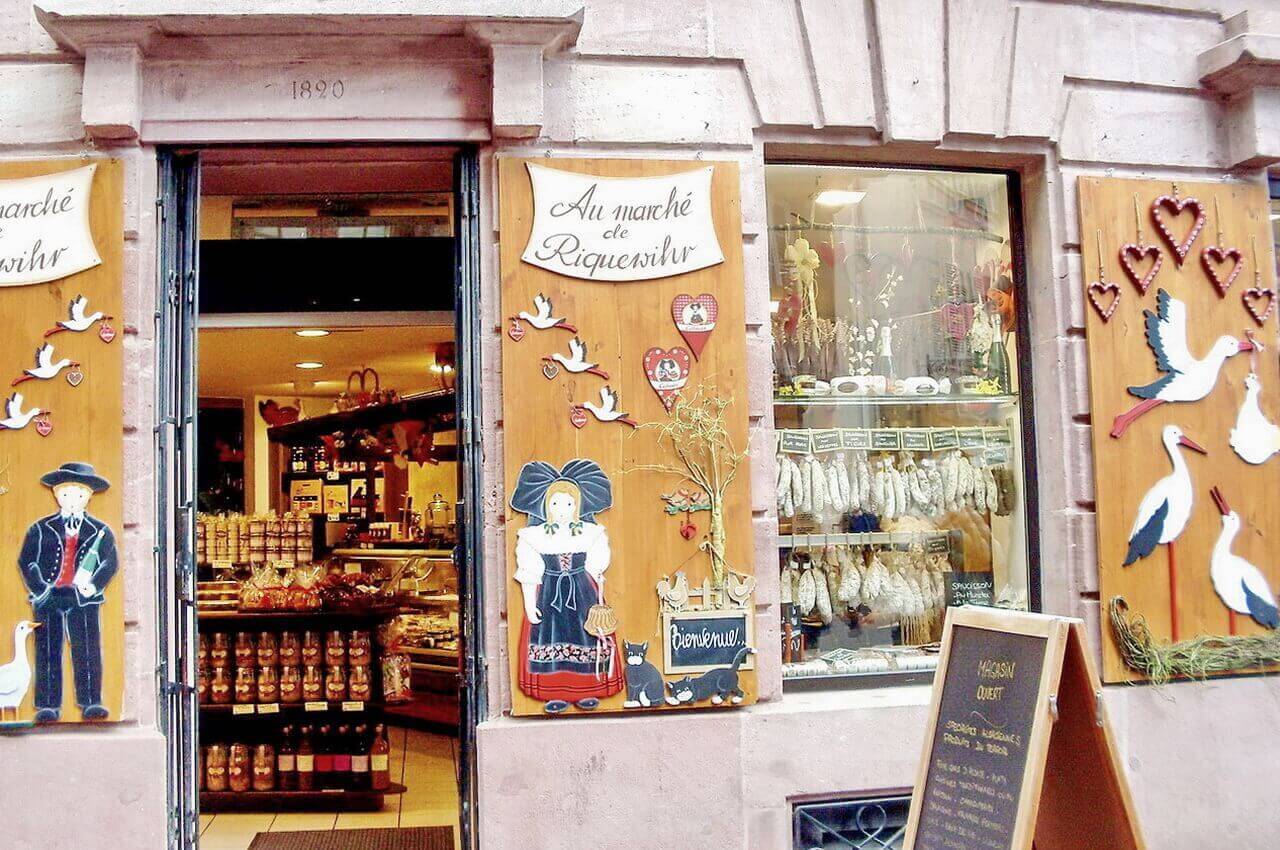
Old traditional shop with local products in Colmar
📌 Where is Colmar, and how to get there
Colmar is located in northeastern France, at the foot of the Vosges mountains, on the river Lauch, which is connected with the River Rhine by a canal. It belongs to the Alsace region, surrounded by Switzerland to the south and Germany to the east. Despite the German and Swiss influence, you will be simply impressed by the uniqueness of Colmar.
It is 70 km from Strasbourg and a few km from the former German border. It can be easily reached by car or by bus, or you can join tours organised by travel agencies.
Colmar can also be reached by train because it is connected with the largest French cities and European cities as well.
And it can be reached by plane. About 70 km from Colmar, there are two international airports: Strasbourg and EuroAirport Basel Mulhouse Freiburg.
History of Colmar
The first time Colmar was mentioned in a chronicle of the Saxon wars was during the rule of Charlemagne, Charles the Great, emperor of the New Western Roman Empire (800–814). Then, in 1226, Colmar got the status of an imperial town by the Holy Roman Emperor Frederick II.
During the Thirty Years’ War, in 1632, it was occupied by Sweden, but three years later it was conquered by Louis IV, king of France. After the Franco-Prussian War, Colmar was annexed and was part of Germany from 1871 to 1919, then returned to France, and again annexed to Nazi Germany in 1940. And finally, in 1945, Colmar was again under French control.
Today, Colmar has about 70,000 inhabitants.
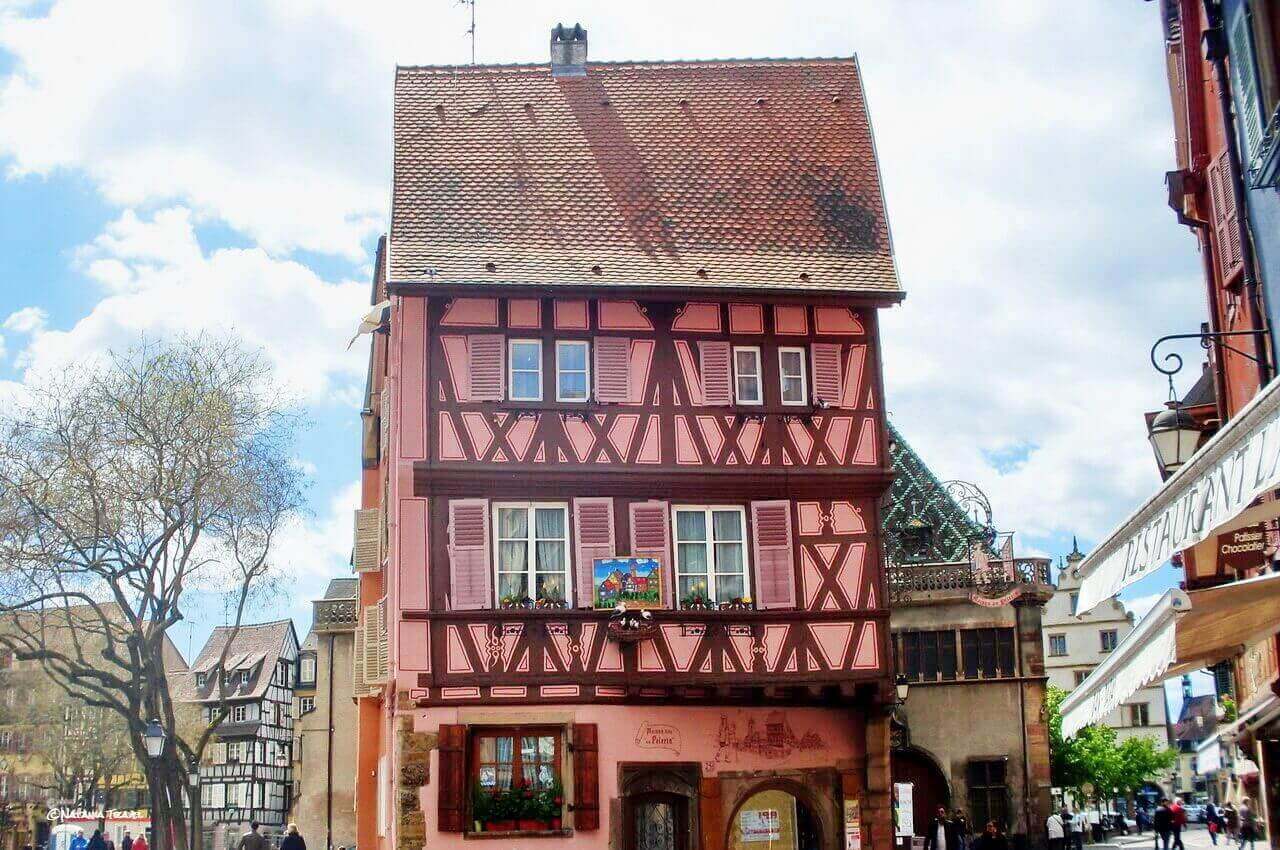
The fairy tale house in Colmar
What to see in Colmar
The town is filled with colourful houses, small squares, pedestrian bridges, and canals. Therefore, it is called “the little Venice“.
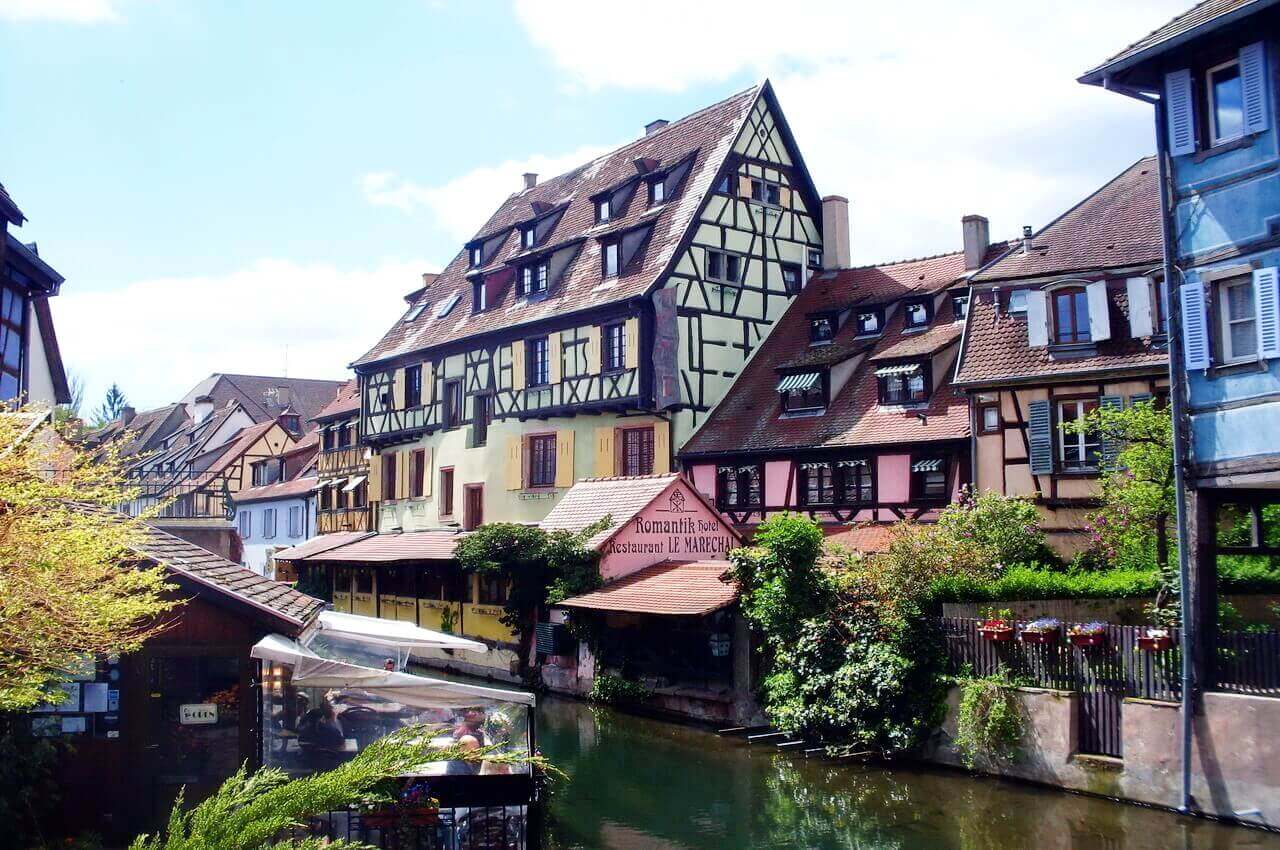
Colmar, the canal in Little Venice
Generally, it takes one day to walk around and see the town. And to try some Alsatian food and wines, as well. So you can take a guided walking tour or wander the town on your own. Also, you can take a boat tour (the ticket for adults is 6 EUR and takes 30 minutes), ride a bike, or explore the city by tourist train (the ticket for adults is 6.5 EUR and takes approx. 35 minutes).
The great way to visit all important sites is to take the Colmar City Pass (adult pass is 35 EUR and 9-17 pass is 30 EUR), which gives unlimited access to the 5 museums and the Dominican Church, and one trip by boat and the little green tourist train in one week.
But if you have limited time, as we had, go for a walk and explore this charming city on foot.
The unique houses of Colmar City
Walking down the cobblestone streets, you can find half-timbered houses on every corner. As I have mentioned at the beginning, the houses are painted in different colours, one next to the other, in lines, making a wonderful view.
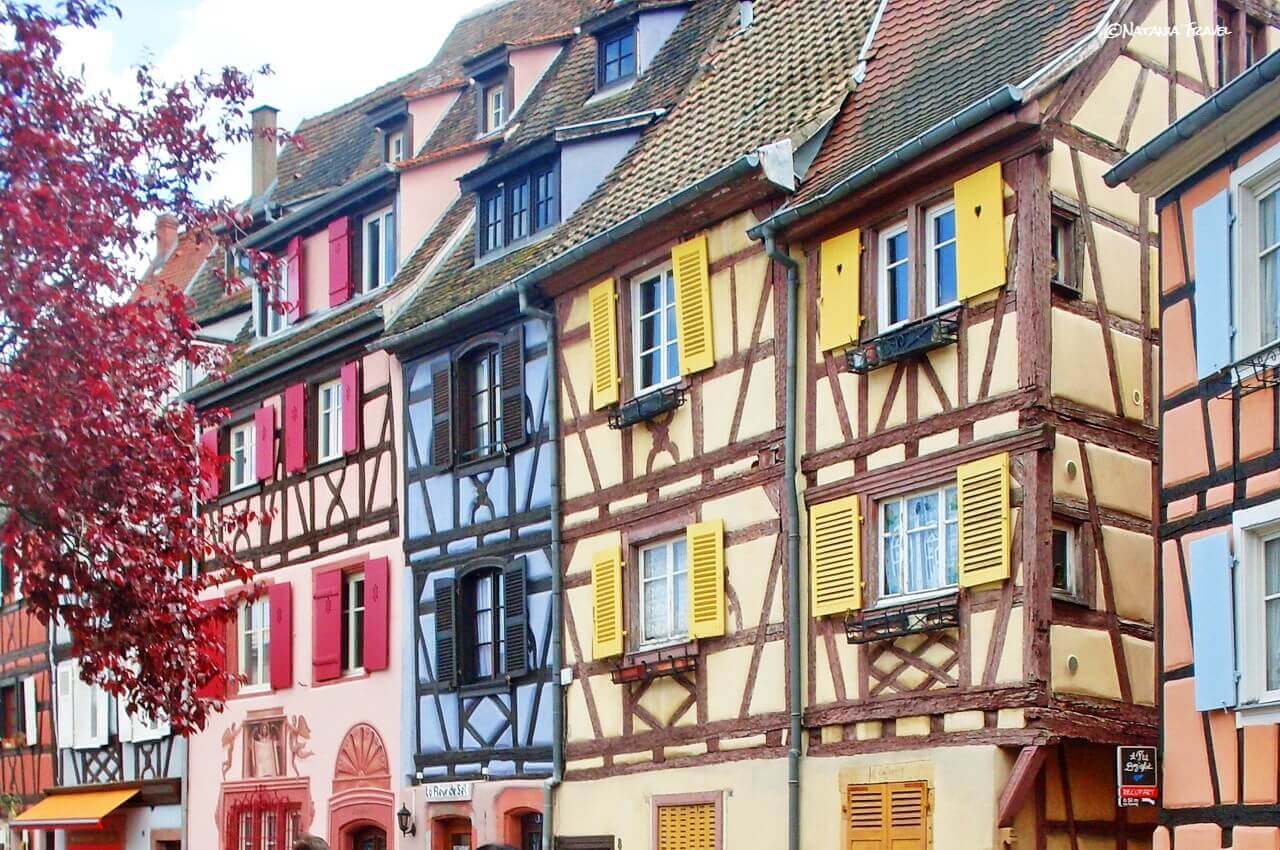
Little Venice, Tanner’s district
But they do not belong to traditional French architecture. These half-timbered houses could be found only in the northeastern part of France, and in Germany. The houses were built in France in the period from the late 15th century to the early 19th century, with some little changes over the years. Usually, they were made from stone and wood, because these regions are abundant in. Some of them are the symbols of the city, such as:
- Adolf house, the oldest house in Colmar, built in 1350.
- Pfister House (Maison Pfister), built in 1537. The house got its name from the Pfister family, who bought the house and lived there from 1841 to 1892. It has a long wooden gallery, painted murals, a two-storey corner oriel, and a turret.
- House of the Heads (La Maison des Tetes) is from the 17th century, in the German Renaissance style. It has a 3-storey oriel and interesting details on its façade: 106 heads or masks. It was restored in 2012, and today it is a 4-star hotel and gourmet restaurant.
The Koïfhus house (Place de l’Ancienne Douane)
One of the most important buildings is the Koïfhus or the Old Custom-house.
It is the oldest public building in the city, built between 1433 and 1480. The ground floor was used as the warehouse for the deposit and transit of all imported and exported goods. The first floor was a place for trade meetings and the place of the Chamber of Commerce and Industry from 1870 to 1930. The roof is covered with glazed tiles.
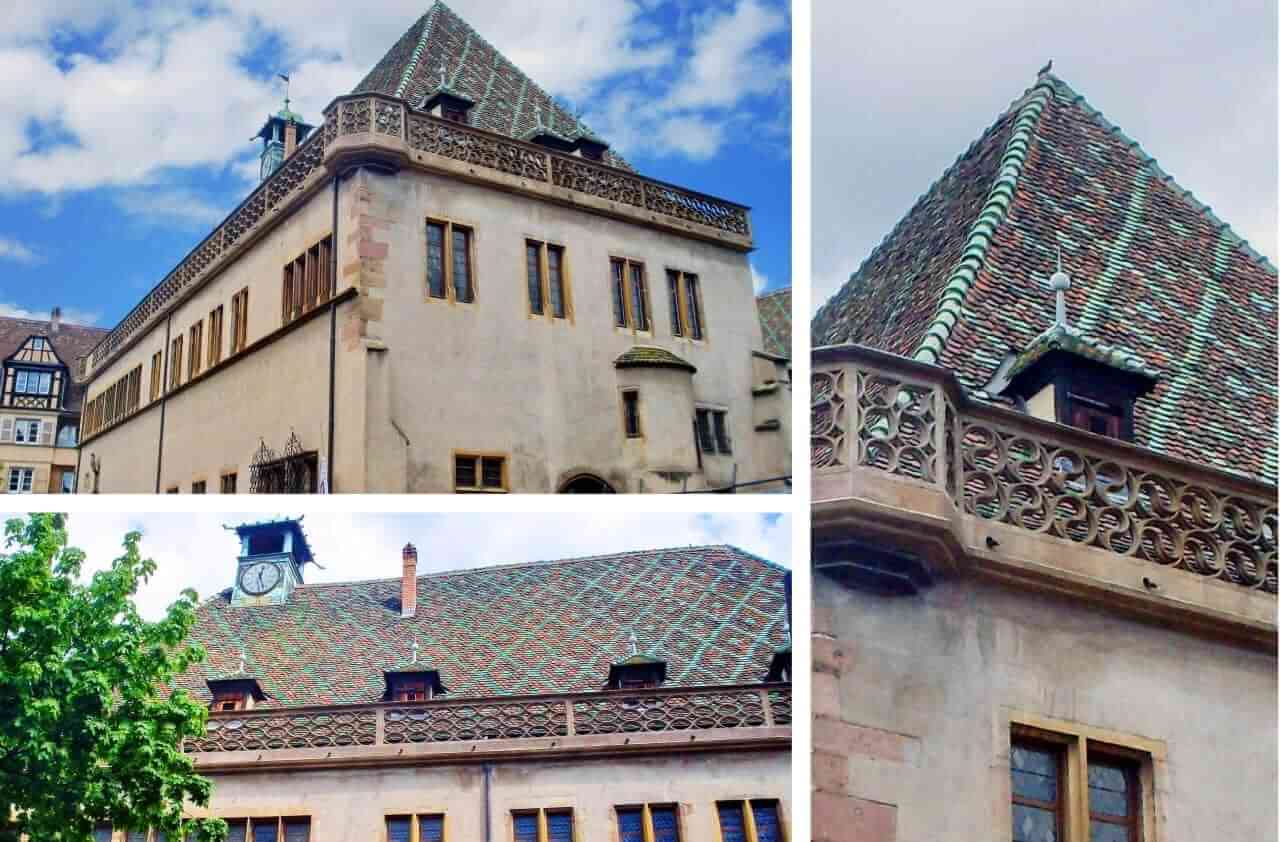
Colmar, Place de l’Ancienne Douane, Koïfhs house
Today, many events and public activities take place here, and a part of the house was converted into a restaurant. So this former customs house had a huge role in the economic and political life of Colmar.
Market Hall (Marche Couvert)
Market Hall is located near the Little Venice district, built in 1865. This orange-red brick building was completely covered and renovated in 2010. Today, it is the place where you can find local products, fruit, vegetables, cheese, fish, and meat, or find refreshments in a restaurant and bar.
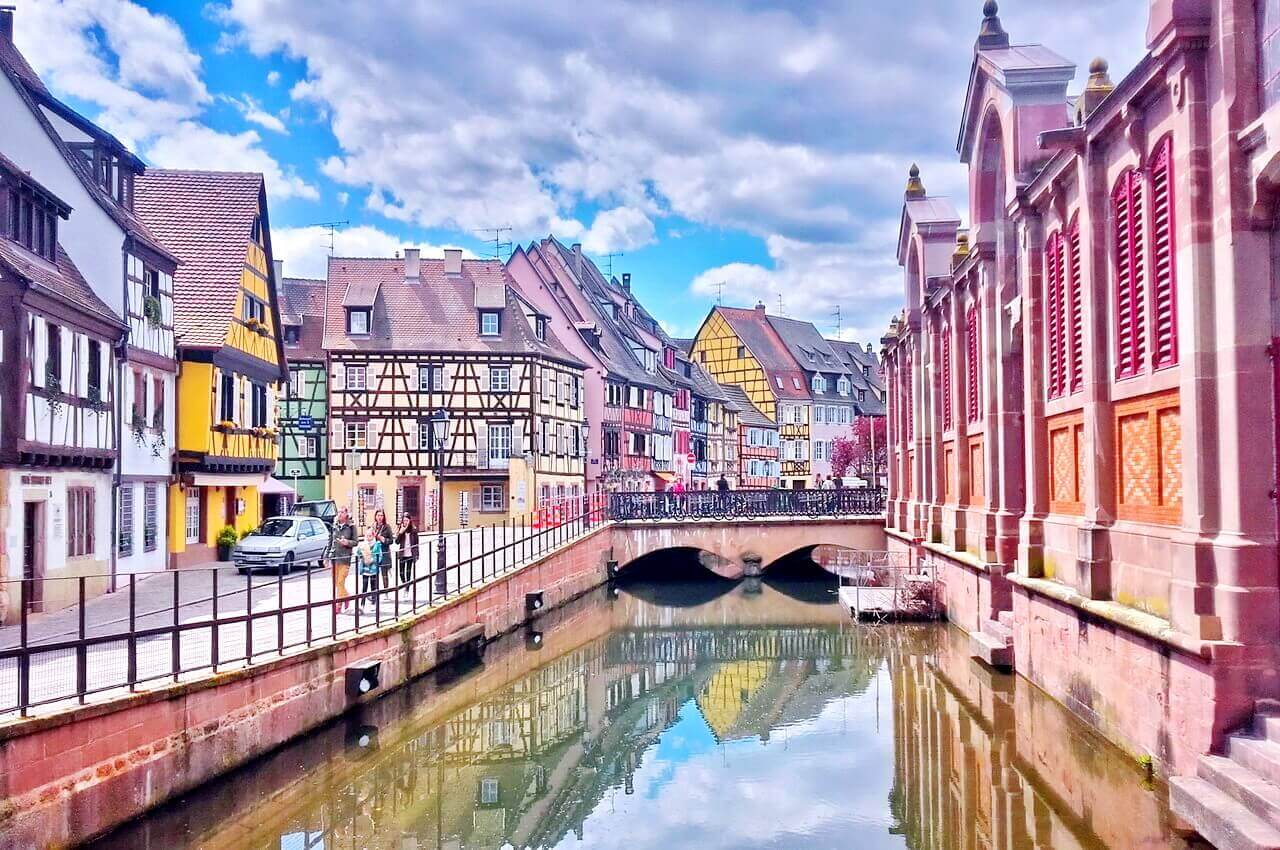
Colourful Little Venice
The Little Venice (La Petite Venise) in Colmar
Well, this is the most photographed spot in the town of Colmar 🙂
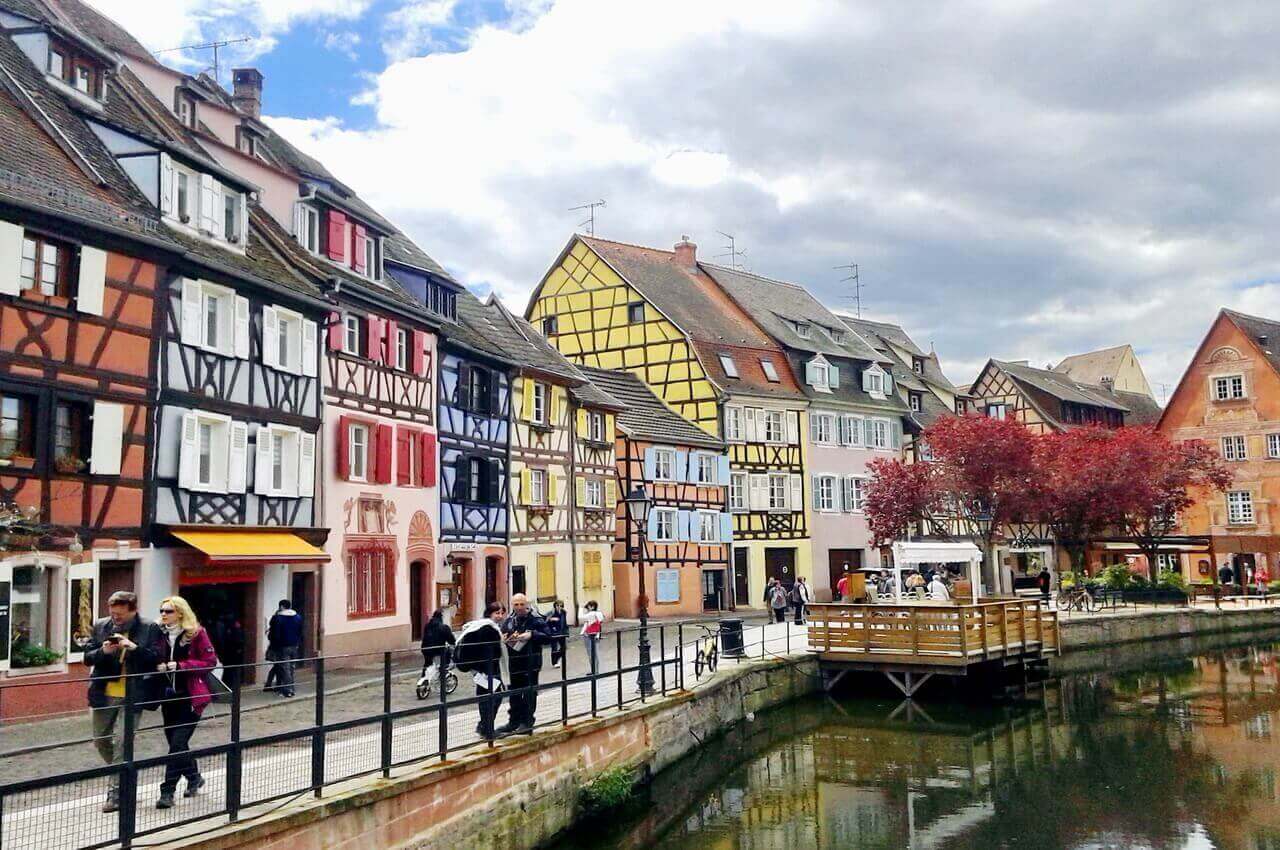
Colmar, Little Venice
Well, Little Venice is a postcard picture view. All around the canal of the Lauch River, there are beautiful and colourful houses.
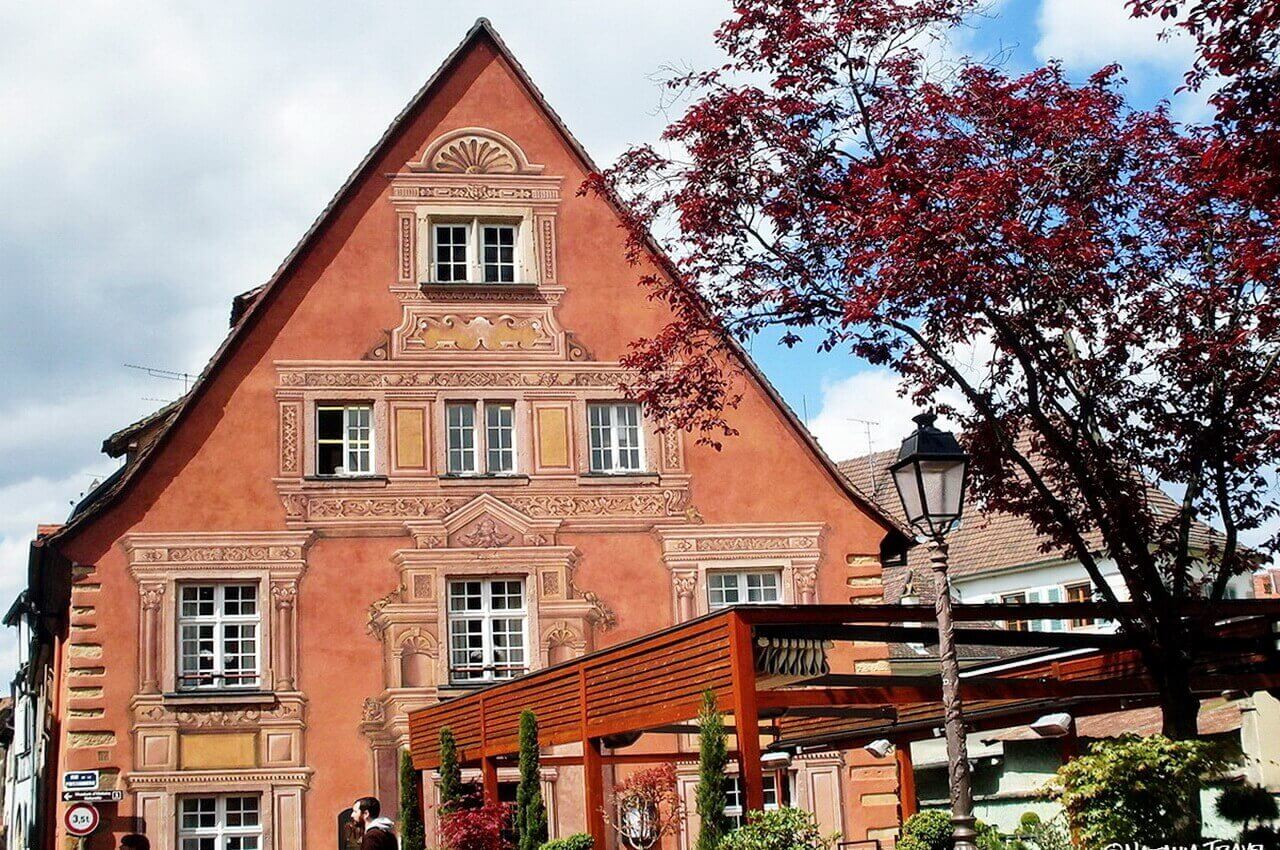
Colmar, Little Venice
So, in the past, each colour on the house was a symbol of the owner’s profession. For example, the white colour was for bakers, yellow for cheese-makers, and green was for gardeners.
In Little Venice, there is the Fishmonger’s district, known because of the professional fishermen and fishmongers who live in Colmar. Their houses were painted blue. This part was destroyed in 1706 by a huge fire and then renovated in the period from 1978 to 1981.
There is also Tanner’s district (Rue des Tanneurs), which dates from the 17th and 18th centuries. It got this name because of the tanners who lived and worked there. Usually, they dried the animal skins on the upper floors of their houses.
Also, you can find the restaurant Brasserie des Tanneurs there. Well, I think that this restaurant is the most decorated house in Colmar 🙂
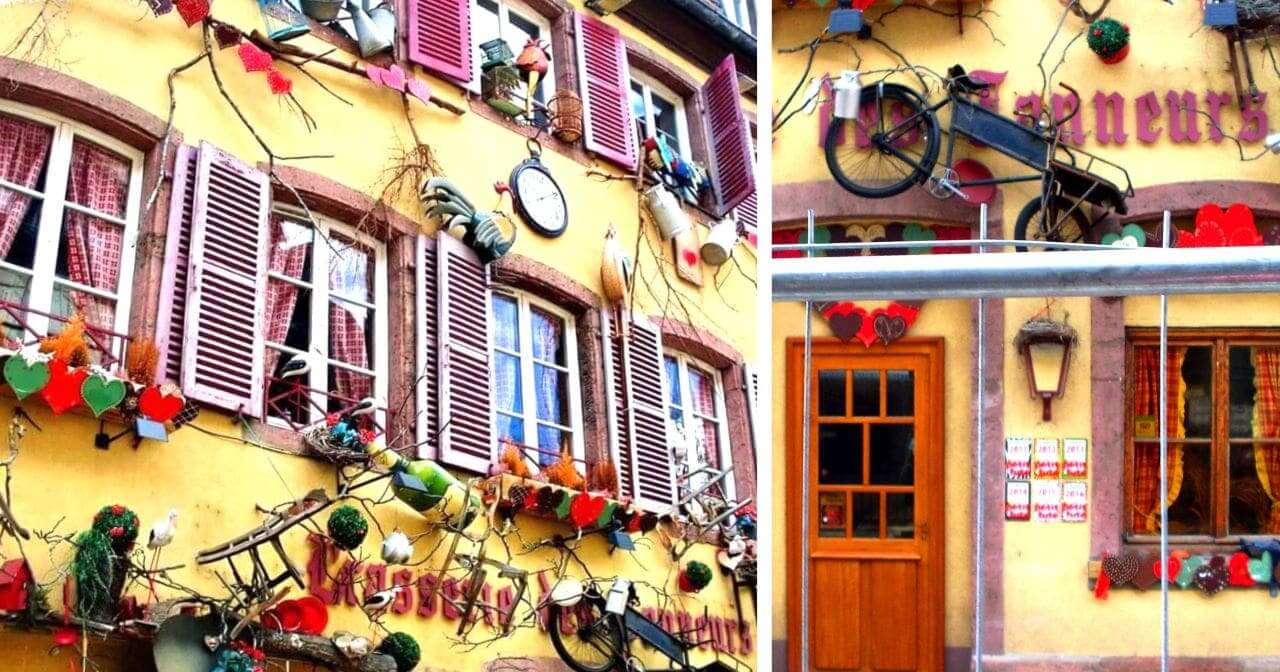
Brasserie des Tanneurs Restaurant
However, there is something else that impressed me greatly in Colmar.
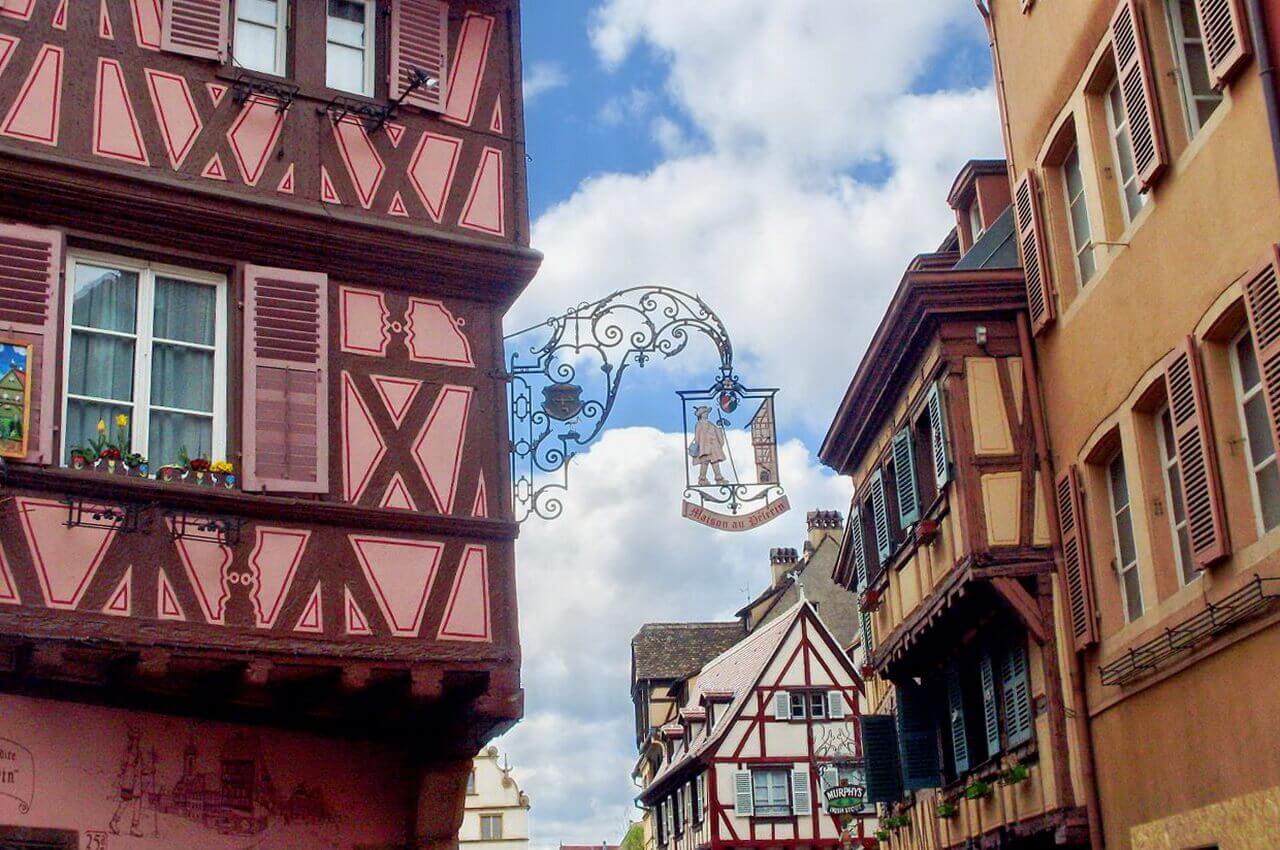
Colmar, the house with the mark
Various signs indicate that a certain activity is being held in houses, such as hotels, apartments, restaurants, and shops. And they look adorable!
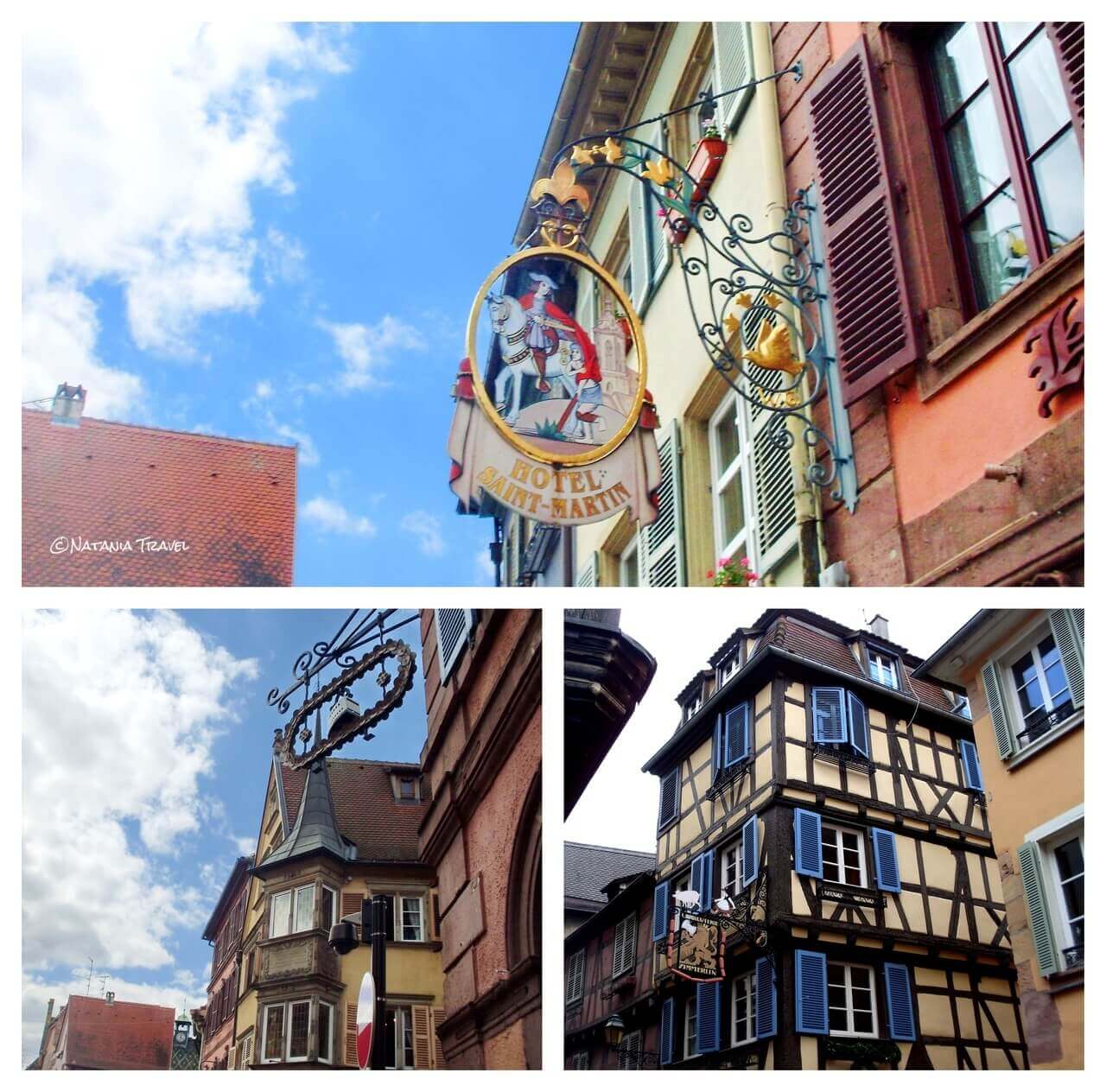
The houses with the different signs in Colmar
Check out apartments and hotels in Colmar here 👇
Frédéric Bartholdi
Close to the canal in Little Venice, there is a square, Place des Six Montagnes Noires (the Six Black Mountains). Once, it was used as a place of accommodation for distinguished visitors. There you can find the Roesselmann fountain, made by the sculptor Frédéric Bartholdi in 1888.
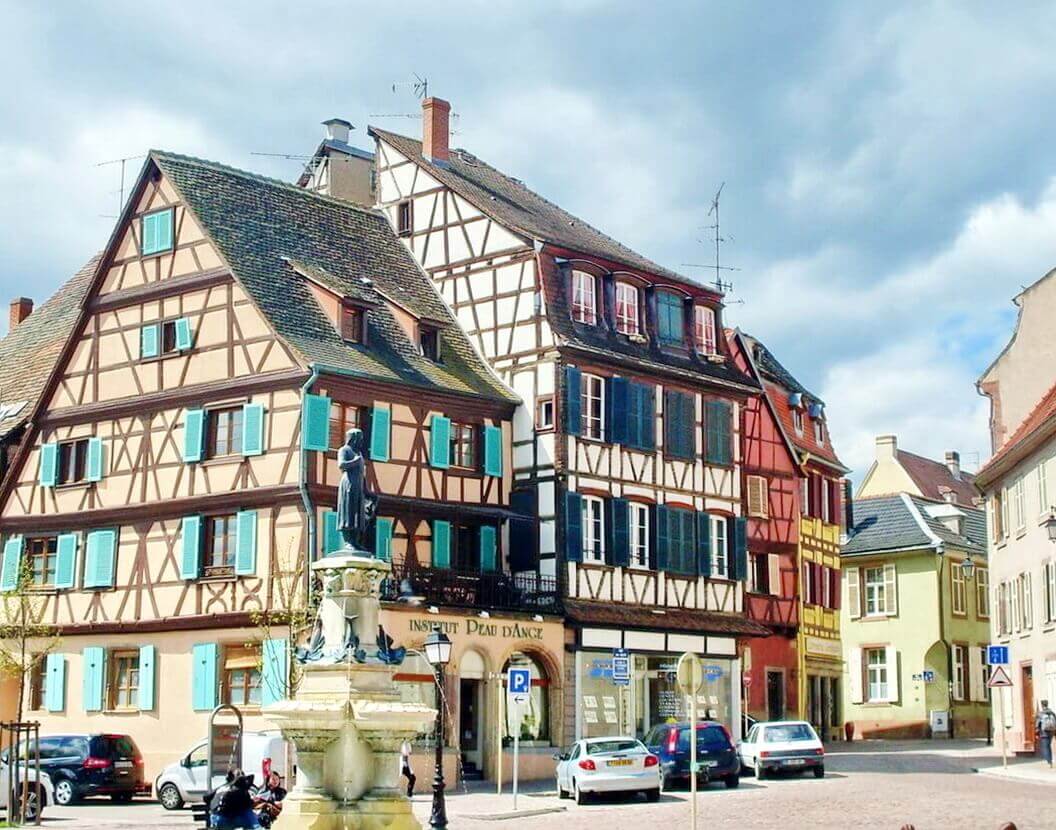
Colmar Little Venice Roesselmann fountain
Bartholdi was born in Colmar. He is known for designing the famous sculpture of the Statue of Liberty (Liberty Enlightening the World), located in New York. It was a gift from the people of France to the people of the United States on October 28, 1886. Today, the house of Bartholdi is transformed into the Bartholdi Museum, where you can see his masterpieces, the family’s furniture, and some temporary exhibitions.
The museums in Colmar
If you have enough time, you can visit other museums, such as the Toy and Little Train Museum, Natural History and Ethnographic Museum, and Hansi Museum.
But the most popular is Musée Unterlinden, located in the former convent and opened in April 1853 as a museum. It was renovated in 1980, and today it consists of two building complexes, with the Issenheim altarpiece, the masterwork of the German religious painter Matthias Grünewald, then medieval and modern paintings, archaeological objects, and art collections.
Saint Martin’s Church
Saint Martin’s Church is a Roman Catholic Church built between 1235 and 1365, in the Gothic architectural style, dedicated to St. Martin. It was restored several times. In 1572, the fire destroyed the roofs and the south tower, which was replaced later in the form of the specific lantern shape. The main restorations were in 1982, when the foundations of a Carolingian church from the year 1000, and traces from the 11th and 12th centuries were found.
The citizens usually call it the Cathedral of Colmar, even though it was a cathedral only temporarily during the French Revolution. It was a Collegiate church, which means that it was administered by a chapter of canons. But the city has never been the seat of a bishop. The church is open every day from 8 AM to 6.30 PM, except Sunday morning.
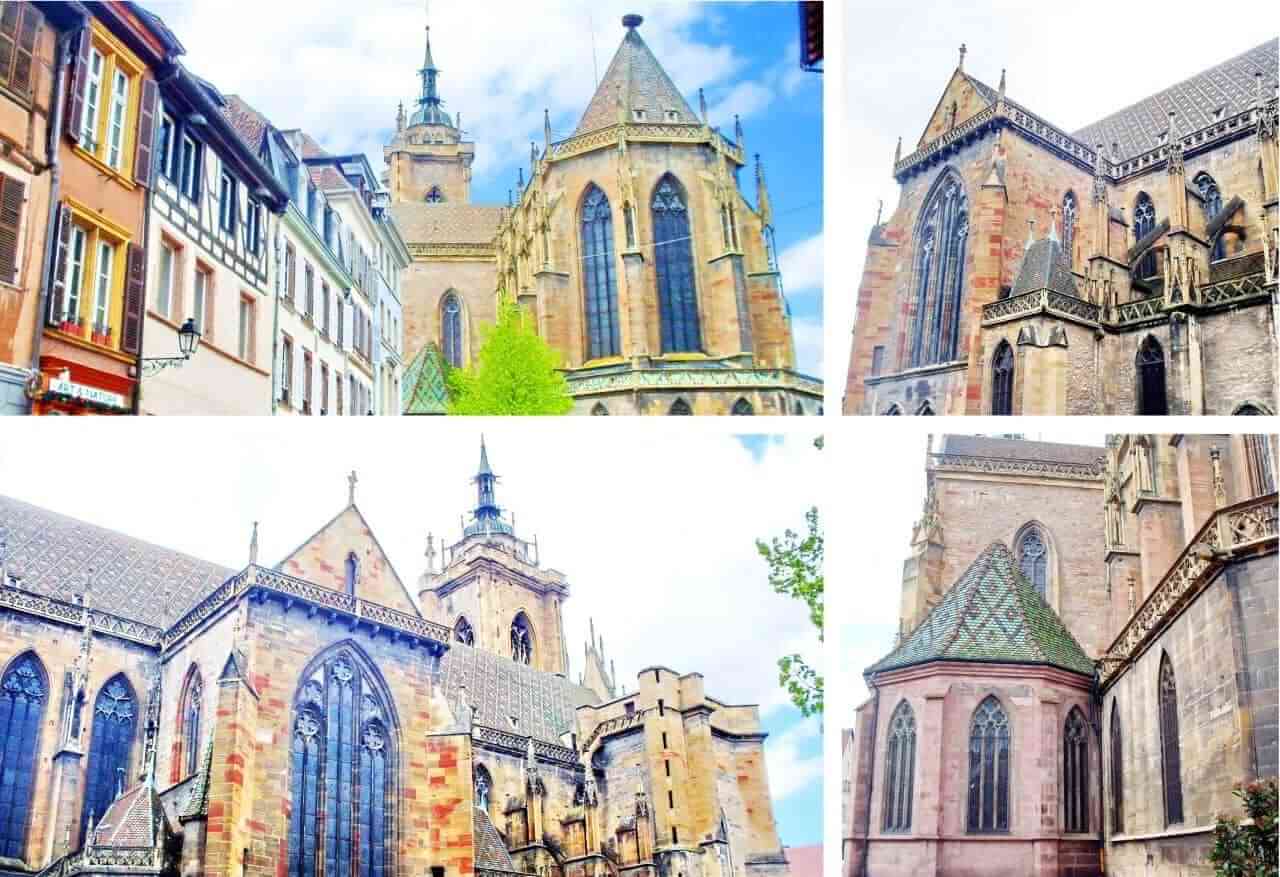
Colmar, Saint Martin’s Church
Dominican Church
Another important religious site is the Dominican Church, built between 1283 and 1346, in the old Gothic style. It was restored a few times, especially in the early 1980 and 1990s. Here you can see the famous masterpiece: the Altarpiece of Madonna of the Rose Bush, made by Martin Schongauer around 1475. The entrance fee is 1,5 euros for adults.
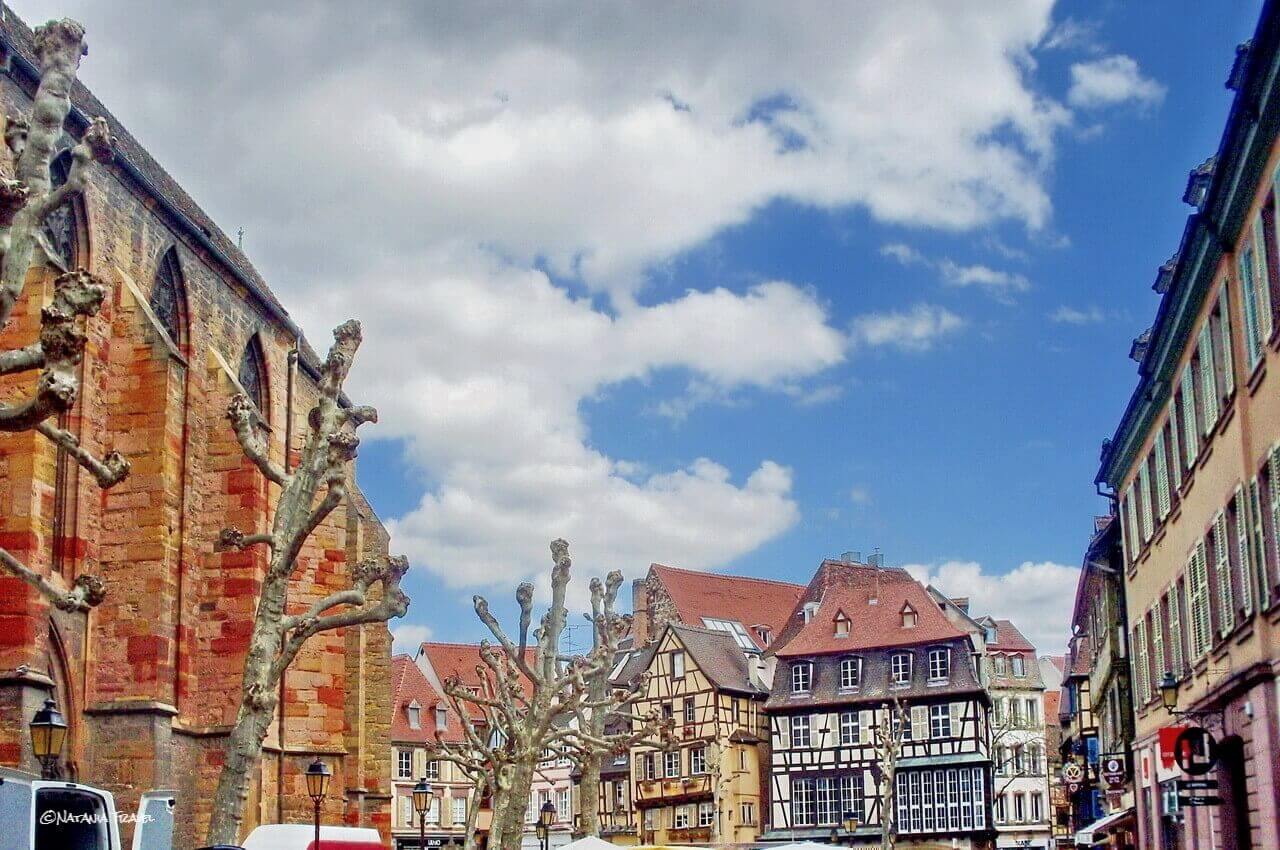
Colmar, the Dominican Church on the left side
Alsace cuisine
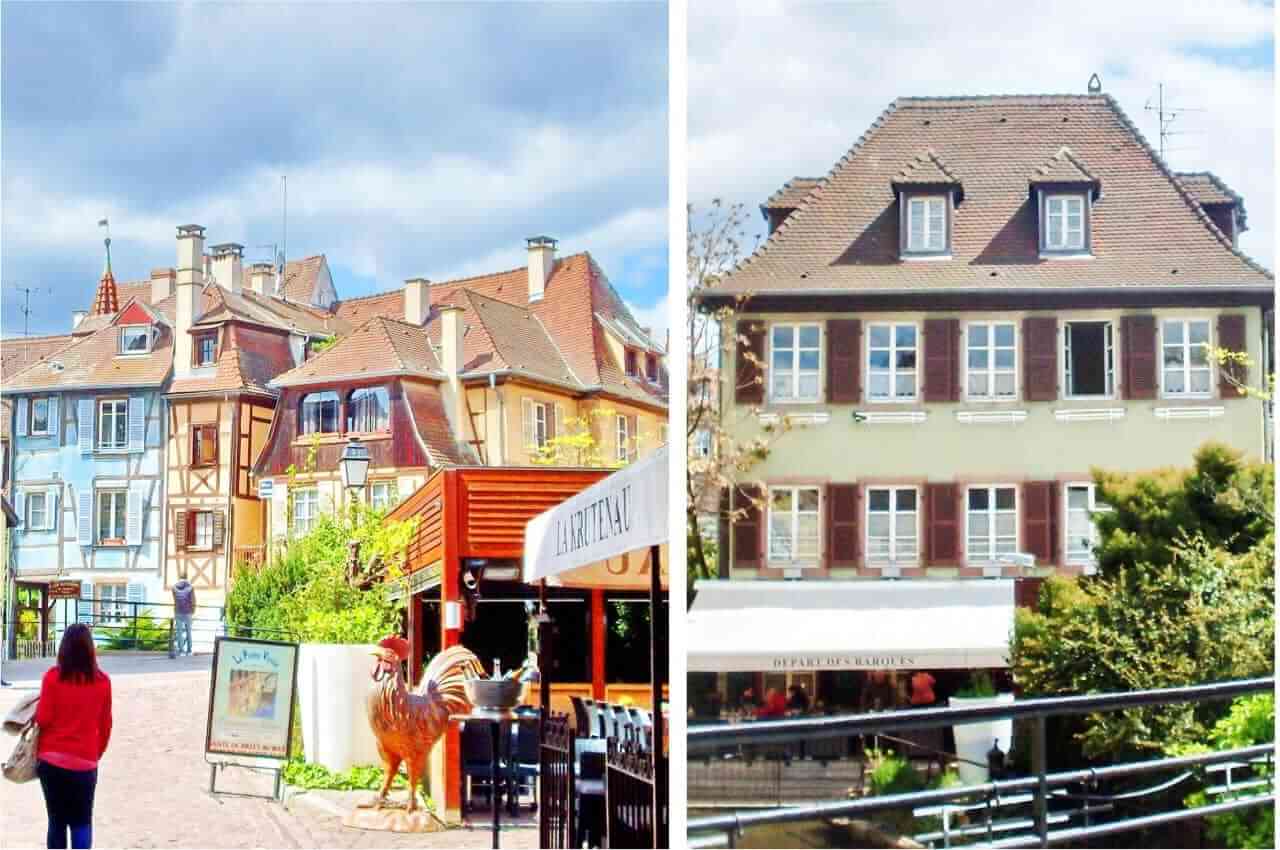
Colmar, Restaurants in the Little Venice
Have lunch in little restaurants and enjoy Alsatian cuisine and wines.
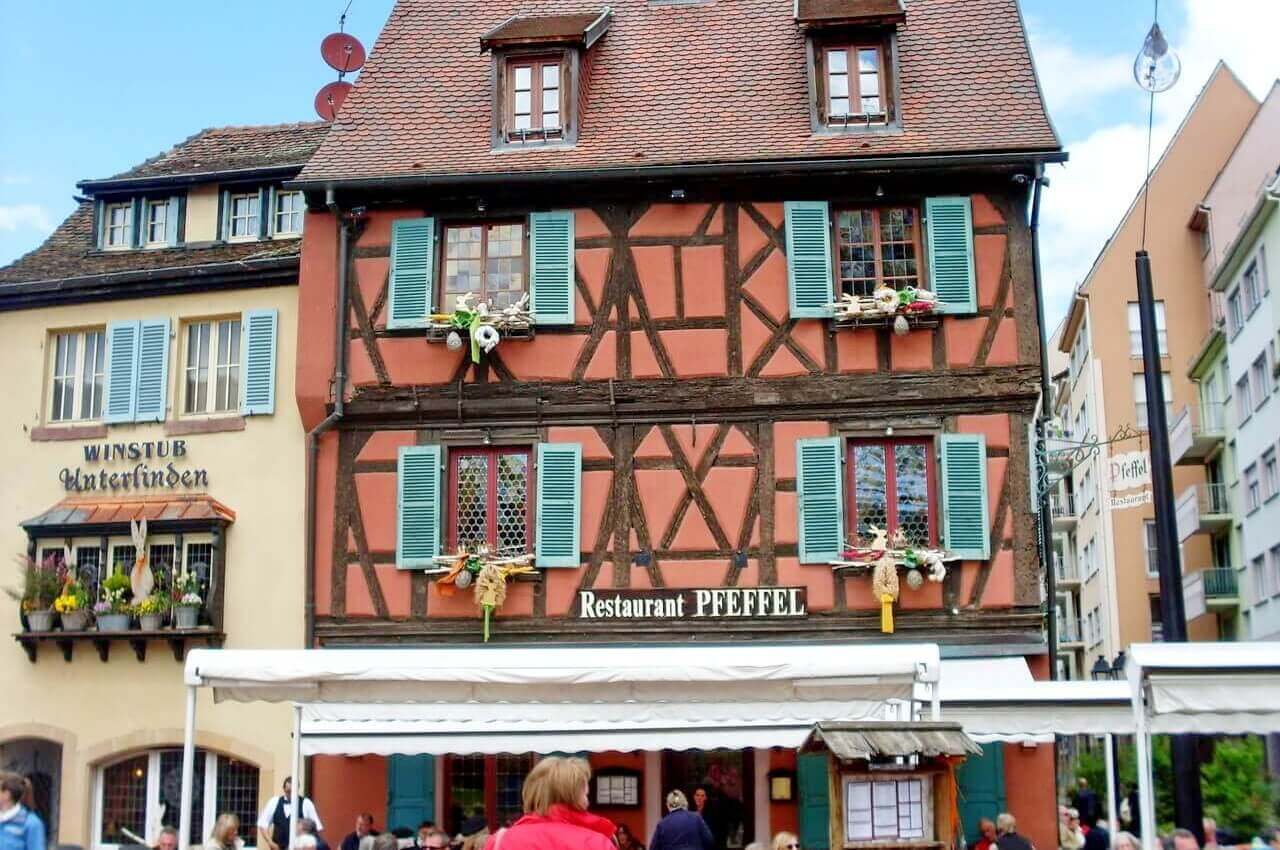
Restaurant Pfeffel
There are a lot of restaurants and winstubs in Colmar.
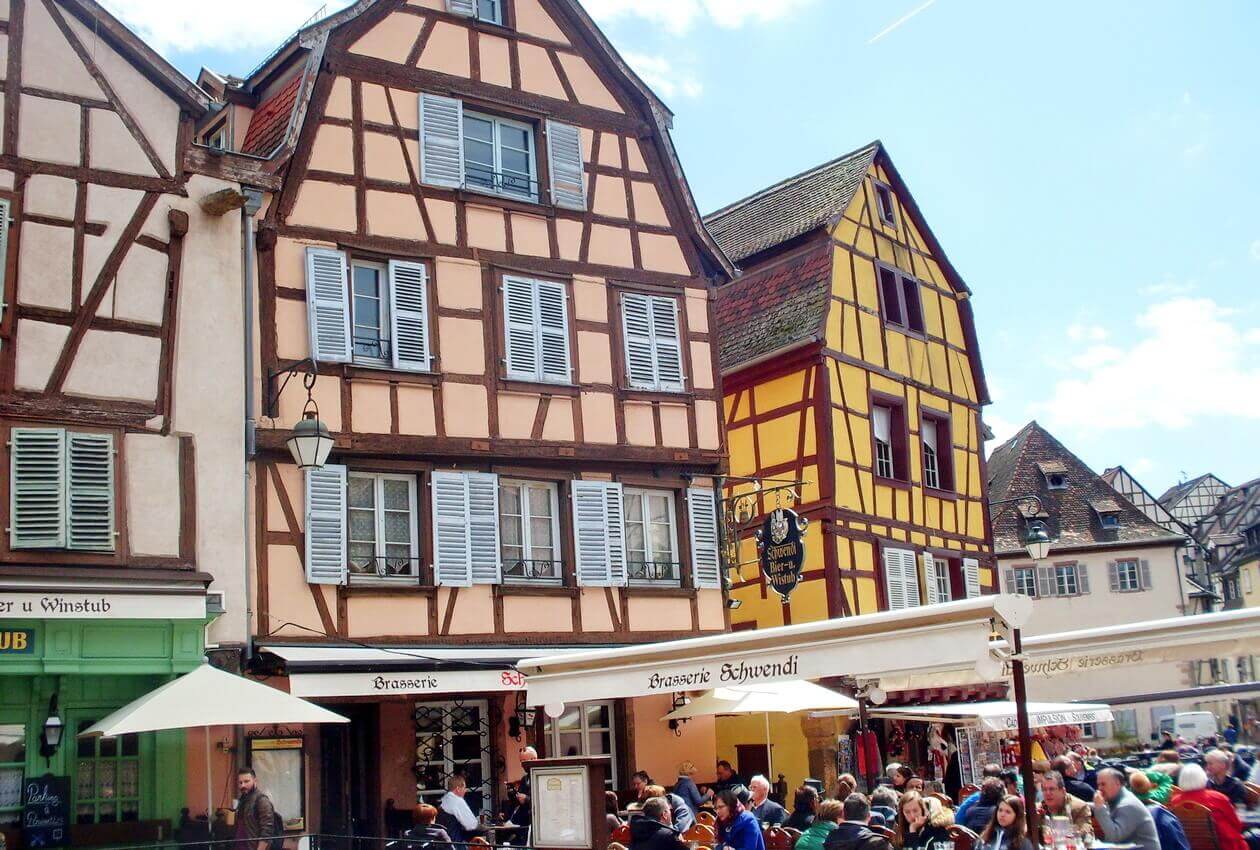
Colmar winstub and restaurants
Alsatian cuisine is very similar to German cuisine, and it uses a lot of pork meat in various forms. One of the most popular dishes is Choucroutegarnie, which is made of cabbage, sausages, bacon, ham, and potatoes.
Also, very popular is Tarte flambée, which is similar to Italian pizza, in a rectangular shape and covered with rich cream, cheese, bacon, and thinly sliced onions. There is also the sweet version with cinnamon, apples, or blueberries, and flambéed with a sweet liqueur.
Alsace wines
Thanks to its geographical position, Colmar is the wine capital of the Alsace region. The small vineyards lie in a narrow strip along the slopes of the Vosges mountains.
The Alsatian climate is semi-continental, with a lot of sunny days in the summer and temperatures from 30° or 35°C. Autumn is also very pleasant, with a small number of rainy days, making this area perfect for producing good wines.
So take the opportunity and try some Alsace wines, such as Pinot Noir, Pinot Blanc, Riesling, Sylvaner, Muscat, Pinot Gris, and Gewurztraminer. The wines are a great souvenir to take home as well.
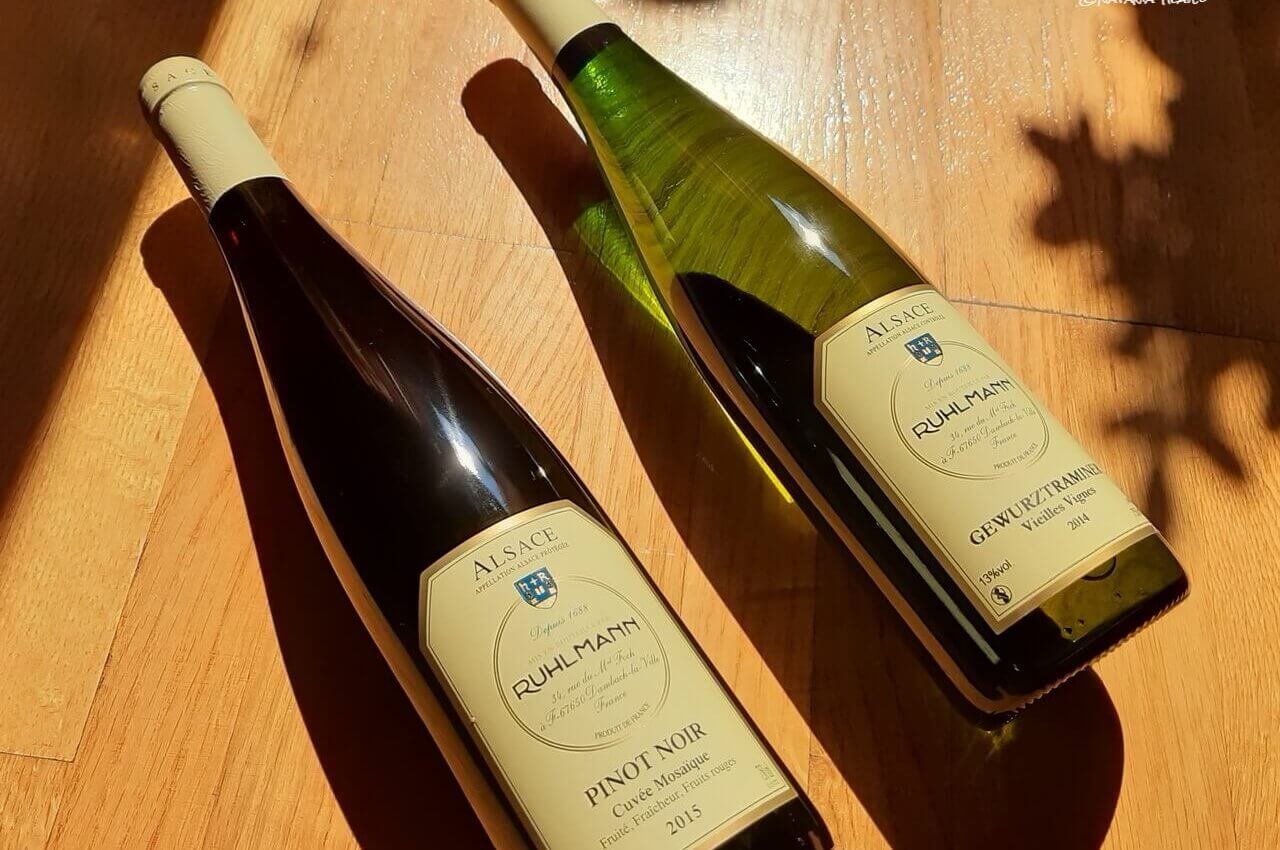
Alsace wines
If you plan to stay here a few days, you can join the Alsace wine tours and enjoy tasting wines and visiting wine cellars.
Also, on the wine route, there are two interesting villages, as colourful as Colmar: Kaysersberg and Riquewihr.
Close to the vineyards, there is the Chateau du Haut-Koenigsbourg, a medieval castle, located in the commune of Orschwiller, in the Vosges Mountains, as well. You can read more about these places in my next posts.
Visit Colmar
In a word, any time is a good time to visit Colmar.
During the spring, summer, and partly in the autumn, it is full of colourful flowers and greenery.
Also, if you enjoy wine and music, the perfect time for a visit is in August. Every year Colmar Wine Fair takes part here, with more than 300 exhibitors and wine producers. At the same time, there are concerts by great international musicians.
And in the winter, Colmar is more decorated during the Christmas holidays. The small stands with local products and gifts make this specific romantic atmosphere.
So, it is up to you to choose the best time to visit Colmar.
And create your own modern and magical fairy tale in this charming town, in Alsace Valley.
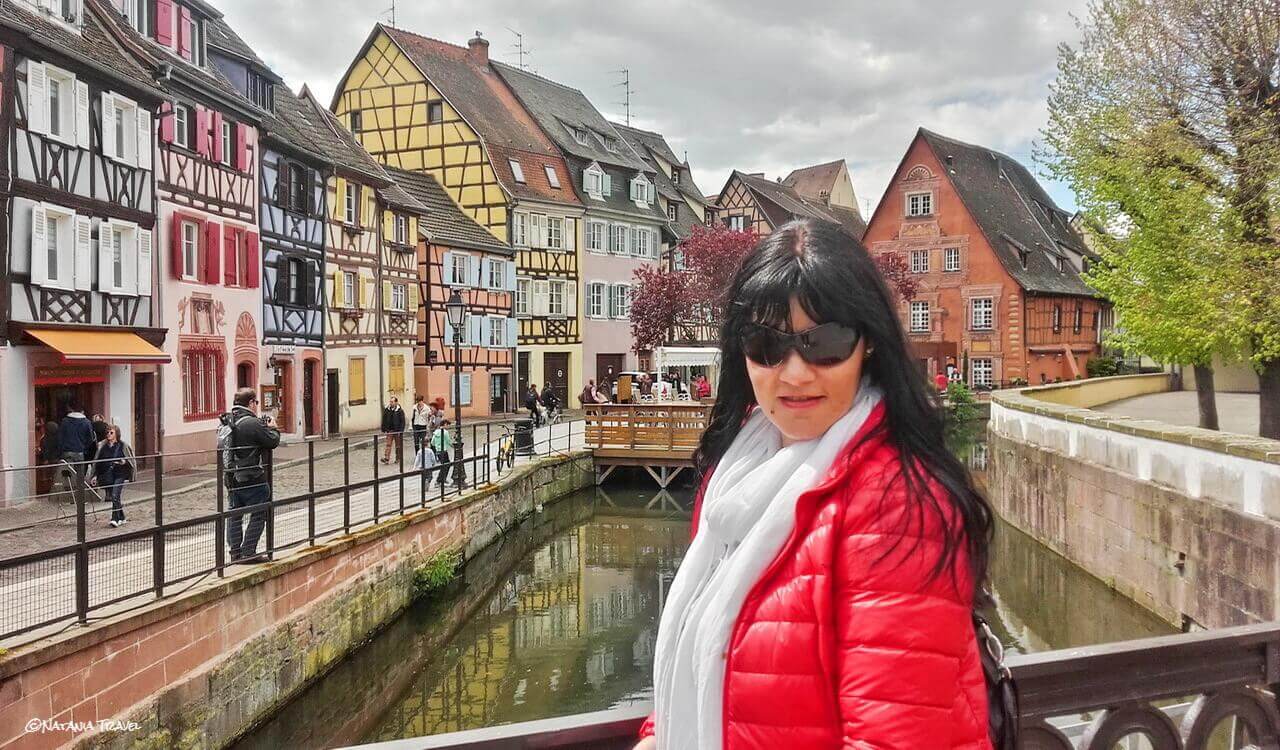
Little Venice, the Lauch river


Leave a Reply
Want to join the discussion?Feel free to contribute!